The Jubilee Year of Mercy: The Corporal Works of Mercy

Tags

, , , , , , , , , , , , , ,

know-mercy-show-mercy

When I posted The Jubilee Year of Mercy – The Basics in March, I promised to post more about mercy, what it is and how we can apply it in our lives.  With the Year of Mercy ending this Sunday, November 20th, on the Solemnity of Christ the King, I’m running out of time.  Yes, I procrastinated, but it took a while to understand the concept of mercy well enough to feel comfortable relating it to you.

Specifically, I want to delve into what we call the Corporal and the Spiritual Works of Mercy. To keep the post short enough, I will break them into two posts.

Corporal Works of Mercy: Meeting the physical needs of others

“The works of mercy are charitable actions by which we come to the aid of our neighbor in his spiritual and bodily necessities….Among all these, giving alms to the poor is one of the chief witnesses to fraternal charity: it is also a work of justice pleasing to God.” (CCC 2447) The corporal works of mercy include:  feeding the hungry; giving drink to the thirsty; clothing the naked; harboring the homeless; visiting the sick; ransoming the captive; and burying the dead.

Feeding the Hungry

“The generous shall be blessed, for they share their food with the poor.” Proverbs 22:9 (NAB)

This corporal work of mercy is nearly self-explanatory. We all know that most communities have a food pantry or soup kitchen that provides meals to those who do not have the means to buy their own food.  Many people volunteer to serve food.  Some organize food drives.  And others who can’t find the time to volunteer donate food to those who do.

But, there are other ways to feed the hungry which often go overlooked. Do you know a person who is unable to cook a meal for themselves or their family?  Perhaps you could prepare a meal and deliver it to them.  Parents and spouses, in a sense, are offering a work of mercy by working and sacrificing to earn money to provide and prepare healthy meals for their families.  It’s not about the kind or amount of food, but the love that goes into providing it.  Give your heart.  Offer your works of mercy out of love for others.

Give Drink to the Thirsty

“Whoever drinks of the water that I shall give him will never thirst; the water that I shall give him will become in him a spring of water welling up to eternal life.” John 4:14 (NAB)

Fortunately, most of us don’t have to worry about having enough clean water to drink. That’s not true in most of the rest of the world.  Even in our own country the urban homeless and those in poverty stricken areas often have too little fresh drinking water.

With this corporal work of mercy, however, we need to think beyond the literal into the figurative aspect of spiritual thirst. How many of us thirst for affirmation, for compassion, to be welcomed and understood?  How many children thirst for attention and closeness from their working parents who barely have the time to devote to them?  How many elderly are lonely for someone with whom they can talk?  Sometimes the merciful “drink” we give to others is simply respect, dignity and kindness.

Clothe the Naked

“He said to them in reply, ‘Whoever has two tunics should share with the person who has none.’” Luke 3:11 (NAB)

If we look around we can see that many people in our communities struggle to adequately clothe themselves and their families. This is especially true during the harshness of winter.  Clothing the naked is perhaps the easiest of the works of mercy to apply in our lives.  There are many outlets, such as St. Vincent de Paul and The Salvation Army, where we can deposit our no longer wanted clothing for distribution to those who do need it.  Similar to Feeding the Hungry, we should not be afraid to give the good stuff.

We can clothe the naked in a figurative sense as well. Consider those who have wronged us in some way and are seeking forgiveness – they are laying their souls bare to receive our forgiveness.  We need to clothe their “nakedness” by listening to their heart-felt pleas and restoring their dignity with compassion.  When we do this we are clothing Jesus.  Our actions transform us by opening us up to receive the grace of God.

Harbor the Homeless

“Jesus answered him, ‘Foxes have dens and birds of the sky have nests, but the Son of Man has nowhere to rest his head.’”  Luke 9:58 (NAB)

This is a tough one. In today’s society, most of us would be foolish and rightfully afraid to open our homes to strangers.  So, how do we harbor the homeless?  Perhaps the easiest way is to support, through monetary contributions and volunteering our time, those organizations which specialize in providing shelter to the homeless.  Another way is to volunteer with an organization that improves people’s living conditions by repairing their homes.  By helping to shelter the homeless we are being Christ to those whom we “harbor”.  And, because we are Christian, we are obligated to see Christ in them.  We are helping “The Son of Man” find a place to “rest His head.”  By being merciful we are introducing them to Jesus.

Visit the Sick

“I was sick and you visited me.” Matthew 25:36 (NAB)

This corporal work of mercy is often misunderstood. Comforting the sick is more the intent.  It’s more than visiting the infirmed just to say you did.  Instead, it’s about reaching out and bringing relief to those who need help.  Whether the person is physically ill or spiritually ailing from isolation or loneliness, a visit borne out of love can be healing.  For many, being present and praying with them can heal their soul.  Unlike children who can be comforted with a “get-well” toy, the best remedy for adult illness is the gift of a loving personal encounter.  A visit to the sick is more than sharing their personal space, it’s sharing their emotional space and bringing love and dignity into it.

Ransom the Captive

“Just so, the Son of Man did not come to be served but to serve and to give his life as a ransom for many.” Matthew 20:28 (NAB)

In the early Church, Christians frequently ransomed fellow Christians being held captive in prisons or in slavery by taking their place. They volunteered their own captivity so that another may have freedom.  We don’t see this anymore and I don’t think we could do it if we wanted to.  So, we have to view this work of mercy in a figurative sense.  In doing so, it is easy to see that we are all held captive in one way or another:  to addictions and self-defeating habits; to the stranglehold of money and possessions; to guilt, fear, and failure; to abusive relationships; to poverty; and to the stigma of past sins.  Many things control us.  How do we help others to be liberated from their captivity?

The starting place is to have a loving desire to help another get out of their pit, to break their chains. Some “prisoners” may need expert help, but, for many, the simple effort of helping one get back on their feet by being loving and encouraging is all it takes to initiate their liberty.  Examples include:  befriending someone who is alone in the world; and rescuing children who are captive in their environments by offering them a way out through mentoring programs.  Ransoming the captive is using our time, talent and treasure to redeem those who are being held in their individual prisons.  We need to remember that Jesus’ death on the cross ransomed us from eternal isolation from God.

Bury the Dead

“Give your gift to all the living, and do not withhold your kindness from the dead.” Sirach 7:33 (NAB)

As Catholics, we confirm our beliefs about the dead every time we profess in our Creed that we believe in the resurrection of the body. This belief drives our funeral rites which, even in death, are outward signs of honoring the dignity of a person.  Our Catechism explains this work of mercy beautifully:  “The bodies of the dead must be treated with respect and charity, in faith and hope of the Resurrection….it honors the children of God who are temples of the Holy Spirit.” (CCC2300)

Before I became Catholic I dreaded funerals. They were uncomfortable events to say the least.  But, now, attending a funeral with the understanding that it is an opportunity to offer mercy, I am not only able, but have a desire to pay my respects to the memory of the deceased and to offer consolation to the mourning family.  And, putting everything in the context of mercy helps me to deal with my own sorrow.

The beauty about this act of mercy is not having to wait for someone you know to die. In the last couple years, I have attended three funeral masses for people whom I didn’t even know.  They were members of my parish community and, in a sense, family.  My prayers joined the prayers of so many others in an expression of faith in the Resurrection and the hope that the faithful departed were on their way to eternal life.

There are other ways to live this act of mercy. Sadly, the cost of a funeral is beyond the means of many in our society today.  Helping the family cover the cost of a funeral is something communities or parishes can do by setting up fund collections.  Another is to provide food for the post-funeral gathering to enable family and friends to continue their consolation and sharing of memories.

One final thought: our Lord was given a decent burial.  The least we can do is honor Him by doing the same for others.

Just because the Year of Mercy is coming to an end doesn’t mean we stop being merciful. The need for mercy is constant and more critical than we can imagine.  And, though we look outward towards those who need our mercy, we can never lose sight that we all need mercy in our own lives.  The mercy we give comes from God the Father.  Likewise, the mercy we receive from our neighbors, loved ones, and even strangers, also comes from God the Father.  I challenge you to consider how you can be more merciful in your life.  Begin today.

Stay tuned for my next post on the Spiritual Works of Mercy!

“Lord God, help me to always recognize and be grateful for the mercy you shower upon me. To show my gratitude, please allow me to be your hands, feet and heart by being merciful to others.  Amen.”

(The Jubilee Year of Mercy – Corporal Works of Mercy was first published on the blog Reflections of a Lay Catholic)

©2016 Reflections of a Lay Catholic. Reposting and sharing of material in its full and original content is permitted, provided that full and clear credit is given to the author(s) and Reflections of a Lay Catholic.

The Big Stuff

Tags

, , , , , , , , , , ,

holy-eucharistI don’t know if it’s just the time of year, or the change in the weather, or some straggling ragweed still in the air, but I felt puny all last week. I decided to take Friday off and I made a 9:15 a.m. appointment to see my doctor.  On Thursday night before bed I told my wife that I was looking forward to sleeping in an extra hour or two.  Then she asked me if I would like to go to 7:30 a.m. mass with her, something I never get to do because of my work hours.  I replied I would be glad to, but then thought to myself I need to change that “hour or two” of extra sleep to just one hour.


Melinda woke before me on Friday morning and was already down stairs when I rolled out of bed. We met up after I showered and dressed and, unlike every normal work day, I had a chance to give her a big hug and good morning kiss.  I growled, “I love you”, in my broken voice that was about two octaves lower than normal.  Melinda replied, “You don’t sound too good!”, to which I said, “I feel great, I got an extra hour of sleep and I’m getting to hug you this morning.  My day is starting off fabulously!”  She responded, “Boy, it just takes little stuff to get you feeling good.”  I didn’t tell her but I thought, “No, darling, this isn’t little stuff.  This is big stuff.  This is why I decided I’m going to retire.  These little moments of intimacy are the big reward.  They’re what makes life worth living.”

We went to mass and got there a couple minutes late. I seldom get to go to weekday masses and always get a little confused with the slightly abbreviated version as compared to the usual Sunday mass.  In one way I miss the hymns (the people around me probably didn’t miss my singing!) but then without them it gets me to the Celebration of the Eucharist that much quicker.  Receiving Holy Communion is always the high point of my day.  As I accepted the Blessed Sacrament I marveled at how that one little round disk, which just a few moments earlier was simply a wafer of bread, can, with its transformation, transform one’s whole life.  And, then, with a glance towards the crucifix which hung above the altar, I thought, “That’s not just a little round wafer of bread, no, that’s BIG stuff!  Bigger than BIG!  It is truly the body of Christ!”  Upon kneeling back at my pew I gave thanks to Jesus for the unity with Him, for His nourishing my spirit, for His forgiveness of my sins and for the grace to avoid sinning, and for giving me the grace to listen to the Holy Spirit and let it fill my heart with love.  Yeah, that’s real big stuff.  It’s what makes life worth living.

Later that afternoon, I had the opportunity to join a friend to talk about our faith. We meet weekly to share with each other how our prayer life has been going over the last week, what we’ve been doing to study and grow our faith, and what actions we have taken to spread the word of God or bring Christ to others.  We’ve found that this weekly exercise helps us hold each other accountable so that we don’t get lazy in our faith.  It only takes an hour.  To some it may seem like small talk, but to me it’s that man to man time when we can be honest with each other and we know that we can trust the other to help keep us on the right path.  More big stuff.  And, more of what makes life worth living.

I love the big stuff.  How about you?  What’s your big stuff?

“Heavenly Father, thank you for opening my eyes to the big stuff in life and helping me decide to turn away from the things that have kept me from the big stuff. As I move into retirement I pray that I can always keep the big stuff the big stuff.  But, Lord, I know I will lose focus from time to time and I pray you will gently bring me back.  Amen.”

(The Big Stuff was first published on the blog Reflections of a Lay Catholic.)

©2016 Reflections of a Lay Catholic. Reposting and sharing of material in its full and original content is permitted, provided that full and clear credit is given to the author(s) and Reflections of a Lay Catholic.

In Which Season Is Your Marriage?

Tags

, , , , , , , ,

On October 25th, my wife and I took time to spend the day together at a Worldwide Marriage Encounter event.  The event, affectionately dubbed the Day of Romance, was attended by nearly 40 couples who were consciously trying to turn their good marriages into great marriages.

The program for the day was inspired by the book The Four Seasons of Marriage by Gary Chapman.  The four seasons depict the different stages through which married couples either thrive or suffer, and the transition periods between them.  The program was presented by four volunteer couples who gave witnesses of periods in their marriages when they were in one of these seasons.

dor-fall

Fall

The first season presented was “Fall”, a cooling period that may follow a time that was filled with much fun and intense closeness but which is beginning to wane. Couples may experience uncertainty about where their marriage is heading and they hope the relationship will get better on its own.  But, if they choose to make no extra effort to improve intimacy and understanding, the relationship can often slide into “Winter”.

dor-winter

Winter

The “Winter” season is often a “Fall” that didn’t get turned around. Instead, it gets colder and causes severe lack of intimacy and feelings of aloneness between the couple.  The previous uncertainty becomes reality.  Lack of communication and understanding of each other’s feelings compounds the situation.  If enough love and effort isn’t devoted to the relationship during this season, the marriage will suffer.

Neither “Fall” nor “Winter” is where we want to be. But, if we find ourselves there, we can rejuvenate our marriage through intentional effort allowing us to emerge with our relationship stronger than it was before.

dor-spring

Spring

“Spring” is that season when the relationship is blooming, the uncertainty is diminishing and there is hope in the air. As partners, intimacy is growing; doubt is being replaced with optimism and trust; and bitterness with love and gratitude.  This change in attitude allows husband and wife to begin enjoying each other again.


dor-summer

Summer

“Summer” is the season we strive for. It’s when we are at our closest.  We have fun, we enjoy being with each other, our positive attitudes are shining, and love is vibrantly alive.  It’s during this summertime of our marriage when other couples take notice and want some of what we have.

As the Day of Romance came to a close I noticed the many smiles, hugs, and hand-holding. There was a lot of summertime in that room.  The attitudes were contagious and I thought how great it would be if that essence could be bottled and gifted to couples who struggle.

Since that day, I have pondered what it is that makes these marriages so good? I’ve decided that good marriages happen independently of the age of the couple or how many anniversaries they’ve had.  I believe the secret is in each husband and wife opening their hearts to God’s Word.  They accept that their marriage is a God-given vocation and their love drives them to live up to God’s expectations.  As such, it appears they are taking the hard road, diligently working to make the most of their marriage.  They intentionally find uncommon ways, perhaps romantically but not necessarily so, to express their love verbally and in their actions.  They are giving their all to their relationship and they are receiving their spouse’s all.

In contrast, they are doing the opposite of many married couples who don’t see their relationship as a God-given vocation. Through laziness and wrong expectations, sadly, these couples don’t put their hearts into helping each other thrive.  It appears they are taking the easy way out by minimizing marriage and doing as little as they can to get by instead of maximizing it.  They are selfishly concerned about their own happiness instead of focusing on that of their spouse.

The truth is, ironically, that those who do accept marriage as a God-given vocation actually have the easy road, and the others have the hard road. For it is God’s grace bestowed on the former, that enables them to easily do the hard work for the benefit of their partners.  Those who do the least possible have a perpetual struggle to keep their marriages afloat because they lack the buoyancy of God’s grace.

I realized that bottling the positive attitudes of successful couples, even if it was possible, would be doing no favors for those who take their marriage for granted. There simply is no substitute for the love, hard work and dedication, which, by its own virtue, receives the supernatural assistance of God’s grace to lift each other up by placing the other’s physical, emotional and spiritual needs ahead of one’s own.

(In Which Season Is Your Marriage? was first published on the blog Reflections of a Lay Catholic)

©2016 Reflections of a Lay Catholic. Reposting and sharing of material in its full and original content is permitted, provided that full and clear credit is given to the author(s) and Reflections of a Lay Catholic.

HOLY FRIENDSHIP IN A HYPERSEXUAL WORLD

main-image-1

A wonderful article appeared in the Federalist this past December by D.C. McAllister titled “How To Stop Sexualizing Everything.” It tapped into the schizophrenic character of our modern age, particularly in American culture, that surrounds our expressions of intimacy. Essentially, she posited, we either fearfully avoid touch and intimacy as it might be misread as a sin or a sexual advance, or we completely give in, and all that we touch is tinged with sexual undertones and innuendos. McAllister notes “The effect of these two warring attitudes – Puritanism and sexualization – has had a distorting effect on friendship. On the one hand, people don’t feel free to show emotions. On the other, when they do, those feelings are sexualized.”

A recent BBC documentary called “The Secret Letters of Pope John Paul II” perfectly illustrates this distorted dichotomy. For decades, St. John Paul II held a well known relationship with Dr. Anna-Teresa Tymieniecka, a Polish philosopher who was an expert in the work of German philosopher Edmund Husserl. The pope’s shared interest in Husserl’s phenomenology allowed the two to form a friendship over the years (albeit, not without its difficult moments – see George Weigel’s excellent article on that backstory here: http://www.nationalreview.com/article/431359/pope-john-paul-ii-letters-women-celibacy). She was a married woman with three children, living in America. He, at the time they met, was a Cardinal in the Church. Their correspondence lasted well into old age.

Journalist Ed Stourton, who crafted the documentary, proposes that the decades long relationship was somehow, for at least one of the parties involved, romantic. His claims are “substantiated” by Emeritus Professor Eamon Duffy of the University of Cambridge, who states in the interview, “Clearly there’s an element of playing with fire when you’ve got a strongly heterosexual man and an attractive woman in a very intense relationship that is cultivated and which engages mind at a high level of intensity. There’s danger everywhere.”

This thought that a male and female friendship simply by its very nature is “dangerous” is given further credence in the remarks of someone Stourton refers to as a “trainee priest” (My research revealed that a “trainee priest” is also known as a seminarian). John Cornwell apparently attended seminary from 1953 to 1958. He states that back then “The perception was that even if you had a close association of friendship with the woman, this could be what was known as an occasion of sin and an occasion of sin was as bad as if you’d actually done it.” This sad (and completely incorrect) articulation of what sin consists of is followed by another interviewee who states that their “training meant most priests would have been wary of such a close relationship. The most natural reaction would have been for him to terminate contact.”

Ironically, the language in this interview reveals to viewers and readers of this breaking story the deepest scandal of all, which has nothing to do with St. John Paul II. It is the scandal that all too many men and women today are incapable of imagining an intimate relationship that does not somehow involve some sort of sexually romantic overtone.

In truth, the Church has a long history of examples of men and women who have formed intimate and affectionate relationships that did not involve sexual relations. They were known as friendships (this is a wonderful word we should restore to the modern lexicon). In fact, St. John Paul II had numerous friendships with women that lasted decades and included letters, phone calls, shared meals, and walks together. The BBC footage seems to imply that this particular relationship with Dr. Tymieniecka was isolated and the meetings exclusive. But the fact is, they were not. St. John Paul II was a magnanimous figure who loved people deeply, and was rather transparent about his friendships. He was also prudent, meeting men and women together for those private meals and taking vacations with friends or families together. In the image of St. John Paul II and Dr. Tymieniecka standing beside a car, one should realize a third person took the photo. I imagine it was her husband.

la-epa-epaselect-poland-pope-john-paul-ii-letters-20160217-1

Now regarding the correspondence, here is an excerpt from a letter:

“I know you have complete confidence in my affection; I have no doubt about this and delight in the thought. I want you to know and to believe that I have an intense and very special desire to serve you with all of my strength. It would be impossible for me to explain either the quality or the greatness of this desire that I have to be at your service, but I can tell you that I believe it is from God, and for that reason, I cherish it and every day see it growing and increasing remarkably… God has given me to you; so consider me as yours in Him, call me whenever you like…”

I’m sorry, I tricked you just there. This was actually an exchange between St. Francis de Sales to St. Jane de Chantal, dated June 24, 1604. After the death of her husband, St. Francis served as her spiritual director for years, giving her counsel in forming a new religious community. (I don’t have access to an extended quote from St. John Paul II’s letters to Dr. Tymieniecka, and would prefer not to cherry pick one out at this point as the BBC interview did.)

Regardless, here is an intimate note, man to woman, celibate man to widowed mother. How did you feel in reading that exchange? Did it make you uncomfortable? Were you shocked? Did you feel it was inappropriate? I know it really struck me personally when I first read it. I found it to be astoundingly beautiful, and I felt duped and double-crossed by this hyper-sexualized culture we live in because I too felt a little manipulated as it were to see romance when I read those words holding such fervent love. But who has the larger issue here? Who needs a little restoration of that original vision we’ve been called to?

The examples of chaste and simultaneously fervent love go on, nonetheless, and in each we are challenged to see others first as “occasions of grace” rather than “occasions of sin.” By this grace, in the words of St. John Paul II “we come to an ever greater awareness of the gratuitous beauty of the human body, of masculinity and femininity. This gratuitous beauty becomes a light for our actions….”

Over a two year period that lead up to her own early death, Saint Thérèse of Lisieux and a seminarian named Maurice would exchange 21 letters in total. He wrote 11 and the Little Flower wrote 10. For both of these holy souls, the letters reveal a love that was fully human and completely chaste. St. Thérèse wrote in one note: “In your letter of the 14th you made my heart tremble with joy. I understand better than ever how much your soul is the sister of my own, since it is called to lift itself up to God by the ELEVATOR of love and not to climb the hard stairway of fear….” Later, as he was about to be sent on mission, she wrote “When my dear little brother leaves for Africa, I shall follow him not only in thought and in prayer; my soul will be with him forever. …”

Let’s look at another intimate exchange, now between men, from over 1600 years ago: “…To talk and jest together, to do kind offices by turns; to read together honied books; to play the fool or be earnest together… (to) long for the absent with impatience; and welcome the coming with joy. These and the like expressions, proceeding out of the hearts of those that loved and were loved again, by the countenance, the tongue, the eyes, and a thousand pleasing gestures, were so much fuel to melt our souls together, and out of many make but one. This is it that is loved in friends…”

That was St. Augustine, taken from his own intimate and perennially modern autobiography “Confessions” (Chapter 8, section 13), written between 397 and 400 AD. For modern ears, this level of intimacy between men can only be seen as some kind of closet homosexuality. The same minds, tinged again by a culture inundated by sexual allusion and innuendo in all things, even place a gay frame around the relationship between David and Jonathan in 1 Samuel 18:1,3. “As soon as he had finished speaking to Saul, the soul of Jonathan was knit to the soul of David, and Jonathan loved him as his own soul.”

We have become, in the words of St. John Paul II himself, “masters of suspicion,” incapable of seeing how human interactions could ever rise above mere sexual gratification and appropriation.

This is nothing new. During the beatification process for Padre Pio, in 1990, the case was blocked after a stash of letters were revealed that the holy Franciscan had written to his spiritual daughter, as he called her, Cleonice Morcaldi. He had met her around 1930. when she was a child, orphaned from both parents. St. Padre Pio had promised her dying mother he would take care of her like a daughter. Some investigators however felt the letters to be too affectionate.

Man and woman. This is holy ground. This is sacred ground, and in this place we are called to a deep self-mastery, and a healthy recognition of our own hearts and where we stand in the ability to truly see one another. I have placed several links to resources below and encourage readers to go further, to pray more deeply about this lost art of friendship, of holy friendship. It must be rekindled. It will take work and prayer and much patience, especially in this present darkness. But with grace we can reclaim a beautiful gift, and our vision of one another can indeed be restored. It is a hope within reach. It is our inheritance and a promise too. “Jesus came to restore creation to the purity of its origins.” (CCC, 2336) I’ll close with a wonderful and deeply personal word from St. John Paul II, originally signed on February 8, 1994 but was not printed until 2006:

“God has given me many people, both young and old, boys and girls, fathers and mothers, widows, the healthy and the sick. Always, when he gave them to me, he also tasked me with them, and now I see that I could easily write a separate book about each of them—and each biography would ultimately be on the disinterested gift man always is for the other. Among them were the uneducated, for instance factory workers; there were also students, university professors, doctors and lawyers, and finally priests and the consecrated religious. Of course, they included both men and women. A long road led me to discover the genius of woman, and Providence itself saw to it that the time eventually came when I really recognized it and was even, as it were, dazzled by it.”

Saint John Paul the Great, Poet of the Divine Mysteries and Apostle of the Beauty of the Human Person, pray for us!

________

Resources:

A Meditation on Givenness by St. John Paul II 

http://www.communio-icr.com/articles/view/a-meditation-on-givenness

But I Have Called You Friends; Reflections on the Art of Christian Friendship by Mother Mary Francis

http://www.amazon.com/But-Have-Called-You-Friends/dp/1586170805

Francis de Sales, Jane de Chantal: Letters of Spiritual Direction (Classics of Western Spirituality (Paperback))

(http://www.amazon.com/Francis-Sales-Jane-Chantal-Spirituality/dp/0809129906)

Love and Responsibility by Karol Wojtyla

http://www.amazon.com/Love-Responsibility-Karol-Wojtyla/dp/0819845582/ref=tmm_pap_swatch_0?_encoding=UTF8&qid=1455825397&sr=1-1

How to Stop Sexualizing Everything by D.C. McAllister

http://thefederalist.com/2015/12/28/how-to-stop-sexualizing-everything/

Article originally posted at: http://tobinstitute.org/john-paul-ii/holy-friendship/

Peace Be With You

Tags

, , , , , , , , , , , , , , ,

peace-be-with-you

At the sign of peace during Mass on a Sunday morning a few months ago I smiled and uttered, “Peace be with you!” to those around me. As they did the same to me I thought to myself, “Thank you, but, actually, I’m not at peace.  It’s more like turmoil.  My life is incongruent with the life I would like to be leading.”  I knew I was living what Henry David Thoreau called, “a life of quiet desperation.”

I was quick to blame the stress of my job, the expanding corporate bureaucracy, and a huge increase in travel away from home, for my discontent. In my 31 years of management with my employer I had never felt such disharmony.

peace-be-with-you-hotel-room-key-cards-2

Just a few of the hotel room key cards I’ve collected over the last two years.

I knew the real rub, however, was that my job demanded so much of my time that there were huge voids in my personal life. Voids I could no longer ignore:  my health was suffering; my relationships weren’t thriving; I was doing very little to stimulate myself mentally; and, because of extensive work related travel, I struggled to find time to pray as I ought, and I desperately missed the fellowship and sharing of my faith with other men in my community.

Since becoming Christian, I have believed that God has placed me here for a purpose. Thus, I found myself praying often for guidance from the Holy Spirit to learn what God’s will is for me.  A semblance of an answer came to me during an Adoration hour, not while I was striving to understand the future, but as I reflected on the past.  I sensed His will for me up to this point in my life had been to provide for my wife and family.  I thought I had done well but I counted the cost and estimated roughly 20 percent of my working life had been spent away from home and family.  In that moment I knew one of the things He wanted me to do with the rest of my life was to be the disciple, husband, father, grandfather, son, brother, and friend He designed me to be.  Clearly, my new purpose would be to pour my love into those relationships and grow them to a deeper level of intimacy.

I don’t think it was coincidence that shortly after this revelation I was reading a book by Matthew Kelly in which he wrote about becoming fully the person God created us to be and living the authentic life He created us to lead. Kelly talked about how living an authentic life helps us reach the essential purpose of our Christianity – Holiness.  And, with respect to the physical, emotional, intellectual and spiritual “legitimate” needs God created in us he wrote, “When we hear these deepest desires calling us forth, we hear the voice of God.”  I realized God was calling me to fill that void by fulfilling those needs.

But, I saw a catch. I knew I couldn’t give my all to His plan and perform my job as I should.  That only left one alternative – retirement.  And that was a scary thought.  I’m not quite 60 years old.  Retirement would mean not earning a paycheck every two weeks.  It would mean purposefully living within my means and my means were nothing more than what I had saved.

I also feared falling into the trap of mistakenly fantasizing that my life would magically be better once I retire. Many retirees believe that spending a life of leisure on their boat, on the golf course, or taking exotic vacations, will bring them happiness.  For some it might but, for most, pleasure seeking doesn’t bring lasting happiness.  I didn’t want that to be me.  I was happy to accept that my purpose would not be pleasure focused or to accumulate more stuff, but to seek God and find happiness by satisfying the essential needs He intended for me.

After more prayer and discussion with my wife, I concluded I needed to retire. I couldn’t ignore the Holy Spirit’s call to refocus my life. As for my financial wherewithal, I accepted that I would have to have faith that my needs would be met.  But, just in case, and afraid of what I might discover, I finally decided to consult with a retirement planner.  When his report came back I was pleasantly surprised to find that we should be able to live comfortably for the rest of our lives.

Having made up my mind, I only needed to tell my boss of my intention to retire. Because the driver for my decision to retire was stress induced unhappiness, I wasn’t sure what I would tell him, without sounding bitter and negative, if he asked why I decided to retire.  As I thought about this during the drive to where we were meeting everything became perfectly clear.  All the things that had kept me from being satisfied were simply steps in the process of God calling me to move on and to fulfill those God-given needs.  In that instant I recalled 1 Thessalonians 5:18 (NAB), “In all circumstances give thanks, for this is the will of God for you in Christ Jesus.” The bitterness I felt evaporated.  I forgave everyone whom I had previously blamed for creating the stress in my life, as well as myself for my own personal contribution.  And, instead of being negative, I praised God for the suffering that pushed me to hear His call.

Last Tuesday when I told my boss of my intention I felt as though a huge weight had been lifted from my shoulders. I know the remaining days between now and the day I retire will be enjoyable and productive because I have a new purpose: to live a healthier, less stressful life; to grow emotionally by bringing more intimacy to my relationships; to help and serve others; to grow intellectually; and to grow spiritually by getting closer to Jesus, and having the time to apply the Gospels to my life every day.

I’m not sure what direction my life will go or exactly what I will do in retirement. But I’m sure it will be an adventure as God unveils new sources of happiness.

This morning at Mass during the sign of peace, when my brothers and sisters shook my hand and said, “Peace be with you!” I thought, “Thank you, by the Grace of God, it is.”

Peace be with you all.

“Heavenly Father, thank You for sending Your Holy Spirit to help me see and hear Your call. I sometimes wish, though, that You would make it just a little easier for me to do so.  Amen.”

(Peace Be With You was first published on the blog Reflections of a Lay Catholic)

©2016 Reflections of a Lay Catholic. Reposting and sharing of material in its full and original content is permitted, provided that full and clear credit is given to the author(s) and Reflections of a Lay Catholic.

Pops, MoM and Mercy

Tags

, , , ,

In yesterday’s post, A Joyful Hour, I said my wife and I are on another road trip from our home in Ohio to Kansas City and then on to Rapid City, South Dakota.  We made it to our daughter’s house safely Saturday evening, enjoyed a nice home cooked dinner and some special time with our two grandsons before they had to go to bed.  Our grandson Jack is 20 months old, and Eddie is two months old.  I slept well that night and I looked forward to the next morning and a full day of fun with the little guys.

When my first grandchild was on her way almost two years ago, my daughters asked what I wanted to be called as a grandfather. I had thought long about this and one thing kept coming to mind.  A friend from Lake Charles, Louisiana, who is a big duck hunter and retriever trainer, told me you should always name a dog with a one syllable name.  That way they can remember it easier.  Well, in my way of thinking this seemed like a good idea when it came to young children, too.  If I went by a one syllable name it would be easier for the little ones to remember it and say it.  So, I chose Pops.

When I awoke in the morning I said a quick prayer knowing that it was going to be a good day. I made it to the breakfast table, poured myself some coffee and waited for Jack to announce he was ready to get out of his crib.  Before long, my son-in-law, Joe, brought him down the stairs, stood him on the floor and the best thing ever happened.  Jack turned around, saw me, hollered, “Pops!”, and came running to me and gave me a hug.  What a fabulous way to start my day!

We ate breakfast and then dressed to go to Mass. While at our daughter’s we usually go to the Prince of Peace Catholic Church in Olathe.  But, Prince of Peace has been busting at the seams because of the growth in the south Kansas City area and the diocese has decided to build a mission church which will actually be closer to her house than Prince of Peace.  The name of the new parish has not been decided yet but we were thinking on the way there that it ought to be called Mother of Mercy parish.  Mother of Mercy, aka “MoM”, as opposed to “PoP” for Prince of Peace – get it?

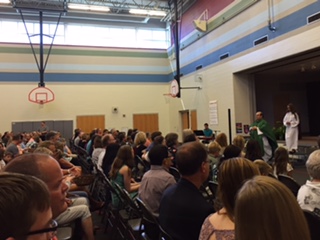
This was the second Sunday for the mission church to celebrate mass in their temporary location -the gymnasium of the Madison Place Elementary School. The altar was set up on the stage with row after row of folding chairs on the gym floor.  Melinda, my daughter, Lisa, Jack, and I got there just in time to get seats.  The engineer in me quickly counted the number of seats in each row, multiplied by the number of rows and estimated the number of people standing in the back and I came up with roughly 550 in attendance.  Not bad at all for the second week of a mission parish!

mom2

Until the parish officially gets its name it will be called the New Johnson County Catholic Church. But, I like MoM better so that’s what I’m going to call it for now.

The priest at MoM was a jovial and, I suspect, a very likeable young man. I thought he will probably be a good priest to draw the young families in the area into his flock.  I was particularly impressed with his homily about the Gospel reading for the day, Luke 15:1-32, which includes the parable of the Prodigal Son.  Although I’ve read this passage many times and heard several homilies about the Prodigal Son, today was the first time I ever fully understood why the brother was so upset about the attention the father was lavishing on the returned son.

I knew that the Prodigal Son, upon demanding his inheritance from his father, was basically wishing his father dead. The father, out of his love, gave his son what he desired.  But, it never occurred to me that the robe, ring, sandals and fatted calf which the father gave to the returning son came from what was left after he had been given his half, in other words, the half that was designated for the other son.  Seeing the situation from that perspective I thought how I might be a little upset, too, if I was the brother.  The priest explained that the father in the parable, when asking his son to celebrate and rejoice the return of his brother with him was actually asking him to forgive and be merciful.  I always thought the brother was just a selfish jerk.

Then, having broached the subject of mercy, the priest reminded us that it is the Jubilee Year of Mercy and what is expected of us during this time. But, what it did instead was play to my guilty conscience and reminded me that I wrote a blog post way back in March of this year about The Jubilee Year of Mercy and I promised that I would write more and elaborate on mercy, how we can be merciful and how God is merciful to us.  Here it is the middle of September and I still haven’t followed through on that promise.  I still have time I thought, and late is better than never.

The rest of the day was spent playing with Jack and holding and getting burped on by Eddie. We went to the Deanna Rose Farmstead in Overland Park where Jack got to see pigs, cows, horses, ducks and, his favorite, chickens.  Back at home, Lisa prepared a superb dinner; we Face-timed with our daughter Mary and her two month old son, Patrick, and our daughter, Sara, and her daughter, Elsa; and we wrapped up the day with a board game which I lost.  All in all, it turned out just as I thought it would when I rolled out of bed in the morning – perfect.

On Monday we plan to drive for about 12 hours to Rapid City, South Dakota to spend a week with more family. I’m looking forward to the drive, the time spent with Melinda, and the opportunity to contemplate how I can improve my relationship with Jesus. Pops is not looking forward to leaving Jack and Eddie behind but I know I will see them on the return trip in two weeks when we come back for Eddie’s baptism.  All in all, I know it will be another good day.

“Dear God, I give you thanks for all your many blessings: for family, and especially for children and grandchildren; and for the opportunity to see more of this magnificent country we call ours, a country in which we can still worship you freely like I did this morning.  Lord Jesus, I pray that tomorrow as I meet people on this road trip I will see You in them and that they may see You in me.  Holy Spirit, I pray that You will guide me and steer me away from any temptations that might come my way.  Amen.”

(Pops, MoM and Mercy was first published on the blog Reflections of a Lay Catholic)

©2016 Reflections of a Lay Catholic. Reposting and sharing of material in its full and original content is permitted, provided that full and clear credit is given to the author(s) and Reflections of a Lay Catholic.

A Joyful Hour

Tags

, , , , ,

the-finding-of-jesus-in-the-temple

The Finding of Jesus in the Temple

Yesterday morning as I was leaving home for a road trip from Ohio to Kansas City, and then on to Rapid City, South Dakota, I was, like always, looking forward to the drive, to spending some valuable one on one time with my wife, and to seeing family at each destination. But, there was a small part of me wishing I was somewhere else.

At the same time I finished putting the kitchen sink in the car and driving down our driveway, several friends were at our church greeting the ten men who, for the next 30 hours, would be opening themselves up to be transformed by the Holy Spirit at a Christ Renews His Parish retreat weekend. My friends would be leading and facilitating the weekend, a labor of love for which they had been preparing for the last six months, a divine and fraternal bonding I have experienced three times myself.

Even though I wasn’t part of the Giving Team this time around I still wanted to participate in some way. Since I was going to be out of town, I opted to take an hour over the weekend to pray for the men on both the Receiving and Giving teams.  My hour of the 30 hour prayer chain was at 3:00 p.m., an hour that found me between Vandalia, Illinois and St. Louis, Missouri.

As I drove across Indiana I wondered how I could best pray for the men on the weekend and still drive. As I fingered the cross around my neck, the same cross I received four and a half years ago when I went on my first Christ Renews weekend, I decided the easiest thing to do would be to pray a rosary as part of my prayer hour.  My wife, Melinda, agreed to join me.

When three o’clock arrived we took out our rosaries and I inserted my special rosary CD as recited by Fr. Rob. It was Saturday so we would be praying the Joyful Mysteries.

With the first mystery, The Annunciation of the Angel to Mary, I gave thanks that Mary said “Yes” to God.  Then, I thought, “Lord, please let the men on this weekend say ‘Yes’ to the Holy Spirit, let them accept God’s plan.  Let them find their humility in the safety of this retreat such that they can hear His voice and be obedient to His will for them.  Amen.”

At the pause before the next mystery, I stopped long enough to realize that I had not just prayed the rosary in rote memorization; I had actually let the spirit of the mystery work itself into my prayer for the men. I thought, “Let’s see what happens with the next one.”

As I prayed the second mystery, The Visitation of Mary to Saint Elizabeth, I thought about how, out of love, Mary carried God to her cousin.  This was exactly what the men on the Giving Team were doing so I prayed, “Lord, please fill the men on the Giving Team with the Holy Spirit so that they, too, may carry Your Love to the men whom they are serving this weekend.  Lord, please let the Receivers accept their gift of charity with gratitude.  Amen.”

I liked the way this was going. I gave a brief prayer of thanksgiving for allowing me to think and express what was in my heart.

The third Joyful Mystery is The Nativity of Jesus in Bethlehem. As I recalled how Joseph, Mary and the shepherds adored Jesus, I prayed that the men on the weekend would see Christ in each other and, in so doing, increase their love for Him and one another.

With the fourth Joyful Mystery, The Presentation of Jesus in the Temple, I thought about how it was revealed to Simeon through the Holy Spirit, that Jesus was the Messiah.  I prayed, “Lord, let the men on this weekend also have it revealed to them through the Holy Spirit that Jesus is truly the Messiah.  Amen.”

As I recited the fifth Joyful Mystery, The Finding of Jesus in the Temple”, I thought about the anxiety that Mary and Joseph must have felt losing their son and the joy they must have felt when they found Him again in the temple.  I prayed, “Lord, let the men on this weekend, who may have been away from Jesus, also experience the joy of finding Him again.  Let them find comfort and safety in His presence.  Amen.”

I finished out my hour of prayer by simply recalling my experience when I was in their shoes; how the witnesses given by the men of the Giving Team broke down the walls I had constructed to keep Jesus out of my life, and how, through the Holy Spirit, I was transformed. I prayed that through that same transformation process, the ten men there this weekend would be renewed in their faith.

“Mother Mary, please take these prayers and, through your intercession with Jesus, ask Him to open the minds of these men to His word, and to renew their hearts, through the Holy Spirit, by kindling in them the fire of His love. Amen.”

(A Joyful Hour was first published on the blog Reflections of a Lay Catholic)

©2016 Reflections of a Lay Catholic. Reposting and sharing of material in its full and original content is permitted, provided that full and clear credit is given to the author(s) and Reflections of a Lay Catholic.

The Calling

Tags

, , , , , , ,

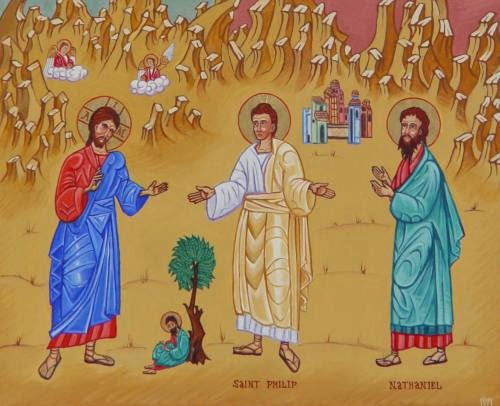
Nathanael meeting Jesus

45Philip found Nathanael and told him, “We have found the one about whom Moses wrote in the law, and also the prophets, Jesus, son of Joseph, from Nazareth.”  46But Nathanael said to him, “Can anything good come from Nazareth?”  Philip said to him, “Come and see.”  47Jesus saw Nathanael coming toward him and said of him, “Here is a true Israelite.  There is no duplicity in him.”  48Nathanael said to him, “How do you know me?”  Jesus answered and said to him, “Before Philip called you, I saw you under the fig tree.”  49Nathanael answered him, “Rabbi, you are the Son of God; you are the King of Israel.”  50Jesus answered and said to him, “Do you believe because I told you that I saw you under the fig tree?  You will see greater things than this.”  51And he said to him, “Amen, amen, I say to you, you will see the sky opened and the angels of God ascending and descending on the Son of Man.” – Jn 1: 45-51 NAB

Wednesday’s Gospel from John made me recall exactly four years and four months earlier when I first met Jesus through the power of the Holy Spirit. My story of that first encounter, while separated and modernized by almost two thousand years, is similar to that of Nathanael (more commonly known as St. Bartholomew).

There was Nathanael minding his own business on the shore of the Sea of Galilee when his friend Philip walked up and said, “Hey, I want you to meet someone important from Nazareth.” Nathanael replied, “What?  From Nazareth?  I don’t think so!”  But, since Philip was such a good friend, Nathanael, although doubtful, decided to go along.

Jesus used Philip as his intermediary. Jesus knew He was going to call Nathanael but He also knew Nathanael would be more likely to follow Him if he received encouragement in the form of testimony from his friend.  It worked, and the rest is history.

I have no idea how many times Jesus might have called me and I wasn’t listening or I out and out rejected Him. But, I think He knew when the time was right and that I would need His disciples to lead me to Him.

Countless times I refused invitations from my friends Clay and Eric to attend men’s bible study sessions where holy men just like them shared their faith with each other. Over a period of months we, along with our wives, occasionally went out for dinner together and the conversations would inevitably turn to discussions of faith, and I would be uncomfortable.  They were sowing the seeds.  They were on a mission to make a friend, be a friend, and bring a friend to Christ.

Just like St. Philip, my two friends arranged the meeting. I accepted their invitation to attend a Christ Renews His Parish retreat weekend.  Then, after they brought Him and me together in the same place, they stepped out of the way.  That part of their job was over.  The rest was up to Him.  And He didn’t disappoint.

That weekend, I witnessed the Holy Spirit at work through the men facilitating the retreat. It didn’t take long before my notion about faith in Jesus changed from, “It can’t be”, to, “It might be.”  Little by little, I heard The Calling.  I gave an inch.  He took a mile.  I gave Him part of me but He wanted all of me.  I was happy to oblige.  Now, over four years later, I’m still giving and trying to find a way to give even more.  And, what I receive in return is beyond anything I could have ever imagined!  I certainly have seen “greater things”.

I owe this life to a couple close friends who weren’t afraid to live the Christ life by evangelizing and introducing me to their Lord Jesus.

It’s not easy being an apostle like St. Philip. It takes courage.  It takes patience.  It takes a lot of prayer.  Some of us are better suited for that type of evangelization than others.  But, we can all evangelize in one way or another.  For me, these blog posts are one of my ways of evangelizing. What is your way? If you don’t know where to begin, you can start by following the advice of St. Francis of Assisi, “Preach the gospel, and if necessary, use words.”

“Lord Jesus, through the love of Your apostles I was led to You and You have shown me the way to eternal life. Help me, I pray, to bring Your love to others who, like I was, are seeking the fullness of life that only You have to offer.  Amen.”

(The Calling was first published on the blog Reflections of a Lay Catholic)

©2016 Reflections of a Lay Catholic. Reposting and sharing of material in its full and original content is permitted, provided that full and clear credit is given to the author(s) and Reflections of a Lay Catholic.

They Don’t Know What They’re Missing

Tags

, , ,

Highway

“They tell me I’m crazy and ask why I subject myself to such suffering. They assume I dread the prospect of it. But, they’re wrong. They don’t understand.

“The 2,320 miles I expect to drive, as opposed to fly, over the next six days – crisscrossing the Midwest from Olathe, Kansas, to Nashville, Tennessee, to Lake Charles, Louisiana then back to Lebanon, Ohio – will be a welcome respite, one I have been looking forward to for over a week. It’s an opportunity to get away from the busy-ness of life and, although it will mean being away from my family for much of that time, it will allow me to get closer to You.

“Lord, You made me the introvert that I am. I thank You for the gift and the ability to look inward, to find peace in a way that strikes others as loneliness and boredom. But, I’m not alone and I’m not bored. I have You, Lord, with Whom I can converse through heart-felt prayer.

“The solitude of being alone behind the wheel, mile after mile, hour after hour, brings a calming peace, a shot-in-the-arm which I need from time to time.

“With the exception of the ‘thuckity-thuck’ of the tires hitting the cracks in the highway, the silence allows me to focus on You. The stereo is turned off, my phone is off. The only way to be distracted from You is if I allow it to happen. My hope is that I will hear Your voice.

“Over the last couple weeks, my time for prayer with You has been limited. I failed to take the opportunity to pray as I should. Over the next few days, I have no excuse. I find comfort and relief in that thought.

“Lord, thank you for this meal I just had somewhere in Missouri. Thank you for the four days I just spent with my daughter, son-in-law, and especially my grandsons. Thank you for my other new grandson I will see in a few days. Thank you for blessing my family with the birth of my youngest daughter 20 years ago today. Thank you for the poison ivy on my right arm – the itch reminds me that I earned it in service to others in Appalachian Kentucky last week. Thank you for letting me see Christ in them. I pray they saw a glimpse of Your Son in me.

“Lord, I pray that You send my guardian angel to watch over and protect me while I’m on the road, and that You do the same for my family while I’m not there with them.

“Lord, I pray that those who struggle to find time to be close to You will find inspiration in this reflection and make time for prayer with You a higher priority. They don’t know what they’re missing.”

(They Don’t Know What They’re Missing was first published on the blog Reflections of a Lay Catholic)

©2016 Reflections of a Lay Catholic. Reposting and sharing of material in its full and original content is permitted, provided that full and clear credit is given to the author(s) and Reflections of a Lay Catholic.

Indirect Grace

Tags

, , , , , ,

Grace

It’s been a good day here in Eastern Kentucky. We worked hard repairing the bathroom floor, tub, and toilet for a gentleman. During the work and at breaks we learned his story. And we came together as a team, teaching and learning woodworking and plumbing skills and getting to know each other.

I have to admit that my mind often wandered as I worked today. I don’t think it kept me from working safely but, unfortunately, I did make a couple saw cuts in error. No, my mind wasn’t always on my work; rather, it drifted to those two new, less than a week old, grandsons whom I have yet to see. So, this post isn’t about our mission work – more will come on that later. This post is kind of a Paul Harvey “Rest of the Story” kind of story about a lesson I learned.

On Sunday I posted in Miracles that my daughter, Lisa, gave birth to her second son on Thursday of last week, two weeks early. On Wednesday morning she went in for an ultrasound and the doctor, after seeing something that didn’t look quite right, recommended inducing labor and delivering the baby as soon as possible. The situation was not life threatening to either mother or baby but it was best to introduce baby Edward to the harsh reality of life outside the womb. I claim I didn’t get the message that it wasn’t a serious issue. My wife says otherwise. But, let’s not go there.

Wednesday afternoon I left on an overnight trip to southern Indiana for business, about a four hour drive. I had a lot of time to worry about Lisa and the baby and all that could go wrong. Memories from a year and a half ago came streaming back to me of how her first son, Jack, had complications after birth and we thought we might lose him. I remembered how I prayed to Jesus with everything I had for Jack’s health. And, I remembered how, after a series of God-moments (see Put Your Faith Where Your Prayer Is) including praying the rosary and asking for the Blessed Virgin Mary’s intercession to Jesus, I was suddenly overcome with joy like I had never known, joy that instantaneously brought me a peace that broke me down to crying tears of Thanksgiving. I felt Jesus assure me that Jack would be just fine.

I wanted that same feeling last Wednesday. I wanted it so bad that I prayed continuously as I drove. I prayed two rosaries and I prayed, “Jesus, I trust in You” until my throat was dry. But, the more I prayed, the more I became discouraged. Nothing was happening. It wasn’t working.  I felt ashamed of my inadequate faith.

Desperately wondering what to do next I decided I needed prayer support, someone who would and could pray for us. I remembered that day 18 months ago as I was driving from Cincinnati to Kansas City to see Lisa and young Jack. I remembered receiving a phone call on that drive from a good friend, a mother with four children of her own, and one of the best prayer warriors I know. I remembered how her words brought me such comfort which, I believe, eventually brought me to placing my full trust in Jesus.

I called her and I reached her on the second try. I explained my predicament and my worries. I confessed that even though I was repeating, “Jesus, I trust in You” over and over, I really wasn’t feeling very trustful. Once again her words helped calm me as she reminded me to simply trust in His will; that my daughter and baby are in His loving hands; to accept His Grace; and that He will not give us anything we can’t handle. She said she would pray for me, Lisa and her baby.

A few miles further down the road I received a message from my friend that she, her husband (also a very close friend) and their four children had just prayed, as a family, a decade of a rosary for us. She told me that she found her prayer very peaceful, that she had a calming peace thinking of me driving and praying the rosary. She reminded me again to lean on and have faith in the Blessed Virgin’s intercessory prayers to Jesus, and that she knew Mother Mary was holding Lisa’s hand. When I arrived at my hotel, I messaged her back thanking her and her family for all their prayers. While I had not yet had that moment of divine revelation that everything was going to be okay, I at least felt better. I was mentally exhausted and, going to bed, I immediately fell asleep.

That was the best night’s sleep I’d had in quite some time. When I awoke on Thursday morning I did something I’d never done before. I don’t know where it came from but I uttered, “God is with me. How can it be anything but a beautiful day?” As I was clearing the fog from my mind I realized I knew Lisa and baby would be just fine.

A short while later I talked to my wife. It was at this time I heard her explain that the complications with Lisa’s pregnancy were nothing to get excited or worried about.

Then, I had another revelation. I realized that my fear had been keeping me from accepting God’s Grace. I thought, “He’s probably been intent on getting His Grace to me one way or the other. If I wasn’t going to accept it directly, He would have to get it to me indirectly. So, He brought my friend to mind knowing I would trust her, that through her she would help me hear Him.”

Now it all became clear: It wasn’t Lisa or her baby who needed help. It was me.

That’s God working through the power of Christian Community.

“Lord Jesus, thank You for Your love and for continuing to shower me with Your Grace. Thank you for blessing me with friends who love me and care for my spiritual welfare and pray for me to grow closer to You. Help me to get past my fear so that I may fully trust in You. Amen.”

(Indirect Grace was first published on the blog Reflections of a Lay Catholic)

©2016 Reflections of a Lay Catholic. Reposting and sharing of material in its full and original content is permitted, provided that full and clear credit is given to the author(s) and Reflections of a Lay Catholic.