
• About
  • Books I’m Reading
  • Links

Reflections of a Lay Catholic

Reflections of a Lay Catholic

Tag Archives: Jesus

Love God and Love Your Neighbor

03 Sunday Nov 2024

Posted by Jerry Robinson in Bible Reflections, Hope, Love

≈ 4 Comments

Tags

Catholic reflection, Charity, Eucharist, Eucharistic Adoration, Faith, Hope, Jesus, Love, Love of Neighbor, Mark 12:28-34, Sacrifice, The Greatest Commandment

Today’s Gospel was from Mark 12:28-34 in which we hear Jesus’ response to the scribe’s question about which is the first of all the commandments.  Jesus replied, “the first is this:  Hear; O Israel!  The Lord our God is Lord alone!  You shall love the Lord your God with all your heart, with all your soul, with all your mind, and with all your strength.  The second is this:  You shall love your neighbor as yourself.  There is no other commandment greater than these.”  

Hearing this at Mass this morning, I thought about the examples I see every day from young mothers and fathers, and grandparents, who lovingly, selflessly and tirelessly give of themselves for the sake of their children and grandchildren.  I thought of social workers and those in the medical field who live the second commandment in their care for the physically and mentally ill.  And then I thought of all those who fail to live this commandment because of their selfish desires for what makes them feel good, or what fits their schedule, over the needs of others.  I think it’s a rare saint that can live this virtue one hundred percent of the time.  Even the best of us are a mixed bag of charity and selfishness.

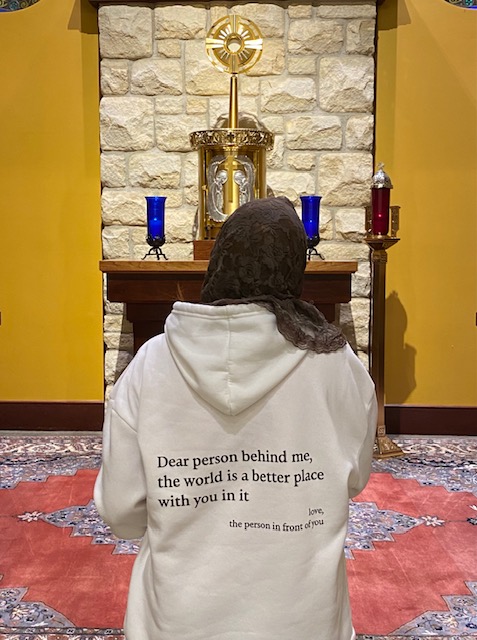
As I meditated on how I might love God and neighbor better today, I recalled one morning a couple weeks ago.  After morning Mass, our priest exposed the Blessed Sacrament for that week’s day of Eucharistic Adoration.  I lingered in my pew for a bit but then decided to go up to the Adoration chapel to kneel before the tabernacle and Jesus in the monstrance.  As I approached the tabernacle, I found a young woman already there kneeling.  I knelt behind her and as I did I noticed the printing on the back of the sweatshirt she was wearing.  It said, “Dear person behind me, the world is a better place with you in it.  Love, the person in front of you.”

“Dear person behind me, the world is a better place with you in it.  Love, the person in front of you.”

I knew this young woman, or rather I know her parents better than I know her, and I knew that if her apple didn’t fall too far from the family tree, she meant the words that were on the back of her hoodie.  I also knew her love for our Lord was strong.  Did it make me feel loved?  Yes, to a certain extent, but mostly it gave me hope.  Hope from the affirmation that there is actually goodness in the world; hope that more people will respect the dignity of all humankind whether they are behind, in front, or on either side of them; and hope that I might grow in that respect, also.

Then, as I knelt there gazing at Jesus in the Eucharist, that in this particular instance, it was the Person in front of the person in front of me Who is the perfection of selfless love.  He is our model.  And it is by loving Him, and letting Him love us, that we can truly love our neighbors as we love ourselves.

“Heavenly Father, thank You for Your endless love!  Thank You, Jesus, for Your sacrifice of love on the cross to save my soul.  Help me Lord, give me the grace to love You and my neighbors as You love the Father and all the sinners for whom you were crucified.  Amen.”

(Love God and Love Your Neighbor, was first published on the blog Reflections of a Lay Catholic)

©2013-2024 Reflections of a Lay Catholic. Reposting and sharing of material in its full and original content is permitted, provided that full and clear credit is given to the author(s) and Reflections of a Lay Catholic.

You’re the Best!

23 Monday Sep 2024

Posted by Jerry Robinson in Bible Reflections

≈ 2 Comments

Tags

Charity, Christ Renews His Parish, CRHP, Cursillo, Friendship, Humility, Jesus, Love, Mark 9:30-37, Matthew 7:5, Pride, Welcome, Who is the Greatest?

In yesterday’s Gospel, Mark 9:30-37, we find Jesus journeying through Galilee with His disciples on their way to Capernaum.  Along the way the disciples are arguing about which of them is the greatest in the Kingdom.  As I reflected on this passage, I could imagine how that conversation went.  John tells Peter, “Hey, bro, you’re the best!”, and Peter replies, “No way, you are!”.  Then James looks at them both and says, “Hey, Philip is the greatest!”, and Philip replies, “Uh uh, Andrew is!

What?  You don’t think this is the way it went?  You think their egos were claiming that they personally were the greatest in the Kingdom?  Yeah, you’re probably right.  Most likely, they each thought their faith was stronger, their actions were more charitable, they worked harder than the other.  Not much has changed in two thousand years, has it?

Our pride does this to us.  We have the need for accomplishment, to feel relevant, to feel worthy, to feel validated by our friends and family, our co-workers.  And when we don’t get what we think we deserve, our egos self inflate as a defense mechanism.  We may not tell another that we’re better than they are, but we certainly feel that way much of the time.  We easily see their faults but neglect to see our own.  Jesus pointed this out when He told us to remove the beam from our own eye and then we will be able to remove the splinter from the eye of our brother (Matthew 7:5).

But what if it wasn’t that way?  What if we ditched our pride and put on a cloak of humility and actually recognized the positive attributes of others and praised them for their goodness?  I’m not talking about false patronizing praise, the kind that makes you want to throw up.  I’m talking about sincere, honest, heart-felt recognition for the dignity of the other, the kind of charity that values another over one’s self.  It’s not just possible, it actually happens.

This is the kind of loving relationship you find when a group of Christians spend time together growing in friendship, getting to know each other on a deep level.  Sure, they know each other’s faults but it’s because the person owning the fault has the self-knowledge and humility to share their weaknesses with their friends.  And those friends, rather than rub it in, help the other overcome and improve.  In a relationship like this, each knows their validation comes from the Lord, that they are a beloved son or daughter of God.  And because of this, they can love as Jesus loved, placing another ahead of themselves without any anxiety about their worth.

Friendship like this can be found in small Bible study groups; with friends who frequently share hospitality; and, especially, those who pray together.  It’s the kind of respect and love you find between members on a retreat team such as Christ Renews His Parish, Welcome, or Cursillo.  It’s the kind of love that brought me to an encounter with Jesus and has helped sustain me for the last twelve years.  It’s life-giving friendship that makes life worth living for everyone involved.  Your parish probably offers opportunities to become involved in ways in which you can experience love like this.  Get you some!

“Heavenly Father, thank You for the life to which You have brought me.  Thank You for the men and women You’ve placed in my life who have invested in me and accompanied me on my journey to You. I pray for the grace to help others do the same.  Amen.” 

(You’re the Best!, was first published on the blog Reflections of a Lay Catholic)

©2013-2024 Reflections of a Lay Catholic. Reposting and sharing of material in its full and original content is permitted, provided that full and clear credit is given to the author(s) and Reflections of a Lay Catholic.
Evangelization Happens at the Pace of Relationship

11 Wednesday Sep 2024

Posted by Jerry Robinson in Evangelization

≈ 3 Comments

Tags

Catholic, church, Culture change, Evangelization, Friendship, Jesus, Love, Love of Neighbor, Mercy, Relationships

In just over a week autumn will be here and summer will officially be over.  With school starting, most parishes have wrapped up their festival season, had their parish picnics, and are beginning to prepare for the season of Advent.

Our parish family had its picnic in August.  (Perhaps I need to explain what I mean by “parish family”.  We have a priest shortage forcing our Archdiocese to combine parishes into parish families.  Our “family” consists of two established churches whose boundaries abut each other.)  To help transition from two parishes into one canonical parish with two campuses, we had one picnic for both churches.  

I made it a point to wander around and meet people I didn’t know and to get reacquainted with folks I hadn’t seen in a while.  I saw one couple whom I had not seen in four or five years sitting alone.  They regularly attend the church that I don’t usually attend.  They were eating their meal so I sat down with my plate of food and we reconnected.  I asked them how long they had been parishioners and they replied they’d been there about nine years.  I said, “You must know a lot of folks here, then.”  They looked at each other and replied, “No, not really.”  I responded, “That’s too bad, do you feel welcome here?”  They again exchanged glances and replied, “No, not really.”

Sadly, this is not an uncommon sentiment by many parishioners.  I’ve met too many people who feel the same.  They’ve attended church for years but have made no real friends.  People from the church I regularly attend have confided the same to me.  My family has experienced this with our many relocations.  And these days, because my wife and I travel often, we attend Mass at more than a dozen different churches each year and it’s rare that anyone takes the time to welcome our unfamiliar faces.

It’s easy for us to say that those who feel unwelcome are partly responsible due to their own introvertedness.  But that doesn’t excuse the rest of us.  We’re not all introverted, but even those who are can learn to be extroverted when called to be such.

By virtue of our faith we are all called to reach out to others and build up the body of Christ, the Church.  In other words, we are called to evangelize.  And evangelization happens at the pace of relationship.  Relationships are begotten when we intentionally meet and get to know each other.  Relationships build trust, and being trusted is essential when we are trying to proclaim the Gospel and bring others to, or closer to, Jesus.

Evangelization is often considered to be something we only do outside the church doors, to the un-churched.  We need to change our thinking.  We have to evangelize within our church family as well.  At any moment, parishioners like those I met at the picnic may decide that if they don’t meet anyone this Sunday, they’re gone!  Tragically, Catholics are leaving the faith in droves, partly because they do not feel welcome.  It’s a problem our Catholic culture has to overcome if we want to survive.  We have to get beyond the idea that our only responsibility is to attend mass each week and go to confession once a year.  Our Creed says we are “One”.  We need to start acting like we are all One family and loving the other as they deserve and need to be loved.  

We are called to be merciful like Jesus was merciful.  That includes practicing the Spiritual Work of Mercy of comforting the sorrowful.  We can’t keep looking past people like they are invisible, rather we have to understand that many are struggling, and that not everything is copacetic in their lives.  People going through a tough time need a listening ear.  A friendly smile and welcoming conversation can turn a difficult day into one of joy and hope.  The making of a new friend can end a life of loneliness.  And personally, the next new person you intentionally meet might just be your next best friend, the someone you need but just don’t know it yet.

Make it a point to meet someone new this Sunday or at your next parish activity.  Be intentional.  Attend a different mass, sit in a different pew, look for that spot in a pew next to someone you don’t know.  Then, after Mass, turn to them with an outreached hand and introduce yourself.  When they respond, take the conversation from there, listening to learn more about them.  It’s not that hard and you’ll be glad you gave it a try.

“Come Holy Spirit, rekindle in me and all those who have been Confirmed the virtue of fortitude to get out of our comfort zones and seek out those who need us.  Help us to look beyond ourselves and commit to bringing the love of Christ to others.  I thank You, Lord, for all those you have placed in my life who have reached out with a friendly hand and a comforting smile and made me feel a welcome member of our Catholic family.  Amen.”

(Evangelization Happens at the Pace of Relationship, was first published on the blog Reflections of a Lay Catholic)

©2013-2024 Reflections of a Lay Catholic. Reposting and sharing of material in its full and original content is permitted, provided that full and clear credit is given to the author(s) and Reflections of a Lay Catholic.

“Do You Love Me More than These?”

17 Friday May 2024

Posted by Jerry Robinson in Bible Reflections

≈ 1 Comment

Tags

Balance, Bible, Catholic, christian, Faith, Jesus, Jn 21:15-19, Love, Meditation, Mental Prayer, Order, Prayer, Rule of Life

In today’s Gospel, John 21:15-19, Jesus has just appeared to the disciples for the third time and has helped them catch a boat load of fish.  He and Peter are sitting around a campfire on the shore of the Sea of Tiberias having a conversation.  Jesus asks Peter, “Simon, son of John, do you love me more than these?”  Over the years I’ve read this passage dozens of times and today my attention was not drawn to Jesus asking Peter to feed and tend his lambs and sheep.  Today, I am pondering what Jesus means by “these”.

I imagine them sitting there together, and as Jesus asks the question, He is gesturing with His hands.  At what are they pointing?  Jesus could be pointing at the other disciples and asking if Peter loves Him more than the other disciples love Him.  Or, He could be pointing at the other disciples and asking if he loves them more than he loves Him.  Or, possibly, he’s pointing at the fish on the grill, the nets, or the boat and asking if Peter, the fisherman, loves those things more than Him.

I know that the Bible is God’s Word, and in it, especially the gospels, He is talking to us.  He could be asking Peter for any of those reasons, but what is He asking us today in those questions?  In the first possibility, it strikes me that one would have to be extremely judgmental and full of pride to think he/she loves Jesus more than other people love Him, especially one’s own friends.  It’s a no-win question, “yes” and “no” are both wrong answers.  Somehow I don’t think Jesus would put us in that predicament.

Answering the second option is also tricky.  Jesus tells us to love our neighbors as He has loved us.  Thus, to say we love one more than the other is, again, a Catch-22 situation, one that Jesus wouldn’t impose on us.

The third option, however, is certainly a possibility!  Peter’s worldly life revolved around his boat, nets and the fish he caught.  My life, and probably yours, too, is consumed with worldly things that too frequently eat up my time and draw my attention away from my Lord.  For the most part, they are good things:  work, family, relationships, food, rest, exercise, creating, admiring beauty, etc.  They are all good things, either created by God or created from the gifts given to us by God.  But, we get too attached to them in a disordered way.  We become workaholics and fail to give attention not only to God but to our loved ones; or we neglect our work which then fails to provide the necessities for our families.  Physically, we eat too much or too much of the wrong things, we exercise too much or too little.  We spend too much time looking at our screens for entertainment rather than admiring what is truly beautiful or creating beautiful things.

Can you imagine yourself in that scene, Jesus asking you that question?  Can you see His hands and arms spreading wide at all the stuff that draws your attention away from Him?  It’s all good stuff in its own way, but you know you’re way too attached to it.  And you know deep inside that it’s wrong, that it causes havoc in your life, that it’s the source of the imbalance and chaos that drives your anxiety and unhappiness.  There’s a hole in your life that these things are not filling.  It’s a God-sized hole that only God can fill.

How do you correct your course?  The answer is creating a personal Rule of Life, that is, identifying the most important things in life and putting them first, ahead of less important things, then determining how much time ought to be spent on each of those things.  I have a friend who considers a well ordered and productive life to be like following a recipe to bake a cake – you need the right ingredients (the things), the right amount or proportion of each ingredient, and incorporate them in the right order.  Of course, time for Jesus in the form of prayer, especially mental prayer meditating on His Word, needs to be one of those ingredients.  How much?  Try just 30 minutes a day, preferably first thing in the morning,  sitting with Him in silence and solitude, reflecting on His Word, loving Him and letting Him love you.  That 30 minutes will change your life.  

“Dear Jesus, we both know there are many things that draw me away from You, things that cannot bring the joy that You bring to life.  Thank You for helping me create a Rule of Life by which I generally keep all of “these” things in order, and first things first.  Yet, I know I often slip-slide.  Through my devoted prayer time with You, You give me the grace to correct my bearings when I drift off course.  Amen.”

(“Do You Love Me More than These?” was first published on the blog Reflections of a Lay Catholic)

©2013-2024 Reflections of a Lay Catholic. Reposting and sharing of material in its full and original content is permitted, provided that full and clear credit is given to the author(s) and Reflections of a Lay Catholic.

Are You In or Out?

16 Thursday May 2024

Posted by Jerry Robinson in Evangelization, Faith

≈ 2 Comments

Tags

Bible, Catholic, christianity, Discipleship, Evangelization, Faith, Fear, Jesus, Jn 16:33, Jn 17:11-19, Trust

It’s Wednesday, May 15th, but I know this won’t get posted until tomorrow. I’m writing this right after my morning meditation on today’s Gospel, John 17:11-19.  After Jesus informed his disciples that he is going away (Jn 16) and they will have to take over from Him, He warns them of the trouble they will encounter from the world, but to have courage because He has conquered the world.  Now (Jn 17), He prays to God before them to consecrate them to the truth, sends them forth into the world to continue His mission, and prays, “for those who will believe in me through their word”.

As I put myself in that scene as one of the disciples, I feel anxious.  I am alarmed and sad that my Messiah, the One I love, is leaving me, and I am fearful because I now have a tremendous responsibility to carry on His mission even though I am hopelessly inadequate.  At the same time, I think about all the good He has brought to the world – the miracles, the lessons about right living, the healing, the interior peace – lessons that simply cannot be set aside and forgotten.  I have a decision to make:  do I just remember Jesus as a friend, teacher, and miracle worker, or do I continue His work, sharing this beautiful life, and help others come to know Him?

I realize that it’s really a no-brainer.  Up until now, I’ve just been tagging along on His robe-tail, letting Him do all the work.  Now He’s asking me, and trusting in me, to step up and take command.  He’s even asked God directly to help me…and I have no reason to believe His prayer won’t be answered no matter how afraid I am.  I have never felt more loved than when I’ve been with Him.  He has asked me to love others as He has loved me.  How can I do otherwise?

My decision:  I’m in.  I know it won’t be easy but I trust that He will be with me.  I’ll make mistakes.  I’ll fall occasionally.  He told me the world will work against me.  I’ll accept that, but I’ll find ways to deal with it and evangelize nevertheless.

What’s your decision?  Are you in or out?

“Lord Jesus, thank You for inviting me to a deep relationship with You, and Your trust in me to lead others to You. Thank You for the gifts You give when I receive You in Communion, the gifts of love for others, and of courage and strength to overcome my fear of evangelizing as I bring that love to them. Amen.

(Are You In or Out? was first published on the blog Reflections of a Lay Catholic)

©2013-2024 Reflections of a Lay Catholic. Reposting and sharing of material in its full and original content is permitted, provided that full and clear credit is given to the author(s) and Reflections of a Lay Catholic.

Relationship vs. Religion

09 Saturday Mar 2024

Posted by Jerry Robinson in Evangelization

≈ 2 Comments

Tags

Catholicism, christianity, Evangelization, Evangelizing, Faith, Friendship, Jesus, Mental Prayer, Prayer, Relationships, Religion

In many previous posts I’ve mentioned the need to develop a close personal relationship with Jesus through prayer, especially mental prayer or mediation, in order to make our evangelizing authentic.  In prayer, we spend time with Jesus, we converse, and we build a friendship with Him that becomes so exciting that we want to introduce Him and share Him with others!  

As Catholics, we are fortunate to be able to claim two thousand years of tradition in our lineage.  We are the original Church, instituted by Christ Himself, and built on the rock of Peter.  We have thousands of saints to whom we can look as role models: men and women who performed incredible acts of charity, who evangelized savage cultures at the risk of losing their lives, and who staunchly defended their faith and were martyred. Our faith is deep, and we have a plethora of books, magazines, podcasts, television, videos, and speakers to help us learn and go deeper into the finer details of Catholicism.  It’s all good and exciting stuff and we can easily get lost in it.  So lost, in fact, that we can begin to think that our religion, our Catholicity, is first and foremost.  And, when we do, Jesus gets relegated to the back seat.  Our excitement about Catholicism becomes a hinderance to actually promoting Jesus. 

If we read the Gospels closely, we see the popularity of Jesus.  People heard of his miracles, and they flocked to Him.  They were cured of sickness and demons, and, as they told more people about Him, more and more people followed Him everywhere He went.  During Jesus’ public ministry, His disciples didn’t tell people to come join them in a new religion.  The term Christianity was not coined until a few decades later.  Rather, they simply invited them to encounter Jesus.  People got excited about Jesus and not some new religion.

If we’re not careful, we can fall into the trap of thinking we are evangelizing when, instead, we are selling Catholicism rather than sharing our love for Jesus, and hoping that an interest in Him will ensue.  We have it backwards.  We ought to follow the example of the Apostles and invite people to meet Jesus.  Once they find and get excited about Him, then we can introduce them to the beauty and truth of our Catholic faith.

How do I know this?  Because it worked on me.

“Dear Jesus, thank You for Your love, for drawing me closer to You each day.  I love You, and in our friendship, Your love overflows so that I may offer it to others who may not know You…yet. Amen.”

(Relationship vs. Religion was first published on the blog Reflections of a Lay Catholic)

©2013-2024 Reflections of a Lay Catholic. Reposting and sharing of material in its full and original content is permitted, provided that full and clear credit is given to the author(s) and Reflections of a Lay Catholic.

From the Archives: Soil Conditioning for the Heart

23 Saturday Sep 2023

Posted by Jerry Robinson in Bible Reflections, Faith, Prayer, Scripture

≈ Leave a comment

Tags

Faith, Jesus, Luke 8:4-15, Mark 4:1-20, Parables, Prayer, Reflection, Resolution, silence, solitude, The Parable of the Sower

The Angelus, Jean-Francois Millet, 1859

Every now and then I recall from my morning meditation something about which I’ve already written.  Today’s Gospel from Luke 8:4-15, the Parable of the Seed and the Sower, rang a bell.  I found what I was looking for from January 2018, except that it was a reflection from Mark’s Gospel, Mark 4:1-20.  As I re-read it, I thought the message from over five years ago was still as relevant as ever, if not more so, and it needed to be shared again. I hope it will lead you to a fuller prayer life.

Peace and blessings to you all! 

Soil Conditioning for the Heart

In my previous life (pre-2012 and pre-Catholic) I would occasionally crack a Bible and read a passage or two before losing interest and closing it up. This didn’t happen often, mostly when I was traveling, alone and bored in a hotel room somewhere and there was a Gideon Bible in the nightstand drawer. I remember reading from the Gospels and wondering why Jesus talked to the people in parables. As far as I could tell, it was all a riddle that nobody in their right mind could understand. It made no sense.

This recollection came back to me today as I read and meditated on today’s Gospel, Mark 4:1-20, the Parable of the Sower. A lot has changed over the last six years. I understand this parable today – that Jesus is the sower, the Word of God is the seed, and the different types of soil are the dispositions of the diversity in our faith. Or at least I think that’s what it’s about.

But, as I meditated on this today, my thoughts were more on why Jesus spoke in parables rather than the message in the parable.

I have learned that the Jewish rabbis and teachers in Jesus’ time, taught using stories with familiar images and experiences to which the learner could relate. The messages in these stories were not explicit but, instead, were designed to make one think. The answers were complex and seldom simple. If you thought you had it figured out, you probably didn’t. You needed to think about it more, and think more deeply.

Jesus’ parables were similar to what we call allegory today. He always had a hidden complex spiritual meaning or moral lesson embedded within his parable. And, depending on one’s level of faith, you either got it, partially got it, or you were totally lost.

Even Jesus’ disciples and His chosen Apostles didn’t always understand. In today’s Gospel, His disciples questioned Him about the parables. Jesus answered them, “The mystery of the kingdom of God has been granted to you. But to those outside everything comes in parables so that they may look and see but not perceive, and hear and listen but not understand, in order that they may not be converted and be forgiven.” Jesus continued, “Do you not understand this parable? Then how will you understand any of the parables?” (Mk 4:11-13)

We often think that the Apostles were all totally on board and on the same page as Jesus. But, the reality was that they never did quite figure it out until Jesus’ resurrection and eventual ascension into heaven. No, they were quite often lost regarding the mysteries of Christ’s life (e.g. Mk 8:32-33, Peter’s response to the first prediction of Jesus’ Passion; and, Mk 9:28-29, the healing of a boy with a demon).

Jesus wanted everyone, His disciples included, to think deeply about His message. He wanted them to look beyond the obvious, below the surface, and outside of the box. He challenged them to compare and relate His stories, His parables, with their own lives. The extent of their understanding and ability to relate often depended on their faith.

Nothing has changed. It still depends on faith. The reason I didn’t understand the Gospel as I read while lounging on a hotel room bed was because I had no faith. The difference between then and now for me is that I now believe the Word of God to be the truth. I have a deep desire to understand it so that I can apply it to my life.

Jesus still challenges us to understand God’s Word within the context of our own lives, our own experiences. He wants to sow the Seed on fertile soil so that it may grow and produce fruit. How do we prepare that garden plot in preparation for His sowing?

First, we need to create an atmosphere in which we can listen to God through His Word in the scripture, an atmosphere of silence and solitude that is conducive to deep thought without distractions. Author Henri J.M. Nouwen in his book, The Way of the Heart, describes silence as, “not not speaking, but listening to God”; and solitude as, “not being alone, but being alone with God.” Finding that time and place is critical.

Once you’re there, open up your heart in prayer. Give thanks to God for the opportunity to be with Him in that moment. Ask the Holy Spirit to open your heart and mind to receive the Word of God, and for the grace to understand His Word as you read and reflect upon it.

As you read the scripture, think deeply about what it is God is telling you at that moment. Maybe there is a verse or a phrase or just a couple words that jump out at you. Stop and reflect on that which catches your attention and let the Holy Spirit take you deeper to reveal God’s unique message for you. Say a prayer of thanksgiving once you’ve absorbed His revelation.

Next, ask yourself how that message relates to your life today. Is there something you can do to change? What can you do today to be more virtuous, to grow in holiness, and to become a better disciple, spouse, parent, and friend? How can you condition your soil to make it more fertile? The Holy Spirit will convict you and show you the way!

Finally, take that one thing, that one change for the better, and write a concrete resolution that will effect an improvement that day. Make it easy but make it concrete. Think baby steps instead of leaping tall buildings. Something that you can, at the end of the day, look back on and say with a sense of accomplishment, “Yes! I did it!”

And then go do it.

This is how you grow in faith. This is how you begin to understand the Word of God and not get confused in the complexity of the parables. And, this is how you gradually grow in holiness on your way to becoming a saint just like the Apostles.

“Heavenly Father, thank You for giving me the deep desire to understand Your Word, and for Your Son, Jesus, to sow that Seed in my heart. Thank You, Holy Spirit, for the gift of faith that has conditioned my heart to be fertile ground for producing fruit for Your kingdom. I pray that, through Your grace, the harvest is abundant. Amen.”

(Soil Conditioning for the Heart was first published on the blog Reflections of a Lay Catholic)

©2013-2023 Reflections of a Lay Catholic. Reposting and sharing of material in its full and original content is permitted, provided that full and clear credit is given to the author(s) and Reflections of a Lay Catholic.

Prayer and Potted Plants

24 Saturday Jun 2023

Posted by Jerry Robinson in Evangelization, Prayer

≈ Leave a comment

Tags

Acts 17:28, Contemplation, Evangelization, Jesus, Jn 4:10, Living Water, Meditation, Prayer, St. Photina, Vocal Prayer, Woman at the Well

I’ve been settling into my new office in our parish center and trying to make it functional for my use. My computer and phone are conveniently located, files are arranged in the file cabinet, and books are in the bookcase.  I have a crucifix and a cast figure of the Blessed Mother holding the child Jesus hanging on the walls, and I hope to get some pictures hung soon.  Finally, I’ve adorned it with a couple house plants to make things look more inviting.

My wife has exclusive ownership of a ‘green thumb’ in our family and I had to ask her advice for how often to water the plants.  She told me in a not so endearing tone of voice, “If the soil feels dry, water it!”  From experience, I know that if you pour water on the soil from the top, it often comes out the hole in the bottom of the pot and makes a mess on whatever surface it’s sitting.  So, my master gardener better-half gave me a shallow plastic tray in which to set the potted plants and then told me to fill the tray with water.  She said the soil in the pot would soak up the water through the hole in the bottom of the pot.  

The other morning, when I checked, the soil was somewhere between dry and parched.  It needed a drink.  I heeded her advice, filled the tray with water, and set the pot in it.

I then went about my business of sketching out a plan of how to create an evangelizing culture in our parish, to wit: how to develop a more welcoming and hospitable community where people will intentionally build relationships with each other; how to grow an attitude of charity towards “neighbors”; and how to encourage people to not be afraid to share their faith with others.

After an hour or so, I noticed that the half inch of water I’d poured into the tray had disappeared.  Just as I was told, the soil had soaked it up.  I envisioned the water molecules defying gravity as they flowed upwards, saturating the soil.  I thought about how thirsty that plant must have been.

Then it struck me – plants aren’t the only thing that thirst for water, we humans do, too.  Except, our thirst is for the Living Water (Jn 4:10).  We may not understand it, but our souls yearn for it.  Our deepest desire, and the only true way of living a spiritually healthy life, is to seek God, the one in Whom we live and move and have our being (Acts 17:28).  It is God Incarnate, Jesus, that sustains our life.

I had omitted from my notes the most crucial element about a culture of evangelization – a deep relationship with our Lord.  Without it, evangelizing amounts to a  worthless attempt.  If the ultimate reason for evangelizing anyone is to bring them into a relationship with Christ, we are hypocrites if we try to evangelize without having our own personal relationship with Jesus.  How can we lead someone to a place which we haven’t been ourselves?

What is a deep and loving relationship with Christ?  Well, what makes up a deep and loving relationship with anyone?  Basically, it’s friendship.  The essence of friendship is spending time with each other, getting to know each other, having enlightening conversations, and loving and wanting the other’s good.  Friendship with Jesus is really no different.  We do that through prayer.  

Us Catholics are good at Vocal prayer, that is, prayers of petition, thanksgiving, intercession and praise (CCC2700-04).  And, we’re good at rote prayers that have been memorized and recited since childhood.  But, there are two other expressions of prayer that are mostly overlooked – Meditation, or Mental prayer (CCC 2705-08), and Contemplation (CCC 2709-19).  Vocal prayer is talking to God.  Meditation, on the other hand, is using our God-given intellect and imagination in seeking to understand what God is asking of us.  Meditation is often accomplished by reading Sacred Scripture, especially the Gospels, reading about the lives of the saints, and other spiritual writing. 

Contemplation takes meditation one step further.  St. Teresa of Avila said, “Contemplation is nothing else than a close sharing between friends; it means taking time frequently to be alone with Him Who we know loves us.”  During this time of Contemplative prayer, we draw very close to Jesus; we tell Him what’s on our minds and we listen to Him telling us how we can grow closer to Him by becoming more virtuous disciples, spouses, parents, children, and friends.

If you are a married person, you know how important it is to listen to your spouse.  A relationship in which one person does all the talking but never listens is doomed for failure.  In Meditation and Contemplation, we quiet our minds and relish just being with Him, ready to respond to whatever He says.

Meditation and Contemplation is immersing ourselves into the font of Living Water.  It is soaking up His Word and seeing how we can follow Him more nearly and love Him more dearly.   It is this Living Water we desire to drink.  But, have you ever tried talking and drinking at the same time?  It doesn’t work very well.  

The Woman at the Well – Carl Heinrich Bloch

St. Photina, the biblical woman at the well, listened to Jesus tell her about her life.  She drank of the Living Water.  Then she hurried back to her Samaritan village, spread the Good News, and evangelized the entire town.  

Evangelization involves many things.  True evangelization begins with having a deep friendship with Jesus and a desire to introduce others to Him, your closest friend.

Spend at least thirty minutes a day quietly immersed and soaking in the presence of our Lord.  Tell Him what’s on your mind and then listen for a response.  When you hear His inspiration, resolve to act on it that day.  Then repeat.  Unlike the plants in my office, we need watering every day.

“Loving Lord, help us to draw closer to You by spending time with You, the One we love.  Send us Your Spirit to open our hearts and minds to Your Word, and inspire us to act with virtue in carrying out Your will.  Help us remove the shades from our lamps, the hang-ups we have in spreading the Good News.  Amen.”

(Prayer and Potted Plants was first published on the blog Reflections of a Lay Catholic)

©2013-2023 Reflections of a Lay Catholic. Reposting and sharing of material in its full and original content is permitted, provided that full and clear credit is given to the author(s) and Reflections of a Lay Catholic.

How to Evangelize Like St. Philip

01 Monday May 2023

Posted by Jerry Robinson in Evangelization

≈ Leave a comment

Tags

Acts 8:26-40, Ethiopian Eunuch, Evangelization, Evangelizing, Jesus, Love, Mt 28:19, St. Philip the Deacon, St. Philip the Evangelist

St. Philip the Deacon and Evangelist

In last Thursday’s first Scripture reading, Acts 8:26-40, we read where St. Philip the Evangelist (the deacon, not the Apostle), at the prompting of the Holy Spirit, met, instructed, converted and baptized the Ethiopian eunuch.  Philip took to heart the Great Commission handed down by Jesus to, “Go, therefore, and make disciples of all nations, baptizing them in the name of the Father, and of the Son, and of the Holy Spirit.” (Mt 28:19).

Let’s take a look at evangelization.  What is it exactly?

In a very simple sense, it is telling someone else about something near and dear to your heart.  Something you love.  People know that I love pizza, I love my wife and family, I love to mow grass, and I love to fly fish in a mountain stream.  They know these things because I talk about them.  I don’t keep them a secret.

But, there’s something I love even more than pizza, my family, my zero turn mower, and fly fishing.  I love Jesus. People who know me know this because I tell them.  And, to people I don’t know, I write about my love for Him in this blog.  It’s one way in which I spread the Gospel (which means “Good News” by the way).  It’s really no different than telling someone the good news of when you have a new grandchild, when you get a new car, or when you’ve become engaged.  

Sadly, the word evangelization makes people uncomfortable.  It brings about visions of knocking on doors, of preaching from a street corner with a bull horn, and of putting one’s self in difficult situations where you might get asked questions to which you don’t have answers.  But, turn that around and look at it from the other side.  There are millions of people out there who have questions and are seeking answers.  Questions about how to be happier, how to feel loved, how to deal with suffering.  Questions about God and Jesus.  Questions that are just waiting for answers from those of us who experience the happiness associated with Christ’s love, and the value of suffering that comes with our faith.  Answers that will help bring about positive change in another person.  Answers that will ultimately save souls.

We all know people who are searching for something better.  They may be family, friends, a co-worker, the next door neighbor, your child’s little league coach or piano teacher.  People you know who see you and see what you have and want some of it for themselves.  They may not feel comfortable in coming to you directly.  But, if you’re observant, you can see the signs – signs that they’re hurting, lonely, afraid.

My conversion experience began with two men who befriended me, saw my struggles, and with love and patience, brought me to an encounter with Christ where I had a “Pauline” experience and got knocked off my horse.  And, then, those two men and several other “Ananaises” brought me even closer to our Lord and helped me get to know Him. 

With my conversion, I immediately felt Christ’s love for me, but I’d be lying to say I was immediately an evangelist.  No, it took a while for me to learn to love Him back and to build up my faith with a strong interior life. That transformation took place through deep and consistent daily prayer during which my relationship with Jesus grew stronger.  I talked to Him and, in meditating on His Word, I listened to what He had to say to me.  By acting on His promptings I grew in virtue, in holiness. People noticed. They began coming to me for answers of how to know Jesus better. 

So, how can you evangelize others?  First, get to know them (and that applies to family members as well as strangers).  Invite them into your life.  Make friends with them.  Build relationships.  Share meals and good conversations.  Get to know what makes them happy and what their struggles are.  Create an atmosphere where they feel comfortable asking the questions for which they are desperately seeking answers.  And, most of all, pray for them!

At some point you can begin talking more openly about your faith, telling them about Jesus.  To start, maybe you invite them to the parish picnic.  Soon, they might join you in a Bible study.  Perhaps, then, they will come and experience mass with you.  As they start growing in their relationship with Jesus, take them deeper in understanding His life by leading them in a meditation of the mysteries of the Rosary.  And, never stop praying for them.  Put all these things together and you have become an evangelist.  You are making disciples. 

The Ethiopian eunuch whom St. Philip evangelized went back to his country and began spreading the Good News to his queen and fellow countrymen.  That one disciple became a disciple maker.  Soon, Christianity spread throughout that region and the Catholic Church in Ethiopia became one of the first Orthodox Christian Churches outside of the Roman Empire and is still strong today.  

Jesus not only gave the Great Commission to the Apostles, he gave it to us.  We are called to make disciples who will go on to become disciple makers themselves.  Our parish needs it.  Our Church needs it.  Humanity needs it.

With whom will you meet today or tomorrow that will bring an opportunity to begin a beautiful new relationship that will ultimately bring them to Christ?  Be like St. Philip the Evangelist!

(How to Evangelize Like St. Philip was first published on the blog Reflections of a Lay Catholic)

©2013-2023 Reflections of a Lay Catholic. Reposting and sharing of material in its full and original content is permitted, provided that full and clear credit is given to the author(s) and Reflections of a Lay Catholic.

Teachable Moments

22 Saturday Apr 2023

Posted by Jerry Robinson in Bible Reflections

≈ 5 Comments

Tags

Do Not Fear, Jesus, John 6:16-21, Prayer, Spiritual Direction, Spiritual Mentoring, Teachable Moment

Thirty years ago when I was a middle manager in operations with an interstate natural gas pipeline company I had a vice president who intimidated me to no end.  He didn’t do it intentionally, rather it was my pride, and perhaps lack of confidence, that permitted the anxiety I felt whenever I had to meet with or give a presentation to him.

His name was Theopolis (which I didn’t realize until I looked up the etymology of that name a few minutes ago that it means “Loved by God”).  Theo was actually a kind man, a faith-filled man, soft spoken, and he usually wore a smile on his face and had a gleam in his eye.  And he was intelligent – super intelligent – and experienced.  He had worked his way up through the ranks, had previously been in my position and knew everything there was to know about my role and those of the engineers who reported to me.

It was impossible to slide something new past Theo, or to hide some mistake.  He knew the ropes.  In a regulated and safety conscious industry, there was little leeway to color outside the lines.  But, he wasn’t averse to one doing so if there was a good reason and a good plan for improving something.  His method of determining whether one’s intentions were good enough, or to get to the bottom of something that didn’t go as expected, was to gently question the poor unfortunate soul to see if they had thoroughly thought through the process.  When the root cause of a problem or the glitch in a plan eventually surfaced, Theo would smile and say, “What we have here is a teachable moment.”  He would then help you realize what could have been done differently or better based on his knowledge and experience.  

Theo passed away ten years or so ago and I probably haven’t thought about him since I retired six years ago….until this morning when I read and meditated on today’s Gospel passage, John 6:16-21.  This morning I saw him as not always being critical of what I did, but as a mentor and teacher.

After feeding the five thousand, Jesus went up the mountain to pray and the Apostles got in their boat and set out across the sea to Capernaum.  On the way, the wind and seas picked up causing the crew to have some heightened anxiety.  Jesus, foreseeing their fears, then came to them walking on the water, which, to the crew of experienced fishermen, may have been an embarrassment before their master and teacher.  Jesus, told them, “It is I. Do not be afraid”.

Whether you’re a young engineer and middle manager or an experienced fisherman, it’s good to have someone who’s been there and done that, who can help you through the rough times.  Someone who can see beyond the immediate situation and find “teachable moments” to ease the tension and dispel the anxiety.

It’s a beautiful thing to learn from the experiences of those who have gone before us, from their mistakes and successes.  The Apostles and early Christians were, in a sense, just trying to figure things out.  They pioneered the New Way with Jesus as their leader.  They had no prior experience or self-study history books on which to fall back.  Their’s was a new learning experience every day.  And, Jesus, as their mentor, found “teachable moments” around every corner, especially when his followers, in their anxiety, needed to be told, “Do not fear.”

We still struggle with anxiety born from trying to do everything on our own.  We forget that Jesus is with us always, even in the midst of life’s storms.  We are fortunate in our faith, however, that the lessons learned by the Apostles and the early Christians have been captured for us in Scripture and in the sacred writings of the saints.  We need to remember that every time we pick up and read from our Bible or the spiritual writings of the saints, we are in the middle of a “teachable moment”.

Even then, trying to learn under our own power can be difficult and frustrating.  As Catholics, we are also fortunate to have available to us Spiritual Mentors who will walk with us on our journey of living a Holy life.  Spiritual Mentors are trained to ask questions that help us see what we can’t see for ourselves, and to gently provide “teachable moments” that help us steer around the difficulties of life.  

If you are interested in learning more about spiritual mentorship, or receiving spiritual mentorship from a trained mentor, or interested in becoming a Spiritual Mentor yourself, please leave me a comment, and I’ll be happy to help you.

“Lord Jesus, too often do I try to navigate rough waters on my own, forgetting that You are always with me.  In my times of prayer, Lord, give me the grace to realize Your presence, be attentive to Your gentle guidance, and learn from those “teachable moments”.  Help me also, Lord, as a Spiritual Mentor of other men, to help them find peace in their lives by relying on Your help. Amen.”

(Teachable Moments was first published on the blog Reflections of a Lay Catholic)

©2013-2023 Reflections of a Lay Catholic. Reposting and sharing of material in its full and original content is permitted, provided that full and clear credit is given to the author(s) and Reflections of a Lay Catholic.

← Older posts
Newer posts →

Enter your email address to follow this blog and receive notifications of new posts by email.

Join 264 other subscribers
Follow Reflections of a Lay Catholic on WordPress.com

Recent Posts

  • Are You Ready to Proclaim the Gospel?
  • A Prayer for Continued Progress
  • Be Like the Thessalonians
  • Be Magnanimous Like Mary
  • Are You an Average Catholic?

Categories

Top Posts & Pages

  • O Holy Night
  • Overflowing Love
  • A Taste of Spiritual Warfare
  • Peace Be With You
  • Conversions
  • "I Am the Way and the Truth and the Life"
  • A Special Prayer Request
  • Please Pray for Our Priests
  • God Answers Prayers of Thanksgiving
  • A Monday Morning Blessing

Archives

  • September 2025
  • August 2025
  • July 2025
  • May 2025
  • April 2025
  • February 2025
  • January 2025
  • December 2024
  • November 2024
  • September 2024
  • July 2024
  • May 2024
  • April 2024
  • March 2024
  • February 2024
  • January 2024
  • December 2023
  • November 2023
  • October 2023
  • September 2023
  • August 2023
  • June 2023
  • May 2023
  • April 2023
  • March 2023
  • February 2023
  • January 2023
  • December 2022
  • November 2022
  • October 2022
  • September 2022
  • June 2022
  • May 2022
  • April 2022
  • March 2022
  • February 2022
  • January 2022
  • November 2021
  • July 2021
  • June 2021
  • May 2021
  • April 2021
  • March 2021
  • February 2021
  • January 2021
  • November 2020
  • October 2020
  • September 2020
  • August 2020
  • July 2020
  • May 2020
  • April 2020
  • March 2020
  • January 2020
  • December 2019
  • November 2019
  • September 2019
  • July 2019
  • June 2019
  • May 2019
  • April 2019
  • March 2019
  • January 2019
  • December 2018
  • November 2018
  • October 2018
  • September 2018
  • August 2018
  • July 2018
  • June 2018
  • May 2018
  • April 2018
  • March 2018
  • February 2018
  • January 2018
  • December 2017
  • September 2017
  • August 2017
  • July 2017
  • June 2017
  • May 2017
  • April 2017
  • March 2017
  • February 2017
  • December 2016
  • November 2016
  • October 2016
  • September 2016
  • August 2016
  • July 2016
  • April 2016
  • March 2016
  • January 2016
  • December 2015
  • November 2015
  • September 2015
  • August 2015
  • July 2015
  • June 2015
  • May 2015
  • April 2015
  • March 2015
  • February 2015
  • January 2015
  • December 2014
  • November 2014
  • October 2014
  • September 2014
  • August 2014
  • July 2014
  • June 2014
  • May 2014
  • April 2014
  • March 2014
  • February 2014
  • January 2014
  • December 2013
  • November 2013
  • October 2013
  • September 2013
  • August 2013
  • July 2013
  • June 2013
  • May 2013
  • April 2013
  • March 2013
  • February 2013

Meta

  • Create account
  • Log in
  • Entries feed
  • Comments feed
  • WordPress.com

©2013 – 2024 Reflections of a Lay Catholic. Reposting and sharing of material in its full and original content is permitted, provided that full and clear credit is given to the author(s) and Reflections of a Lay Catholic.

Create a free website or blog at WordPress.com.

  • Subscribe Subscribed
    • Reflections of a Lay Catholic
    • Join 264 other subscribers
    • Already have a WordPress.com account? Log in now.
    • Reflections of a Lay Catholic
    • Subscribe Subscribed
    • Sign up
    • Log in
    • Report this content
    • View site in Reader
    • Manage subscriptions
    • Collapse this bar
 

Loading Comments...