The Assumption of the Virgin Mary, Peter Paul Rubens, cir. 1616-1618; Wikimedia commons
Today we celebrate the Solemnity of the Assumption of the Blessed Virgin Mary, honoring the day our Blessed Mother was taken into heaven, body and soul, at the end of her earthly life. The Gospel today, Luke 1:39-56 recounts Mary’s visit to Elizabeth (vv 39-45), and Mary’s response to Elizabeth’s greeting, her Magnificat (vv 46-55).
As I listened to the gospel being read at Mass this morning, I found myself marveling at Mary’s magnanimity. Here was a young woman, pregnant, who had just walked or rode a donkey nearly a hundred miles over several days, weary and probably hungry, and her humility still allowed her to express her joy and gratitude to God for the special gift she’d been given. Hers was the greatest gift that God could possibly give, the honor, but tremendous responsibility, of bearing His only Son. I wondered why we have difficulty recognizing and being grateful for the amazing gifts God gives to us, and being magnanimous in expressing that gratitude to others.
Mary begins her Canticle saying, “My soul magnifies the greatness of the Lord” (v46). How often do we proclaim the greatness of the Lord?
She continues,“My spirit rejoices in God my savior.” (v47). Would a casual observer say that our spirit is rejoicing in God our savior?
“He has looked upon His handmaid’s lowliness; behold, from now on will all ages call me blessed.” (v48). Do we realize that we are blessed to be His beloved in spite of our brokenness?
“The Mighty One has done great things for me; and holy is His name.” (v49) Do we give credit to God for all the good things he has done for us in our lives?
“His mercy is from age to age to those who fear Him.” (v50). Do we love God enough to turn to Him in reconciliation and let His mercy flow over us, absolving us of our sins?
Because of her humility, God chose Mary to be the one to bring Jesus to us, you and me. It’s her role, too, to bring us to Jesus. Being the loving Mother that she is, she’s giving us an example of how we should live our lives, to be magnanimous like her.
Think about it and resolve to grow in this virtue. Not only will you grow in holiness, but it can be a simple and effective way to evangelize others by letting them experience your joy.
“Heavenly Father, thank You for the gift of Your Son, Jesus, whom you gifted to us through Your beloved Mary. Help us to emulate her humility by being grateful for all the wonderful gifts you give us each day even though we do not deserve them, especially the gift of the Holy Eucharist. We are not worthy to have You enter under our roof, yet you give us Yourself in that Blessed Sacrament. Mary, Cause of Our Joy, pray for us! Amen.”
(Be Magnanimous Like Mary was first published on the blog Reflections of a Lay Catholic)
For eight days from June 26th through July 3rd, I had the pleasure of being on pilgrimage to Rome, Italy along with three other parish Directors of Evangelization, and five from our Archdiocese Center for New Evangelization. This being the Jubilee Year of Hope, as well as having a new pope, made it a special trip. A particularly special occasion was being able to celebrate Mass inside St. Peter’s Cathedral Basilica on the Feast of Sts. Peter and Paul with Pope Leo XIV as celebrant.
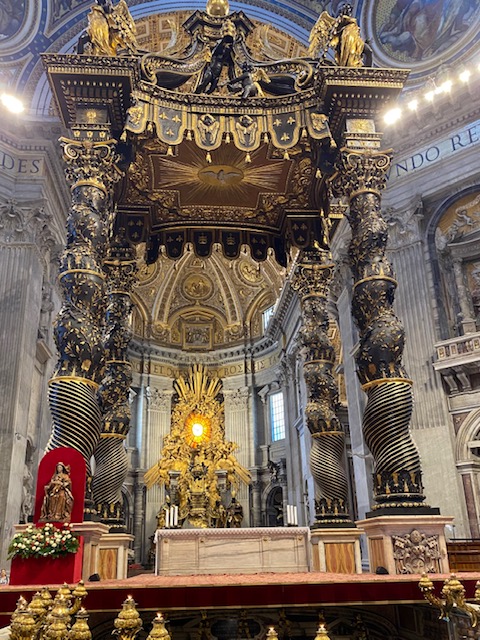
St. Peter’s Basilica altar baldacchino, by Bernini.
This was my second pilgrimage to Rome, the first being in 2019. Of course, when you go to Rome, you have to visit the major cathedrals and basilicas in and around the Vatican. We visited St. Peter’s, St. Mary Major, St. John Lateran, and St. Paul Outside the Walls, all marvelous examples of renaissance architecture and elaborate baroque sculpture and art. It truly is beautiful beyond words! However, this year, it was astoundingly beautiful because it is a jubilee year and a boat load of money was spent cleaning and polishing everything. The skill of the artists, sculptors, and craftsmen, men like Michelangelo, Raphael, Bernini, and so many others, is purely mind blowing!
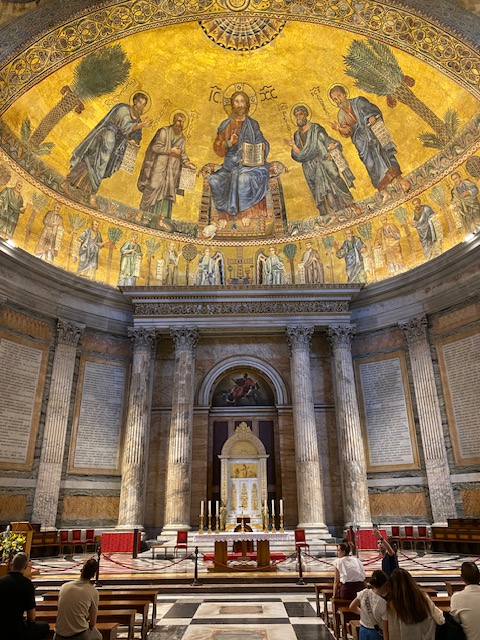
Domed apse of St. Paul Outside the Walls
It is beautiful, no doubt, but unless you make notes in a journal, It’s almost impossible to remember where a photograph was taken. And after three or four days of gawking at the grandeur, it all started to run together. I began to wonder why I was there, what was God’s plan for me? Was it just to be impressed with the beauty? No, there had to be more. The underlying purpose of our pilgrimage was to go deeper in our faith so that we would be inspired to encourage people in our parishes to better evangelize. Unfortunately, I wasn’t feeling any special inspiration. So, each day I prayed for an answer to my question, “Why am I here?”
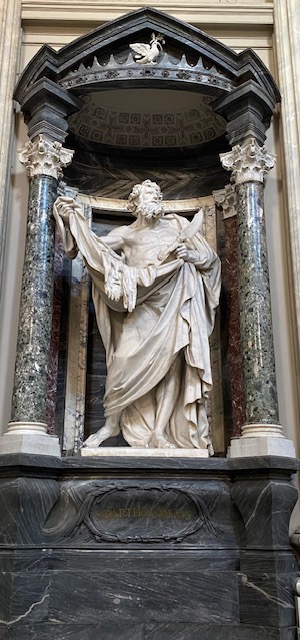
St. Bartholomew holding a knife representing his martyrdom by being filleted alive, at St. John Lateran
One morning we visited the catacombs of St. Calixtus, where, in the 2nd through 4th centuries, nearly a half million Christians were buried, a majority of whom were martyred for opting to profess rather than deny their faith. It was their courageous faith that convinced so many Roman pagans to convert even knowing that they might be the next to be executed. As we meandered through a small portion of the 20 kilometers of underground corridors that were lined with now vacant graves stacked eight to ten high, it was easy to imagine the persecutions they endured and all the hideous and creative ways they were tortured.
Catacombs of St. Calixtus
On our last day in Rome we ventured into the city center and visited several minor basilicas within a couple block radius of Piazza Navona, an oval plaza that was once a center for Roman foot and chariot races, as well as for putting Christians to death. On the piazza sits the minor basilica of St. Agnes, a smaller church but still beautifully adorned with magnificent paintings and sculptures, but specifically of martyrs.
Altarpiece of St. Agnes in flames, by Ercole Ferrara, 1660.
The church is dedicated to St. Agnes, the 3rd century 12-year old virgin who refused to abandon her faith and succumb to the advances of prominent Roman men. She was martyred by beheading after attempts to burn her at the stake were unsuccessful. Also honored are St. Emerenziana, Agnes’ sister who was stoned to death for opposing the pagans who were trying to prevent Agnes’ body from being buried; St. Sebastian, a converted Roman soldier who was martyred by being shot through with arrows but not killed, and then thrown into the sewers where he died; and St. Cecilia, a young girl who was discovered to be a Christian and was beheaded.
Altarpiece of St. Sebastian, by Pietro Paolo Fields, 1719
There, before the statues and relics of St. Agnes and these other martyred saints, with tears running down my cheeks, my prayer was answered. With unbelievable awe and respect for these martyred faithful men, women, and children, the Holy Spirit convinced me that I was there to fully comprehend what it means to not be afraid to profess one’s faith, so that I could help others to not be afraid.
There, in the moment, I was struck by the relative comparison between these martyrs who risked and sacrificed their lives, and the average Catholic in our world today. How many Catholics refrain from saying grace before dinner at a restaurant because of what other people might think? Too many. How many will not say “God bless you!” to a stranger and mean it because they’re afraid of confrontation? Again, too many. How many are afraid of being questioned about their faith because they know they haven’t done what they should do to be properly catechized? Way too many. How many are willing to risk asking someone who is obviously hurting if they can pray for them? Not too many, but too few. I don’t mean to judge, but generally speaking, we are weak in our faith. So many have forgotten, if they ever actually knew, what it means to be Christian. Jesus said,
“Blessed are they who are persecuted for the sake of righteousness, for theirs is the kingdom of heaven. Blessed are you when they insult you and persecute you and utter every kind of evil against you [falsely] because of me. Rejoice and be glad, for your reward will be great in heaven.” (Mt 5:10-12)
Those early Christians – St. Agnes, St. Cecilia, St. Sebastian, St. Emerenziana, and all the martyrs in the catacombs of St. Calixtus – died with hope, hope in the glory of heaven. They understood it so well that they embraced the prospect of being persecuted and put to death by torturing far worse than a disapproving glance from the diners at the next table over.
Sadly, I get it. Been there, done that, and got the t-shirt. But thankfully it doesn’t fit me any more because I’ve learned it’s not hard to overcome that fear. In fact, the mere chance that I might cause another to ask me about my faith far outweighs the risk. So, just start. Start small and go from there. If someone sneers at you for thanking God for the food you are about to receive, just smile at them and thank the Lord for them, too. Trust in the Lord to be with you, and pray that you might be the one to inspire someone else to turn to Jesus.
Remember His words, “Do not fear!” And resolve to ask yourself every now and then, “Am I just an average Catholic?”, for, if you are to fear anything, it is just that.
“Loving Father, thank You for the gift of faith and for the fortitude to protect and defend that gift. Nevertheless, You and I know that I need constant strengthening. May I receive that grace every time I receive You in the Holy Eucharist, remembering the sacrifice You made for me. I ask You Lord, and all the holy martyrs in heaven, to help me and all Your faithful to demonstrate our faith with courage and zeal. Amen.”
“Are You an Average Catholic?”was first published on the blog Reflections of a Lay Catholic)
In yesterday’s gospel, Mt 10:1-7, Jesus sent his apostles on mission to announce that the kingdom of heaven is near. He specifically told them to go to the lost sheep of the house of Israel rather than to pagan territory and Samaritan towns. This is in contrast to his instructions in Mt 28:19 when, after his resurrection, he commands them to “Go, therefore, and make disciples of all nations…”. In both cases, Jesus is telling them, and us, to evangelize. But why the difference?
It seems as though Jesus is giving the twelve a chance to practice evangelizing to those, who, unlike the pagans, already knew the teachings of the law of Moses and the prophets and would be more receptive to their message. He knew that taking the Word to all nations would be much more difficult. They needed to start slow and hone their skills along the way.
There is a message here for all of us, too, who, through our baptism, are also obligated to be evangelists on mission. We need to continuously increase our knowledge and understanding of our faith, and become more skillful at professing it, before we can expect to be proficient at making disciples of all nations. We need to begin with baby steps.
The best way to do this is to spend time with our friends in conversation about our faith, discussing the message of the gospel and what it is saying to us. I’m sure the apostles spent time together out of earshot from Jesus discussing all that they were learning, and sharing what it meant to them. By sharing our thoughts and insights in small faith sharing groups, or faith-based conversations over a meal with friends, we strengthen our faith and grow in virtue, and are better prepared to articulate to others His message of salvation.
I’m sure your parish offers opportunities to gather with other men and women in small faith-sharing groups and Bible studies at which you can safely share what it is that you hear God saying to you, and listen to and learn from others about the graces they receive through prayer and service. But, you don’t have to depend on your parish to organize groups or meetings. You can simply start from scratch by inviting friends to your house for a meal, spend a relaxing Sunday afternoon getting to know each other better, and interjecting faith based conversation into the experience. Do this enough and it will become second nature. Whether you realize it or not, you will be evangelizing each other. And, you will eliminate the fear that accompanies the prospect of evangelizing to people you don’t know.
“Lord Jesus, thank You for giving me insight into how to become a more effective evangelist, and for Your patience while I learn. You know I can’t go from zero to sixty in three seconds, but need space and time to accelerate slowly. You gave Your Apostles three years and even then they hesitated. I pray for the grace to grab hold of the opportunities to evangelize when You place them before me. Amen.”
(Practice Makes Perfect was first published on the blog Reflections of a Lay Catholic)
The Catholic Church’s liturgical seasons fall more or less the same time every year. Advent in December, and Christmas the last week of December through the middle of January. Lent usually starts in late February and runs into April. The 50 days of Easter takes us into late May or early June. Then, we also have months with special devotions: May to the Blessed Virgin Mary, October to the Rosary, and November to the Saints and the souls in purgatory.
In the U.S., every month is also set aside to promote awareness to various other worthy causes, e.g., Human Trafficking Awareness Month in January, and Suicide Prevention Month in September. Some months celebrate less serious interests such as National Ice Cream Month in July, and Zombie Awareness month in May.
The month of May is also devoted to Mental Health Awareness. Yesterday, as in each Sunday Mass this month, one of the petitions mentioned was for all those suffering from mental health issues. Certainly, this is something we should all pray for. Our collective prayers are a type of spiritual social outreach. But it occurred to me there is a petition that I’ve never heard mentioned at my parish church or any other church I’ve ever been to in all my travels – a petition for the faithful to evangelize.
Evangelization is the central mission of the Church. The proclamation of the Gospel – the saving message of who Jesus is and what He has done for us – is a responsibility we all have by virtue of our baptism and confirmation. Unfortunately, there are so few who actually take that responsibility seriously. If we believe our prayers will be heard for those with mental health issues, or for any special interest, then shouldn’t we believe that our prayers for the faithful to muster up the courage to evangelize will be efficacious, as well? A simple petition such as, “For all the faithful, that they evangelize by proclaiming the Gospel, let us pray…” will at least remind everyone of their role. Or, we can get bold, and amp it up a notch with, “For each and every baptized Catholic to honor their responsibility by evangelizing at least one person this month and bring them to Jesus, or deeper in their relationship with Him, let us pray…”
If we want to follow and obey our Lord, we have to spread the Good News. Every month of the year should be Catholic Evangelization Month! It is that important, not only for the salvation of the souls of those being evangelized, but our own, as well.
“Good and gracious Lord, thank You for loving me. Please help me and each and every one of the baptized faithful bring others to know Your amazing love, also. Help us to realize the grace of Fortitude that was bestowed upon us by the Holy Spirit at our Confirmations so that we may be effective evangelizers. Amen.”
(What Month Is It, Anyway?was first published on the blog Reflections of a Lay Catholic)
As I’m writing this, our parish school’s 8th grade class is having its graduation ceremony. I’m sure our gym is filled with proud parents hardly believing their “baby” boys and girls will soon be high school freshmen; and those same sons and daughters, while also proud and excited, may be having some separation anxiety knowing that they and their friends will disperse to either our public high school or one of four or five nearby Catholic high schools.
This has been a big year for these youths. Tonight’s graduation is only two months after they received the Sacrament of Confirmation. Unfortunately, many of them will consider their Confirmation to be synonymous with their “Catholic graduation”. Now that they’re confirmed, they see no need for any additional catechesis, scripture study, or even prayer. Many will begin to exhibit the onset of spiritual atrophy, and in four years, when they go on to college, many will cease practicing their faith.
Yesterday I attended a conference on evangelization at a nearby Catholic church which also has a school. During a break I ventured into the hallway outside the meeting room and saw that school’s trophy case. There were years of trophies representing championships and tournament wins for volleyball, basketball, soccer and other sports. There were photographs, autographed volleyballs, and plaques with player’s names. And as I admired this memorabilia, I wondered how many of those student athletes still practice their faith. I thought, “Wouldn’t it be nice if a school had a trophy case that celebrated the graduates who continued to practice their faith in the years to come? Perhaps they could display bronze medals or plaques for those who continued to be faithful for five years on, silver for ten years, and gold for twenty-five years.”
I was quick to tell myself, though, that the attrition in the faithful is not completely the fault of our Catholic schools or youth faith formation catechists. Sure, some could be better. They probably can improve at helping students build a loving and meaningful relationship with Jesus, a faith foundation upon which they will continue to build virtuous lives. But, of course, there are other factors, as well, such as the pressures of the predominant secular culture that easily leads youths and young adults down paths of vice.
And, then, there are the parents – what role have they played in instilling a strong faith in their children? While it’s not a parent’s job to get their kids to heaven, it is their job, and in their control, to give their kids holy parents. Have they provided an attractive example of how an adult lives a life of holiness? Again, I checked myself so as to not put too much blame on the parents. Many have good intentions. The problem may not be with a lack of desire to lead their children deeper in faith, but that they can’t lead them past the point at where they are themselves.
I couldn’t help but see the hand of God in these thoughts. There I was at a conference on how to evangelize adults, and because of a simple trophy case, I became fully aware that none of this is the kids fault, rather it is an adult problem. Somewhere along the line we’ve lost the connection that the only way our children will develop and maintain a healthy life of faith is if us adults teach, guide, mentor and reinforce what that life looks like. The teachers, the youth catechists, and the parents are all adults, and while youth faith formation is important, it is secondary to adult faith formation. And to form adults who will form our youths, we need adult evangelists who will step forward and fill this void. We need catechists for OCIA, competent leaders for Bible studies, willing facilitators to participate in adult faith formation programs, and spiritual mentors who will guide other adults to living lives of deeper prayer that will help them grow in holiness.
I went back into the conference after the break with a renewed sense of determination. I know I don’t have all the answers, but as our parish’s Director of Evangelization, there is an onus that goes with wearing that hat, a responsibility to put into place ways to lead people into a deeper relationship with Jesus that will move them along the pathway from minimal maintenance to missionary discipleship.
“Heavenly Father, I give You thanks for your trust in me, that my participation will bear fruit for Your Kingdom. Inspire me, Lord, to evangelize other men and women to be Your disciples who will lead others closer to You. And I pray that You will put in the lives of our children who have fallen away from the faith someone who will inspire them and bring them home. Amen.”
Jesus and Nicodemus, Crijn Hendricksz Volmarijn, c. early 1600s
The Gospels for yesterday and today (Jn 3:1-15), put us in the scene with Jesus and the renowned Pharisee, Nicodemus, who came to Jesus under the cover of darkness to ask questions about his ministry. We are led to believe that Nicodemus must have seen or heard of Jesus’ healing miracles and wanted to learn more about him. We know that Nicodemus eventually converted to be a secret follower of Jesus, so we can surmise that his curiosity was genuine and not a ploy to trap Jesus.
The fact that he came to meet Jesus at night may also give us a clue about his intentions. A nighttime rendezvous would be less conspicuous. If he was genuinely interested about Jesus, he may have feared being observed by other Pharisees that could result in his condemnation and rejection. In his position, he would have accumulated wealth that supported a luxurious lifestyle, which would have been jeopardized if his clandestine meeting had been discovered.
When I placed myself in this scene, I pondered Nicodemus’ motive and his dilemma. He had to satisfy his curiosity for truth, but the answer could result in his ruin. His fear of the environment and exterior influences would ultimately cause him to lead a secret and unfulfilled life.
There are millions of Nicodemuses in our world today – men, women, and teens, who are searching for truth, who are curious about Christianity, and who would like to know more but, because of negative social influences, balk at publicly asking questions for fear of what others will think or what they might lose. They are hiding out there in our workplaces, our schools, and our neighborhoods. We should be looking and waiting for them with intentionality, ready to answer their questions and allay their fears.
When a modern day Nicodemus does muster the courage to step out and seek answers, he may simply want to learn more about Jesus, or he’s aware that there’s possibly a different set of beliefs and a better way to live than he’s ever experienced. His curiosity may manifest itself by privately asking questions to a Christian friend or acquaintance. When he does, he is giving us an opportunity to evangelize, and we need to respond utilizing good listening skills. His questions may be phrased in ways that hide their real intent, and we may have to look behind the words. We should not make stuff up, nor answer questions with excess theology. He needs simple answers, and if we don’t know an answer, we should say so and endeavor to find the answer for him. We should try to avoid vocabulary that is foreign to non-Catholics.
Like Nicodemus, his questions may appear antagonistic but probably aren’t meant to be so. Instead, they are likely due to his personal cynicism and relativism that has developed over years. He’s not ready to reveal that he’s on any kind of spiritual quest. He is curious but cautious, and still needs to feel safe and unthreatened when asking questions. We should respond in a friendly manner to increase the trust that has allowed him to ask questions in the first place.
Our gentle evangelizing should have an eye towards bringing this person from a a place of curiosity to being open to exploring the idea that God is a personal God rather than a concept, and that we can have a relationship with Him. We can introduce him to Jesus and the story of His passion, death, and resurrection in atonement for our sins. And we should be patient and pray for him, being grateful that, while he may not yet be making a commitment to spiritual or personal change, he no longer rejects the idea.
“Heavenly Father, I thank You for the virtue of fortitude given to me with my Confirmation that has prepared me to proclaim the saving message of salvation of Your Son, Jesus. May I ever be vigilant and prepared to welcome anyone who is curious about our Christian faith. I pray that Your Spirit affords me the grace to respond to them lovingly with humility and gentleness. Amen.”
(Curious Like Nicodemuswas first published on the blog Reflections of a Lay Catholic)
I attended our parish’s Mass of the Lord’s Supper tonight and, as always, it was especially beautiful and reverent. During the reading of the Gospel (Jn 13:1-15), I envisioned myself in the scene, sitting around the supper table with Jesus and the Apostles. Nobody seemed to notice a fourteenth person there. When Jesus washed the feet of his Apostles, I recalled the first time I had my feet washed by our priest as he performed the Mandatum Rite, and what a humbling experience that was for me.
Then during the Liturgy of the Eucharist, as our pastor held aloft the Body of Christ, my mind drifted. (I know that’s not supposed to happen, but it did). My thoughts turned to a disagreement my wife and I often have. We both like to read, and she frequently flips to the last chapter, spoiling the story by learning how it turns out. Me, well, you couldn’t pay me ten bucks to cheat. I delight in seeing the story unravel. I want to be surprised, and I certainly don’t want her to spoil the story for me by telling me how it ends before I’ve read the book.
And then it dawned on me that I was the only one sitting at that supper table who knew what was to come in just a few hours. I knew that Judas the Iscariot would soon leave to go bargain for his thirty pieces of silver in return for his betrayal of Jesus. I knew Jesus would soon be arrested and tried, and of the pain he would endure being tortured and crucified, and I knew our beloved teacher would die. I could see all these horrendous events.
But, I also knew the happy ending: that Jesus would be lifted up after three days, that His resurrected self would join and encourage His friends in the upper room, and that at Pentecost, He would ascend into heaven.
But I couldn’t tell any of this to the other twelve reclining at table there with me. And I wondered if, through some twist of time and it was even possible for me to tell them, would they be like me and not care to know how it all plays out, or would they be like my wife and want to know what the future held in store?
I’ve been mulling this conundrum for the last couple hours. I’ve decided this is one case in which I’m glad I know the story has a happy ending. It gives me hope, takes away my fears, and makes me want to give a spoiler alert to the whole world!
How about you? Won’t you join me?
“My dear Jesus, You know and I know what You’re about to experience. At every Mass, I am filled with both tears of joy and sadness as I reflect on Your Passion. I know You gave it all for me…sinful me. I am so deeply grateful for Your love. Thank you! Amen.”
(The Lord’s Supper, was first published on the blog Reflections of a Lay Catholic)
From 1968 to 1971 I spent my junior high and first year of high school in English grammar schools in the U.K. My typical weekly class schedule was a far cry from what I’d received in American grade schools. It included: math, biology, chemistry, physics (not just one but all three), history, geography (not social studies), English, and one or more foreign languages. I took French all three years, plus German as an 8th grader, and Latin in the 9th grade. Unfortunately, none of it stuck with me. One thing I do remember clearly, though, is conjugating verbs – first, second, and third person singular and plural, in past, present and future tenses. In any language, we always began with the verb “To Be”, i.e., “I am” (first person singular present tense); “You were” (second person singular/plural past tense); and “They will” (third person plural future tense).
I recalled this today while meditating on today’s Gospel from John 8:51-59, in which Jesus had an altercation with a group of Jews over the identity of their fathers: God as the Father of Jesus, and Abraham as the father of the Jews. Jesus states, “Amen, amen, I say to you, before Abraham came to be, I AM.”, effectively claiming that He was equal to God, (see Ex 3:14-15). Because this was blasphemous to the Jews, they attempted to stone Him to death.
“I AM” – the first person singular present tense of the verb “To Be”. Jesus speaks about Himself. If we were talking to Jesus, we would say, “YOU ARE”. If we were talking about Jesus to someone else, we would say, “HE IS”. Jesus doesn’t say, “I WAS”, or “I WILL BE”, in the past or future tenses, and we can’t say about Him, “HE WAS”, or, “HE WILL BE”. Jesus is simply, “I AM” day after day, moment after moment, with every tick of the second hand. HE IS now, and HE IS again in the next moment.
We can’t think that Jesus was with us once, or that He will be with us one day to come. No, He is with us only NOW, at this present moment, and every present moment to come. He is there with us in every present moment regardless if the circumstances of that moment are to our liking or not.
Don’t we often forget this, especially when times are tough? When remembering events from the past that caused you grief, don’t you sometimes wonder, “Why was He not there when I needed Him?” But, we forget that HE IS there, and if we had remembered this, we would have found comfort in His presence. When we unite our crosses with His cross, He helps us carry ours.
Or, consider some dream you have of the future and how you will pat yourself on the back for thinking, “Wow, look what I accomplished!” We forget that HE IS with us then, too, and that it is only through His grace that we will find that joy and satisfaction we now imagine.
Whether it’s in good times or bad, when we lose the feeling of closeness with Jesus, we open a doorway allowing the Enemy to lead us down the wrong path.
How do we keep in mind that Jesus is with us at every moment, ready to answer our call? The first and best way is through prayer. Developing a habit of daily prayer keeps Him close to us. Prayers of praise, thanksgiving, and asking for His intercession are all ways to acknowledge His presence. More effective yet is meditative prayer, when we take time to sit in silence and solitude, lovingly conversing with Him, telling Him what’s on our minds and hearts, and listening for His loving reassurance. In this way, we readily remember all the times we’ve felt His presence, and reinforce our trust in Him in the present moment.
Reading scripture, especially the Gospels, before entering into prayerful meditation is an excellent way to relate to Jesus and His love for us. During this time of closeness, we receive the graces and mercy we need to persevere through our anxieties. And when we act on these promptings of grace by adopting a resolution to change or accept our situation, we again grow in trust with Him.
When we receive the Sacraments of the Eucharist and Reconciliation, we immediately feel His presence. The Eucharist gives us supernatural strength to combat sin in our lives. But then, when we fall and regret our actions, we can turn back to Him in the Sacrament of Reconciliation, be restored and experience His merciful love.
Remembering that our Lord works in us through our interpersonal relationships helps us feel His presence, also. A network of faithful friends accompanying each other provides a source of encouragement and support when times get tough. It can keep us grounded, reminding us to be grateful to God.
“Dear Jesus, I know deep in my heart that You are always by my side. My faith can get clouded when the world challenges me, and even when everything is going my way. Help me, Lord, to remember You, to meet You each and every day through prayer and frequent reception of the Sacraments. I love You, Jesus, and I know You love me. Amen.”
(I AM was first published on the blog Reflections of a Lay Catholic)
Calming the Storm, Simon de Vlieger, 1637, (Wikimedia Commons/Art Collection of Univ. of Gottingen)
It’s been almost thirteen years since my conversion experience that brought me to Christianity, that instant when I knew for certain there is a God, that Jesus is real, and the Holy Spirit filled me with more love than I’d ever known. And, last month was the tenth anniversary of what I consider to be my second conversion experience, the event when I learned to trust in God’s mercy and providence, and which I recorded in Put Your Faith Where Your Prayer Is.
My daughter had just given birth to my first grandson, Jack. He appeared to be a healthy newborn but the day after he came home from the hospital we thought we’d lost him. My wife was holding him and he quit breathing. I truly believe his guardian angel was watching over him because, just hours before, my wife’s sister, a nurse, and her husband, a doctor, stopped by to visit as they were traveling across the country. They had the knowledge and expertise to revive Jack until the EMTs arrived. Jack spent the next two weeks in the NICU experiencing multiple epileptic seizures per day.
To say the least, I was consumed with fear for Jack and for the emotional health of my daughter and son-in-law. Upon learning the news, I began praying continuously, including praying many Rosaries, imploring our Blessed Mother to intercede and make Jack well. In the midst of my fear, there came a moment when I finally knew there was nothing I could personally do to help heal Jack, and that it was all in God’s hands. I uttered the words, “Jesus, I trust in You!”, and I immediately broke into uncontrolled sobbing, crying tears of joy because in that instant I knew in my heart that Jack would be made well. Two weeks later he came home from the hospital and for ten years did not have another seizure. That is until this last Wednesday.
Wednesday evening, Jack was at basketball practice and went into convulsions. Again, his guardian angel was watching over him because the father of a team mate, an emergency pediatric doctor, was present and he took control until the EMTs arrived. Once again, I fell into a state of fear for Jack and for my daughter, and began praying unceasingly.
Mid-day Thursday, with Jack still on my heart, I needed to prepare for a men’s group meeting that night. Our group reflects on and discusses the following Sunday’s Gospel, so I opened my Bible to the passage upon which our group leader instructed us to meditate. However, through some error, the passage was not tomorrow’s Gospel reading, but, instead, today’s, Mark 4:35-41, the account of Jesus calming the storm at sea and alleviating the terrifying fear of his disciples. As I read it and came to verse 40, I knew the error was no coincidence: “Why are you terrified? Do you not yet have faith?”. I heard Jesus say to me, “Son, have you forgotten I was there for Jack, his parents, and you ten years ago? With faith you gave it up and trusted in Me then, trust again in Me now.” Once again, my eyes sprung a serious leak and I knew I had nothing to worry about, that Jack was in good hands.
Today’s first reading is from Hebrews 11:1-2. The author reminds us that, “Faith is the realization of what is hoped for and evidence of things not seen.” Through faith, I realized for a wonderful ten years that for which I hoped. And through that experience, I received evidence that Jesus’ saving grace will make all things well again.
“Dear God, I wish Your method of grabbing my attention and drawing me closer to You through faith wasn’t quite so extreme! But, Your ways are not my ways. Once again, I thank You for this experience, for reminding me of Your love, and reinforcing my faith and trust in Your Son, Jesus. I may think He’s asleep in my boat in the middle of the storms in my life, but He is always with me. Help me to recognize that moments like this are opportunities for faith to be the ballast in my boat when the storms of life rage. I know You will make all things well, even better than they were. I thank You in advance. Amen.”
(Fear and Faith, was first published on the blog Reflections of a Lay Catholic)
In today’s Gospel, Mark 6:34-44, we read St. Mark’s account of Jesus feeding the five thousand. Jesus’ heart is moved with pity for the crowd of “lost sheep”, all those who are following Him, and His disciples are concerned about them going hungry. The disciples ask Jesus to dismiss the people so they can find food for themselves. Jesus responds by saying, “Give them some food yourselves”, which, of course, they see no way of doing with only five loaves and two fish between them.
In this passage we read about one of our Lord’s greatest miracles as he feeds thousands of people with so little food. We get a sense of the extent of His pity, His compassion for all people. Jesus knows they are hungry, that they need food. But, He also knows they are hungry for spiritual nourishment, hungry for truth and hope, and hungry to be recognized as people with dignity and value – things they’re not getting from the Romans and their own religious leaders.
Normally when I read the accounts of feeding the five thousand (or the four thousand in Mt 15), my thoughts go directly to what I can do to reach out and show love and compassion of my own to those who are suffering in some physical or emotional way, whether that is my wife, a child, a friend, or a co-worker. Nearly everyone struggles with life in some regard, and empathic compassion can bring comfort. Occasionally, though, I’m driven by feelings of remorse for being distant and realizing I haven’t loved as I should, or that I’ve ignored someone and haven’t made them feel valued.
It’s easy to place ourselves into the scene of this Gospel as one of Jesus’ disciples and wonder what we can do to better love someone else. But, we too often forget that, like everyone else, we also suffer in many ways. We fail to see ourselves as one of the five thousand and, while putting others ahead of ourselves is a good thing, we also need some love and compassion from time to time.
In the first reading for today, 1 Jn 4:7-10, St. John reminds us that “God is love”, and, “He [God] loved us and sent His only Son as expiation for our sins.” God loves me and He loves you. He has loved us for all of eternity. He loves us for who we are despite our sins. He loves us the same no matter how different we are from each other because He made us in His image. He wants nothing more than for us to be happy, and the happiest we can be is to be united to Him. He loves us in our relationships with other people, in the tiny blessings He sends and for which we are too often ungrateful. He loves us so much that He continues to give Himself to us in the Holy Eucharist! His love surrounds us each and every moment of every day but we are too busy with life to realize it. Consequently, it can be too easy to forget to put ourselves in His presence and actively receive His love.
So, today my post-meditation resolution was not to be intentional about finding a way to love someone else as they deserve to be loved. No, today I resolved to simply spend time loving Jesus and letting Him love me. My Holy hour of Adoration was at 4:00 p.m., and for an entire hour I gazed at Jesus in the tabernacle and let Him cast His loving gaze on me. I shared with Him what was on my heart, what I am struggling with, my concerns and desires. And then I let him console me with His love. It was a beautiful thing!
I’m sure you make time to love other people in some way. And, I’m sure you make time to express your love for Jesus in some way, either through personal prayer or time in Adoration. But do you ever intentionally make time to let Jesus love you, and all that is expected of you is to soak it up? If not, give it a try! You won’t regret it.
“Lord Jesus, You showed the extent of Your love for me by offering Yourself upon the cross to redeem me of my sins. You love me enough to supernaturally give me Yourself in the Holy Eucharist. Lord, You know that in my heart I love You. But help me to more frequently acknowledge Your love for me by spending time with You, by placing myself in Your presence, and letting You love me. Amen.”
(Let Jesus Love You!, was first published on the blog Reflections of a Lay Catholic)