In today’s first scripture passage we read about King Saul who, because of his jealousy and wounded pride, planned to kill David because David received more accolades for victory in battle than he did. Saul’s son, Jonathan, out of love for his friend, David, and, I believe, having a heart for the sanctity of innocent life, stood up and spoke to his father, intervening and discouraging him from taking David’s life. Through sensible and peaceful conversation, he prevented an evil and senseless murder.
As I read this in preparation for mass this morning, I thought about all the “Jonathans” who are traveling to Washington D.C. today to peacefully participate in tomorrow’s March for Life. And I prayed that, through the grace of God, their peaceful march on behalf of the most innocent and vulnerable will change the hearts of those who seek to senselessly destroy a human life for their own self-satisfaction.
Heavenly Father, I pray for the safety of all my friends and the hundreds of thousands of others who will be marching for the preservation and sanctity of life tomorrow in our nation’s capitol. May they feel in their hearts the prayers of all the faithful who cannot be there with them. By lifting our prayers up to You, Lord, may their strength and conviction be the agent needed to sensibly and peacefully change hearts to do Your will. And, may those who are touched and converted by Your disciples feel Your immense and merciful love. Amen. + Blessed Holy Mary of the Immaculate Conception, Patron Saint of the United States, pray for us. Amen.
(Praise and Prayer for the Pilgrims on the 2020 March for Life was first published on the blog Reflections of a Lay Catholic)
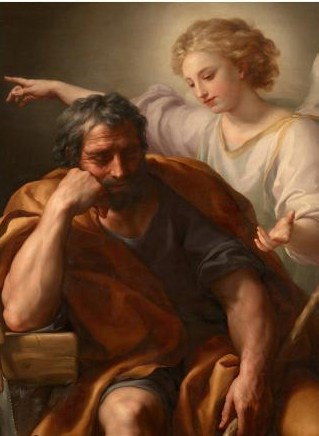
The Dream of St. Joseph, by Anton Raphael Mengs, 1774
Today’s Gospel is from Matthew 1:18-25, the story leading up to the birth of Jesus. Every year I am reminded about St. Joseph and what may have been going through his heart and mind when he learned that his betrothed was carrying a child that wasn’t his. My reminder is Jason Gray’s song, Forgiveness is a Miracle (A Song for Joseph) from his 2012 album Christmas Stories: Repeat the Sounding Joy, which I dig out of my CD case every year at the beginning of Advent.
Note: Much of this post is excerpted from the original, A Man of Mercy, from 5 December 2013. I am posting it here under a different title because since then we have garnered many new followers who may not have seen that post. Whether this is your first time to read this or your second, my hope is that it encourages you to find a way to grow in love and mercy, and in preparing your heart to be offered as a gift to our Lord on His birthday.
For me, I continue to be struck with each listening by the profound example that Gray paints for us of the mercy extended by Joseph to Mary. He gives us some insight into the divine wisdom of God. Both the Gospel and the song help me to remember God’s will for me every day is always about love.
As I delved into the song, I discovered that Gray had written an article for The Rabbit Room describing the story behind the song and he explores this difficult situation in which Joseph found himself. I have re-posted his article below and included a link to The Rabbit Room’s website. I hope you find it as thought provoking as I did.
As I approached writing songs for each of the characters in the Christmas story, I felt particularly protective of Joseph, who I think sometimes doesn’t get the attention he’s due. At the very least I know that I’ve been guilty of not really “seeing” him for the remarkable man that he was, and I wanted to amend that. I enlisted my friend Andy Gullahorn, one of the most masterful storytellers I know, to explore a particular moment in Joseph’s story with me.
Taking my cue from Frederick Buechner’s book, “Peculiar Treasures,” in which he breathes new life into biblical characters who have grown so familiar to us that we no longer experience them as real human beings, I hoped to recapture some of the humanity of the people in the Christmas narrative. It was also important to me to try and write songs that were relevant beyond the four weeks between Thanksgiving and Christmas day. I wanted to tell timeless human stories, and with Joseph we have the makings of just that with a love triangle, a question of revenge or forgiveness, and the age old drama of fathers and sons.
As I read his part in the narrative, I found that more than just a foster parent without much to do (as he was often relegated to in my mind), Joseph is revealed as a man after God’s own heart. Faced not only with the news that his fiancée is pregnant, but also with her incredulous story of how it was God’s doing, Joseph’s character is tested and laid out for all of us to see. What will he do? Will he hurt the one who has hurt him? Will he forgive? This is his moment, and all of history waits and watches in wonder.
There are few things more painful than the betrayal and rejection by the one you love most, so we know it must have deeply wounded him—shattering the dreams he may have had of a future with the girl he loved. Pain is like a lightning bolt striking with a violent energy that can’t be held in the human heart for long. It looks for a way out. The way it usually passes through us is in the all too common progression of hurt turning into anger and then into vengeance. Unless the miracle of forgiveness takes place in a person’s heart to absorb it, the pain we experience will pass through us and be visited upon others.
There is debate as to whether it was within Joseph’s power to have her stoned—while Jewish custom might have allowed it, Roman rule did not. However, if not to her body, we know he still could have done violence to her reputation and her heart. But I believe that Joseph did the hard work of bringing his pain to God rather than letting it pass through him, and that God graced him with the miracle of forgiveness. The narrative tells us he was a “godly man” and that instead of doing her harm, “he decided to dismiss her quietly” so that she wouldn’t be publicly shamed. He took the full force of the blow and–acting as the husband he might have been–became a covering over her supposed sin.
It’s hard for us to experience the tension in Joseph’s story since, as the reader, we know from the start that she isn’t guilty of what he naturally supposes and that God is up to something beautiful that the world has never seen before. But to see Joseph for who he is, I have to remember that he couldn’t know these things in real time. It was only after he had given himself to the work of forgiveness that the angel appeared to him in a dream to tell him that what Mary had said was true after all, and that he should marry her.
It occurred to me that perhaps this is where Joseph’s heart was proven—if not to God who already knew his heart, then perhaps to himself. (I haven’t met a man yet who isn’t daunted by the responsibility of being a father, let alone a father to the Son of God. Maybe this was a test to reveal to Joseph what kind of man he could be.) In this moment he is found to be a man of mercy, which I imagine to be just the kind of man that God was looking for to be the earthly father of his son Jesus. In a way, we see that Joseph carries in his heart the same world changing power of forgiveness that Mary carried in her womb.
It’s also meaningful to me to think of how Joseph forgiving Mary is part of the story that leads to the birth of the savior in whom Joseph would find forgiveness for his own sins. Perhaps it’s the narrative form of Jesus’ teaching that as we forgive we find ourselves forgiven.
As we wrote the song, it was good to be reminded that forgiveness is a kind of miracle. I could be wrong, but I’m not sure that we can muster up forgiveness on our own. It seems to me to be a supernatural force of renewal that we participate in as we point our hearts toward it, pray for it, and make room for it in our lives, but that ultimately we receive it as a gift from God, in his due time.
Love can make a soul come alive Love can draw a dream out of the darkness And blow every door open wide But love can leave you broken hearted
Did she dare to look you in the eye Did her betrayal leave you raging? Did you let her see you cry When she said the child was not your baby?
Pain can turn to anger then to vengeance It happens time and again Even in the best of men It takes a miracle to save us
When love is like an open wound There’s no way to stop the bleeding Did you lose sleep over what to do? Between what’s just and what brings healing
Pain can be a road to find compassion When we don’t understand, and bring a better end It takes a miracle to show us
Forgiveness is a miracle A miracle And a miracle can change your world Forgiveness is a miracle
An angel in a dream spoke into your darkest night So you trusted in the Lord and you took her as your wife But the forgiveness that you gave would be given back to you Because you carried in your heart what she was holding in her womb
Love was in a crowded barn There you were beside her kneeling You held it in your arms As the miracle started breathing
Forgiveness is the miracle The miracle And a miracle will change your world Forgiveness is the miracle Forgiveness is the miracle The miracle A miracle will save the world Forgiveness is the miracle Forgiveness is the miracle Forgiveness is the miracle
Blessed Joseph Your heart is proven And through you the Kingdom has come For God delights in a man of mercy And has found an earthly father for his son
(St. Joseph:A Man of Mercy was first published on the blog Reflections of a Lay Catholic)
The Four Cardinal Virtues – The Strasbourg Cathedral, 13th Century
Several years ago, say around 1994, my daughter, Lisa, who was seven or eight years old at the time, did something she shouldn’t have done (today, I don’t even remember what it was) and I caught her at it. When confronted, she lied to me to try to keep from getting in trouble. So, to teach her a lesson about honesty, I had her read a story from William J. Bennett’s book, The Book of Virtues, and then write me a letter telling me what she learned and why it was important not to lie.
The story I had her read was, Matilda Who Told Lies, and Was Burned to Death by British writer, historian, and Catholic, Hilaire Belloc, which is sort of a “Boy Who Cried Wolf” kind of tale. The title sounds harsh but the story is actually more tame. Young Matilda had, it seemed, a tendency to lie and once telephoned the fire department claiming her house was on fire. The firemen responded and began to douse the house until Matilda’s aunt convinced them the house was not on fire. Then, one night just a few weeks later, while Matilda’s aunt was away….
“….a fire did break out – You should have heard Matilda shout! You should have heard her scream and bawl, And throw the window up and call To people passing in the street – (The rapidly increasing heat Encouraging her to obtain Their confidence) – but all in vain! For every time she shouted ‘Fire!’ They only answered ‘Little Liar!’ And, therefore, when her aunt returned Matilda, and the house, were burned.”
Lisa’s letter to me read:
“To Daddy, Well Daddy they could call you that [Little Liar] some day. And it tells me to always tell the truth and never tell a lie. Lisa”.
A few years later, her younger sister, Grace, was caught lying and was given the same punishment. Her letter read:
“To Mom and Dad, It’s important to be honest so you don’t get in trouble and so people will trust you. If you aren’t honest people won’t trust you on anything so you won’t get to do much. Grace”.
These memories came to my mind last Sunday when I listened to the second reading of the Mass:
“For whatever was written previously was written for our instruction, that by endurance and by the encouragement of the scriptures we might have hope. May the God of endurance and encouragement grant you to think in harmony with one another, in keeping with Christ Jesus,” (Rom 15:4-5)
Bill Bennett, compiled The Book of Virtues from stories, old and new, with the intention for them to collectively be an instruction manual for right living, to teach us how to be people of virtue, how to live a moral life that brings, as St. Paul says, “harmony with one another”.
But, Paul’s words tell us that there is another book, even better than Mr. Bennett’s, which has been around for over two thousand years, with stories that have been the basis for virtuous and harmonious living to entire civilizations: the Bible, God’s instruction book on how to get to heaven, and, conversely, in many cases, how not to get there.
To learn about the Cardinal Virtues one only has to read Proverbs, the stories of Solomon, or the book of Sirach to understand how to apply the virtue of Prudence; or to read the stories of David to learn about Justice, Temperance and Self-Control (see 1 Sam 24:1-23). In the Old Testament books of Judith and Esther, one can find classic examples of Fortitude.
In Exodus, Moses sets the example for Perseverance and Leadership as he leads the Israelites out of Egypt towards the Promised Land. And, Job’s experience can teach us much about Patience.
The Theological Virtues are exemplified in Genesis through the Faith of Abraham as he nearly sacrificed his son, Isaac; and the Love (Charity) and Compassion of Joseph as he forgave his brothers who sold him into slavery. And, Hope can be found on nearly every page of the Psalms.
Other examples of virtues like Responsibility, Wisdom, Hard Work, Friendship, Loyalty, and Honesty are strewn throughout the Old Testament, as are other magnificent examples of how to live in right relation to one another.
When Paul wrote, “whatever was written previously”, in his letter to the Romans, he was referring to all the books of the Old Testament. The New Testament had not yet been written, but the virtuous life of Jesus Christ was indeed being told, retold and shared throughout the known world by the Disciples who witnessed it up close and personally. And, as they, like Paul, came to realize, all that had been “written previously” simply prefigured and pointed to the life of Christ.
Jesus was the perfect man – because He was also God. Thus, He is the One Who we should look to and imitate when we want to live a virtuous life. There has never been, nor ever will be, anyone better from whom to learn about living in right and harmonious relationships.
In the predominantly secular culture of the world today, a world that has turned its back on Christian morality and is rife with hedonism, individualism, relativism, and materialism, is it any wonder there is so much hatred, turmoil and erosion of relationships among people? The ultimate casualty has been the loss of virtue.
I wish I could snap my fingers and people (myself, included) would suddenly know that earned labels such as “Little Liar”; that relationships broken due to lack of trust from those we love; and other selfish acts and vices, are behaviors that destroy us as individuals and as society. But, I know I can’t. It’s not that easy. It requires the difficult task of personally living and exhibiting the virtues in a way that others see the good. It means reading Scripture and desiring to imitate Christ. And, it requires prayer, a lot of prayer. Because, we can’t do it ourselves. Our concupiscence won’t let us. We can only live a completely virtuous life by the grace of God. Without Him, as can be seen in much of the world today, it is impossible.
With which vices do you struggle every day? What changes can you make to replace those vices with virtues and grow in holiness so that you can be an example for others?
“Heavenly Father, I pray for the grace to grow in virtue, to become a better disciple, husband, father, son, brother and friend. As I am faced with trials and temptations throughout my day, help me, Lord, to keep Christ, the One Who I desire to imitate, at the center of my life, Through Your grace, I pray I may be an example for others to follow. Amen.”
(Virtue: A Casualty of a Secular Culture was first published on the blog Reflections of a Lay Catholic)
A couple Mondays ago I drove home to Ohio from Kansas City. I left my daughter’s house a little before 6:00 a.m. hoping to make it out of town before morning rush hour traffic got too bad. I made it to Columbia, Missouri before stopping for gas and grabbing a bite to eat for breakfast. As I pulled through the fast-food drive-thru, I waffled on whether or not I ought to use my digital coupon, with which I could get a second breakfast sandwich for only one dollar more, or limit myself to just one sandwich. I knew I didn’t need two sandwiches but the deal was just too good to pass up. So, I bought both.
As I waited on traffic to pull out of the parking lot, I unwrapped the first sandwich and chowed down. I pulled out onto the street and drove about 100 feet to the left turn lane that would take me back to the interstate. I had to stop at this traffic light, and as I took my second big bite of that hot, juicy sausage, egg and cheese muffin, I saw a man standing on the island holding a sign that read, “Homeless and hungry. Please help.”
I looked over at the open bag in my passenger seat. I looked back at the man and our eyes met. I looked upwards to God, as if I could see through the roof of my truck, and gave Him a big smile. I rolled down my window and handed the sack and sandwich to the man. With a, “Thank you, Sir! God bless you!”, he sat down and immediately began wolfing down his breakfast as though he hadn’t eaten in a week. As I turned left onto the main road, I uttered, “Thank You, Lord!”, knowing that God had just turned my lack of discipline and temptation for indulgence into an opportunity to be generous and merciful.
I had forgotten about this little event until today when I sat down for my morning prayer. As I usually do, I looked to see who the saint of the day was and today happened to be the Memorial of St. Nicholas (yes, the original Santa Claus). St. Nick was known for his generosity to the poor and is considered the patron saint of poor people.
Then, as I read the scripture for the day, I saw how this all came together. In the first reading I read how the Lord will make the deaf hear, the blind see, the lowly find joy, and the poor “rejoice in the Holy One of Israel.” (Is 29:17-24).
Next, in the Psalm for the day I read, “I believe that I will see the Lord’s goodness in the land of the living.” (Ps 27:13).
And, finally, in the Gospel, I read about Jesus bringing sight to the two blind men after they proclaimed their faith in Him. (Mt 9:27-31).
All of these brought me back to that moment two Mondays ago and moved me to give thanks, again, to our Lord for all the goodness He brings to our lives, especially for His sacrifice on the Cross – that merciful act of love that redeemed us of our sins.
I thought about how, as Christians, we are all called to imitate Christ, and how bringing a little goodness to the world is a good place to start. We meet people all the time during the normal course of our day but we probably don’t have a clue as to how they may be struggling in their lives. Any one of the people with whom our paths cross during any given day could have said a prayer that day asking God for help, relief or healing.
And, I thought how God, in His infinite goodness, may just be putting me in that person’s life, even for a fleeting moment, to help in answering their prayer in some small way through an act of generosity, whether it be a corporal or spiritual work of mercy.
How can you imitate Christ today through your generosity?
“Lord Jesus, today, and always, I desire to sow the seeds of Your Word by being thankful for the opportunity to be Your instrument through whom Your mercy touches those in need. Amen.”
(God Uses Us to be Christ to Others was first published on the blog Reflections of a Lay Catholic)
Dear faithful readers, it’s been a long time since I’ve posted anything on Reflections of a Lay Catholic. This post is not a normal post, rather it’s very special.
Ever since the inception of this blog back in early 2013, the single most popular post was a reflection posted in April 2013 by my friend Rich Brewers entitled, How We Respond to Prayer Requests, (https://reflectionsofalaycatholic.com/2013/04/15/how-we-respond-to-prayer-request/ ) It has been hit thousands of times by readers from over 100 countries around the world. It is so gratifying to know that so many people are willing to take time to pray effectively for those in need.
This post is a call to all of you faithful for your prayers.
A young friend of mine, Seth, 19 years old, was involved in a tragic vehicle accident on Monday night. He was hit head on by another vehicle traveling the wrong way on a divided highway. Seth survived the accident but, unfortunately, the other driver lost his life. Seth is in the hospital undergoing surgeries for two broken legs (femurs), a broken right ankle, a shattered knee, a shattered elbow, a broken collar bone, and a broken sternum. He has a brain bleed and lacerations to his face. Undoubtedly, he has a long road to recovery.
Seth is a quiet young man with a big heart. He has been a member of our parish mission team for five straight years to serve the less fortunate in Appalachian Kentucky. In September, I was with him on a men’’s retreat and I watched his relationship with our Lord grow even stronger.
Many friends from our parish community are praying for Seth and his family – prayers for healing and support as they endure a new reality for the unforeseeable future. The family has also asked for prayers for the peaceful repose of the soul of the elderly man who lost his life and for his family.
My hope is that, via this post, I can extend these local prayers world wide, especially to all of those who have shown such interest in how to respond to prayer requests. So, I ask you, as a Spiritual Work of Mercy, to pray for Seth and his family, and for the deceased gentleman. And, if you will, ask others to pray, as well. You have permission to forward and/or repost this post to spread the word.
Thank you in advance for your prayers! May God bless you always!
Yours in Christ, Jerry Robinson
“Good and gracious God, please hear our prayers of healing for Seth and for peace and comfort for his family, and for the peaceful repose of the soul of the gentleman who lost his life last Monday night. Lord, thank you for all the faithful around the world who, through their generosity and charity, also offer up their prayers and sacrifices. Amen.”
(A Special Prayer Request was first published on the blog Reflections of a Lay Catholic)
Icon of the Prophet Haggai – Orthodox Church in America
(A meditation on Haggai 1:1-8)
In today’s scripture passage, the prophet admonishes the Israelites for being preoccupied about their personal lives and relegating God, and building His temple, to secondary importance. Their attitude was, “We’ll have time for that after taking care of our own problems.”
Haggai tells them, “Reflect on your experience”, suggesting that if they put God first their troubles may be lessened.
Ouch! Personal self-reflection tells me I’m often no different. How easy it is to get wrapped up in my own daily trials and push God to the side.
What’s keeping you from placing God first in your life today?
“Lord, each morning I offer you my prayers, works, joys and sufferings for all the intentions of Your Sacred Heart, for union with the Holy Sacrifice of the Mass, for reparation for my sins, for the intentions of my family and friends, and for the intentions of the Holy Father. Help me Lord, to consistently live each moment of the day, recognizing and accepting the nearness of Your presence, and look to you with each test and trial. Amen.”
(Reflect on Your Experience was first published on the blog Reflections of a Lay Catholic)
Parable of the Hidden Treasure – Rembrandt, c. 1630
(A reflection on Mt 13:44-46)
Jesus tells us that the Kingdom of Heaven is like a treasure buried in a field which, when found, brings us joy.
God reveals Himself to us through golden nuggets which He scatters throughout our lives. If we close our hearts to these blessings we will never see them. Instead, opening our hearts to His grace allows us to find and appreciate His love.
But, by actively digging for them through daily mental prayer, searching the Word of God for His will for me, I uncover the mother lode of joy-filled grace.
Uncover your treasure through daily mental prayer!
“Heavenly Father, thank You for the treasure of Your grace, and thank You for the desire to mine for it daily. Lord, I pray for all those who need to find a nugget of Your grace in their lives and, when once found, will themselves become devoted treasure hunters. Amen.”
(Treasure Hunting was first published on the blog Reflections of a Lay Catholic)
Moses receiving the tablets of the Law – Joao Zeferio da Costa, 1868
The Lord used to speak to Moses face to face, as a person speaks to a friend (Ex 33:11, NAB).
In today’s scripture, I imagined Moses in intimate conversation with God at the meeting tent outside the camp – their special place. There they hammered out a new covenant and made plans for Israel’s future.
I love my time spent with our Lord in daily mental prayer. But today, like every Tuesday afternoon, I met and adored Jesus in our special place – His Tabernacle in our church’s Blessed Sacrament chapel. There we have our intimate, friendly, face to face conversations. I share what’s on my heart and He shares what His will is for me.
He’s waiting there for you, too.
“Holy Spirit, thank You for opening my heart and mind to the will of God when I spend time with our Lord in prayer. Thank You, Jesus, for being a friend with Whom I can be open and share my most intimate thoughts and concerns. And, thank You for Your loving patience and mercy. Amen.”
(Face to Face was first published on the blog Reflections of a Lay Catholic)
Monday was the Memorial of the Blessed Virgin Mary, Mother of the Church. Before Monday morning, I didn’t know there was such a memorial. But, I didn’t feel too bad when I discovered that it had only been established in February 2018. By Vatican decree, its date will always be the Monday after Pentecost Sunday, emphasizing the connection between Pentecost as the “birthday” of the Church; and the role of Mary, through whom the Church was born.
I’ve meditated much about Mary over the last week. As I prayed the Sorrowful Mysteries of the Rosary last Friday, I found it, as always, impossible to imagine the pain Mary endured as she witnessed her son being tortured and crucified unto death. I wondered if she was in some way privy to the idea that Jesus, her son and God Incarnate, had to die and be resurrected to demonstrate God’s true love for us. If so, I wondered if it eased her suffering.
As I read the day’s Gospel (John 19:25-27), I imagined myself at the foot of the cross along with Mary and “the disciple whom Jesus loved”. Jesus, as His final act of love, entrusted His mother to that disciple. But, by not actually naming the disciple, Jesus entrusted His mother to all disciples, not just the Apostles, but to you and me and all the Church’s faithful. And, in His infinite wisdom and love for us, Jesus knew that we all would need the loving care of a mother – not just any mother, but His very own, the holiest of all mothers.
I’ve thought about the role Mary might have played in the days after her son’s crucifixion. She, and the other holy women, remained with the Apostles. Was she the glue that held them together as they struggled to process what had happened and what was yet to come? Did she bolster their strength and encourage them to be patient and persevere?
On Saturday, as we approached Pentecost, I was thinking about the Apostles gathered together with Mary in the upper room waiting for the Holy Spirit to come as Jesus promised. I’m sure they didn’t know what to expect. I doubt Mary knew what to expect, but I’m sure she knew it would be a profound moment when He did come. She would know. Because thirty three years earlier she welcomed the Holy Spirit and, with and through Him, she conceived and gave birth to the Son of God. Through Mary, the Holy Spirit brought Christ into the world. Through Mary, the Holy Spirit brought Christ to us, you and me. (CCC 723)
I believe Jesus knew what He was doing when He entrusted his mother to us. Because just as Mary, in union with the Holy Spirit, brought Christ to us, it is through Mary that the Holy Spirit begins to bring men, the objects of God’s merciful love, into communion with Christ. (CCC 725) Just as the Holy Spirit brought Christ to us through Mary, He brings us to Christ through Mary.
Just as our natural mothers gave their love as they cared for and nurtured us, Mary, our spiritual Mother, cares for and nurtures our souls by lovingly bringing us to her Son, Jesus.
I must admit that, as a convert, devotion to Mary has been a difficult concept for me to comprehend. The seed was planted with my baptism but there’s been a cloud of doubt that asked, “What’s so special about Mary when I can go straight to Jesus?” But, my time meditating this week on Mary has been like warm sunshine on a garden that has ripened the fruit to it’s fullness! Our Lord entrusted His mother to us so that she, united with the Holy Spirit, may bring us to Him!
That seed received a welcome watering last week when my wife and I attended a Robinson family reunion at the Lake of the Ozarks in Missouri from June 1st to the 5th. On Sunday, we attended mass in the nearby town of Laurie, Missouri at what I thought was St. Patrick’s Catholic Church. But, during the summer mass is held outdoors on property adjacent to St. Patrick’s at The National Shrine of Mary, Mother of the Church. (Coincidence? I think not.)
The shrine was set in the beautiful Ozark Mountains on a terraced hillside amidst tall oak and hickory trees. The altar was at the foot of the hill with a lake and fountain as the backdrop. The “center aisle”, where one might normally find a baptismal font, consisted of an elevated reflection pool beneath a tall, rotating statue of a woman, a mother, with outstretched arms and palms turned upwards to receive the Holy Spirit. The granite walls surrounding the reflection pool were engraved with the names of over 4,000 mothers, the mothers of those who donated the funds to create the shrine.
Nearby was a stone memorial upon which was engraved a passage from Joseph Cardinal Mindszenty, titled, Behold Thy Mother:
“The most important person on earth is a mother. She cannot claim the honor of having built Notre Dame Cathedral. She need not. She has built something more magnificent than any cathedral – a dwelling for an immortal soul, the tiny perfection of her baby’s body. The angels have not been blessed with such a grace. They cannot share in God’s creative miracle to bring new saints to heaven. Only a human mother can. Mothers are closer to God the Creator than any other creature; God joins forces with mothers in performing this act of creation. What on God’s good earth is more glorious than this: to be a mother?”
May God bless all our mothers as He has blessed His own, Mary, Mother of the Church.
“Heavenly Father, thank You for Mary, Your all-holy ever-virgin Mother, the masterwork of Your mission of Your Son and Spirit in the fullness of time. In Mary, You prepared a dwelling place in which Your Son and Spirit could dwell among us, Your beloved. (CCC 721). And, Lord, thank you for our natural mothers and their love for us. May they both always know our everlasting love. Amen.”
(Blessed Virgin Mary, Mother of the Church was first published on the blog Reflections of a Lay Catholic)
Kneeling in prayer before mass on Monday morning, I remembered, honored, and gave thanks for the men and women who made the ultimate sacrifice of their lives for the preservation of freedom and liberation from tyranny.
Opening my eyes, I gazed upon Jesus on the Crucifix, Who gave up His life for our sins. His ultimate sacrifice on the cross showed us the way to everlasting life and liberation from slavery to sin.
As He continues to give His life for us and to us in the Holy Eucharist in the Sacrifice of the Mass, every day is Memorial Day.
“Heavenly Father, may all those who have gone before us, who have offered their lives for the protection of our freedom and liberties, find their reward by Your side. May all of us whom they have served never forget their sacrifice. And, Lord, may I never cease to remember, honor, adore and glorify You and give You thanks for Your sacrifice to save me, a sinner. Amen.”
(Memorial Day was first published on the blog Reflections of a Lay Catholic)