• About
  • Books I’m Reading
  • Links

Reflections of a Lay Catholic

Reflections of a Lay Catholic

Category Archives: Scripture

Without Cost You Have Received; Without Cost You Are To Give

08 Friday Jul 2016

Posted by Jerry Robinson in Bible Reflections, Evangelization, Faith, Grace, Scripture

≈ 10 Comments

Tags

Faith, God-moments, Gospel of Matthew, Grace, Jesus sends the Apostles, Mt 10:1-15, Without Cost You Are To Give, Without Cost You Have Received

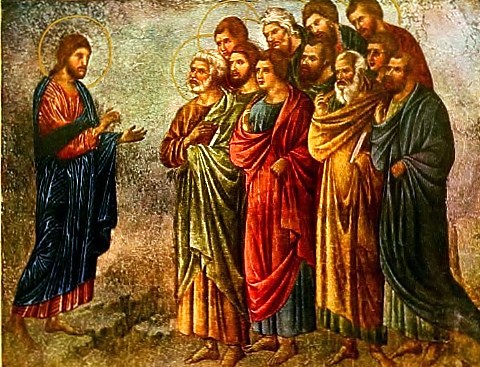
Jesus sends the Apostles c.1300 Duccio Di Buoninsegna

Jesus Sends the Apostles – Duccio di Buoninsegna, c.1300

1Jesus summoned His twelve disciples….and said: 7“As you go, make this proclamation: ‘The kingdom of heaven is at hand.’ 8Cure the sick, raise the dead, cleanse lepers, drive out demons. Without cost you have received; without cost you are to give….11Whatever town or village you enter, look for a worthy person in it, and stay there until you leave. 12As you enter a house, wish it peace. 13If the house is worthy, let your peace come upon it; if not, let your peace return to you.” (Mt 10:1, 7-13, NAB)

It’s been two and a half months since I’ve posted. I’d like to say my busy-ness has been a factor but, honestly, I haven’t felt inspired. I had three posts in four days back in April and then….nothing, not an idea, not a sign, nada. Looking back, I’m sure God spread many gems of Grace in my path but in my blindness all I saw was a gravel pit.

Fast forward to this week and suddenly I feel as though I’m drinking from a fire hose. It’s like a divine thirst quenching and God will only close the valve when He knows I am sated. Everywhere I look I see with acute clarity God working in my life: events, conversations, images, ideas, scripture, people I’ve met. I sense God telling me, “Son, I’m giving you a plethora of inspiration, now do something with it!”

But, where do I begin? I was pondering this question yesterday afternoon when I finally had a chance to read the last two day’s scripture passages. As I read the Gospel, Mt 10:1-15, it became clear where to start: heed Christ’s command to “Go”. Go and spread the Word. Jesus summoned me three years ago in my Confirmation and asked me then to share my faith with others, a directive I gladly accepted. And I have let Him down over the last 10 weeks.

I know that without cost, without asking, I have received God’s freely given Grace. My so-called “inspiration” is actually His gift to me. His expectation is for me to pass the gift along to others without cost.

Within the boundaries of my world, the sphere of influence in which I live, my opportunities to evangelize are few. This blog has been my way of spreading the Word. I know though, for the most part, that my reflections are mere preaching to the choir, that the audience I reach is already strongly Catholic.

My hope has always been that, through His Grace, my repackaging of His gift to me may reach a few who need just that little extra something to help them turn back to Him, a cure for their sickness so to speak; and occasionally reach one or two who will have a conversion experience, a driving out of demons if you will, because of a God-moment I’ve shared.

I admit I have, at times, allowed myself to become discouraged when it comes to posting and occasionally I have not posted because of it. I get few comments or feedback on my posts to tell me whether I’m connecting with my readers. I suspect that’s an indication of the quality of my content or of my writing style. But, I do the best I know how and I remind myself that I’m not in it for my ego. Thus, as I contemplated the Gospel passages above, I realized that I’m called to offer this gift with a wish of peace regardless if many choose to accept it or pass it along further. One or two is enough. And, if it’s not accepted, I need to move to the next house, or post, and let my peace return to me.

In going back to the question of, “where do I begin?” I hope to share with you several new reflections over the next few days. I hope they will cause you to reflect a moment on your own. I hope you will share them with me and others. And, I hope they bring you His peace.

God bless you all.

(Without Cost You Have Received; Without Cost You Are To Give was first published on the blog Reflections of a Lay Catholic)

©2016 Reflections of a Lay Catholic. Reposting and sharing of material in its full and original content is permitted, provided that full and clear credit is given to the author(s) and Reflections of a Lay Catholic.

Listen to Your Mother!

18 Monday Jan 2016

Posted by Jerry Robinson in Bible Reflections, Grace, Love, Mary, Scripture

≈ 2 Comments

Tags

Grace, Love, Mary, Prayer, Wedding Feast at Cana

Wedding Feast at Cana Large

Wedding Feast at Cana – Bartolome’ Esteban Murillo, circa 1675

How many of you remember hearing the words, “Listen to your mother!” from your dad or other adult when you were growing up? Most of you, I’m sure. They were words of sound advice based on experience. My mother, and the moms of the kids I hung around with, seemed to possess an uncanny sixth sense. They knew when we were about to do wrong or make a bone-head mistake that would cost us down the road. It hurt to heed that advice but we usually knew it was in our best interest.

We know very little about the early life of Jesus Christ, those years before He began His public ministry. We know He probably gave His mother and father fits from time to time, such as hanging around the temple and missing His ride home. I can imagine Him bristling up, perhaps not wanting to do His chores. And, I can imagine Joseph saying, “Son, listen to your mother and do as she says!”

Throughout the New Testament the Scripture hints that Jesus had a respectful and loving relationship with His mother, Mary. We know that she was a disciple and stayed close to Him throughout His adult life. The first account of this is the story of the wedding at Cana, which was yesterday’s Gospel reading:

1On the third day there was a wedding in Cana in Galilee, and the mother of Jesus was there. 2Jesus and his disciples were also invited to the wedding. 3When the wine ran short, the mother of Jesus said to him, “They have no wine.” 4Jesus said to her, “Woman, how does your concern affect me? My hour has not yet come.” 5His mother said to the servers, “Do whatever he tells you.” (John 2:1-5, NAB)

I’m imagining standing there near Jesus and listening to this conversation. Mary, in her foresight, sees that running out of wine will be an embarrassing social disaster for the bride and groom and, in her kindness, wants to prevent it. She turns to her son, whom I’m sure she knows is more than an ordinary young man, and subtly suggests he do something about it. Jesus alludes that He may not be ready to start performing miracles. Not quite yet.

Then, in my mind’s eye, I imagine her leaning over and whispering to Jesus, “Son, you have to start sometime and it might as well be now.” And, then, without further discussion, she tells the server to, “Do whatever he tells you.”

In my imagination I see Jesus is in a predicament. It’s either put up or make his mother look bad. Even though He may roll His eyes, He listens to His mother:

6Now there were six stone water jars there for Jewish ceremonial washings, each holding twenty to thirty gallons. 7Jesus told them “Fill the jars with water.” So they filled them to the brim. 8Then he told them, “Draw some out now and take it to the headwaiter.” So they took it. 9And when the headwaiter tasted the water that had become wine, without knowing where it came from (although the servers who had drawn the water knew), the headwaiter called the bridegroom 10and said to him, “Everyone serves good wine first, and then when people have drunk freely, an inferior one; but you have kept the good wine until now.” 11Jesus did this as the beginning of his signs in Cana in Galilee and so revealed his glory, and his disciples began to believe in him. (John 2:6-11, NAB)

Jesus listened to His mother because of His great love for her, a love so great that He created a place for her in Heaven next to Him. And, He still loves and listens to her. That is why I often ask Mary, our Blessed Mother, to intercede for me and personally deliver my most sincere prayers to her son, Jesus. What better way can there be to have my prayers heard and obtain God’s grace?


(Listen to Your Mother! was first published on the blog Reflections of a Lay Catholic)

©2016 Reflections of a Lay Catholic. Reposting and sharing of material in its full and original content is permitted, provided that full and clear credit is given to the author(s) and Reflections of a Lay Catholic.

The Protestant Achilles’ Heel

16 Saturday Jan 2016

Posted by richbrewers in Bible, Scripture, Uncategorized

≈ Leave a comment

Reposted from Catholic Answers, by Tim Staples, I thought this was a good reflection on Sola Scriptura.

sola scripturaIII

According to ancient Greek legend, the great warrior, Achilles, was invulnerable against attack, except for one area of weakness—his heel. That weakness would be exploited near the end of the Trojan War by Paris. As the story goes, he shot Achilles in the heel with an arrow, killing his seemingly undefeatable foe.

Okay, so referring to Sola Scriptura as the Protestant Achilles’s Heelis not a perfect analogy. There are many weak spots in Protestant theology. But the use of the image of “Achilles’s Heel” in prose today is employed not only to accentuate a singular weakness in an otherwise impenetrable person or institution, but a particularly acute weakness. It is in that sense that I think the analogy fits.

Sola Scriptura was the central doctrine and foundation for all I believed when I was Protestant. On a popular level, it simply meant, “If a teaching isn’t explicit in the Bible, then we don’t accept it as doctrine!” And it seemed so simple. Unassailable. And yet, I do not recall ever hearing a detailed teaching explicating it. It was always a given. Unchallenged. Diving deeper into its meaning, especially when I was challenged to defend my Protestant faith against Catholicism, I found there to be no book specifically on the topic and no uniform understanding of this teaching among Protestant pastors.

Once I got past the superficial, I had to try to answer real questions like, what role does tradition play? How explicit does a doctrine have to be in Scripture before it can be called doctrine? How many times does it have to be mentioned in Scripture before it would be dogmatic? Where does Scripture tell us what is absolutely essential for us to believe as Christians? How do we know what the canon of Scripture is using the principle of sola scriptura? Who is authorized to write Scripture in the first place? When was the canon closed? Or, the best question of all: where is sola scriptura taught in the Bible? These questions and more were left virtually unanswered or left to the varying opinions of various Bible teachers.

The Protestant Response

In answer to this last question, “Where is sola scriptura taught in the Bible?” most Protestants will immediately respond as I did, by simply citing II Tm. 3:16:

All scripture is inspired by God and profitable for teaching, for reproof, for correction, and for training in righteousness, that the man of God may be complete, equipped for every good work.

“How can it get any plainer than that? Doesn’t that say the Bible is all we need?” Question answered.

The fact is: II Timothy 3—or any other text of Scripture—does not even hint at sola scriptura. It says Scripture is inspired and necessary to equip “the man of God,” but never does it say Scripture alone is all anyone needs. We’ll come back to this text in particular later. But in my experience as a Protestant, it was my attempt to defend this bedrock teaching of Protestantism that led me to conclude: sola scriptura is 1) unreasonable 2) unbiblical and 3) unworkable.

Sola Scriptura is Unreasonable

When defending sola scriptura, the Protestant will predictably appeal to his sole authority—Scripture. This is a textbook example of the logical fallacy of circular reasoning which betrays an essential problem with the doctrine itself. One cannot prove the inspiration of a text from the text itself. The Book of Mormon, the Hindu Vedas, writings of Mary Baker Eddy, the Koran, and other books claim inspiration. This does not make them inspired. One must prove the point outside of the text itself to avoid the fallacy of circular reasoning.

Thus, the question remains: how do we know the various books of the Bible are inspired and therefore canonical? And remember: the Protestant must use the principle of sola scriptura in the process.

II Tim. 3:16 is not a valid response to the question. The problems are manifold. Beyond the fact of circular reasoning, for example, I would point out the fact that this verse says all Scripture is inspired tells us nothing of what the canon consists. Just recently, I was speaking with a Protestant inquirer about this issue and he saw my point. He then said words to the effect of, “I believe the Holy Spirit guides us into all truth as Jesus said in Jn. 16:13. The Holy Spirit guided the early Christians and helped them to gather the canon of Scripture and declare it to be the inspired word of God. God would not leave us without his word to guide us.”

That answer is much more Catholic than Protestant! Yes, Jn. 16:13 does say the Spirit will lead the apostles—and by allusion, the Church—into all truth. But this verse has nothing to say about sola scriptura. Nor does it say a word about the nature or number of books in the canon. Catholics certainly agree that the Holy Spirit guided the early Christians to canonize the Scriptures because the Catholic Church teaches that there is an authoritative Church guided by the Holy Spirit. The obvious problem is my Protestant friend did not use sola scriptura as his guiding principle to arrive at his conclusion. How does, for example, Jn. 16:13 tell us that Hebrews was written by an apostolic writer and that it is inspired of God? We would ultimately have to rely on the infallibility of whoever “the Holy Spirit” is guiding to canonize the Bible so that they could not mishear what the Spirit was saying about which books of the Bible are truly inspired.

In order to put this argument of my friend into perspective, can you imagine if a Catholic made a similar claim to demonstrate, say, Mary to be the Mother of God? “We believe the Holy Spirit guides us into all truth and guided the early Christians to declare this truth.” I can almost hear the response. “Show me in the Bible where Mary is the Mother of God! I don’t want to hear about God guiding the Church!” Wouldn’t the same question remain for the Protestant concerning the canon? “Show me in the Bible where the canon of Scripture is, what the criterion for the canon is, who can and cannot write Scripture, etc.”

Will the Circle be Unbroken?

The Protestant response at this point is often an attempt to use the same argument against the Catholic. “How do you know the Scriptures are inspired? Your reasoning is just as circular because you say the Church is infallible because the inspired Scriptures say so and then say the Scriptures are inspired and infallible because the Church says so!”

The Catholic Church’s position on inspiration is not circular. We do not say “the Church is infallible because the inspired Scriptures say so, and the Scriptures are inspired because the infallible Church says so.” That would be a kind of circular reasoning. The Church was established historically and functioned as the infallible spokesperson for the Lord decades before the New Testament was written. The Church is infallible because Jesus said so.

Having said that, it is true that we know the Scriptures to be inspired because the Church has told us so. That is also an historical fact. However, this is not circular reasoning. When the Catholic approaches Scripture, he or she begins with the Bible as an historical document, not as inspired. As any reputable historian will tell you, the New Testament is the most accurate and verifiable historical document in all of ancient history. To deny the substance of the historical documents recorded therein would be absurd. However, one cannot deduce from this that they are inspired. There are many accurate historical documents that are not inspired. However, the Scriptures do give us accurate historical information whether one holds to their inspiration or not. Further, this testimony of the Bible is backed up by hundreds of works by early Christians and non-Christian writers like Suetonius, Tacitus, Pliny the Younger, Josephus, and more. It is on this basis that we can say it is an historical fact that Jesus lived, died, and was reported to be resurrected from the dead by over 500 eyewitnesses. Many of these eyewitnesses went to their deaths testifying to the veracity of the Christ-event (see Lk. 1:1-4, Jn. 21:18-19, 24-25, Acts 1:1-11, I Cr. 15:1-8).

Now, what do we find when we examine the historical record? Jesus Christ—as a matter of history–established a Church, not a book, to be the foundation of the Christian Faith (see Mt. 16:15-18; 18:15-18. Cf. Eph. 2:20; 3:10,20-21; 4:11-15; I Tm. 3:15; Hb. 13:7,17, etc.). He said of his Church, “He who hears you hears me and he who rejects you rejects me, and he who rejects me rejects him who sent me” (Lk. 10:16). The many books that comprise what we call the Bible never tell us crucial truths such as the fact that they are inspired, who can and cannot be the human authors of them, who authored them at all, or, as I said before, what the canon of Scripture is in the first place. And this is just to name a few examples. What is very clear historically is that Jesus established a kingdom with a hierarchy and authority to speak for him (see Lk. 20:29-32, Mt. 10:40, 28:18-20). It was members of this Kingdom—the Church—that would write the Scripture, preserve its many texts and eventually canonize it. The Scriptures cannot write or canonize themselves. To put it simply, reason clearly rejects sola scriptura as a self-refuting principle because one cannot determine what the “scriptura” is using the principle of sola scriptura.

Sola Scriptura is Unbiblical

Let us now consider the most common text used by Protestants to “prove” sola scriptura, II Tm. 3:16, which I quoted above:

All scripture is inspired by God and profitable for teaching, for reproof, for correction, and for training in righteousness, that the man of God may be complete, equipped for every good work.

The problem with using this text as such is threefold: 1. Strictly speaking, it does not speak of the New Testament at all. 2. It does not claim Scripture to be the sole rule of faith for Christians. 3. The Bible teaches oral Tradition to be on a par with and just as necessary as the written Tradition, or Scripture.

1. What’s Old is Not New

Let us examine the context of the passage by reading the two preceding verses:

But as for you, continue in what you have learned and have firmly believed, knowing from whom you learned it and how from childhood (italics added) you have been acquainted with the sacred writings which are able to instruct you for salvation through faith in Jesus Christ.

In context, this passage does not refer to the New Testament at all. None of the New Testament books had been written when St. Timothy was a child! To claim this verse in order to authenticate a book, say, the book of Revelation, when it had most likely not even been written yet, is more than a stretch. That is going far beyond what the text actually claims.

2. The Trouble With Sola

As a Protestant, I was guilty of seeing more than one sola in Scripture that simply did not exist. The Bible clearly teaches justification by faith. And we Catholics believe it. However, we do not believe in justification by faith alone because, among many other reasons, the Bible says, we are “justified by works and not by faith alone” (James 2:24, emphasis added). Analogously, when the Bible says Scripture is inspired and profitable for “the man of God,” to be “equipped for every good work,” we Catholics believe it. However, the text of II Tim. 3:16 never says Scripture alone. There is no sola to be found here either! Even if we granted II Tm. 3:16 was talking about all of Scripture, it never claims Scripture to be the sole rule of faith. A rule of faith, to be sure! But not the sole rule of faith.

James 1:4 illustrates clearly the problem with Protestant exegesis of II Tim. 3:16:

And let steadfastness (patience) have its full effect, that you may be perfect and complete, lacking in nothing.

If we apply the same principle of exegesis to this text that the Protestant does to II Tm. 3:16 we would have to say that all we need is patience to be perfected. We don’t need faith, hope, charity, the Church, baptism, etc.

Of course, any Christian would immediately say this is absurd. And of course it is. But James’s emphasis on the central importance of patience is even stronger than St. Paul’s emphasis on Scripture. The key is to see that there is not a sola to be found in either text. Sola patientia would be just as much an error as is sola scriptura.

3. The Tradition of God is the Word of God

Not only is the Bible silent when it comes to sola scriptura, but Scripture is remarkably plain in teaching oral Tradition to be just as much the word of God as is Scripture. In what most scholars believe was the first book written in the New Testament, St. Paul said:

And we also thank God… that when you received the word of God which you heard from us, you accepted it not as the word of men but as what it really is, the word of God… (I Thess. 2:13)

II Thess. 2:15 adds:

So then, brethren, stand firm and hold to the traditions you have been taught by us, either by word of mouth or by letter.

According to St. Paul, the spoken word from the apostles was just as much the word of God as was the later written word.

Sola Scriptura is Unworkable

When it comes to the tradition of Protestantism—sola scriptura—the silence of the text of Scripture is deafening. When it comes to the true authority of Scripture and Tradition, the Scriptures are clear. And when it comes to the teaching and governing authority of the Church, the biblical text is equally as clear:

If your brother sins against you go and tell him his fault, between you and him alone … But if he does not listen, take one or two others with you … If he refuses to listen … tell it to the church; and if he refuses to listen even to the church, let him be to you as a Gentile and a tax collector. (Mt. 18:15-17)

According to Scripture, the Church—not the Bible alone—is the final court of appeal for the people of God in matters of faith and discipline. But isn’t it also telling that since the Reformation of just ca. 480 years ago—a reformation claiming sola scriptura as its formal principle—there are now over 33,000 denominations that have derived from it?

For 1,500 years, Christianity saw just a few enduring schisms (the Monophysites, Nestorians, the Orthodox, and a very few others). Now in just 480 years we have this? I hardly think that when Jesus prophesied there would be “one shepherd and one fold” in Jn. 10:16, this is what he had in mind. It seems quite clear to me that not only is sola scriptura unreasonable and unbiblical, but it is unworkable. The proof is in the puddin’!

If you liked this post and you would like to dive deeper into this topic and more, click here.


Tim Staples is Director of Apologetics and Evangelization here at Catholic Answers

Source: The Protestant Achilles’ Heel

Ephphetha – Be Open!

07 Monday Sep 2015

Posted by Jerry Robinson in Bible Reflections, Evangelization, Faith, Fear, Scripture

≈ 2 Comments

Tags

Baptism, Ephphatha, Evangelization, Faith, Fear, Isaiah 35:4-6, Mark 7:32-36

Ephphatha“32And people brought to him a deaf man who had a speech impediment and begged him to lay his hand on him.  33He took him off by himself away from the crowd. He put his finger into the man’s ears and, spitting, touched his tongue; 34then he looked up to heaven and groaned, and said to him, “Ephphetha!” – that is, “Be opened!”.  35And immediately the man’s ears were opened, his speech impediment was removed, and he spoke plainly.  36He ordered them not to tell anyone. But the more he ordered them not to, the more they proclaimed it.” – Mark 7:32-36 (NAB)

When I heard this Gospel reading yesterday morning at St. Mary’s Catholic Church in Muncie, Indiana I couldn’t help but think back to April 2013. I will never forget the day when I first heard this scripture passage – the morning of Easter Saturday. Later that night, after my baptism, first communion and confirmation, I became Catholic.

I wrote about the experience a few days later in my first ever blog post, My First Easter Vigil Mass. Thinking back to that post, my focus was on verses 35 and 36 – why did Jesus not want those whom he healed to tell anyone? But, this Sunday, my mind settled on the last two words of verse 34, “Be opened!”

Just minutes before my attention was captured by those two words, I heard the first reading from Isaiah in the Old Testament:

“4Say to those whose hearts are frightened: Be strong, fear not! Here is your God, he comes with vindication; with divine recompense he comes to save you.  5Then will the eyes of the blind be opened, the ears of the deaf be cleared; 6then will the lame leap like a stag, then the tongue of the mute will sing.” – Isaiah 35:4-6 (NAB)

So, when the Deacon read, “Be opened!”, I had a slight epiphany. I knew that Jesus meant more than to cease being deaf and dumb when he cured the man. He meant exactly what the celebrant says at a child’s baptism, “The Lord Jesus made the deaf hear and the dumb speak. May he soon touch your ears to receive his word, and your mouth to proclaim his faith, to the praise and glory of God the Father.”

Ever since that April two years ago, I have tried earnestly to be open to God’s Word and to proclaim my faith. I have made that effort not because I remembered and tried to live up to that which the celebrant prayed over me at my baptism, but because I wanted to, and because it was what I know is right.

Now, looking back, I began to wonder if I have given it my all. Have I been as open to His Word as I could be? Have I studied and tried to understand as much as I ought? Have I shied away from professing my faith to others because of the fear of not knowing enough to defend myself? Have I helped others to better understand and strengthen their faith or have I been laissez-faire in evangelizing?

The answer, of course, is, regardless of how well I’ve done, I can still do better.

When was the last time you asked yourself those questions?

“Lord God, thank You for all I’ve learned in the last two years. But, I need Your help to continue to do better. Please, help me to always be open to and understand Your Word. And, give me courage to proclaim my faith and help others live theirs. Amen.”

(Ephphatha – Be Open! was first published on the blog Reflections of a Lay Catholic)

©2015 Reflections of a Lay Catholic. Reposting and sharing of material in its full and original content is permitted, provided that full and clear credit is given to the author(s) and Reflections of a Lay Catholic.

Laetare (Joyful) Sunday

16 Monday Mar 2015

Posted by Jerry Robinson in Bible Reflections, Communion, Grace, Lent, Love, Scripture

≈ 5 Comments

Tags

Baptism, Communion, Faith, God-moments, Gospel of John, Grace, John 3:16, Lent, Love

Laetare SundayYesterday morning found me at my daughter’s house in Kansas City. We were having a celebration brunch for my grandson, Jack, who would be baptized after the 12:30 p.m. Mass. As I was looking around the room at my family gathered there – my daughter holding Jack, her husband, my wife, and my youngest daughter – I couldn’t help but feel immense joy and overwhelming love for them all. If only my two older daughters, their husbands and my granddaughter were there, my joy would be complete. I thought, “How could I possibly love anything more than I love them?”

At Mass, the priest read today’s Gospel, which included John 3:16 – “For God so loved the world that He gave His only Son, so that everyone who believes in Him might not perish but might have eternal life.”

During his homily, the priest talked about an evil which Satan particularly likes to use against us, the Sin of Familiarity. This condition in which we often find ourselves leads to complacency and taking our Graces for granted. We forget from Whom they come. Everything we have has been provided, in one way or another, by God: our food, water, clothing, shelter, everything. We are so used to them, we take them for granted. I thought, “That’s me, I give thanks for many things but I usually forget those basics.”

Of course, he was leading up to his main message. We see “John 3:16” on signs at sporting events, on street corners, and in social media so frequently that we forget what it is telling us – that GOD LOVES US SO MUCH THAT HE SACRIFICED HIS ONLY SON SO WE MAY HAVE ETERNAL LIFE! It has become so familiar that we forget its importance. Like the shirt on our back and the shoes on our feet, we take it for granted. Yep, that’s me.

Thinking more about God’s love for me I remembered a quote from St. Augustine, “God loves each one of us as if there were only one of us to love.” I remember this quote because I often pray telling God that I wish I could love Him as much as He loves me.

You can see where my analytical mind is going with this, can’t you? Things make sense to me when I can go from point A to B to C in logical progression. If God loves me with an infinite love which I can’t hope to equal, and I love my family with more love than I can describe, and it is only because of God’s Grace to me that I have a family to love, then my question of, “How could I possibly love anything more than I love them (my family)?”, is answered: that which I love more than anything else is God.

Or, more simply put, if the only way possible for me to not only love but have something to love is because of His love through His grace, then I must love the source of this love, God, most of all.

As the communion hymn began, I understood clearly that Jesus’ words written similarly in Matthew, Mark and Luke, “You shall love the Lord, your God, with all your heart, with all your soul, and with all your mind”, wasn’t just a commandment to “do as I say”. It is a Commandment based on a logical truth, one which is so familiar to us that we take its meaning for granted.

And, I thought, if God can love me like I’m the only one He has to love and still have an infinite amount of love for everyone else, then my love for Him doesn’t take away from the amount of love I have for my family and others who I love so deeply.  It simply makes it stronger.

As I returned to my pew after receiving Holy Communion I sang these words from the hymn We Have Been Told, “….as the Father has loved me, so I have loved you.” It’s a familiar hymn….so familiar, in fact, I had lost its meaning.

During the priest’s closing remarks before the final blessing, he announced that today, the fourth Sunday of Lent, is called “Laetare Sunday” which, translated from Latin to English, means “Joy Sunday”. As I stood there with my family, waiting for the congregation to leave after the recessional hymn so that the priest could begin Jack’s Sacrament of Baptism, I prayed silently, “Thank you, Lord, it certainly has been ‘Joy Sunday’ for me. You have opened my mind and my heart today to understanding Your Word. I’m not going to let the meaning of this God-moment get lost to familiarity!”


(Laetare (Joyful) Sunday was first published on the blog Reflections of a Lay Catholic).

©2015 Reflections of a Lay Catholic. Reposting and sharing of material in its full and original content is permitted, provided that full and clear credit is given to the author(s) and Reflections of a Lay Catholic

Put Your Faith Where Your Prayer Is

10 Tuesday Feb 2015

Posted by Jerry Robinson in Faith, Fear, Hope, Prayer, Reconciliation, Scripture

≈ 10 Comments

Tags

Faith, Fear, God-moments, Hope, Jason Gray, Mary, Prayer, Reconciliation, Rosary

Photo: Catholicexchange.com

Photo: Catholicexchange.com

On January 5th I became a grandfather for the second time. My grandson, Jack, and his parents came home from the hospital on the 7th. On the evening of the 8th Jack stopped breathing. 

My wife, Melinda, was holding him when the event occurred. Her sister, Barbara, who is an RN, and her husband, Dave, a physician, had stopped by to visit and see the new arrival as they were driving from South Dakota to St. Louis. They helped revive him. The EMTs arrived and whisked Jack to the hospital where he spent the next 17 days undergoing a plethora of tests. Jack is home now and doing well.

But, this story really isn’t about Jack. I needed to set the stage with his life-threatening event in order to relate the life-changing experience I had because of it.

In my life I have had no major tragedies, and only one significant infirmity, within my immediate family. Thus, after Melinda phoned me the next morning, I wasn’t as cool and collected as I had been trained to be in emergency situations. Panicked would be a better adjective. I prepared to go home, pack a bag, and start the ten hour drive from Ohio to Kansas City. But first, I sent an email to friends from church and to the coordinator of our parish prayer chain describing the situation and asking for prayers.

I’ve never driven so far with something so heavy weighing on my heart and mind. Before I reached Indianapolis I found myself crying, fraught with fear for Jack’s health and grief for Lisa and Joe. I felt helpless. I’m a man and an engineer. One of my jobs is to fix problems. Not knowing how to fix little Jack nor how to comfort my daughter was eating me up.

At a rest stop just past Indy I checked my phone for emails. Angie, a dear friend back home, emailed saying she believed that Jack’s guardian angel was with him the night before. Had he been lying down instead of being held, he could have stopped breathing with no one the wiser. Then, she stressed that Barb and Dave were there by no mere coincidence. She believed they were sent there by God at just the moment Jack needed them. Her message was so positive and encouraging, and she lifted my spirits.

But, by the time I reached Illinois I was again in a state of despair. Searching the console between the seats for a napkin to wipe my tears, I found, instead, one of my rosaries. I don’t know how it got there; I don’t remember putting it there. I am not accomplished at praying the Rosary but I sensed I was meant to find that rosary at that moment, and, if there was ever a time to ask Our Lady to intercede and help me in my prayers to Jesus, I felt this was it.

It was Friday and the Sorrowful Mysteries were to be prayed. I contemplated the first Mystery, The Agony of Jesus in the Garden, and read, “In praying to the Father, Jesus found strength, trust, and an angel was sent to comfort Him. So, Jesus will be your comforting angel. It’s as He said to us, ‘Why do you worry in your difficulties? Be strong in Me; look to your God in your most troubled hour, and you will be triumphant.’”

The second Mystery, The Scourging of Jesus at the Pillar, reminded me to bear my pain for the love of our Lord. The third Mystery, The Crowning with Thorns, suggested, “He seems to say to us, ‘Why do you despair when you suffer? Is that the way you love me? Meditate about my passions.’ Let us ask for the gift of patience in our suffering.”

In the fourth Mystery, The Carrying of the Cross, I contemplated how Jesus accepted His suffering out of His love for us. I thought about how His Mother, Mary, must have felt as they met on the road to Calvary. “Oh, how Her Heart must have ached.” I felt we had something in common.

And, finally, as I prayed the fifth Mystery, The Crucifixion and Death of Jesus, I was reminded of Jesus’ words to his disciple just before He died, “Behold your Mother”, and how He wishes that we depend on Her Immaculate Heart for a refuge.

Over the next couple hours I thought much about these messages. I didn’t know how to “give it up”, so I prayed fervently for the Lord to help me help Jack and his parents.

West of St. Louis I took my rosary in hand and prayed again. This time I asked the Lord to take away my pain and suffering or, at least, let me bear it so that Jack and his parents would not have to.

I arrived at the hospital in time to see Jack for a few minutes before visiting hours were over. Seeing him connected to all those wires and tubes was difficult. But, seeing the fear in Lisa’s and Joe’s eyes was even more so.

That night, before bed, I prayed for God to help them and to help me know what to do.

On Saturday morning I saw an article on social media about self-pity and how we need to look to God instead of to ourselves. This drifted in and out of my conscious thoughts the rest of the morning.

Also that morning, I discovered a headlight out on my car. I didn’t need that, but I knew it would need repairing before heading home the next day. I spent a few precious minutes with Jack back at the hospital before I left for the dealership. Standing there, unable to hold him, I still felt helpless. I knew Lisa felt the same way.

On my way to the dealership, I recalled Angie’s note, the messages I received from praying the Rosary, the message about self-pity, and my despair of not knowing what to do. Then, with the images of Jack wired to the monitors, and the concern on my daughter’s face, my emotions reached a climax. I’m not sure how to explain what happened next. I think I realized it was all beyond me, that only God could help. I think, in my heart, I finally gave it up to Him. I say “I think” because, in the nanosecond in which I made that leap of faith, I went from bewilderment to immediate, unprecedented, and intense joy. I instantly began praying, “Thank you, Jesus, thank you!” In that moment when I had unconsciously placed my trust in Him, He told me Jack was going to be okay. I also knew that my faith had finally become more than words.

Over the next couple hours, He reinforced my faith with more God-moments. Afraid I was likely to have a wreck, I got control of my emotions. I turned on the stereo and the first song I heard was one from Jason Gray, A Way to See in the Dark1:

“Here I am begging for certainty again / But simple trust is what You’re asking me to give…

“The question mark hung at the end of every fear / Is answered by the promise that You are with me here / And that’s all I’ve got when the lights go out and I lose my way / So, I’ll close my eyes, I won’t be afraid, I won’t be afraid.

“And, I’ll reach for your hand in the night / When the shadows swallow the light / ‘Cause I’m giving up, giving in / Once again a childlike faith is my only way to see in the dark….”

I have listened to this song hundreds of times but this was the first time I actually heard its message. It was like Jesus telling me, “Son, how many times do I have to tell you to trust in Me?”

At the moment I pulled into the dealership I received a text from Eric, a friend back home, saying he was praying for Jack and the rest of us. This text was special because Eric is the one person I know who routinely says, “Let go and let God.” It was as if he intuitively knew I had just done so for the first time in my life.

Preparing for a long wait, I grabbed my rosary and a devotional from my back pack. Since it was Saturday, the Joyful Mysteries were the prayers of the day (Coincidence? I don’t think so!). My take-away message from this Rosary was, “In the difficulties of life, the only safety is finding Jesus and never again leaving his great love.”

I had not taken time that morning to read Saturday’s scriptures. The first reading for January 10th included 1 John 5:14-15, and said, “Beloved: We have this confidence in him that if we ask anything according to his will, he hears us. And if we know that he hears us in regard to whatever we ask, we know that what we have asked him for is ours.” God was telling me again, “Trust me!”

The Gospel for that day, included John 3:30: “He must increase; I must decrease.” It was a reminder to look constantly to Jesus instead of inwardly with self-pity like I had the last day and a half.

From my devotional for January 10th I read: “Practice trusting Me during quiet days, when nothing much seems to be happening. Then when storms come, your trust balance will be sufficient to see you through. Store up for yourself treasure in heaven, through placing your trust in Me. This practice will keep you in My Peace.”2

I thought, “Okay, Lord, I get it now. In one hour, You have, in several ways, affirmed there is no such thing as despair if I will only put my faith and hope in You.”

Finally, I read the daily reflection from Presentation Ministries. It referenced 1 John 5:16 saying, “Many have not had Christmas because they have not repented of sin in their lives. Through the Lord’s forgiveness, they will be given Christmas just before the season ends. On this second to last day of the Christmas season, go to Confession. For so many, Confession is the key to Christmas.”

At 2:10 p.m. my car was repaired. I wanted to get back to the hospital to see more of Jack, but, I now felt pulled to go to Reconciliation. I found the Queen of the Holy Rosary Church was on my route back to the hospital and they had Confession at 2:30 p.m. I arrived there at 2:27 p.m. After relating my story to the priest and confessing my sin of not trusting God, he assigned me a penance to say a prayer of Thanksgiving.

When I returned to the hospital and saw the little man again I knew in my heart he was going to be okay. I didn’t know when but I knew, in God’s time, he would be. I felt the positive power of hundreds of prayers being said for him. I was at peace.

It is in these God-moments, when the Lord reveals Himself to me, that I feel closest to Him. I now know what Eric means by, “Let go and let God.” I know what trusting in Him means. And, I now know how to put my faith where my prayer is.

(Put Your Faith Where Your Prayer Is was first published in Reflections of a Lay Catholic)

1 A Way To See In the Dark, ©2011 Centricity Music Publishing, (ASCAP)/Nothing is Wasted Music (ASCAP)/Simply Complex Songs (SESAC)/Countermechanical Music (SESAC)/Centric Songs (SESAC), words and music by Jason Gray, Doug McKelvey, and Seth Mosley.

2Jesus Calling, ©2014 Sarah Young, Thomas Nelson Publishing

©2015 Reflections of a Lay Catholic. Reposting and sharing of material in its full and original content is permitted, provided that full and clear credit is given to the author(s) and Reflections of a Lay Catholic.

Heart on Fire

29 Wednesday Oct 2014

Posted by Jerry Robinson in Bible Reflections, Evangelization, Faith, Fear, Love, Prayer, Renewal, Scripture

≈ 6 Comments

Tags

Faith, Fear, God-moments, Grace, HolySpirit, Love, Prayer, Renewal

Road to Emmaus St. MaxEver since I became a Christian people have asked me two questions about my conversion. The first question has been along the lines of, “What was it that convinced you to give up your search for hard proof and accept on faith Christ’s saving Grace and God’s Word?”; and the second has been, “How did it feel when you discovered the Truth?”

My answer to the first question has always been easy for me to explain. Simply put, it was God bringing to fruition my deepest and longest held desires within hours after my witnessing the positive power of prayer and, because of what I had seen and heard, deciding to take a leap of faith by getting down on my knees and praying to Him for help in making those dreams come true.

But, I’ve always had difficulty answering the second question. With respect to Him answering those particular prayers, I certainly felt immense relief and tremendous joy. But, how did I feel about the fact that He answered my prayers at all? That’s a totally different feeling and the one I’ve struggled with adequately describing.

Even as late as this last Sunday, when I related my story in a witness I gave at a men’s Christ Renews His Parish retreat at our church, I still couldn’t do it justice. I know I was amazed, but amazement is a condition of the mind, and there was more to it than that. It felt more like an affair of the heart than of the mind. It was like an instantaneous falling in love and then feeling that same love being reciprocated.

Then, on Monday, in a God-moment, I found the best answer I can expect to find.

I was flying from Chicago to Houston and I couldn’t sleep because the lady behind me, bless her heart, could not keep her two year old son from screaming the entire three hours of the flight. So, I pulled out my bible and opened it to a random page. That page happened to be the start of chapter 24 of the Gospel of Luke. Starting at verse 13, Luke recalls Christ’s Appearance to the two Disciples on the road to Emmaus. After Jesus said the blessing and broke bread with the Disciples, and their eyes were suddenly opened and they realized it was Jesus with whom they had been walking and talking, He disappeared from them.

“Then, they said to each other, ‘Were not our hearts burning within us while he spoke to us on the way and opened the scriptures to us?’” – Luke 24:32 NAB

That is precisely what happened that weekend in April 2012. Through the men of that Christ Renews giving team, Jesus, by the Light of the Holy Spirit, opened the scriptures to me and set my heart aflame. That’s how it felt when I discovered the Truth – my heart was on fire. And, it still is.

After saying a little prayer of Thanksgiving for this revelation, I pondered why this happened to me. To this I came up with my own answer: my heart was open to the truth that weekend two and a half years ago. I was tired of fighting it, tired of trying to do everything on my own and getting nowhere. By deciding to go on that retreat I cracked the door open enough to let God into my life.

But, more specifically, I wondered why it doesn’t happen to more people. In thinking about my own life up to that point, I saw where there are varying degrees of unbelievers. There are those who are just outside the margin, like I was most of my life. Then there are the unbelievers who fight hard to not believe. Their doors are not just shut, they have deadbolts on them. The first might be perpetuated by a certain laziness or simple self-reliance, but I think the latter is due to fear. Fear of being wrong. Either way, I know now that folks on both those shores are missing the boat. And, in doing so, they are missing out on that wonderful feeling of burning love within their hearts.

It’s ironic, though, that all it takes to get that feeling is to give in to the One you have fought so hard against, and to open your heart a crack, just enough to let the Light shine in.

That’s our challenge as Christians in trying to bring others to Christ. How do we convince them to not be afraid, to see that there is goodness in the Alternative, and that life is so much easier and sweeter when the locks have been removed and their hearts are freely open?

“Lord Jesus, I am so grateful for Your presence in my life. Thank You for Your patience, for waiting for me to open my heart so that You could set it afire. Lord, I pray that, as Your disciple and through Your good Graces, I am able to convince those who are afraid, and those who are sitting on the fence, to open their hearts to You. Amen.”

©2014 Reflections of a Lay Catholic. Reposting and sharing of material in its full and original content is permitted, provided that full and clear credit is given to the author(s) and Reflections of a Lay Catholic.

You Speak To Me

18 Thursday Sep 2014

Posted by Jerry Robinson in Bible Reflections, Discernment, Faith, Grace and Mercy, Prayer, Scripture

≈ 2 Comments

Tags

Faith, God-moments, Prayer

Listening to GodDo you ever talk to God? Does He speak to you when you pray for understanding? He certainly did for me over the last week.

I am fortunate.  I love my job….except for days like a week ago Monday when a new employee gave me his resignation. I had spent months trying to find a person with his skill set and potential. He was young and enthusiastic and I thought he would make a good employee. His reason for leaving was because he could not get along with the experienced employee under whom he had been assigned to train. In addition, he made several serious allegations about the behavior of the tenured employee, one of the hardest working and most dependable employees I have.

I spent the next two days preparing for individual meetings with them and HR. We would meet on Thursday and Friday. Much of our preparation was about disciplining the experienced employee. In business, at least in the world of corporate Human Relations, an employee who allegedly offends another employee is usually considered guilty until proven innocent. This is because, in the hierarchy of things, the offended employee’s perception matters more than the offender’s intent.

These situations require time and immense concentration. As such, it stole personal time away from my daily scripture reading and reflecting. Thus, when Wednesday night arrived, I desperately looked forward to the bi-weekly get-together of my men’s faith sharing group. The topic for the night was the Gospel from the previous Sunday, Matthew 18:15-20:

“(15) If your brother sins go and tell him his fault between you and him alone. If he listens to you, you have won over your brother. (16) If he does not listen, take one or two others along with you, so that ‘every fact may be established on the testimony of two or three witnesses.’”

I thought this passage fit my issue at hand and reaffirmed my decision to approach the accused employee and discuss his many ‘sins’. I planned to gather a couple witnesses who could corroborate the allegations, too.

Later that night I read the first reading from that same Sunday’s liturgy, Ezekiel 33:7-9:

“(8) When I say to the wicked, ‘You wicked, you must die,’ and you do not speak up to warn the wicked about their ways, they shall die in their sins, but I will hold you responsible for their blood. (9) If, however, you warn the wicked to turn from their ways, but they do not, then they shall die in their sins, but you shall save your life.”

I read this several times to let it sink in. I had an inkling God was trying to tell me that, as a leader, I have a little skin in the game. Before I convict an employee, I first need to give him a chance to defend himself, and coach and counsel him so that he can consider changing his behavior.

Continuing to catch up on other missed scripture readings from the week, I read Tuesday’s passage from 1 Corinthians 6:1-11:

“(2) Do you not know that the holy ones will judge the world? If the world is to be judged by you, are you unqualified for the lowest law courts?

This was getting interesting. I was, indeed, expected to wear the judge’s robe in this ‘case’. Was I judging fairly and acting as a judge should act? Or, was my mind already made up?

Thursday morning I awoke early and read the Gospel for the day from Luke 6:27-38:

“(31) Do to others as you would have them do to you. (35) … love your enemies and do good to them…. (36) Be merciful, just as your Father is merciful. (37) Stop judging and you will not be judged. Stop condemning and you will not be condemned. Forgive and you will be forgiven.”

For sure, God was speaking to me through this passage. Could I be open-minded and not convict until I had the facts? Shouldn’t I be hoping I would not find evidence of wrong-doing? Was I in a state of mind to be merciful? Would I be willing to give the employee a second chance if he was remorseful?

After reading the daily Bible scriptures, I normally read from my devotional of writings by St. Augustine. On this Thursday morning the passage was from his Letter 22, 5:

“Be assured that abuses are not done away with by harsh or severe or autocratic measures, but by teaching rather than by commanding, by persuasion rather than by threats. This is the way to deal with the people in general, reserving severity for the sins of the few.”

Okay, this was getting uncanny! God was driving his point home! He was reminding me to be kind and respectful to the experienced employee, instead of accusing and confrontational, and to paint a clear picture of my expectations for his behavior around other people.

That day the HR rep arrived and we interviewed the resigning employee. His allegations were serious. We corroborated parts of his story with others. We planned our strategy for the next day’s discussion with the ‘offender’.

On Friday morning I again woke early and read the daily Gospel from Luke 6:39-42:

“(41) Why do you notice the splinter in your brother’s eye but do not perceive the wooden beam in your own? (42)….You hypocrite! Remove the wooden beam from your eye first; then you will see clearly to remove the splinter in your brother’s eye.’”

Wow, this week was all about judgment! Smiling, I looked upward and said, “Okay, God, I get it. Thank you! For three days You have taken my hand and shown me the way.” I thought who among us hasn’t, at some time, behaved unprofessionally and been just a little ashamed? Don’t we appreciate a friendly warning, some sound advice and a second chance? And, could it be that I helped cause the employee’s behavior by overlooking a tell-tale sign or by overworking him?

We met with the employee on Friday. He was surprised about the allegations. He agreed his actions were, at times, less than professional, and explained that it was never his intent to offend anyone. There seemed to be some truth to each story. I let him know I would consider his responses and I would follow up with him in a few days. I also knew I would probably let this consume me and otherwise ruin my weekend.

On Friday afternoon I went to my regular Adoration hour where I frequently pray for God to help me understand what He has in store for me. Occasionally, I pick up on little things but too often I’m blind to them. Not this week. No, this week He left no doubt by telling me not to be too critical in my judgment, to be fair and respectful in my approach, and to be temperate with any discipline I may hand out. I thanked Him and prayed for the Grace to handle this according to His will.

On Saturday morning I read from another devotional, Jesus Calling. I had not read from it all week and missed its inspiration. After the “God-moments” of the last few days, I wasn’t surprised when I read the following passage for that day:

“Come to Me and rest. Give your mind a break from its habitual judging. You form judgments about this situation, that situation, this person, that person, yourself… as if judging were your main function in life….When you become preoccupied with passing judgment, you usurp My role.”

If this wasn’t the exclamation point at the end of His lesson for me, I don’t know what could be. I knew I could trust Him and I knew He will grace me with the wherewithal to do the right thing. All I have to do is listen and follow His lead.

“Dear God, thank You for being here, for speaking to me and counseling me when I need You most. Thank You for drawing me to You and helping me understand Your word. Thank You for Your persistence – You knew I needed it to convince me to trust in You.  Lord, I pray that I will honor You by exhibiting the Grace You have bestowed upon me. Amen.”


(The post You Speak To Me was first published in Reflections of a Lay Catholic)

How’s Your Spirituality?

13 Thursday Feb 2014

Posted by Jerry Robinson in Faith, Love, Prayer, Scripture

≈ 1 Comment

Tags

Charity, Faith, HolySpirit, Love, Prayer

Every six weeks or so when I see my friend, Tim, I get asked the question, “Hey, Jer, how’s your spirituality?”  The neat thing is he’s not just making small talk, he’s sincerely interested in knowing how I’m doing spiritually and is willing to jump in and give me a boost if I need it. 

The first time he asked me I was taken by surprise and didn’t know what to say, so I gave him an automatic, “Great, everything’s wonderful!” response.  The next time I was a little better prepared and, fortunately for me, I was being truthful when I said, “Man, it couldn’t be better.”  The third time he asked, I hesitated because, although I wanted to tell him everything was fantastic, I would have been lying.  Instead, I gave him a tentative look and said, “Well, actually, I’ve been going through a little dry spell lately.”  And then, true to form, he helped me talk through it and helped me get back on track.

Tim’s concern for not necessarily just my physical well being but, instead, for my spiritual health, is a good example of the type of friend I’ve made since becoming a Christian.  I have been blessed with many friends just like him. 

At some point a couple months ago I started thinking seriously about his question. “Why should I wait for him to ask me?  Why not ask myself from time to time?  And, if I take time for reflection and do a self-evaluation, how do I describe and qualify my spiritual life?  What makes it great as opposed to being only mediocre or not good at all?”

First, I thought I needed to define Spirituality.  So, I Googled the word hoping to find a dictionary but the first hit that came up was a link to the Student Wellness Center at Ohio State University (go figure?).  Their definition of Spirituality started out like this, “Spirituality is not religion and is not even necessarily affiliated with religion.”  I thought, “Hmm, the heck you say!”  Obviously, this was not going to get me close to the spirit (pun intended) of what Tim was asking.  Finally, in checking Webster’s dictionary, I found a suitable definition – “Spirituality:  The sensitivity or attachment to religious values”.  I thought, “Now, I can work with that!”.

The word “Sensitivity” lends itself towards how I feel about my religious values.  Generally, from one day to the next, I feel grateful, excited and full of hope about my faith in God, my acceptance of Jesus Christ as my Savior, and my desire to live life as He wants me to live – full of charity for, and service to, others.  It feels good to acknowledge and accept His love, and to recognize and proclaim my love in return. 

But, I have so-so days at times, too.  These are when I feel overwhelmed trying to understand everything; feeling confounded that I can’t get the pieces to fit together, which causes me to doubt; and days when life simply gets in the way and keeps me from those precious prayer moments.

Then, there are the bad days:  the days when I let my concupiscence get the upper hand; days when I let stress and aggravation cause me to feel less charitable than I ought to be and I don’t realize it until it is too late

The second part of the definition is, “Attachment to religious values”.  Unlike the feelings related to sensitivity, “Attachment” conjures up the idea of putting that acceptance into action.  Again, there seem to be different levels of qualification to this aspect.

The best days seem to include some element of showing kindness to others – there’s not much that feels better than that. I admit I feel pleased with myself when I go out of my way to help others.  Same thing for sacrificing for others – there’s just something special about it.  And then there’s prayer.  The act of telling and showing Him my love, and accepting His love, definitely produces a spiritual high.  I’ve noticed, too, the wonderful feeling, the positive self-affirmation, when I do something that appears to influence and lead others toward Christ.  I feel like I’ve earned my pay for the day.

In business it’s often said, “Some days they pay me too much and others they don’t pay me nearly enough.”  The same goes with spirituality, I think.  There are days I just don’t earn the right to feel very spiritual.  Days when I don’t act with love to others.  Times when I take out frustrations either intentionally or unintentionally on others.  And, worst of all, when I sin and I know I’m sinning but I do it anyway.  I’m thankful this doesn’t happen often but when it does it feels devastating.  When I look at those actions in retrospect, I know that Jesus is weeping for me. 

When I became Catholic, many caring friends, Tim and others, cautioned me to take it easy, to accept a certain slowness to the learning process.  Sometimes I just don’t want to go slow.  But, I think they’re right.  It’s easy to put the cart before the horse, as the saying goes, and get ahead of myself in trying to understand Christianity and trying to live it like a saint.  I kind of feel like a newbie golfer who is just learning the game but gets frustrated because he can’t shoot par.  It’s easy to lose sight of the fact that even the pros don’t always shoot par.

During this exercise of examining my spirituality I’ve learned a few other things, too.  I’ve found that when I pray, when I read the scriptures, study the bible, and associate with other men and women who do the same, I begin to understand what was in Jesus’ mind and I think I’m starting to think more like he did.  My mind is becoming renewed.  Instead of just existing in the flesh like I did for years, I have begun existing in Spirit, too.  I think my mind has reached a higher level because of its connection with the Holy Spirit. 

So whoever is in Christ is a new creation: the old things have passed away;  behold, new things have come. – 2 Corinthians 5:17

I am so very grateful to all the people who have gently pushed me, pulled me, guided me, offered insight along the way, and waited at each way-point with open arms and a knowing smile.  I appreciate friends like Tim, the guys in my bible study group, the men and women on the Christ Renews His Parish teams, and my family who care enough about me to ask about my spirituality, my walk with God.  It’s heartening to know that, as I move ahead, you will be there for me.  God bless you all.

(The post How’s Your Spirituality? appeared first on Reflections of a Lay Catholic)

The Parable of the Lost Son – Part One

25 Saturday May 2013

Posted by Jerry Robinson in Bible Reflections, Prayer, Scripture

≈ 2 Comments

Tags

Parable of the Prodigal Son, Self-forgiveness, Self-mercy

Well, it’s been awhile since my last post, one month ago today actually.  Business has picked up as well as being busy trying to stay caught up with Mother Nature.  Spring is my least favorite season mainly because it’s like a sneaky old cat that’s lurking out there waiting to pounce on you.  You know it’s going to happen but you’re not quite sure when, and when she does, you’re never quite ready for it.  I have a large yard with many trees and flower beds and trying to squeeze in a little gardening when I get home from work between the rains in the evening is a real crap shoot sometimes.  I’m struggling to keep up!

I’ve found that while my mind and actions are bent towards taking advantage of every break in the weather to take care of things around the house and at work, I’ve let my spiritual life get the short end of the stick.  I haven’t prayed quite as much as I ought to, I’ve been less optimistic than usual, I’m not quite as “at peace” with everything, and I seem to notice the negative things that happen instead of the good God moments which I know are there but I’m too wrapped up in other stuff to notice them for what they are.  I’ve also noticed when I get this way I have a tendency to do things sometimes which aren’t quite up to my moral or ethical standards, things that leave me shaking my head after I’ve done them because they are out of character for me, and things that I’ve been trying not to do but they just happen and I don’t yet know how to keep myself from doing them.  It drives me crazy.  I like to think of myself as a good boy who does the right things. Does this ever happen to you?  I was ruing about this to a friend the other day and he said, “Don’t beat yourself up about it, you’re not perfect, you’re a Christian.” 

I didn’t pay much attention to these kinds of frustrations before I became Catholic.  They happened and I didn’t think much of them.  It was part of life.  But, I now recognize them as being counter to the way God would prefer me to lead my life.  And, I feel a little guilty about it.  Not long ago a good friend of mine in Louisiana, who also converted to Catholicism, asked whether or not I had started feeling guilty yet.  I had to ask what she meant.  With tongue-in-cheek humor she explained that since I now have a more intimate understanding of right and wrong principles and behavior, and since I am more in-tune with myself as a sinner and not quite as perfect as I thought I was, I should begin feeling guilty about my behavior – not because it has become worse than it was but because my reality around that behavior has changed.  I’ve thought a lot about what she said and I think she’s almost right.  I think the word “guilty” needs to be changed to something like “enlightened awareness”.  “Guilty” has a negative connotation to it whereas “enlightened awareness” is a touch rosier and optimistic.  Like most people, I respond more favorably to positive stimuli than I do to the negative brand.  And if, as Christians, we constantly want to move closer to Christ by trying to become better people, then we can use all the positive affirmation we can get.  But, regardless if it’s guilt or enlightened awareness, I nevertheless kick myself when I fail to live up to my expectations.

I was pondering this the other evening while I was watching my grass grow after an afternoon rain and I became acutely aware of my recent sins and out of character transgressions in their various states of ugliness.  I realized that the more I get into my faith the more of them I see.  Not big things, thank goodness, but lots of little things.  I’m sure they have always been there, and, if the truth be told, probably a lot worse than they are now.  Sometimes they pop up one at a time but occasionally they seem to come in droves. I am starting to get used to it but for a while there I was in panic mode. I can see how, if not looked at in the right light, I could easily feel guilty about them. 

One thing that has helped me get through these bouts of self-inflicted mental beatings has been an understanding of Jesus’ Parable of the Lost Son (Luke 15:11-32).  I had read this scripture passage a couple times but I never really read it until January during Advent.  On January 10, 2013 the author of the Little Blue Book referenced this passage when he wrote about how Jesus came for everyone, all sinners, the rebellious and the spendthrifts, and even the “losers, nerds, and ….people with bad attitudes”.  As I recall those words I find I fall frequently into at least the last category.  The author finished by saying, “But, Jesus came for me. My job is to believe it.”  Well, as someone whose faith is still in its infancy, and who is still getting used to praying for the Lord’s mercy and forgiveness for his sins, that caught my attention.  

At the same time I was trying to comprehend all this back in January, I was also listening to a song on a new CD I had purchased.  The song is The Golden Boy and the Prodigal by Jason Gray (if you haven’t figured it out yet, I really like this guy’s music!)  The premise of the song is that there is a little of the Golden Boy who can do no wrong, as well as a little Prodigal Son who can do no right, in each of us, and our human nature tends to cause us to be proud of the former and ashamed of the latter.  The last verse of his song goes:

           So take a good look in the mirror, can you tell me who you see?

           The one who Jesus died for or the one you’d rather be? 

           Can you find it in your heart to show mercy to the one,

           The Father loved so much that he gave His only Son?

When I looked at the reflection from the Little Blue Book together with these powerful lyrics, I understood that no matter how down on myself I get, God is still there for me.   I understood it’s simply not good enough to pray for the Lord’s mercy and forgiveness; I need to also have faith that He will answer my prayers.  And, then, when I do believe, when I’ve shown true remorse and at the same time shown true gratitude for His divine mercy, I need to heed Jason Gray’s advice for complete healing and forgive and show mercy to myself, as well.  For me, that might be easier said than done.  If you have any hints on how to do this effectively, please let me know.

Good night and God bless.

Newer posts →

Enter your email address to follow this blog and receive notifications of new posts by email.

Join 264 other subscribers
Follow Reflections of a Lay Catholic on WordPress.com

Recent Posts

  • Are You Ready to Proclaim the Gospel?
  • A Prayer for Continued Progress
  • Be Like the Thessalonians
  • Be Magnanimous Like Mary
  • Are You an Average Catholic?

Categories

Top Posts & Pages

  • O Holy Night
  • "I Am the Way and the Truth and the Life"
  • A Taste of Spiritual Warfare
  • Conversions
  • Overflowing Love
  • Are You Prepared for Lent?
  • A Monday Morning Blessing
  • Peace Be With You
  • Are You an Average Catholic?
  • God Bless Planned Parenthood

Archives

  • September 2025
  • August 2025
  • July 2025
  • May 2025
  • April 2025
  • February 2025
  • January 2025
  • December 2024
  • November 2024
  • September 2024
  • July 2024
  • May 2024
  • April 2024
  • March 2024
  • February 2024
  • January 2024
  • December 2023
  • November 2023
  • October 2023
  • September 2023
  • August 2023
  • June 2023
  • May 2023
  • April 2023
  • March 2023
  • February 2023
  • January 2023
  • December 2022
  • November 2022
  • October 2022
  • September 2022
  • June 2022
  • May 2022
  • April 2022
  • March 2022
  • February 2022
  • January 2022
  • November 2021
  • July 2021
  • June 2021
  • May 2021
  • April 2021
  • March 2021
  • February 2021
  • January 2021
  • November 2020
  • October 2020
  • September 2020
  • August 2020
  • July 2020
  • May 2020
  • April 2020
  • March 2020
  • January 2020
  • December 2019
  • November 2019
  • September 2019
  • July 2019
  • June 2019
  • May 2019
  • April 2019
  • March 2019
  • January 2019
  • December 2018
  • November 2018
  • October 2018
  • September 2018
  • August 2018
  • July 2018
  • June 2018
  • May 2018
  • April 2018
  • March 2018
  • February 2018
  • January 2018
  • December 2017
  • September 2017
  • August 2017
  • July 2017
  • June 2017
  • May 2017
  • April 2017
  • March 2017
  • February 2017
  • December 2016
  • November 2016
  • October 2016
  • September 2016
  • August 2016
  • July 2016
  • April 2016
  • March 2016
  • January 2016
  • December 2015
  • November 2015
  • September 2015
  • August 2015
  • July 2015
  • June 2015
  • May 2015
  • April 2015
  • March 2015
  • February 2015
  • January 2015
  • December 2014
  • November 2014
  • October 2014
  • September 2014
  • August 2014
  • July 2014
  • June 2014
  • May 2014
  • April 2014
  • March 2014
  • February 2014
  • January 2014
  • December 2013
  • November 2013
  • October 2013
  • September 2013
  • August 2013
  • July 2013
  • June 2013
  • May 2013
  • April 2013
  • March 2013
  • February 2013

Meta

  • Create account
  • Log in
  • Entries feed
  • Comments feed
  • WordPress.com

©2013 – 2024 Reflections of a Lay Catholic. Reposting and sharing of material in its full and original content is permitted, provided that full and clear credit is given to the author(s) and Reflections of a Lay Catholic.

Blog at WordPress.com.

  • Subscribe Subscribed
    • Reflections of a Lay Catholic
    • Join 264 other subscribers
    • Already have a WordPress.com account? Log in now.
    • Reflections of a Lay Catholic
    • Subscribe Subscribed
    • Sign up
    • Log in
    • Report this content
    • View site in Reader
    • Manage subscriptions
    • Collapse this bar
 

Loading Comments...