
• About
  • Books I’m Reading
  • Links

Reflections of a Lay Catholic

Reflections of a Lay Catholic

Category Archives: Bible Reflections

Soil Conditioning for the Heart

24 Wednesday Jan 2018

Posted by Jerry Robinson in Bible Reflections, Faith, Prayer, Scripture

≈ 4 Comments

Tags

Faith, Jesus, Mark 4:1-20, Parables, Prayer, Reflection, Resolution, silence, solitude, The Parable of the Sower
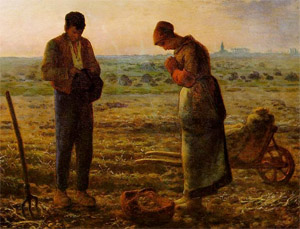
The Angelus

The Angelus, Jean-Francois Millet, 1859

In my previous life (pre-2012 and pre-Catholic) I would occasionally crack a Bible and read a passage or two before losing interest and closing it up. This didn’t happen often, mostly when I was traveling, alone and bored in a hotel room somewhere and there was a Gideon Bible in the nightstand drawer. I remember reading from the Gospels and wondering why Jesus talked to the people in parables. As far as I could tell, it was all a riddle that nobody in their right mind could understand. It made no sense.

This recollection came back to me today as I read and meditated on today’s Gospel, Mark 4:1-20, the Parable of the Sower. A lot has changed over the last six years. I understand this parable today – that Jesus is the sower, the Word of God is the seed, and the different types of soil are the dispositions of the diversity in our faith. Or at least I think that’s what it’s about.

But, as I meditated on this today, my thoughts were more on why Jesus spoke in parables rather than the message in the parable.

I have learned that the Jewish rabbis and teachers in Jesus’ time, taught using stories with familiar images and experiences to which the learner could relate. The messages in these stories were not explicit but, instead, were designed to make one think. The answers were complex and seldom simple. If you thought you had it figured out, you probably didn’t. You needed to think about it more, and think more deeply.

Jesus’ parables were similar to what we call allegory today. He always had a hidden complex spiritual meaning or moral lesson embedded within his parable. And, depending on one’s level of faith, you either got it, partially got it, or you were totally lost.

Even Jesus’ disciples and His chosen Apostles didn’t always understand. In today’s Gospel, His disciples questioned Him about the parables. Jesus answered them, “The mystery of the kingdom of God has been granted to you. But to those outside everything comes in parables so that they may look and see but not perceive, and hear and listen but not understand, in order that they may not be converted and be forgiven.” Jesus continued, “Do you not understand this parable? Then how will you understand any of the parables?” (Mk 4:11-13)

We often think that the Apostles were all totally on board and on the same page as Jesus. But, the reality was that they never did quite figure it out until Jesus’ resurrection and eventual ascension into heaven. No, they were quite often lost regarding the mysteries of Christ’s life (e.g. Mk 8:32-33, Peter’s response to the first prediction of Jesus’ Passion; and, Mk 9:28-29, the healing of a boy with a demon).

Jesus wanted everyone, His disciples included, to think deeply about His message. He wanted them to look beyond the obvious, below the surface, and outside of the box. He challenged them to compare and relate His stories, His parables, with their own lives. The extent of their understanding and ability to relate often depended on their faith.

Nothing has changed. It still depends on faith. The reason I didn’t understand the Gospel as I read while lounging on a hotel room bed was because I had no faith. The difference between then and now for me is that I now believe the Word of God to be the truth. I have a deep desire to understand it so that I can apply it to my life.

Jesus still challenges us to understand God’s Word within the context of our own lives, our own experiences. He wants to sow the Seed on fertile soil so that it may grow and produce fruit. How do we prepare that garden plot in preparation for His sowing?

First, we need to create an atmosphere in which we can listen to God through His Word in the scripture, an atmosphere of silence and solitude that is conducive to deep thought without distractions. Author Henri J.M. Nouwen in his book, The Way of the Heart, describes silence as, “not not speaking, but listening to God”; and solitude as, “not being alone, but being alone with God.” Finding that time and place is critical.

Once you’re there, open up your heart in prayer. Give thanks to God for the opportunity to be with Him in that moment. Ask the Holy Spirit to open your heart and mind to receive the Word of God, and for the grace to understand His Word as you read and reflect upon it.

As you read the scripture, think deeply about what it is God is telling you at that moment. Maybe there is a verse or a phrase or just a couple words that jump out at you. Stop and reflect on that which catches your attention and let the Holy Spirit take you deeper to reveal God’s unique message for you. Say a prayer of thanksgiving once you’ve absorbed His revelation.

Next, ask yourself how that message relates to your life today. Is there something you can do to change? What can you do today to be more virtuous, to grow in holiness, and to become a better disciple, spouse, parent, and friend? How can you condition your soil to make it more fertile? The Holy Spirit will convict you and show you the way!

Finally, take that one thing, that one change for the better, and write a concrete resolution that will effect an improvement that day. Make it easy but make it concrete. Think baby steps instead of leaping tall buildings. Something that you can, at the end of the day, look back on and say with a sense of accomplishment, “Yes! I did it!”

And then go do it.

This is how you grow in faith. This is how you begin to understand the Word of God and not get confused in the complexity of the parables. And, this is how you gradually grow in holiness on your way to becoming a saint just like the Apostles.

“Heavenly Father, thank You for giving me the deep desire to understand Your Word, and for Your Son, Jesus, to sow that Seed in my heart. Thank You, Holy Spirit, for the gift of faith that has conditioned my heart to be fertile ground for producing fruit for Your kingdom. I pray that, through Your grace, the harvest is abundant. Amen.”

(Soil Conditioning for the Heart was first published on the blog Reflections of a Lay Catholic)
©2013-2018 Reflections of a Lay Catholic. Reposting and sharing of material in its full and original content is permitted, provided that full and clear credit is given to the author(s) and Reflections of a Lay Catholic.

The Choosing

13 Wednesday Sep 2017

Posted by Jerry Robinson in Bible Reflections, Discernment, Prayer, Scripture

≈ 4 Comments

Tags

Apostles, Bible Reflection, Discipleship, Faith, Grace, Jesus, Love, Luke 6:12-19, Mercy, Prayer, The Twelve


Take Up Your Cross pic

As I read and meditated on Tuesday’s Gospel,  I couldn’t help but wonder about a few things.

“In those days He departed to the mountain to pray, and He spent the night in prayer to God. When day came, He called His disciples to Himself, and from them He chose Twelve, whom He also named apostles: Simon, whom He named Peter, and his brother Andrew, James, John, Philip, Bartholomew, Matthew, Thomas, James the son of Alphaeus, Simon who was called a Zealot, and Judas the son of James, and Judas Iscariot, who became a traitor.” (Luke 6:12-16 NAB)

Did Jesus spend the night in prayer discerning which of His disciples He would choose to be the Twelve? And, if so, what criteria did He consider? Was He looking for the one with the greatest love for God? Or, the one who was most faithful? Or, maybe the one most loyal to Him? Perhaps the deciding quality was the ability and willingness to show compassion and mercy to others. Could it have been the ones who demonstrated love for their neighbors as they loved themselves? Or, was it the ones who had the greatest zeal to go out and spread the Good News?

One would think it would have been several or all of those things. But, then, maybe it was none of them.

And, did He learn from his prayerful conversation with God that night that Judas Iscariot would betray Him?

Who knows.

But, an even more important question came to my mind: “Would He have chosen me?”

Followed by, “If not, why not?”

In which of those qualities that, on the surface, would seem to have been the most important to Him, do I not measure up? Just a few? Or all of them?

It gives me something to pray about, to ask Him to show me where I should focus my attention.

Would you have been chosen? What would have excluded you?

“Lord Jesus, I love You and I desire to grow closer to You. I give You thanks for Your Mercy. I pray for the Grace to always trust in You, to always live the Father’s commandments, and to be Your voice, hands and feet in spreading Your Good News. Amen.”

(The Choosing was first published on the blog Reflections of a Lay Catholic)
©2013-2017 Reflections of a Lay Catholic. Reposting and sharing of material in its full and original content is permitted, provided that full and clear credit is given to the author(s) and Reflections of a Lay Catholic.


Thoughts on the Total Solar Eclipse

21 Monday Aug 2017

Posted by Jerry Robinson in Bible Reflections, Faith, Scripture

≈ 3 Comments

Tags

Eclipse, Faith, Jesus, Jgs 2:11-12, Lk 23:44-45, Mt 19:21-22, Ps 106:36-37, Solar Eclipse, Total Solar Eclipse, Worldly Attachments

Solar_eclipse_22_July_2009_taken_by_Lutfar_Rahman_Nirjhar_from_BangladeshToday’s the day the scientific community and millions of regular folks across America have been waiting for: the total solar eclipse. The last one to occur was in 1979, and prior to that, the last to be visible from the contiguous 48 states was in 1918.
From my perch here in southwest Ohio, the eclipse is supposed to begin at 1:02 p.m., peak at 2:28:41 p.m., and end at 3:52 p.m. – almost three hours. The sky is clear and we should see a 90% eclipse.

I don’t have any special dark glasses with which to look at the eclipse, nor did I make a pinhole viewer from a shoe box. I’m just sitting here on my front porch waiting to see it get dark in the middle of the day.

Waiting to see if anything special happens when the moon blocks out the sun.

I recall a story of an eclipse which happened about 2,000 years ago that also lasted about three hours.

“It was now about noon and darkness came over the whole land until three in the afternoon because of an eclipse of the sun. Then the veil of the temple was torn down the middle” (Lk 23:44-45).

It occurred in Jerusalem as Jesus was dying on the cross – a death demanded by the self-righteous of the time, most notably the Jewish scholars and priests who were blinded by their man-made beliefs to which they were attached and who refused to accept that God had finally sent their Messiah, the Son of Man, as He promised.

Their beliefs blocked out the “Son”.

I recall this morning’s Scripture passages:

“The children of Israel offended the Lord by serving the Baals. Abandoning the Lord, the God of their fathers, who led them out of the land of Egypt, they follow the other gods of the various nations around them, and by their worship of these gods provoked the Lord.” (Judges 2:11-12)

“They served their idols, which became a snare for them. They sacrificed their sons and their daughters to demons.” (Psalms 106: 36-37)

“Jesus said to him, ‘If you wish to be perfect, go, sell what you have and give to the poor, and you will have treasure in heaven. Then come, follow me.’ When the young man heard this statement, he went away sad, for he had many possessions.” (Matthew 19:21-22)

Each of these passages spoke to me about how our society often puts other things ahead of God and His Son, Jesus, making it easy to turn away from Them. These other things, our “possessions”, our attachments, are the habits and “important” stuff we can’t turn loose of. They’re those things that keep us from focusing on, and spending time with, our Lord.

They, too, block out the “Son”.

One has to wonder if the Church picked these passages specially for today. But, I know they didn’t. I also know it’s not just coincidence. This is the way God works.

Perhaps, then, today, the day the moon eclipsed the sun, would be a good day to think about what things we allow in our lives to eclipse the “Son”, and what it will take to turn loose of them.

“Heavenly Father, I give you thanks for Your great glory. Thank You for this world in which we live with all its wonders – Your Wonders. Thank You especially for the greatest Wonder of all, Your Son, Jesus. Holy Spirit, help me to turn loose of my unnecessary worldly attachments so that I may grow closer to Christ. Amen.”

(Thoughts on the Total Solar Eclipse was first published on the blog Reflections of a Lay Catholic)

©2013-2017 Reflections of a Lay Catholic. Reposting and sharing of material in its full and original content is permitted, provided that full and clear credit is given to the author(s) and Reflections of a Lay Catholic.Thout

You Reap What You Sow

24 Monday Jul 2017

Posted by Jerry Robinson in Bible Reflections, Discernment, Faith

≈ Leave a comment

Tags

Faith, God, Matthew 13:24-43, Reap what you sow, Trust in God, Weeds in the wheat

Sunday morning’s Gospel, Matthew 13:24-43, was the parable about the weeds being sown with the wheat. As I made my morning prayers, I asked what message God was trying to send me. I came up with an answer in short order and then readied myself to go to mass.

Come to find out, our priest’s interpretation of that passage of scripture was no where near what I came up with. Not even on the same continent. His was philosophically much deeper and, of course, right on the money. The only thing his and mine had in common were the words reaping and sowing.

Turns out that my take is more from Galatians 6:7.  Oh, well.

Since I was a child I’ve heard the adage, “You reap what you sow”. When I hear it, it’s usually with a negative connotation. Frequently, someone discovers, in hindsight, that they screwed up. They’re ruing about a choice they made sometime way back in the past that has resulted in unfortunate circumstances for them. Too often, the regret is over a relationship with another – a matter of the heart.

I usually hear, “If only….” somewhere in there.

Sometimes it’s me speaking those words.

But, my epiphany from this reflection was, “Why can’t it be the other way around?” Why can’t I, instead of regretting the seeds I’ve already sown, focus on the reaping before I sow them?

Why don’t I learn to ask, “What do I need to do now in order to reap what I desire later on?” Why don’t I have that foresight?

Then, I had an epiphany on top of my epiphany. In thinking about that last question, I realized there were too many “I’s” in there. And, that’s the problem.

What I need to do is ask God what the right thing to do is; pay attention and listen to Him; and then do it. Forget about the reaping and trust that there will be a harvest. That which I eventually reap, whether it’s what I desire or a surprise, will be His gift to me for sowing the right seeds.

“Loving and Gracious God, I give you thanks for the bountiful harvest of blessings you’ve bestowed on me. Please help me to discern your will, to sow the good seeds, in the decisions I make, and then trust in You for the harvest. Amen.”

(You Reap What You Sow was first published on the blog Reflections of a Lay Catholic)

©2013-2017 Reflections of a Lay Catholic. Reposting and sharing of material in its full and original content is permitted, provided that full and clear credit is given to the author(s) and Reflections of a Lay Catholic.

Take Up Your Cross

18 Tuesday Jul 2017

Posted by Jerry Robinson in Bible, Bible Reflections, Faith, Hope

≈ 6 Comments

Tags

Faith, God, Jesus, Joy, Matthew 10:38, Resurrection, Suffering, Take Up Your Cross

Take Up Your Cross pic

“…and whoever does not take up his cross and follow after me is not worthy of me.” – Mt 10:38

As I read this passage from this morning’s (Monday’s) Gospel I asked myself the questions, “What does Jesus mean by ‘take up your cross’?”, and, “What is my cross?”. It was like deja vu. I’ve asked myself those two questions a gazillion times and never took the time to reflect upon them.  But, this time the last four words of that verse, “is not worthy of me”, jumped out at me and I decided I really ought to know the answers.

I’ve been thinking about this most of the day.  Here’s what my simple brain came up with:

In the first sense, the cross is a sign of suffering. It’s where Jesus suffered and died and it’s where many were crucified by the Romans before and after Him. Our “cross” is that which causes us to suffer.

We all suffer in some way. It may come in the form of real physical or emotional pain. Perhaps our suffering is a physical handicap, the loss of a loved one, the experience of an injustice, or the loss of a job and the inability to make ends meet.

Or, maybe, our suffering is one of inconvenience – the perceived pain of not getting our way, of being “put out” by circumstances beyond our control.

By “taking up our cross”, I think Jesus is telling us in a round-about way that, no matter what our suffering is, we need to deal with it. Life isn’t a bowl of cherries. In this life there will always be a certain amount of suffering. Not until we find ourselves in heaven will we live a peaceful and painless eternity.

Taking up our cross, then, means to accept that which causes us to suffer. It means we need to take ownership and, in doing so, we need to accept our suffering without complaining, moaning and groaning. But, I think there are two kinds of complaining.

The first, the good complaining, is like groaning that your legs hurt after you’ve just completed the fastest mile you’ve ever run. It’s a hurt that is expected, and one you’re glad to experience because it means you’ve grown/advanced/improved. It’s a hurt for which you’re grateful. There’s no cross to be taken up in this case.

The second, the bad kind of complaining, is when we express our misery because of an unfortunate circumstance: we couldn’t get our grass mowed this week because it rained and then our lawn mower wouldn’t start. The irony is that, if we think about it, we should be grateful for the time we have, while we’re not mowing the lawn, to do other things, like improving relationships, that often get pushed to the back burner. In this regard, I think about the verse from 1 Thessalonians 5:18, “In all circumstances give thanks, for this is the will of God for you in Jesus Christ.” By doing this, we’re elevating the circumstance to the first level, the good complaint.

With respect to this second type of complaining, taking up our cross is not making another person, intentionally or unintentionally, feel bad because of our situation. This is where taking ownership comes into play. It’s ours and we can’t make it someone else’s. Asking someone to pray for us and hoping for their compassion is fine. But, expecting someone to commiserate with us and personally feel bad over our personal issue isn’t part of taking up our cross.

On the other hand, there is one person whom we can ask to bear our suffering with us – Jesus. He tells us throughout the Gospels that He is there for us, that we can trust in and turn our troubles over to Him. He will make our burdens light.

Taking up our cross means that, in accepting our circumstances, we realize it is in the past, it’s behind us, and we can’t do anything about what’s already happened. We need to let it die.

It’s now that the second meaning of taking up our cross and following after Jesus comes into play. After we’ve let that which causes our suffering to die, we need to start living again. That’s when we not only take up our cross but we begin to follow after Jesus. It’s a resurrection for us.

Jesus died and, upon His resurrection, went to a better place. By taking up our cross and following Him, we, too, can find a kind of resurrection, a better place. We begin to open ourselves up to finding joy in the every day gifts which God provides. In opening up, we begin to accept His love for us, a love that is independent of our circumstances. Then, ultimately, our resurrection is complete when we begin to love others unselfishly in spite of our personal suffering. In fact, we no longer view it as suffering but, instead, as a unique gift.

You know what? I’m not going to expound on what my cross is. That’s because I can see that I have many crosses to bear. After going through this exercise, I realize my crosses can be different from one day to the next, or even one hour to the next. Some crosses are heavier than others. Some I accept quicker than others. I think the important thing is that I have figured this out for myself and can begin to see my suffering, both the real and the inconvenient, as crosses to bear.

And, I resolve to pray to our Lord, Jesus, for His help in lightening the load of each of those crosses.

Won’t you take some time to think about your crosses and how you take them up in following Him?

“Lord Jesus, I know that You know that I know what my crosses are. And, I know that You’re just waiting for me to turn to You, to place my trust in You to lighten my load. I know You will because You have so many times before. I pray for an increase in faith that it is Your will that is done, not mine. Lord, thank You for all your many blessings, even those which I didn’t recognize as blessings at the time. Amen.”

(Take Up Your Cross was first published on the blog Reflections of a Lay Catholic)
©2013-2017 Reflections of a Lay Catholic. Reposting and sharing of material in its full and original content is permitted, provided that full and clear credit is given to the author(s) and Reflections of a Lay Catholic.

Who Do You Say That I Am?

30 Friday Jun 2017

Posted by Jerry Robinson in Bible Reflections, Faith, Prayer, Scripture

≈ 2 Comments

Tags

C.S. Lewis, Faith, Jesus, Matthew Kelly, Mental Prayer, Mere Christianity, Mt 16:13-19, Prayer, The Jesus Question

Who Do You Say I am Pic“Who do you say that I am?” That’s the question Jesus asked the Apostles in yesterday’s Gospel (Mt 16:13-19). As I reflected on what God’s Word was saying to me in this passage, I made a resolution to articulate my own answer and understand its weight.

Fundamentally, that is the question Jesus asks all of us. Who do we say that He is?

A few short years ago, in the infancy of my faith formation, a friend read to me a passage from C. S. Lewis’ Mere Christianity.  It profoundly opened my mind:

“I am trying here to prevent anyone saying the really foolish thing that people often say about Him: ‘I’m ready to accept Jesus as a great moral teacher, but I don’t accept His claim to be God.’ That is the one thing we must not say. A man who was merely a man and said the sort of things Jesus said would not be a great moral teacher. He would either be a lunatic…or else he would be the Devil of Hell. You must make your choice (emphasis added). Either this man was, and is, the Son of God; or else a madman or something worse….But let us not come with any patronizing nonsense about His being a great human teacher. He has not left that open to us. He did not intend to.”

“You must make your choice.” Author Matthew Kelly explains in The Jesus Question, “not making a choice is making a choice.” There’s no in-between.

So, who do I say that Jesus is? To begin, I have to mimic Simon, soon to be named Peter, when he answered collectively for the Apostles: “You are the Christ, the Son of the living God.”

Jesus is God made man, the second person of the Trinity. He came into this world to suffer and die for me (and you), to offer me salvation for my sins, to give me a fresh start and the opportunity to live with Him in heaven for all of eternity.

Jesus is my Guiding Light, my North Star. He shows me the path I need to take in this earthly life to find my way to God, a God whose love for me is never ending and Who, after creating me, desires that I return to Him.

After Simon answered Jesus, Jesus replied, “Blessed are you, Simon son of Jonah. For flesh and blood has not revealed this to you, but my heavenly Father.” I can relate to that.

The Heavenly Father offered His gift of faith to me in a manner I could neither ignore nor refuse, and, through it, revealed to me His love manifested in His Son, Jesus. It was a no-brainer that happened in a nanosecond. There was no learning involved and no teaching required from others to make me believe. It was after my conversion that other men and women, true “flesh and blood”, began teaching me about this thing called Christianity. And, it was only because I had accepted God’s gift of faith that I was able to accept the full revelation of what I was learning.

My faith formation has progressed such that I no longer have to rely on others to show me the way, although I still learn from them daily. I have found a better way – a way that isn’t just about learning, but about building a relationship with God. It’s called prayer. By talking to God through my verbal prayer, and by listening to God through mental prayer and meditating on the Sacred Scriptures, He and I are building an intimate relationship where He reveals Himself to me and I, by revealing myself to him, learn about myself that which He already knows.

It’s a beautiful thing!

When was the last time you stopped to answer Jesus’ question of you, “Who do you say that I am?” Maybe it’s time.

“Heavenly Father, I love and worship You. I give You thanks for Your Grace which has bent my free will towards you. Thank you, Jesus, for leading me to the Father. Thank you, Holy Spirit, for opening my mind and heart to the Word of God that continues to transform my life. Amen.”

(Who Do You Say That I Am? was first published on the blog Reflections of a Lay Catholic)
©2013-2017 Reflections of a Lay Catholic. Reposting and sharing of material in its full and original content is permitted, provided that full and clear credit is given to the author(s) and Reflections of a Lay Catholic.

A Spiritual Dichotomy

19 Monday Jun 2017

Posted by Jerry Robinson in Bible Reflections, Spirituality

≈ 6 Comments

Tags

2 Cor 6:1-10, God, Joy, Mt 5:38-42, Peace, Spirituality

7d77efabcfa5fc8fec489b03377d783c--baby-jesus-holy-holyI often think I have it tough. But, all it takes to jerk me back to reality is to read about the lives of the Apostles and the saints.

In today’s reading from Paul’s second letter to the Corinthians (2 Cor 6:1-10), St. Paul gives us an idea of what life was like for the Apostles. They had to endure through “afflictions, hardships, constraints, beatings, imprisonments…”, by employing the virtues of “purity, knowledge, patience, kindness, …. love and truthful speech”.

The Apostles were treated as, “deceivers but yet they spoke the truth; as unrecognized and yet they were acknowledged; as sorrowful yet always rejoicing; as poor yet they enriched many; and, as having nothing yet they possessed all things.”

Paul’s letter is evidence that he and the Apostles practiced what Jesus preached in today’s Gospel (Mt 5:38-42) about retaliation. They didn’t resist being persecuted. Their mercy for others let them set aside the old law of “an eye for an eye” and let them “turn the other cheek”. And, when someone needed help, they went the extra mile.

It’s evident that, from the beginning, living the life of a Christian was a spiritual dichotomy.

I may not be persecuted like the Early Christians. But, I still experience a spiritual dichotomy in my life. Since becoming Catholic, I have found an interior peace like I never knew could exist. But, because I am called to spread to others that peace and joy found only through the love of Jesus Christ, I may never be totally at peace again. At least not in this life. And, that’s okay.

“Dear God, thank you for giving us Your Son, Jesus, to lead us to You. Thank You, Jesus, for showing us the way to the Father. And, thank You, Holy Spirit, for filling me with Your love and peace, and for the fire that has burned yet healed my soul. Through Your grace, I pray I may be an instrument for enlightening others to Your love. Amen.”

(A Spiritual Dichotomy was first published on the blog Reflections of a Lay Catholic)
©2013-2017 Reflections of a Lay Catholic. Reposting and sharing of material in its full and original content is permitted, provided that full and clear credit is given to the author(s) and Reflections of a Lay Catholic.

Do You Love Me?

04 Sunday Jun 2017

Posted by Jerry Robinson in Bible Reflections, Faith, Grace and Mercy

≈ 4 Comments

Tags

Commitment, Faith, John 21:15-19, Love, Sin

jesus_peter__

It’s Sunday morning and I’m still ruminating over Friday’s Gospel (John 21:15-19) and what it said to me. It hit me so profoundly that I wanted to let the message sink in so I will never forget it.

When Jesus appeared to the Eleven the third time after being raised from the dead, He ate a breakfast of bread and fish with them. Right afterwards, He pulled Simon Peter aside and asked, “Simon, son of John, do you love me?” He didn’t ask only once. No, He asked three times. And, I think, by doing so, Jesus gave Peter the opportunity to redeem himself for having denied Jesus three times before His death. I’m sure that is what was on Peter’s mind as he answered, “Yes, Lord, You know that I love You.”

But, I don’t think Jesus was trying to rub it in. He wasn’t concerned about the depth of Peter’s love for Him, rather, he was looking for commitment from the one He was appointing to lead His church.

Commitment. That’s what He asks of me, too.

It’s taken two days for that to sink in. Jesus asks me in every waking moment, “Jerry, do you love Me?” Especially every time I am on the verge of sinning. I realize now that, at those times when I’m aware of the sin I am committing, my cognizance is actually Jesus asking me, “Do you love Me?” I’m ashamed that, by my actions, I all too often respond otherwise.

Jesus asks of us only two main things to be Holy: to love God, and to love our neighbors. Every sin contradicts one or both of those commandments. Each time an action, a spoken word, or a disrespectful thought, which damages a relationship with another person, damages my relationship with the Lord. That’s not conducive to getting me to heaven.

“Jesus, You know that I love You. I resolve today to make that evident in all that I do. I know I need the help of Your Sanctifying Grace to override my occasional wavering commitment. And, when I fail, as I will, I need Your loving Mercy and Actual Grace to let me try again. Amen.”

(Do You Love Me? was first published on the blog Reflections of a Lay Catholic)
©2013-2017 Reflections of a Lay Catholic. Reposting and sharing of material in its full and original content is permitted, provided that full and clear credit is given to the author(s) and Reflections of a Lay Catholic.

Waiting to Learn – Learning to Wait

25 Thursday May 2017

Posted by Jerry Robinson in Bible Reflections, Christian Community, Evangelization, Faith

≈ Leave a comment

Tags

John 16:12-13, Learning to Wait, Spiritual Mentorship, Waiting to Learn

Trinity by Andrei Rublev

The Trinity by Andrei Rublev

Do you remember when you were young and Christmas or your birthday was just around the corner? Perhaps you had a good idea of the presents you might expect to receive and you just couldn’t wait for the day to get there. Remember the anxiety of anticipation?

That is one of the two thoughts that went through my mind as I reflected on Wednesday’s Gospel:

“Jesus said to His disciples, ‘I have much more to tell you, but you cannot bear it now. But when He comes, the Spirit of truth, He will guide you to all truth. He will not speak on his own, but he will speak what He hears, and will declare to you the things that are coming.’” (John 16:12-13)

Once again, Jesus was talking in figures of speech and he dangled a curious carrot out there by declaring they would have to wait to learn what ‘things were coming’. In all honesty, though, what else could He do? There was no concrete way to explain what the Holy Spirit was and even if He did try there was no way the Apostles would understand it. Jesus knew they would have to experience it a little at a time….and when the time was right.

At face value, the Apostles knew Jesus was going away and He was promising to give them something special (and it had to be very special) to take His place. But, there was a hitch – they would have to wait to learn what it would be. Waiting, and its accompanying anticipation, can be agonizing.

The second thought was more personal and immediate as it relates to me, and, I know, many of my cohorts in the Spiritual Mentorship Program. We are two days into our week of training and formation, the first of four sessions over a two year period, and we are on fire! The course work and practicum presented by the two professors from the School of Faith has been the best classroom experience I’ve ever had. They present the material with incredible wisdom and conviction that makes it easy to learn and, naturally, desire more. The Sisters and Brothers of the Apostles of the Interior Life demonstrate a special spirituality that is evident in their generosity, kindness, and desire to teach; and they exude a rare happiness that can only come from an intimate relationship with Christ. We want to learn how to get a little more of what they have!

We know we have a good thing going here and we don’t want it to stop. But, we know it will come to an end on Sunday. At least for this semester. Our mentors know, as Jesus did, that we can only absorb so much at one time, that we will have to ruminate on what we’ve learned so that it will become internal to us before we can move forward to learn more. Alas, in waiting to learn more, we will have to learn to wait. The waiting, and the anticipation of the good things to come, will be agonizing….but worth it.

“Heavenly Father, through Your grace, please instill in us the virtues of Persistence as we learn methods to bring others closer to You, and of Patience as we eagerly await to learn more about our faith and how to be Your disciples. Amen.”

(Waiting to Learn – Learning to Wait was first published on the blog Reflections of a Lay Catholic)
©2013-2017 Reflections of a Lay Catholic. Reposting and sharing of material in its full and original content is permitted, provided that full and clear credit is given to the author(s) and Reflections of a Lay Catholic.

You Are Mine

23 Tuesday May 2017

Posted by Jerry Robinson in Bible Reflections, Confirmation, Fear

≈ 13 Comments

Tags

Confirmation, Faith, Holy Spirit, John 14:15-21, Prayer, silence, the Advocate

imagesCA56VJ5B

I’ve been trying to improve my prayer life by making more time to read sacred scripture and meditate on what the Word of God is trying to tell me in relation to my life. I have to admit there are many days when, no matter how hard I try, I simply cannot make a connection. But, at other times, His message is loud and clear. Or, at least, I think it is.

Such was the case this last Sunday. The Gospel reading was from John 14:15-21, regarding the “Advocate”, the Holy Spirit:

“And I will ask the Father, and He will give you another Advocate to be with you always, the Spirit of truth, which the world cannot accept because it neither sees nor knows it. But, you know it, because it remains with you, and will be in you….On that day you will realize that I am in my Father and you are in me and I in you.”

As I listened to this, I thought, “This is one of the problems in our faith today. People forget that Jesus is with us always by the Holy Spirit that He placed within us. It’s like we forget the whole point of our Sacrament of Confirmation. We remember the meaning of Baptism, we experience Communion every week, and, we are reminded, reluctantly for many, of the Sacrament of Reconciliation. But, we forget that the Holy Spirit was poured out upon us at our Confirmation. Imagine the difference we could make if we only remembered this!”

A few minutes later, I joined the congregation of the Holy Family Catholic Church in Shell Knob, Missouri in singing one of my favorite hymns, You Are Mine.  The first verse and refrain simply reinforced my earlier thought:

“I will come to you in the silence, I will lift you from all your fears,
“You will hear my voice, I claim you as my choice,
“Be still and know I am here.
“Do not be afraid, I am with you. I have called you each by name.
“Come and follow me, I will bring you home, 
“I love you and you are mine.”

Fast forward to last night, Monday evening. I arrived in Kansas City, Kansas to attend my first, in-residence week of formation, study and practice in the Spiritual Mentorship Program offered by the Apostles of the Interior Life, and the School of Faith of the Archdiocese of Kansas City. I’ve been studying for and looking forward to this week since January. As I knelt in the chapel after night prayers, I felt my nervousness grow. I was afraid – afraid that I won’t have what it takes to become a good spiritual mentor, and afraid that my faith was too new and poorly grounded. I feared not being able to remember everything I will need to remember, and, consequently, be inadequate in the example I set for others.

I prayed for God to open my mind and my heart to what I will be learning this week. I prayed that my detailed and analytical mind won’t blind me from understanding the concepts which will be presented (not seeing the forest for the trees has always been a struggle for me). And, I prayed for the ability to internalize the message so that I will easily be able to relate it to others. I simply prayed, “God, help me do this!”

As I took a breather from my verbal prayer, I became distracted and lost my train of thought. Normally, I get frustrated with distractions while I pray, but this time the distraction – the tune for You Are Mine that was running through my head – was a blessing. As I tried to remember the words to the song, not only it but the Gospel and my thoughts about it from Sunday’s mass came flooding back to me. And, in a moment of humiliation in front of the Lord, I saw that, through my self-righteousness, I was the one guilty of not remembering the point of my own Confirmation. I realized I was asking God to help me do this and help me do that, as if I was in this alone and the burden was all on me.

In that moment I lost the slump in my posture and knelt more upright. I felt a surge of adrenaline. My prayer changed from fear and despair to anticipation and new hope! I prayed, “Oh God, it is You Who led me to discern this opportunity and Who brought me here. I know that, through Your Holy Spirit, You are with me and You won’t leave me hanging. You have ‘come to me in silence’ and You have lifted my fears; I am not afraid because You are with me. I trust in You. I love You and I am Yours.”

“Oh, loving and forgiving God, You teach me in many ways, often uncomfortable ways. You know what I need and You set the stage in advance so that when the moment comes I may learn from the experience. Thank you, Holy Spirit, for living within me. Help me to always feel your presence. Amen.”

(You Are Mine was first published on the blog Reflections of a Lay Catholic)
©2013-2017 Reflections of a Lay Catholic. Reposting and sharing of material in its full and original content is permitted, provided that full and clear credit is given to the author(s) and Reflections of a Lay Catholic.

← Older posts
Newer posts →

Enter your email address to follow this blog and receive notifications of new posts by email.

Join 264 other subscribers
Follow Reflections of a Lay Catholic on WordPress.com

Recent Posts

  • Are You Ready to Proclaim the Gospel?
  • A Prayer for Continued Progress
  • Be Like the Thessalonians
  • Be Magnanimous Like Mary
  • Are You an Average Catholic?

Categories

Top Posts & Pages

  • Are You Hall of Fame Bound?
  • The Cry Room Blues
  • The Anti-Beatitudes
  • Proverbs 27:17 - Iron Sharpens Iron as One Person Sharpens Another
  • A Special Prayer Request
  • Thoughts on the Total Solar Eclipse
  • The Choosing
  • A Point of Reference
  • So Many Churches, Too Little Time
  • Fear is Easy, Love is Hard (1) / Nothing is Wasted (2)

Archives

  • September 2025
  • August 2025
  • July 2025
  • May 2025
  • April 2025
  • February 2025
  • January 2025
  • December 2024
  • November 2024
  • September 2024
  • July 2024
  • May 2024
  • April 2024
  • March 2024
  • February 2024
  • January 2024
  • December 2023
  • November 2023
  • October 2023
  • September 2023
  • August 2023
  • June 2023
  • May 2023
  • April 2023
  • March 2023
  • February 2023
  • January 2023
  • December 2022
  • November 2022
  • October 2022
  • September 2022
  • June 2022
  • May 2022
  • April 2022
  • March 2022
  • February 2022
  • January 2022
  • November 2021
  • July 2021
  • June 2021
  • May 2021
  • April 2021
  • March 2021
  • February 2021
  • January 2021
  • November 2020
  • October 2020
  • September 2020
  • August 2020
  • July 2020
  • May 2020
  • April 2020
  • March 2020
  • January 2020
  • December 2019
  • November 2019
  • September 2019
  • July 2019
  • June 2019
  • May 2019
  • April 2019
  • March 2019
  • January 2019
  • December 2018
  • November 2018
  • October 2018
  • September 2018
  • August 2018
  • July 2018
  • June 2018
  • May 2018
  • April 2018
  • March 2018
  • February 2018
  • January 2018
  • December 2017
  • September 2017
  • August 2017
  • July 2017
  • June 2017
  • May 2017
  • April 2017
  • March 2017
  • February 2017
  • December 2016
  • November 2016
  • October 2016
  • September 2016
  • August 2016
  • July 2016
  • April 2016
  • March 2016
  • January 2016
  • December 2015
  • November 2015
  • September 2015
  • August 2015
  • July 2015
  • June 2015
  • May 2015
  • April 2015
  • March 2015
  • February 2015
  • January 2015
  • December 2014
  • November 2014
  • October 2014
  • September 2014
  • August 2014
  • July 2014
  • June 2014
  • May 2014
  • April 2014
  • March 2014
  • February 2014
  • January 2014
  • December 2013
  • November 2013
  • October 2013
  • September 2013
  • August 2013
  • July 2013
  • June 2013
  • May 2013
  • April 2013
  • March 2013
  • February 2013

Meta

  • Create account
  • Log in
  • Entries feed
  • Comments feed
  • WordPress.com

©2013 – 2024 Reflections of a Lay Catholic. Reposting and sharing of material in its full and original content is permitted, provided that full and clear credit is given to the author(s) and Reflections of a Lay Catholic.

Create a free website or blog at WordPress.com.

  • Subscribe Subscribed
    • Reflections of a Lay Catholic
    • Join 264 other subscribers
    • Already have a WordPress.com account? Log in now.
    • Reflections of a Lay Catholic
    • Subscribe Subscribed
    • Sign up
    • Log in
    • Report this content
    • View site in Reader
    • Manage subscriptions
    • Collapse this bar
 

Loading Comments...