A couple Mondays ago I drove home to Ohio from Kansas City. I left my daughter’s house a little before 6:00 a.m. hoping to make it out of town before morning rush hour traffic got too bad. I made it to Columbia, Missouri before stopping for gas and grabbing a bite to eat for breakfast. As I pulled through the fast-food drive-thru, I waffled on whether or not I ought to use my digital coupon, with which I could get a second breakfast sandwich for only one dollar more, or limit myself to just one sandwich. I knew I didn’t need two sandwiches but the deal was just too good to pass up. So, I bought both.
As I waited on traffic to pull out of the parking lot, I unwrapped the first sandwich and chowed down. I pulled out onto the street and drove about 100 feet to the left turn lane that would take me back to the interstate. I had to stop at this traffic light, and as I took my second big bite of that hot, juicy sausage, egg and cheese muffin, I saw a man standing on the island holding a sign that read, “Homeless and hungry. Please help.”
I looked over at the open bag in my passenger seat. I looked back at the man and our eyes met. I looked upwards to God, as if I could see through the roof of my truck, and gave Him a big smile. I rolled down my window and handed the sack and sandwich to the man. With a, “Thank you, Sir! God bless you!”, he sat down and immediately began wolfing down his breakfast as though he hadn’t eaten in a week. As I turned left onto the main road, I uttered, “Thank You, Lord!”, knowing that God had just turned my lack of discipline and temptation for indulgence into an opportunity to be generous and merciful.
I had forgotten about this little event until today when I sat down for my morning prayer. As I usually do, I looked to see who the saint of the day was and today happened to be the Memorial of St. Nicholas (yes, the original Santa Claus). St. Nick was known for his generosity to the poor and is considered the patron saint of poor people.
Then, as I read the scripture for the day, I saw how this all came together. In the first reading I read how the Lord will make the deaf hear, the blind see, the lowly find joy, and the poor “rejoice in the Holy One of Israel.” (Is 29:17-24).
Next, in the Psalm for the day I read, “I believe that I will see the Lord’s goodness in the land of the living.” (Ps 27:13).
And, finally, in the Gospel, I read about Jesus bringing sight to the two blind men after they proclaimed their faith in Him. (Mt 9:27-31).
All of these brought me back to that moment two Mondays ago and moved me to give thanks, again, to our Lord for all the goodness He brings to our lives, especially for His sacrifice on the Cross – that merciful act of love that redeemed us of our sins.
I thought about how, as Christians, we are all called to imitate Christ, and how bringing a little goodness to the world is a good place to start. We meet people all the time during the normal course of our day but we probably don’t have a clue as to how they may be struggling in their lives. Any one of the people with whom our paths cross during any given day could have said a prayer that day asking God for help, relief or healing.
And, I thought how God, in His infinite goodness, may just be putting me in that person’s life, even for a fleeting moment, to help in answering their prayer in some small way through an act of generosity, whether it be a corporal or spiritual work of mercy.
How can you imitate Christ today through your generosity?
“Lord Jesus, today, and always, I desire to sow the seeds of Your Word by being thankful for the opportunity to be Your instrument through whom Your mercy touches those in need. Amen.”
(God Uses Us to be Christ to Others was first published on the blog Reflections of a Lay Catholic)
Today’s Gospel is the Parable of the Rich Man and Lazarus (Lk 16:19-31). As I read and reflected upon it, several thoughts came to my mind. The rich man didn’t treat Lazarus as a person. To the rich man, Lazarus was simply part of the “landscape.” (Meditation from Regnum Christi, 21 March). His pride prevented him from entering an inch into Lazarus’ world. He was content to allow him to grovel for any sustenance he could find. As I read on, I found myself thinking, “Yep, you got just what you deserved. Your pride was the hamartia that brought your demise and even in hell you still looked down your nose at Lazarus.”
Then, no sooner had I passed judgment on the “rich man”, than I recalled the shame of having been in his shoes myself just two weeks ago.
It was the first Friday of Lent. I had skipped breakfast that morning before going to nine o’clock mass because it was a day of fasting and abstinence and I wanted to eat a late breakfast and then skip lunch. After mass I stopped by a fast food restaurant and purchased a bacon, egg and cheese biscuit (sans bacon) to go. I had a coupon that let me buy the sandwich and still have a few pennies more than I needed to get a haircut, which was my next planned stop after I woofed down the sandwich. As I walked out of the restaurant towards my truck a young, disheveled man, probably in his twenties, approached me from my left. I heard him say, “Hey, dude, you got a couple bucks? I’m homeless.”
Without hardly looking up, my response was quick, “Nope, not today.” The young man didn’t say anything else and just walked on by. I got in my truck and started it up and that’s when it hit me: I had just lied to that guy. Then, in quick succession, all the other available options I could have chosen popped into my mind. I could have stopped and offered my sandwich to him. I could have kept my fifteen dollars I needed for my haircut but offered to buy his breakfast with my credit card. I could have at least asked him about his situation and then made an informed decision whether to help him or not. Instead, I treated him as though he wasn’t there. I hadn’t entered an inch into his world. He was just part of the “landscape”.
My next response was to give thanks to God for the grace to realize the error of my way, and I knew I had to try and make it right. I backed out of my parking spot and thought I would find him and make amends. But, I had to drive around the restaurant and by the time I got back to the street he was nowhere in sight. I drove down the block but never saw him again.
I ate my sandwich but it wasn’t very satisfying. And, I thought, I had some good fodder to take to reconciliation the next afternoon.
In today’s first Scripture reading we hear, “I, the Lord, explore the mind and test the heart, giving to all according to their ways, according to the fruit of their deeds.” (Jer 17:10) I realize that He tested my heart that Friday morning, and in the split second of that moment of choice, my heart showed what it was really made of, and it was found lacking a good measure of humility.
I may be wrong, but I don’t think I’m much different than most folks who try to be charitable. My tithing includes indirect charity to others through donations of money and goods to organizations that help people in need. That all sounds well and good, and is truly necessary, but is it much different than the rich man throwing a few scraps of food out the door so that Lazarus might scavenge them before the dogs could get them?
Like many folks, I try, also, to be kind and charitable by helping others directly, one-on-one, through organized mission work. In a way, this forces me to step at least a few feet into another’s world, and I’ve found those times to be life changing experiences. This episode, however, shows me that I still have a lot of work to do to be the rich soil that embraces the seed (Word of God) with a generous and good heart, and bear fruit through perseverance (Lk 8:15).
My meditation today leaves me with this thought: God doesn’t want me to be like most folks. No, He wants me to be like Him, to love others with a good and generous heart, and, with the help of His grace, persevere and bear fruit for His Kingdom.
How about you? Are you going to be like most folks?
“Heavenly Father, thank You for the grace to realize my need for continued growth in the virtue of humility; and for opening my heart to the Holy Spirit to receive Your Word today. Lord, help me today to recognize the opportunities where I may be able to make a difference in the lives of others, and, at the moment of choice, choose to act accordingly. Lord, I love You and I want to bring others to You. I don’t want to find myself in purgatory wishing I had worked harder to save more souls. Amen.”
(Are You a Rich Man or Rich Soil? was first published on the blog Reflections of a Lay Catholic)
Since yesterday’s Gospel was from Matthew 1:18-25, the story of the birth of Jesus, I meant to post this yesterday. But, I got busy with other stuff and forgot. Every year during Advent I think about St. Joseph and what was going through his heart and mind when he learned that his betrothed was carrying a child that wasn’t his. And, I’m reminded of Jason Gray’s song Forgiveness is a Miracle (A Song for Joseph) (link to YouTube music video) in which he paints for us a profound example of mercy that was offered by Joseph, and gives us some insight into the divine wisdom of God. Both the Gospel and the song help me to remember God’s will for me every day is always about love. I hope you enjoy the song, that it encourages you to find a way to grow in love and mercy, and that it helps you prepare your heart to be offered as a gift to our Lord on His birthday. Let me know what you think.
God bless you and may this be your best Advent and Christmas ever!
A Man of Mercy(Reprinted from 5 December 2013)
About this time last year I was listening to a new CD I had purchased by my new favorite singer/songwriter, Jason Gray. The CD is called Christmas Stories: Repeat the Sounding Joy. One particular song on it, “Forgiveness Is A Miracle (A Song For Joseph)”, caught my attention because it was so different from any other Christmas song I had ever heard. Plus, its subject was something which I had never considered: what was going through Joseph’s mind and heart prior to, and during, his wife giving birth to not his son, but Jesus, the Son of God?
I discovered that Jason Gray had written an article for The Rabbit Room describing the story behind the song and he explores this difficult situation in which Joseph found himself. I have re-posted his article below and included a link to The Rabbit Room’s website. I hope you find it as thought provoking as I did.
As I approached writing songs for each of the characters in the Christmas story, I felt particularly protective of Joseph, who I think sometimes doesn’t get the attention he’s due. At the very least I know that I’ve been guilty of not really “seeing” him for the remarkable man that he was, and I wanted to amend that. I enlisted my friend Andy Gullahorn, one of the most masterful storytellers I know, to explore a particular moment in Joseph’s story with me.
Taking my cue from Frederick Buechner’s book, “Peculiar Treasures,” in which he breathes new life into biblical characters who have grown so familiar to us that we no longer experience them as real human beings, I hoped to recapture some of the humanity of the people in the Christmas narrative. It was also important to me to try and write songs that were relevant beyond the four weeks between Thanksgiving and Christmas day. I wanted to tell timeless human stories, and with Joseph we have the makings of just that with a love triangle, a question of revenge or forgiveness, and the age old drama of fathers and sons.
As I read his part in the narrative, I found that more than just a foster parent without much to do (as he was often relegated to in my mind), Joseph is revealed as a man after God’s own heart. Faced not only with the news that his fiancée is pregnant, but also with her incredulous story of how it was God’s doing, Joseph’s character is tested and laid out for all of us to see. What will he do? Will he hurt the one who has hurt him? Will he forgive? This is his moment, and all of history waits and watches in wonder.
There are few things more painful than the betrayal and rejection by the one you love most, so we know it must have deeply wounded him—shattering the dreams he may have had of a future with the girl he loved. Pain is like a lightning bolt striking with a violent energy that can’t be held in the human heart for long. It looks for a way out. The way it usually passes through us is in the all too common progression of hurt turning into anger and then into vengeance. Unless the miracle of forgiveness takes place in a person’s heart to absorb it, the pain we experience will pass through us and be visited upon others.
There is debate as to whether it was within Joseph’s power to have her stoned—while Jewish custom might have allowed it, Roman rule did not. However, if not to her body, we know he still could have done violence to her reputation and her heart. But I believe that Joseph did the hard work of bringing his pain to God rather than letting it pass through him, and that God graced him with the miracle of forgiveness. The narrative tells us he was a “godly man” and that instead of doing her harm, “he decided to dismiss her quietly” so that she wouldn’t be publicly shamed. He took the full force of the blow and–acting as the husband he might have been–became a covering over her supposed sin.
It’s hard for us to experience the tension in Joseph’s story since, as the reader, we know from the start that she isn’t guilty of what he naturally supposes and that God is up to something beautiful that the world has never seen before. But to see Joseph for who he is, I have to remember that he couldn’t know these things in real time. It was only after he had given himself to the work of forgiveness that the angel appeared to him in a dream to tell him that what Mary had said was true after all, and that he should marry her.
It occurred to me that perhaps this is where Joseph’s heart was proven—if not to God who already knew his heart, then perhaps to himself. (I haven’t met a man yet who isn’t daunted by the responsibility of being a father, let alone a father to the Son of God. Maybe this was a test to reveal to Joseph what kind of man he could be.) In this moment he is found to be a man of mercy, which I imagine to be just the kind of man that God was looking for to be the earthly father of his son Jesus. In a way, we see that Joseph carries in his heart the same world changing power of forgiveness that Mary carried in her womb.
It’s also meaningful to me to think of how Joseph forgiving Mary is part of the story that leads to the birth of the savior in whom Joseph would find forgiveness for his own sins. Perhaps it’s the narrative form of Jesus’ teaching that as we forgive we find ourselves forgiven.
As we wrote the song, it was good to be reminded that forgiveness is a kind of miracle. I could be wrong, but I’m not sure that we can muster up forgiveness on our own. It seems to me to be a supernatural force of renewal that we participate in as we point our hearts toward it, pray for it, and make room for it in our lives, but that ultimately we receive it as a gift from God, in his due time.
Love can make a soul come alive Love can draw a dream out of the darkness And blow every door open wide But love can leave you broken hearted
Did she dare to look you in the eye Did her betrayal leave you raging? Did you let her see you cry When she said the child was not your baby?
Pain can turn to anger then to vengeance It happens time and again Even in the best of men It takes a miracle to save us
When love is like an open wound There’s no way to stop the bleeding Did you lose sleep over what to do? Between what’s just and what brings healing
Pain can be a road to find compassion When we don’t understand, and bring a better end It takes a miracle to show us
Forgiveness is a miracle A miracle And a miracle can change your world Forgiveness is a miracle
An angel in a dream spoke into your darkest night So you trusted in the Lord and you took her as your wife But the forgiveness that you gave would be given back to you Because you carried in your heart what she was holding in her womb
Love was in a crowded barn There you were beside her kneeling You held it in your arms As the miracle started breathing
Forgiveness is the miracle The miracle And a miracle will change your world Forgiveness is the miracle Forgiveness is the miracle The miracle A miracle will save the world Forgiveness is the miracle Forgiveness is the miracle Forgiveness is the miracle
Blessed Joseph Your heart is proven And through you the Kingdom has come For God delights in a man of mercy And has found an earthly father for his son
(A Man of Mercy: (Reposted from the Archives) was first published on the blog Reflections of a Lay Catholic)
(A reflection on Luke 10:25-37 and Galatians 1:6-12)
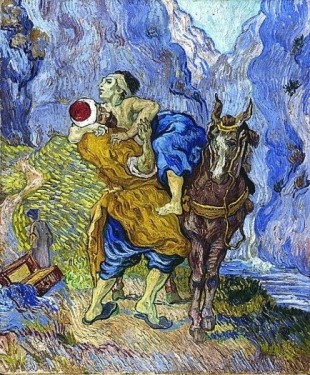
The Good Samaritan – Vincent van Gogh, 1890
In today’s Gospel, Jesus tells the scholar of the law that the greatest commandment isn’t just about loving God with all your heart, being, strength and mind, but also loving your neighbor as yourself. And, in His parable about the Good Samaritan, Jesus defines our neighbor as anyone who is near us, regardless of race, gender, social status, age, and political or religious beliefs. He asks us to be observant of our neighbors, and to look for opportunities to be charitable, especially in their times of need, even when doing so is inconvenient or forces us out of our comfort zones. In other words, He asks us to be merciful as He is merciful.
As I normally do each morning during my prayer and meditation on the day’s scripture, I try to relate to what God is revealing to me through His Word, and then write a resolution to do something along those lines that will help me grow closer to Him today. I pondered, “In what situations will I find myself today in which I can observe others and look for opportunities to be merciful?” And, then I realized my main plan for the day, besides going to morning Mass, was to stay home and work in the yard. I wasn’t going to have much of a chance to observe others.
Falling back into prayer, I asked, “Lord, unless You want me to scrap my plans to weed and spread mulch and go someplace where I can observe others, what else do You have for me today?” As I listened, my mind came back to today’s first reading from St. Paul’s letter to the Galatians in which Paul reaches out to the new Christians after others had perverted his teaching and led them astray. Paul’s mission was to convert souls, never giving up no matter how frustrating or exhausting it was to him. I thought how lucky the people of Galatia were to have had Paul reach out to them as their Good Samaritan, and how they should have been thankful.
Then I remembered a time when some good Samaritans made it their mission to save my soul by bringing me to Christ. At a time when I was hurting spiritually, two couples, in cahoots with my wife, gently but persistently preached the Word of God through their actions and set the stage for me to meet with our Lord through His Holy Spirit. Had they not been the faithful, on-fire disciples that they are, they could have easily passed me by as I lay on my “road to Jericho” struggling for survival.
With prayers of thanksgiving for opening my heart to this revelation, I made it my resolution today to thank God, for the millionth time, for placing these merciful friends, who didn’t steer clear and look the other way, in my life at the time when I needed them most.
“Heavenly Father, thank You for these and all the other Good Samaritans whom You have put in my life! Help me, I pray, to look with love upon all my family and friends, and neighbors who are yet to be friends, and to be observant of their trials so that I will not miss the opportunities to be an instrument of Your mercy. Amen.”
(Good Samaritans was first published on the blog Reflections of a Lay Catholic)
It’s difficult to get a good night’s sleep the older I get. This morning I woke up grumpy (me, not my wife), missed my morning coffee, and waited forever on traffic at a busy intersection. It was not a good start to my day. Kneeling in prayer at mass, I knew I was in a foul mood.
In the first reading from Micah, God reminded me of His expectation regardless of the circumstances: to be just and merciful, and to walk humbly with God. I needed to hear that. It changed the rest of my day.
“Thank you, Lord. Amen.”
(Daily 100: Do Justly, Love Mercy, Walk Humbly was first published on the blog Reflections of a Lay Catholic)
This morning I find myself back in Appalachia volunteering with Hand in Hand Ministries, preparing to serve those less fortunate than me. I will be working today to make Sam’s house more livable. But, my real job will be to mercifully bring God’s healing power of love and understanding to help set him free of his weariness and isolation.
“Lord, as I work at Sam’s house today, lead me in your merciful ways; overwhelm my heart and stir my pity; and, as you told your disciples, ‘Without cost you have received’, so, without cost let me give of myself.”
(Daily 100: An Opportunity for Mercy was first published on the blog Reflections of a Lay Catholic)
Father’s day is a day of thanksgiving to my dad for his sacrifices to support his family; for his forgiveness which I didn’t deserve; for teaching me right from wrong; and being the person I could trust when I needed help.
It’s also a day to thank God for the sacrifice of His Son that redeemed me of my sins; for His loving care, forgiveness and mercy which I don’t deserve; for giving me the virtues to live right and justly according to His will; and for being the One in Whom I know I can trust.
Thank you both!
(Daily 100: Father’s Day was first published on the blog Reflections of a Lay Catholic)
This July another group of adults and youths from St. Francis de Sales Parish in Lebanon, Ohio, will make our fifth consecutive Hand in Hand Ministries Appalachian Immersion experience. I look forward again to seeing how the first-timers and veterans apply what we call the Corporal Works of Mercy, those actions in Matthew 25:35-40 about which Jesus says, “Whatever you did for one of these least brothers of mine, you did for me.”
Sheltering the Homeless is the most visible sign of our efforts. Although those whom we help are not actually homeless, they cannot afford to maintain their homes. By repairing their homes, we, in a sense, are possibly keeping them from becoming homeless.
We Feed the Hungry by preparing lunches for those at whose houses we will be working. Lunch may only be a couple sandwiches, chips, an apple, and a few cookies, but it might be their best meal of the week. I love to watch the kids fight each morning over who is going to make the lunch for the family and the put their love into making it.
We’ve given Drink to the Thirsty, by repairing plumbing, or, in once instance, connecting plumbing to a house which previously only had access to dirty well water.
We have Clothed the Naked by donating gently used clothing to be made available at Hand in Hand’s Auxier Center.
By building wheelchair ramps for homeowners, we have liberated them from the confines of their homes, thus Comforting the Sick by reaching out and relieving their isolation and loneliness.
We don’t stop by the local jailhouse to Visit the Imprisoned, rather, we offer those who may have no family or friends a way out of seclusion and loneliness, and the imprisonment of poverty.
We’ve Buried the Dead. Well, not literally, but I recall witnessing our youths show amazing compassion to a widower whose wife had just died a few days before.
We’ve also had the opportunity to offer Spiritual Works of Mercy by being witnesses to Jesus and spreading the knowledge of His love; by quenching the thirst and satisfying the hunger of those who need affirmation and compassion; by restoring the dignity of men and women who’ve forgotten what it means; by being present and relieving the suffering of those who yearn to feel as though they matter; and by praying for each other and those whom we are serving.
I also look forward to the many other positive revelations that come from within our own group, especially the growth in spirit and maturity among our youths, e.g.: High-schoolers who haven’t cleaned their rooms in months treating homeowner’s personal belongings with care and respect; volunteers, young and old, making it their “job” for that day to be a caring friend to the homeowner yearning for company; experienced craftsmen watching out for the safety of the less skilled and helping them learn; and kids volunteering to take a dirty job so that another can rest and get a cold drink of water. They make me proud to associate with them!
And, as we go around the room on our last morning reflecting on the highs and lows of the week, I’ve seen humility that would make Jesus proud!
As I anticipate this upcoming trip, I think about these words from a sermon by St. Augustine, “Fill your empty neighbor from your fullness, so that your emptiness may be filled from God’s fullness.”
The cost for an individual to attend an Appalachian Immersion Mission trip is $250.00. The ability for many in our group to go, especially the youths, is dependent on financial assistance from benevolent donors. Won’t you please consider helping to “fill your empty neighbor” and help others in need by making a generous donation? You can make an on-line donation at this link St. Francis de Sales Mission Trip Donations.
Thank you and God Bless!
“Heavenly Father, thank you for the grace that You bestow on all those who give of their time, talent, and treasure to make these mission trips to help the least of Your brothers truly missions of mercy. You give us the opportunity to make a difference in this world, a difference that is desperately needed. Please open our hearts and fill us with compassion. Amen.”
(A Mission of Mercy was first published on the blog Reflections of a Lay Catholic)
Last September I was introducing myself to a group of men with whom I would be spending the next six months in formation for an upcoming retreat presentation. Like everyone else, I gave a brief bio of my life: family, childhood, career, etc.
Fast forward to a few days ago. I was recalling our team formation and how I introduced myself as the oldest of four children in my family. I suddenly realized what I told everyone was incorrect. I was the oldest of five.
My sister, Sandra Faye, was born on February 21, 1961. She died 57 years ago today, February 22, 1961. I never met her.
I don’t remember my parents ever talking about the experience of losing a child. I wasn’t quite four years old when the event happened so I wouldn’t have understood even if they had talked about it at the time. By the time I was old enough to understand, their hurt and heartbreak had been diminished by time and the blessing of another daughter and son for which to be thankful.
I admit that I often forget about Sandra. I seem to recall her birth only because my oldest sister also has her birthday in February. This year, as her birthday approached, I found myself wondering if our souls will one day meet in heaven.
The possibility for that eventuality, I thought, depends on two things: that I get to heaven, and, if I do make it, that she is already there. With God’s grace I’m trying to do everything I can to improve my chances of ensuring that meeting. But, our family was not a religious family and I paused to wonder, since she was not baptized, will she be there? I didn’t know the answer and knew I would need to do some research to see what scripture and Church doctrine tells me.
Our faith tells us that Baptism is necessary for salvation1. The Church does not know of any means other than Baptism that assures entry into eternal beatitude.2 In Jesus’ words, “No one can enter the Kingdom of God without being born of water and spirit.”3
With respect to Baptism, I remembered reading something written by author C.S. Lewis, “We do know that no man can be saved except through Christ; we do not know that only those who know Him can be saved through Him.”4 Lewis alludes to the fact that the Bible doesn’t reveal everything to us.5 Thus, this gave me a bit of hope that, when Jesus said what he said, he wasn’t including infants who were born but not baptized by their parents; nor given the opportunity to use their own free will or reason to be baptized; or those who were conceived but died before birth by either natural miscarriage or from malicious abortion.
Since the Bible isn’t explicit on this and many other subjects, there has been, since the Middle Ages, a theory elaborated by theologians that the souls of unbaptized infants are in a state of limbo. Although the Church has never adopted this possibility as doctrine and doesn’t teach it, it remains therefore a possible theological hypothesis.6
However, the Magisterium of the Catholic Church does accept and teach that the fate of unbaptized infants is an unanswered question and states, “As regards to children who have died without Baptism, the Church can only entrust them to the mercy of God. Indeed, the great mercy of God who desires that all men should be saved, and Jesus’ tenderness toward children which caused Him to say: ‘Let the children come to me, do not hinder them,’7 allow us to hope that there is a way of salvation for children who have died without Baptism. All the more urgent is the Church’s call not to prevent little children coming to Christ through the gift of the holy Baptism [emphasis added].8
Finally, to back up what I found in the Catechism (CCC), I discovered a 2007 document published by the International Theological Commission in which the Church, driven by the urgency to address the number of unbaptized infants in our contemporary culture of relativism and religious pluralism9, sought to clarify the possibility of salvation of unbaptized infants. The Commission concluded by reinforcing Church doctrine that there is “serious theological and liturgical grounds for hope that unbaptized infants who die will be saved and enjoy the Beatific Vision”, and emphasized “that these are reasons for prayerful hope, rather than grounds for sure knowledge.”10
Understanding this Church teaching brought me comfort. But, I wondered, since my family were non-practicing Protestants and not Catholic, if there would be a different Protestant point of view. In doing some research into Protestant views on the subject, I found a variety of stances, depending on the Protestant denomination, but little substance that led me to believe the Protestant views are significantly different than our own.
In the end, my research, while not allowing one hundred percent certainty that Sandra is in heaven, gave me hope that she is there. It made me think, too, that, regardless if a person has been baptized, we can’t know the state of another person’s soul – only God knows that – and the only soul we can have some insight into is our own. We must place our faith and hope in God for the salvation of ourselves and others.
That’s good enough for me.
“Heavenly Father, help me to always remember that my ways are not necessarily Your ways. I give You thanks for the gifts of faith, hope and love which You have bestowed upon me through the Holy Spirit. Amen.”
_______________________
1CCC1257, 2Ibid, 3Jn 3:5, 4C.S. Lewis, Mere Christianity, 1942, 5cf. Jn 16:12, 6The Hope of Salvation for Infants Who Die Without Being Baptized, 7Mk 10:14 8CCC 1261, 9The Hope of Salvation for Infants Who Die Without Being Baptized, 10Ibid
(Thoughts on The Fate of Infants Who Die Without Being Baptized was first published on the blog Reflections of a Lay Catholic)
As I read and meditated on Tuesday’s Gospel, I couldn’t help but wonder about a few things.
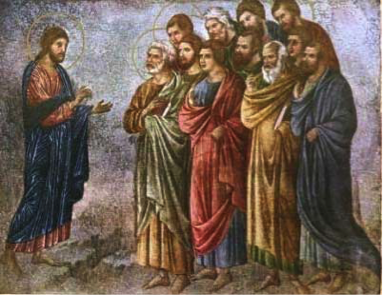
“In those days He departed to the mountain to pray, and He spent the night in prayer to God. When day came, He called His disciples to Himself, and from them He chose Twelve, whom He also named apostles: Simon, whom He named Peter, and his brother Andrew, James, John, Philip, Bartholomew, Matthew, Thomas, James the son of Alphaeus, Simon who was called a Zealot, and Judas the son of James, and Judas Iscariot, who became a traitor.” (Luke 6:12-16 NAB)
Did Jesus spend the night in prayer discerning which of His disciples He would choose to be the Twelve? And, if so, what criteria did He consider? Was He looking for the one with the greatest love for God? Or, the one who was most faithful? Or, maybe the one most loyal to Him? Perhaps the deciding quality was the ability and willingness to show compassion and mercy to others. Could it have been the ones who demonstrated love for their neighbors as they loved themselves? Or, was it the ones who had the greatest zeal to go out and spread the Good News?
One would think it would have been several or all of those things. But, then, maybe it was none of them.
And, did He learn from his prayerful conversation with God that night that Judas Iscariot would betray Him?
Who knows.
But, an even more important question came to my mind: “Would He have chosen me?”
Followed by, “If not, why not?”
In which of those qualities that, on the surface, would seem to have been the most important to Him, do I not measure up? Just a few? Or all of them?
It gives me something to pray about, to ask Him to show me where I should focus my attention.
Would you have been chosen? What would have excluded you?
“Lord Jesus, I love You and I desire to grow closer to You. I give You thanks for Your Mercy. I pray for the Grace to always trust in You, to always live the Father’s commandments, and to be Your voice, hands and feet in spreading Your Good News. Amen.”







 Reflections of a Lay Catholic