
• About
  • Books I’m Reading
  • Links

Reflections of a Lay Catholic

Reflections of a Lay Catholic

Tag Archives: Friendship

Jesus and the Woman at the Well

08 Sunday Mar 2026

Posted by Jerry Robinson in Evangelization

≈ 2 Comments

Tags

Discipleship, Evangelization, Faith, Friendship, Grace, Jesus, Jn 4:16, Jn 4:4, Jn 4:5-42, Living Water, Love, Mercy, Missionary Discipleship, OCIA, Order of Christian Initiation of Adults, Spiritual Thirst
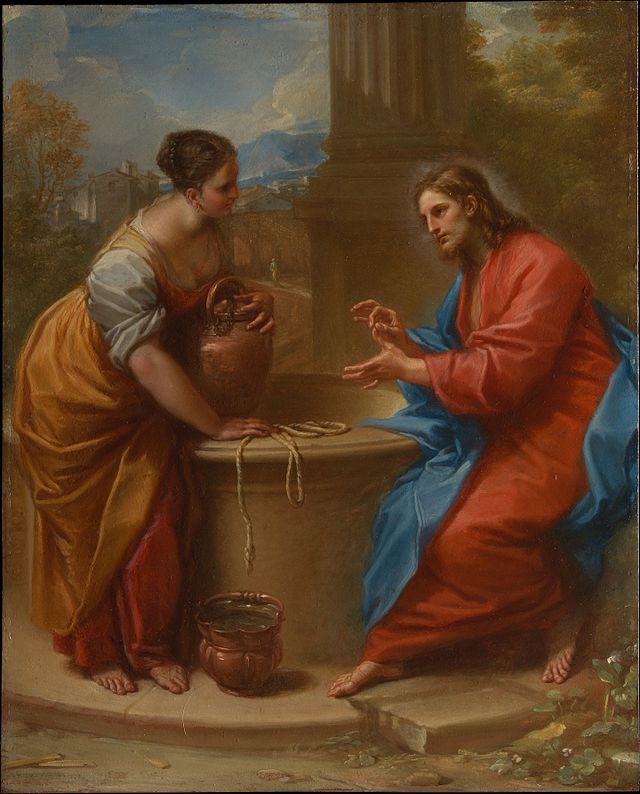
Christ and the Woman of Samaria, by Benedetto Luti, via Wikimedia Commons

It is Sunday, March 8th, the third Sunday of Lent and, for us catechists and Elect in the Order of Christian Initiation of Adults (OCIA) process, it marks the First Scrutiny leading up to the Elect’s baptism at the Great Easter Vigil.  The Scrutinies (over three consecutive Sundays) consist of Scripture passages which help us to look inside and see the truth about ourselves, our predominant faults and habitual sins; and the divine love and mercy that God bestows on us when we repent and learn to trust in Him. 

Today’s Gospel was Jn 4:5-42, Jesus’ meeting with the Samaritan woman at the well.  In this passage there are numerous messages that help us see our brokenness, our need for spiritual fulfillment, and our futile efforts for finding happiness outside of a relationship with our Lord.  But, thankfully, it shows us the joy we will find when we accept the “Living Water” that Christ offers to quench our spiritual thirst, replacing all the other things we’ve tried which failed to satiate us.

As I prepared to facilitate a discussion on this gospel, focusing on our sinfulness and the grace and mercy we receive from God in spite of that sinfulness, I couldn’t help but see a message about evangelization, as well.

In verse 4, the line before the selected passage, we read that Jesus, “had to pass through Samaria” on his way from Judea to Galilee.  Jesus didn’t have to pass through Samaria, He could have crossed the Jordan and gone around Samaria like any other cautious Jew. Passing through Samaria was risky business since Jews and Samaritans hated each other.  Thus, Jesus must have had a purpose in mind that was worth risking His and His disciples lives. That purpose must have been to encounter the woman at the well.

Jesus set an example for us – even in the face of fear, we should still evangelize and be intentional about it.  It’s unlikely any of us are at risk of losing our life by proclaiming the gospel and bringing Jesus to those who don’t know Him.  In Jesus’ case, He already knew the woman’s history, that she had failed to find happiness in her relationships, and that she was a pariah in her village.  In spite of her sinfulness, Jesus met her where she was and spoke to her heart.  We, unfortunately, don’t have that supernatural luxury. Instead, we have to explore and learn more about the people we encounter through intentional friendship so we can meet them where they are when we do present the gospel message to them.  It can feel awkward at first, but, with practice, you get the hang of it.  The perceived risk lies in our expectations of whether we will succeed or fail.  But what matters is simply that we try.

Another verse in this passage, verse 16, plays to evangelization where Jesus tells the woman, “Go call your husband and come back”.  When she responds that she does not have a husband, Jesus reveals that He knows she has been married five times and that the man she is presently living with is not her husband.  The absence of judgment and condemnation from Jesus is seen by the woman as mercy, a loving acceptance of who she is, and the essence of an immediate conversion. The woman ran home and told her whole village about Jesus, instantly becoming a missionary disciple.  When we encounter others, it is our hope that, by accepting and loving them for who they are, and sharing the gospel message that God is infinitely more gracious than our efforts could ever be, they will also become missionary disciples who will then lead others to Christ.

Tradition tells us that the name of the woman at the well is St. Photina.  She and her sons were martyred for their faith during the persecutions of Nero.  Her feast day is Friday, March 20th.  St. Photina, pray for us as we evangelize!

“My loving Jesus, may I always come to You seeking spiritual fulfillment from the Living Water that You give, and that it will be a spring that wells up within me for eternal life.  I pray for the grace to love and accept those I meet as true spiritual brothers and sisters and lead them to You so that their spiritual thirst may also be quenched.  Amen.”

(Jesus and the Woman at the Wellwas first published on the blog Reflections of a Lay Catholic)

©2013-2026 Reflections of a Lay Catholic. Reposting and sharing of material in its full and original content is permitted, provided that full and clear credit is given to the author(s) and Reflections of a Lay Catholic.


Welcoming the Stranger

24 Tuesday Feb 2026

Posted by Jerry Robinson in Evangelization

≈ Leave a comment

Tags

Almsgiving, Charity, Faith, Fasting, Friendship, Invitation, Lent, Love, Mercy, Mt 25:31-46, Prayer, Sheep and the goats, Welcoming, Works of Mercy

(A reflection on Matthew 25:31-46)

In the gospel for today, Monday, February 23rd, Matthew 25:31-46. Jesus tells his disciples that when the Son of Man comes, He will separate the sheep from the goats; that the sheep are those who fed the hungry, gave drink to the thirsty, welcomed the stranger, clothed the naked, cared for the ill, and visited the imprisoned, and the unfortunate goats are those who didn’t.  It’s all about the charitable works of mercy.

With the Lenten season upon us we should be sincerely trying to live and grow in a deeper relationship with our Lord through focused prayer, fasting and almsgiving.  However, our focus can easily become self-centered as we endeavor to stick with our plans to fast and improve our piety.  But almsgiving, the charitable and outward looking aspect of the trio, can take a back seat.  What can you do to avoid this?

Certainly you can increase your weekly contribution to the collection basket and let that serve the less fortunate in a variety of ways.  You can easily feed the hungry by purchasing groceries and drop them off at your local food pantry, or invest a little more effort by serving at a food kitchen.  You can clean out your closet and donate the seldom worn clothing to a charitable organization.  You can care for the ill and imprisoned by visiting a nursing home.  But, where will you fit welcoming the stranger into the mix this Lent?

Welcoming a stranger, someone you don’t know, is the first step in building a friendship.  It helps the stranger feel comfortable in their new surroundings by removing some of the fear they may have built up inside them.  And, In a very real sense, welcoming a stranger is the first step in evangelizing a stranger when the person being welcomed is a stranger to our faith even if we already know them.  This could be someone who is un-churched, someone from another ecclesial community other than Catholicism, or even a lukewarm or fallen-away Catholic.  The feeling of being welcomed and accepted by us for who they are as a wonderfully made child of God is necessary before any conversion will ever happen.

Fortunately most parishes have a plethora of opportunities during the Lenten season that can be avenues for evangelization through invitation, such as: Lenten missions, small group Bible studies, guest speakers, and no-pressure social functions.  And don’t forget the friendly Friday fish fries and the all powerful Stations of the Cross!  If you’re a self-starter and want to truly welcome strangers who are new to your parish, you can ask your parish office for their contact information so you can call them and arrange to meet for a cup of coffee at a local diner and offer to help them navigate their new parish surroundings.  Or simply introduce yourself at Mass or an event to someone you’ve never met before.  All of these are opportunities to evangelize by welcoming and inviting others to experience friendship and ultimately hear the gospel proclaimed.

So, who will you welcome and invite this Lent?

“Heavenly Father, this Lent I pray for the grace to grow closer to You by building self-control through fasting, by conversing with You more often in prayer, and in almsgiving by inviting others into a relationship with You, the best gift this side of heaven.  Amen.”

(Welcoming the Stranger was first published on the blog Reflections of a Lay Catholic)

©2013-2026 Reflections of a Lay Catholic. Reposting and sharing of material in its full and original content is permitted, provided that full and clear credit is given to the author(s) and Reflections of a Lay Catholic.

Take a Walk

13 Friday Feb 2026

Posted by Jerry Robinson in Evangelization

≈ Leave a comment

Tags

Charity, Evangelization, Faith, Fear, Friendship, Grace, Jesus, Love, Mark 7:31-37, Meeting others, Mercy, Proclaim the gospel, Relationships, Restraints, Walking

As Christians, we know we are supposed to follow and imitate Jesus by proclaiming the gospel message of salvation as He did.  Yet, for so many of us, that is difficult to do.  Why is that?  It’s certainly not because someone else is restraining us.  We don’t live in a country where it is illegal to live and talk about our faith.  We’re not threatened with 20 years in prison because we’re Christian.  We don’t live with the threat of having our village burned down because of what we believe.  No, the difficulty lies completely within ourselves.  Maybe it’s laziness, the busy-ness of life, letting other things become more important than God, fear, or simply a lukewarm faith.  Whatever it is, it’s so familiar to us that we don’t even give it a second thought.

Today’s Gospel from Mark 7:31-37 is the story of Jesus healing a deaf man.  What struck me about this passage was not the act of healing the man, nor that the witnesses defied Jesus and told others about it.  Rather, it was the opening sentence, “Again he left the district of Tyre and went by way of Sidon to the Sea of Galilee, into the district of the Decapolis.”  Since I have a love for geography and maps, I checked to see how far it was that Jesus actually walked.  It’s about 30 miles north from Tyre to Sidon, and then another 60 miles south to the district of the Decapolis on the south side of the Sea of Galilee.  That’s 90 miles on foot through rough and rocky territory.  Why did He make such an effort?

Jesus wasn’t just out for a stroll.  He had a purpose to bring the message of salvation to not only the Jews but to the gentiles, as well.  His method was to go out and build relationships with people, meeting them where they were in whatever physical, mental, emotional, or social state they were in.  Let’s contrast His effort with how much effort we’re willing to expend.  Most of us today live in some form of self-imposed isolation.  It’s easier to not tidy up our home and stay hidden there than to invite another over for hospitality.  Rather than get out of our vehicle to meet other parents while waiting in the school pickup line, it’s easier to stare at our screens.  Rather than recognize the poor and needy, it’s easier to keep our heads down and walk fast around them.  The list of lame reasons can go on forever.

God made us for each other.  He comes to us through other people, our families, friends, and the strangers around us.  Conversely, God reaches them through us, too.  Behind our fast-paced and technological culture, our souls are screaming for the peace we get from a little silence and solitude, yet they still need to be nourished by healthy, interdependent relationships, both old and new.  

We need to get off the couch or away from our desks, get off our screens, take a walk, and meet others who might just need to meet us.  While we’re at it, we should think about the restraints we’re imposing on ourselves that keep us from following in the footsteps of our Lord.  And then think about how we will explain this when it’s time for our particular judgment.

“Heavenly Father, thank You for the many gifts you bestow on me, especially the gift of faith.  Thank You for my family and friends who sustain me and through whom I find joy.  Help me, Lord, to grow that circle and be the friend who sustains someone else in need.  Amen.”

(Take a Walk was first published on the blog Reflections of a Lay Catholic)

©2013-2026 Reflections of a Lay Catholic. Reposting and sharing of material in its full and original content is permitted, provided that full and clear credit is given to the author and Reflections of a Lay Catholic.

Practice Makes Perfect

10 Thursday Jul 2025

Posted by Jerry Robinson in Evangelization

≈ 2 Comments

Tags

Apostles, Evangelization, Faith, Faith sharing, Friendship, Jesus, Mt 10:1-7, Small group

In yesterday’s gospel, Mt 10:1-7, Jesus sent his apostles on mission to announce that the kingdom of heaven is near.  He specifically told them to go to the lost sheep of the house of Israel rather than to pagan territory and Samaritan towns.  This is in contrast to his instructions in Mt 28:19 when, after his resurrection, he commands them to “Go, therefore, and make disciples of all nations…”.  In both cases, Jesus is telling them, and us, to evangelize.  But why the difference?

It seems as though Jesus is giving the twelve a chance to practice evangelizing to those, who, unlike the pagans, already knew the teachings of the law of Moses and the prophets and would be more receptive to their message.  He knew that taking the Word to all nations would be much more difficult.  They needed to start slow and hone their skills along the way.

There is a message here for all of us, too, who, through our baptism, are also obligated to be evangelists on mission.  We need to continuously increase our knowledge and understanding of our faith, and become more skillful at professing it, before we can expect to be proficient at making disciples of all nations.  We need to begin with baby steps.  

The best way to do this is to spend time with our friends in conversation about our faith, discussing the message of the gospel and what it is saying to us. I’m sure the apostles spent time together out of earshot from Jesus discussing all that they were learning, and sharing what it meant to them. By sharing our thoughts and insights in small faith sharing groups, or faith-based conversations over a meal with friends, we strengthen our faith and grow in virtue, and are better prepared to articulate to others His message of salvation.

I’m sure your parish offers opportunities to gather with other men and women in small faith-sharing groups and Bible studies at which you can safely share what it is that you hear God saying to you, and listen to and learn from others about the graces they receive through prayer and service.  But, you don’t have to depend on your parish to organize groups or meetings.  You can simply start from scratch by inviting friends to your house for a meal, spend a relaxing Sunday afternoon getting to know each other better, and interjecting faith based conversation into the experience.  Do this enough and it will become second nature.  Whether you realize it or not, you will be evangelizing each other.  And, you will eliminate the fear that accompanies the prospect of evangelizing to people you don’t know.

“Lord Jesus, thank You for giving me insight into how to become a more effective evangelist, and for Your patience while I learn.  You know I can’t go from zero to sixty in three seconds, but need space and time to accelerate slowly.  You gave Your Apostles three years and even then they hesitated.  I pray for the grace to grab hold of the opportunities to evangelize when You place them before me.  Amen.”

(Practice Makes Perfect was first published on the blog Reflections of a Lay Catholic)

©2013-2025 Reflections of a Lay Catholic. Reposting and sharing of material in its full and original content is permitted, provided that full and clear credit is given to the author(s) and Reflections of a Lay Catholic.

Curious Like Nicodemus

29 Tuesday Apr 2025

Posted by Jerry Robinson in Evangelization

≈ 1 Comment

Tags

christianity, Evangelization, Faith, Fear, Friendship, Grace, Jesus, Jn 3:1-15, Nicodemus, Prayer

Jesus and Nicodemus, Crijn Hendricksz Volmarijn, c. early 1600s

The Gospels for yesterday and today (Jn 3:1-15), put us in the scene with Jesus and the renowned Pharisee, Nicodemus, who came to Jesus under the cover of darkness to ask questions about his ministry.  We are led to believe that Nicodemus must have seen or heard of Jesus’ healing miracles and wanted to learn more about him.  We know that Nicodemus eventually converted to be a secret follower of Jesus, so we can surmise that his curiosity was genuine and not a ploy to trap Jesus.

The fact that he came to meet Jesus at night may also give us a clue about his intentions.  A nighttime rendezvous would be less conspicuous.  If he was genuinely interested about Jesus, he may have feared being observed by other Pharisees that could result in his condemnation and rejection.  In his position, he would have accumulated wealth that supported a luxurious lifestyle, which would have been jeopardized if his clandestine meeting had been discovered.

When I placed myself in this scene, I pondered Nicodemus’ motive and his dilemma.  He had to satisfy his curiosity for truth, but the answer could result in his ruin.  His fear of the environment and exterior influences would ultimately cause him to lead a secret and unfulfilled life.

There are millions of Nicodemuses in our world today – men, women, and teens, who are searching for truth, who are curious about Christianity, and who would like to know more but, because of negative social influences, balk at publicly asking questions for fear of what others will think or what they might lose.  They are hiding out there in our workplaces, our schools, and our neighborhoods.  We should be looking and waiting for them with intentionality, ready to answer their questions and allay their fears.

When a modern day Nicodemus does muster the courage to step out and seek answers, he may simply want to learn more about Jesus, or he’s aware that there’s possibly a different set of beliefs and a better way to live than he’s ever experienced.  His curiosity may manifest itself by privately asking questions to a Christian friend or acquaintance.  When he does, he is giving us an opportunity to evangelize, and we need to respond utilizing good listening skills.  His questions may be phrased in ways that hide their real intent, and we may have to look behind the words.  We should not make stuff up, nor answer questions with excess theology.  He needs simple answers, and if we don’t know an answer, we should say so and endeavor to find the answer for him.  We should try to avoid vocabulary that is foreign to non-Catholics.

Like Nicodemus, his questions may appear antagonistic but probably aren’t meant to be so.  Instead, they are likely due to his personal cynicism and relativism that has developed over years.  He’s not ready to reveal that he’s on any kind of spiritual quest.  He is curious but cautious, and still needs to feel safe and unthreatened when asking questions.  We should respond in a friendly manner to increase the trust that has allowed him to ask questions in the first place.

Our gentle evangelizing should have an eye towards bringing this person from a a place of curiosity to being open to exploring the idea that God is a personal God rather than a concept, and that we can have a relationship with Him.  We can introduce him to Jesus and the story of His passion, death, and resurrection in atonement for our sins.  And we should be patient and pray for him, being grateful that, while he may not yet be making a commitment to spiritual or personal change, he no longer rejects the idea. 

“Heavenly Father, I thank You for the virtue of fortitude given to me with my Confirmation that has prepared me to proclaim the saving message of salvation of Your Son, Jesus.  May I ever be vigilant and prepared to welcome anyone who is curious about our Christian faith.  I pray that Your Spirit affords me the grace to respond to them lovingly with humility and gentleness.  Amen.”

(Curious Like Nicodemuswas first published on the blog Reflections of a Lay Catholic)

©2013-2025 Reflections of a Lay Catholic. Reposting and sharing of material in its full and original content is permitted, provided that full and clear credit is given to the author(s) and Reflections of a Lay Catholic.

I AM

10 Thursday Apr 2025

Posted by Jerry Robinson in Bible Reflections

≈ Leave a comment

Tags

Abraham, Accompanyment, Eucharist, Friendship, I AM, Jesus, John 8:51-59, Meditation, Prayer, Present moment, Reconciliation, Sacraments

From 1968 to 1971 I spent my junior high and first year of high school in English grammar schools in the U.K.  My typical weekly class schedule was a far cry from what I’d received in American grade schools.  It included:  math, biology, chemistry, physics (not just one but all three), history, geography (not social studies), English, and one or more foreign languages.  I took French all three years, plus German as an 8th grader, and Latin in the 9th grade.  Unfortunately, none of it stuck with me.  One thing I do remember clearly, though, is conjugating verbs – first, second, and third person singular and plural, in past, present and future tenses.  In any language, we always began with the verb “To Be”, i.e., “I am” (first person singular present tense); “You were” (second person singular/plural past tense); and “They will” (third person plural future tense).  

I recalled this today while meditating on today’s Gospel from John 8:51-59, in which Jesus had an altercation with a group of Jews over the identity of their fathers:  God as the Father of Jesus, and Abraham as the father of the Jews.  Jesus states, “Amen, amen, I say to you, before Abraham came to be, I AM.”, effectively claiming that He was equal to God, (see Ex 3:14-15).  Because this was blasphemous to the Jews, they attempted to stone Him to death.

“I AM” – the first person singular present tense of the verb “To Be”.  Jesus speaks about Himself.  If we were talking to Jesus, we would say, “YOU ARE”.  If we were talking about Jesus to someone else, we would say, “HE IS”.  Jesus doesn’t say, “I WAS”, or “I WILL BE”, in the past or future tenses, and we can’t say about Him, “HE WAS”, or, “HE WILL BE”.  Jesus is simply, “I AM” day after day, moment after moment, with every tick of the second hand.  HE IS now, and HE IS again in the next moment.

We can’t think that Jesus was with us once, or that He will be with us one day to come.  No, He is with us only NOW, at this present moment, and every present moment to come. He is there with us in every present moment regardless if the circumstances of that moment are to our liking or not.

Don’t we often forget this, especially when times are tough?  When remembering events from the past that caused you grief, don’t you sometimes wonder, “Why was He not there when I needed Him?”  But, we forget that HE IS there, and if we had remembered this, we would have found comfort in His presence.  When we unite our crosses with His cross, He helps us carry ours.

Or, consider some dream you have of the future and how you will pat yourself on the back for thinking, “Wow, look what I accomplished!”  We forget that HE IS with us then, too, and that it is only through His grace that we will find that joy and satisfaction we now imagine.  

Whether it’s in good times or bad, when we lose the feeling of closeness with Jesus, we open a doorway allowing the Enemy to lead us down the wrong path.

How do we keep in mind that Jesus is with us at every moment, ready to answer our call?  The first and best way is through prayer.  Developing a habit of daily prayer keeps Him close to us. Prayers of praise, thanksgiving, and asking for His intercession are all ways to acknowledge His presence.  More effective yet is meditative prayer, when we take time to sit in silence and solitude, lovingly conversing with Him, telling Him what’s on our minds and hearts, and listening for His loving reassurance.  In this way, we readily remember all the times we’ve felt His presence, and reinforce our trust in Him in the present moment.  

Reading scripture, especially the Gospels, before entering into prayerful meditation is an excellent way to relate to Jesus and His love for us.  During this time of closeness, we receive the graces and mercy we need to persevere through our anxieties.  And when we act on these promptings of grace by adopting a resolution to change or accept our situation, we again grow in trust with Him.

When we receive the Sacraments of the Eucharist and Reconciliation, we immediately feel His presence. The Eucharist gives us supernatural strength to combat sin in our lives.  But then, when we fall and regret our actions, we can turn back to Him in the Sacrament of Reconciliation, be restored and experience His merciful love.  

Remembering that our Lord works in us through our interpersonal relationships helps us feel His presence, also.  A network of faithful friends accompanying each other provides a source of encouragement and support when times get tough.  It can keep us grounded, reminding us to be grateful to God.

“Dear Jesus, I know deep in my heart that You are always by my side.  My faith can get clouded when the world challenges me, and even when everything is going my way.  Help me, Lord, to remember You, to meet You each and every day through prayer and frequent reception of the Sacraments.  I love You, Jesus, and I know You love me.  Amen.” 

(I AM was first published on the blog Reflections of a Lay Catholic)

©2013-2025 Reflections of a Lay Catholic. Reposting and sharing of material in its full and original content is permitted, provided that full and clear credit is given to the author(s) and Reflections of a Lay Catholic.

You’re the Best!

23 Monday Sep 2024

Posted by Jerry Robinson in Bible Reflections

≈ 2 Comments

Tags

Charity, Christ Renews His Parish, CRHP, Cursillo, Friendship, Humility, Jesus, Love, Mark 9:30-37, Matthew 7:5, Pride, Welcome, Who is the Greatest?

In yesterday’s Gospel, Mark 9:30-37, we find Jesus journeying through Galilee with His disciples on their way to Capernaum.  Along the way the disciples are arguing about which of them is the greatest in the Kingdom.  As I reflected on this passage, I could imagine how that conversation went.  John tells Peter, “Hey, bro, you’re the best!”, and Peter replies, “No way, you are!”.  Then James looks at them both and says, “Hey, Philip is the greatest!”, and Philip replies, “Uh uh, Andrew is!

What?  You don’t think this is the way it went?  You think their egos were claiming that they personally were the greatest in the Kingdom?  Yeah, you’re probably right.  Most likely, they each thought their faith was stronger, their actions were more charitable, they worked harder than the other.  Not much has changed in two thousand years, has it?

Our pride does this to us.  We have the need for accomplishment, to feel relevant, to feel worthy, to feel validated by our friends and family, our co-workers.  And when we don’t get what we think we deserve, our egos self inflate as a defense mechanism.  We may not tell another that we’re better than they are, but we certainly feel that way much of the time.  We easily see their faults but neglect to see our own.  Jesus pointed this out when He told us to remove the beam from our own eye and then we will be able to remove the splinter from the eye of our brother (Matthew 7:5).

But what if it wasn’t that way?  What if we ditched our pride and put on a cloak of humility and actually recognized the positive attributes of others and praised them for their goodness?  I’m not talking about false patronizing praise, the kind that makes you want to throw up.  I’m talking about sincere, honest, heart-felt recognition for the dignity of the other, the kind of charity that values another over one’s self.  It’s not just possible, it actually happens.

This is the kind of loving relationship you find when a group of Christians spend time together growing in friendship, getting to know each other on a deep level.  Sure, they know each other’s faults but it’s because the person owning the fault has the self-knowledge and humility to share their weaknesses with their friends.  And those friends, rather than rub it in, help the other overcome and improve.  In a relationship like this, each knows their validation comes from the Lord, that they are a beloved son or daughter of God.  And because of this, they can love as Jesus loved, placing another ahead of themselves without any anxiety about their worth.

Friendship like this can be found in small Bible study groups; with friends who frequently share hospitality; and, especially, those who pray together.  It’s the kind of respect and love you find between members on a retreat team such as Christ Renews His Parish, Welcome, or Cursillo.  It’s the kind of love that brought me to an encounter with Jesus and has helped sustain me for the last twelve years.  It’s life-giving friendship that makes life worth living for everyone involved.  Your parish probably offers opportunities to become involved in ways in which you can experience love like this.  Get you some!

“Heavenly Father, thank You for the life to which You have brought me.  Thank You for the men and women You’ve placed in my life who have invested in me and accompanied me on my journey to You. I pray for the grace to help others do the same.  Amen.” 

(You’re the Best!, was first published on the blog Reflections of a Lay Catholic)

©2013-2024 Reflections of a Lay Catholic. Reposting and sharing of material in its full and original content is permitted, provided that full and clear credit is given to the author(s) and Reflections of a Lay Catholic.

Evangelization Happens at the Pace of Relationship

11 Wednesday Sep 2024

Posted by Jerry Robinson in Evangelization

≈ 3 Comments

Tags

Catholic, church, Culture change, Evangelization, Friendship, Jesus, Love, Love of Neighbor, Mercy, Relationships

In just over a week autumn will be here and summer will officially be over.  With school starting, most parishes have wrapped up their festival season, had their parish picnics, and are beginning to prepare for the season of Advent.

Our parish family had its picnic in August.  (Perhaps I need to explain what I mean by “parish family”.  We have a priest shortage forcing our Archdiocese to combine parishes into parish families.  Our “family” consists of two established churches whose boundaries abut each other.)  To help transition from two parishes into one canonical parish with two campuses, we had one picnic for both churches.  

I made it a point to wander around and meet people I didn’t know and to get reacquainted with folks I hadn’t seen in a while.  I saw one couple whom I had not seen in four or five years sitting alone.  They regularly attend the church that I don’t usually attend.  They were eating their meal so I sat down with my plate of food and we reconnected.  I asked them how long they had been parishioners and they replied they’d been there about nine years.  I said, “You must know a lot of folks here, then.”  They looked at each other and replied, “No, not really.”  I responded, “That’s too bad, do you feel welcome here?”  They again exchanged glances and replied, “No, not really.”

Sadly, this is not an uncommon sentiment by many parishioners.  I’ve met too many people who feel the same.  They’ve attended church for years but have made no real friends.  People from the church I regularly attend have confided the same to me.  My family has experienced this with our many relocations.  And these days, because my wife and I travel often, we attend Mass at more than a dozen different churches each year and it’s rare that anyone takes the time to welcome our unfamiliar faces.

It’s easy for us to say that those who feel unwelcome are partly responsible due to their own introvertedness.  But that doesn’t excuse the rest of us.  We’re not all introverted, but even those who are can learn to be extroverted when called to be such.

By virtue of our faith we are all called to reach out to others and build up the body of Christ, the Church.  In other words, we are called to evangelize.  And evangelization happens at the pace of relationship.  Relationships are begotten when we intentionally meet and get to know each other.  Relationships build trust, and being trusted is essential when we are trying to proclaim the Gospel and bring others to, or closer to, Jesus.

Evangelization is often considered to be something we only do outside the church doors, to the un-churched.  We need to change our thinking.  We have to evangelize within our church family as well.  At any moment, parishioners like those I met at the picnic may decide that if they don’t meet anyone this Sunday, they’re gone!  Tragically, Catholics are leaving the faith in droves, partly because they do not feel welcome.  It’s a problem our Catholic culture has to overcome if we want to survive.  We have to get beyond the idea that our only responsibility is to attend mass each week and go to confession once a year.  Our Creed says we are “One”.  We need to start acting like we are all One family and loving the other as they deserve and need to be loved.  

We are called to be merciful like Jesus was merciful.  That includes practicing the Spiritual Work of Mercy of comforting the sorrowful.  We can’t keep looking past people like they are invisible, rather we have to understand that many are struggling, and that not everything is copacetic in their lives.  People going through a tough time need a listening ear.  A friendly smile and welcoming conversation can turn a difficult day into one of joy and hope.  The making of a new friend can end a life of loneliness.  And personally, the next new person you intentionally meet might just be your next best friend, the someone you need but just don’t know it yet.

Make it a point to meet someone new this Sunday or at your next parish activity.  Be intentional.  Attend a different mass, sit in a different pew, look for that spot in a pew next to someone you don’t know.  Then, after Mass, turn to them with an outreached hand and introduce yourself.  When they respond, take the conversation from there, listening to learn more about them.  It’s not that hard and you’ll be glad you gave it a try.

“Come Holy Spirit, rekindle in me and all those who have been Confirmed the virtue of fortitude to get out of our comfort zones and seek out those who need us.  Help us to look beyond ourselves and commit to bringing the love of Christ to others.  I thank You, Lord, for all those you have placed in my life who have reached out with a friendly hand and a comforting smile and made me feel a welcome member of our Catholic family.  Amen.”

(Evangelization Happens at the Pace of Relationship, was first published on the blog Reflections of a Lay Catholic)

©2013-2024 Reflections of a Lay Catholic. Reposting and sharing of material in its full and original content is permitted, provided that full and clear credit is given to the author(s) and Reflections of a Lay Catholic.

Biscuits and Gravy

11 Thursday Apr 2024

Posted by Jerry Robinson in Evangelization, Faith, Friendship

≈ 3 Comments

Tags

Biscuits and Gravy, Catholic, Evangelization, Faith, Friendship, Missionary Discipleship, The Rescue Project

My southern-raised grandmother had a saying when she received something good over and above what she expected:  “Well, isn’t that just gravy on the biscuit!”.  This Lent our parish offered a faith-filled “biscuit” and got a heaping ladle of “gravy” thrown in.

Approximately ninety parishioners and parishioners-to-be gathered to experience The Rescue Project, a faith-building/evangelization program.   Participants sat at the same table of eight, and, over eight weeks, filled their bellies with good food and their minds and souls with delicious “biscuits” – an expected deeper understanding of our Catholic faith.

The “gravy” came in the form of evangelizing through developing friendships.  Many at the tables were strangers to each other, so table leaders had to be intentional about creating an inviting atmosphere for everyone to comfortably share their personal insights and what they received from the presentations.  This intentionality had to stem from a genuine interest in the other person and a desire to get to know their story.  With each successive week, participants became more comfortable and trusting, laughed and cried together, and became close friends.  Since the program ended, table members have arranged to meet for meals, for prayer, and have stayed in touch supporting each other in their daily walk with Christ.  

Everyone who attended The Rescue Project came to be inspired in their faith, and they left with much more – new friends with whom they could share their love for Jesus.  But, those ninety folks are not unique in the world.  There are millions just like them eager for friendship and the chance to tell their story if only someone is interested enough to listen. They are in our parishes, our neighborhoods, and our workplaces.  They are the people sitting next to you in the church pew, or the new parishioner who’s just moved to town and doesn’t know anyone.  They could be someone who is lost and despairing, who is blindly looking for salvation.  God put you in their path on purpose.

To be missionary disciples, we need to intentionally seek opportunities to be friends who can bring others to Christ.  We need to be welcoming and hospitable, and help others find joy in the world by delighting in them and helping them feel relevant, that they are beloved sons and daughters of God.  God made us for each other.  He shows His love for us through other people.  Your next best friend may just be the person you’re about to meet.  Delight in them.  Be the “gravy” on their “biscuit”.

“Heavenly Father, thank You for the gift of faith, for the gift of friendship, and the opportunity to bring the two together.  Thank You for Fr. John Riccardo and his ACTS XXIX team for developing The Rescue Project.  Thank you for putting it on the hearts of so many in our parish to participate and bring the love of Christ to others.  Amen.”

(Biscuits and Gravy was first published on the blog Reflections of a Lay Catholic)

©2013-2024 Reflections of a Lay Catholic. Reposting and sharing of material in its full and original content is permitted, provided that full and clear credit is given to the author(s) and Reflections of a Lay Catholic.

Faith is Personal…but Should Never Be Private

26 Tuesday Mar 2024

Posted by Jerry Robinson in Evangelization

≈ 6 Comments

Tags

Catholicism, Confirmation, Evangelization, Friendship, Holy Spirit, Prayer, Virtue

Jesus Sends the Apostles – Duccio di Buoninsegna, c.1300

We all know people who claim to believe in God but then won’t talk about it.  They clam up and say their faith is personal…end of discussion.  They are right, one’s faith is, and should be, personal.  But Jesus never intended for it to be private.  He tells us in the Gospels to go and be disciples.  How can we evangelize if we keep our faith private?

The most common excuse for keeping one’s faith private may be that the basics were never learned well enough in the first place to share it with, or defend it before, others.  One can easily deflect blame onto one’s teachers or parents, but to remain in this state is to succumb to the deadly vice of sloth, which is a laziness or a lack of love for the ways of God. The virtue opposing sloth is diligence, which may simply mean spending a little time each day learning more about one’s faith through daily prayer, reading scripture or other Catholic publications, or listening to Catholic television, radio, or podcasts, all of which can help us increase our understanding of our faith.

Another is our failure to fully understand and accept the graces we received at our Confirmation.  The infusion of the Holy Spirit supernaturally strengthened the virtue of fortitude within us, enabling us to share in the mission of Jesus Christ to spread and defend our faith.  Like a child who receives affirmation from a parent over a good behavior continues to improve in that behavior, we, too, simply have to believe we already possess what we need.

And, finally, the exigencies of modern life can make us forget that we need other people. Jesus didn’t live as a hermit.  He gathered family and friends with whom He shared life.  St. Paul urged the Corinthians to not live their faith privately but in community with one another.  Like an ember that falls away from a fire and dies out, we can grow cold if we don’t stay close to others who are on fire with their faith, and others can grow cold if we don’t bring our fire to them.

To effectively evangelize, we can’t be passive.  We have to actively learn, strengthen our relationship with Jesus through prayer and study, and build friendships with those whose fires need stoking.

“Lord Jesus, I pray for the grace to love You more dearly, and to exercise the grace which You’ve already bestowed on me in my Confirmation to bear fruit for Your Kingdom. Amen.”

(Faith is Personal…but Should Never be Private was first published on the blog Reflections of a Lay Catholic)

©2013-2024 Reflections of a Lay Catholic. Reposting and sharing of material in its full and original content is permitted, provided that full and clear credit is given to the author(s) and Reflections of a Lay Catholic.

← Older posts

Enter your email address to follow this blog and receive notifications of new posts by email.

Join 264 other subscribers
Follow Reflections of a Lay Catholic on WordPress.com

Recent Posts

  • Jesus and the Woman at the Well
  • Welcoming the Stranger
  • Take a Walk
  • Winter Respite
  • Are You Ready to Proclaim the Gospel?

Categories

Top Posts & Pages

  • Where are you at Calvary?
  • Is Your Faith Contagious?
  • Peace Be With You
  • Giving Your Heart
  • How to Make a Thorough Examination of Conscience - Part 1: The "Checklist" Method
  • The Anti-Beatitudes
  • Ephphatha!
  • How Will You Evangelize?
  • Soil Conditioning for the Heart
  • Listen to Your Mother!

Archives

  • March 2026
  • February 2026
  • January 2026
  • September 2025
  • August 2025
  • July 2025
  • May 2025
  • April 2025
  • February 2025
  • January 2025
  • December 2024
  • November 2024
  • September 2024
  • July 2024
  • May 2024
  • April 2024
  • March 2024
  • February 2024
  • January 2024
  • December 2023
  • November 2023
  • October 2023
  • September 2023
  • August 2023
  • June 2023
  • May 2023
  • April 2023
  • March 2023
  • February 2023
  • January 2023
  • December 2022
  • November 2022
  • October 2022
  • September 2022
  • June 2022
  • May 2022
  • April 2022
  • March 2022
  • February 2022
  • January 2022
  • November 2021
  • July 2021
  • June 2021
  • May 2021
  • April 2021
  • March 2021
  • February 2021
  • January 2021
  • November 2020
  • October 2020
  • September 2020
  • August 2020
  • July 2020
  • May 2020
  • April 2020
  • March 2020
  • January 2020
  • December 2019
  • November 2019
  • September 2019
  • July 2019
  • June 2019
  • May 2019
  • April 2019
  • March 2019
  • January 2019
  • December 2018
  • November 2018
  • October 2018
  • September 2018
  • August 2018
  • July 2018
  • June 2018
  • May 2018
  • April 2018
  • March 2018
  • February 2018
  • January 2018
  • December 2017
  • September 2017
  • August 2017
  • July 2017
  • June 2017
  • May 2017
  • April 2017
  • March 2017
  • February 2017
  • December 2016
  • November 2016
  • October 2016
  • September 2016
  • August 2016
  • July 2016
  • April 2016
  • March 2016
  • January 2016
  • December 2015
  • November 2015
  • September 2015
  • August 2015
  • July 2015
  • June 2015
  • May 2015
  • April 2015
  • March 2015
  • February 2015
  • January 2015
  • December 2014
  • November 2014
  • October 2014
  • September 2014
  • August 2014
  • July 2014
  • June 2014
  • May 2014
  • April 2014
  • March 2014
  • February 2014
  • January 2014
  • December 2013
  • November 2013
  • October 2013
  • September 2013
  • August 2013
  • July 2013
  • June 2013
  • May 2013
  • April 2013
  • March 2013
  • February 2013

Meta

  • Create account
  • Log in
  • Entries feed
  • Comments feed
  • WordPress.com

©2013 – 2026 Reflections of a Lay Catholic. Reposting and sharing of material in its full and original content is permitted, provided that full and clear credit is given to the author(s) and Reflections of a Lay Catholic.

Create a free website or blog at WordPress.com.

  • Subscribe Subscribed
    • Reflections of a Lay Catholic
    • Join 264 other subscribers
    • Already have a WordPress.com account? Log in now.
    • Reflections of a Lay Catholic
    • Subscribe Subscribed
    • Sign up
    • Log in
    • Report this content
    • View site in Reader
    • Manage subscriptions
    • Collapse this bar
 

Loading Comments...