In today’s first reading from Paul’s letter to the Church in Colossae (Col 1:1-8), St. Paul writes that he and Timothy offer prayers of thanksgiving for them because of their faith in Jesus and their hope for heaven.
We say prayers of petition asking for God’s help, often for the intentions of someone we love to grow deeper in their faith. We say prayers of thanksgiving for all the grace and mercy we receive but don’t deserve. But, how often do we give thanks and pray for those who already know the love of Christ, who follow Him, and who proclaim the Gospel at every chance? Do we tell them and affirm them that, by glorifying God with their words and in their actions, they are making the world a better place, that they are doing their part to grow His Kingdom? Maybe not so much.
We are one Church, one Body, and, if we practice the theological virtue of charity as we ought, we look outside of ourselves to other people. Usually our focus is on the poor and needy, the sick, and those who are far from our Lord. But, we can’t forget to recognize the good that people do, especially the good that results from those who have a deep faith and love for Jesus. Without them, there would be no proclamation of the Gospel and no propagation of the faith.
Our world today presents us with endless disorder and distractions that work to diminish the faith of even the strongest among us. Couple this with the natural force of entropy, and the faithful are faced with a constant uphill battle. Is there any wonder why Christianity, and especially Catholicism, in America is on the decline? Perhaps one reason is that we do not affirm, accompany, and pray specifically for continued courage and strength for all of our holy brothers and sisters, especially our priests, who are committed to making disciples and bringing the love of Christ to all people.
“Heavenly Father, I give You thanks for all the holy priests, deacons, religious, lay leaders and evangelists, and spiritual directors who proclaim the Gospel in their words and deeds. I don’t encourage them and pray for them nearly as much as I should. Thank You for opening my heart and mind to Your Word today. I resolve to sow the seeds of this Word by making a concrete resolution to pray daily for, and give thanks for all those who are leading the charge in the battle to win souls. Amen.”
(Pray Like Saints Paul and Timothy was first published on the blog Reflections of a Lay Catholic)
The Parable of the Laborers in the Vineyard, Andrey Mironov
As I sit down to write it occurs to me that it’s been two months since my last post. Time flies when you’re having fun! Since June I’ve road-tripped about seven thousand miles and I hope to write soon about some of the blessings received on both sides of the windshield. But, mostly, I’ve been busy at my new job trying to find ways to evangelize and bring people to Jesus through other people. I told a friend the other day that, for the first time in a couple decades, I look forward to going to work every morning! I am blessed!
Just because I haven’t written doesn’t mean I’ve not been inspired through reading Scripture and daily meditation. Quite the contrary, my prayer life has been amazing. But, I’ve put other things of importance ahead of writing. Let’s see if I can fix that tonight.
In today’s Gospel from Matthew, Mt 20:1-16, Jesus tells his disciples the parable of the landowner hiring the laborers for his vineyard. He hires some in the morning and then more every three hours during the day. The last hired, at five o’clock, received the same daily wage at six o’clock as those who were hired first thing in the morning. Those laborers who worked all day grumbled about the unfairness of it all, comparing their labor to those who only worked one hour. The landowner reminded them that they were paid what they had agreed on and asked them, “Am I not free to do as I wish with my own money? Are you envious because I am generous?”
Can you imagine that scene? How would you feel if you were one of the laborers hired early and had worked hard all day only to be paid the same as someone who’d not yet broken a sweat? If you’re like me, you’d have grumbled, too. And we both would have succumbed to the deadly sin of envy.
Envy is the vice of finding sorrow in the good fortune of someone else. It can also be the feeling of joy at someone else’s misfortune. It’s the vice associated with comparing one’s self to another. And, when we grumble about the unfairness, we are directing our complaint to God.
As I read this passage this morning I recalled a moment some twenty-one or twenty-two years ago. My youngest daughter, Grace, was five or six years old. She had lost a tooth and placed it under her pillow in hopes of finding money left by the Tooth Fairy when she awoke the next morning. The “Tooth Fairy” was, I think, very generous with the dollar he left under her pillow. But, when Grace awoke and found the dollar, she threw it across the room and exclaimed, “Hannah (her best friend) got five dollars for her tooth!”, and, sobbing, buried her head back in her pillow.
Of course, Grace was too young to really understand the concept of finding joy in another’s good fortune; and too young to understand, appreciate and be grateful for the blessings generously bestowed upon her that others may not receive. She was too young to understand that we have to combat the vice of envy with the virtues of gratitude and generosity. She was only five or six years old.
Sadly, many folks haven’t improved much by the time they reach 25, or 40, or 65 years old. They often still feel envious over someone’s larger and fancier house, of their new high performance car, of their luxurious vacation, or simply that they have more friends and get more likes on their social media account. I think, though, that I’ve made some progress now that I’m 66. I find that I am happy for another when they receive special recognition, or when it seems that luck has found them instead of me. I’m happy with my state in life and don’t desire more than I need. Through grace, I know that I am loved and that the Lord has been super generous to me, more so than I deserve. And, I know it’s His business to decide the blessings He gifts to each one of us. He’s free to do as He wishes with His own graces. It’s not for me to compare what others receive to what He gives me.
Well, to be honest, maybe It’s more truthful to say that I feel that way most of the time.
Oh, I didn’t mention that my daughter Grace not only received a dollar that morning for her tooth, but she also received the truth about the Tooth Fairy.
And the Easter Bunny.
And Santa Claus.
And then I went and had a talk with Hannah’s dad.
“Gracious and loving God, thank You for all the blessings You so generously bestow on me. I know that I do not always say ‘thank You’. Help me to always be joyful and sincerely grateful over another’s good fortune and the blessings they receive from You, knowing that You willed it out of love for them. May I always rejoice in the many ways that You bless all Your children. Amen.”
(Envy, Unfairness, and Grace was first published on the blog Reflections of a Lay Catholic)
A good friend and I often text each other about parish functions and she occasionally includes a colored heart emoji within her text. A couple months ago she responded to a text of mine and it included a blue heart emoji. I couldn’t remember ever getting any message with anything but a red heart emoji so I wondered, “why blue?” I did an internet search on what the different colored emojis mean and, whoa!, I wasn’t prepared for what I found.
The first site I went to indicated that a blue heart alluded to a desire for BDSM (bondage, discipline, sadism, masochism). I won’t even mention what the other colors signified. Then I realized I was looking at a site devoted strictly to sexual connotations. (Don’t get any ideas, we are both happily married to our own spouses!) Continuing on to two other sites, I read where blue indicates trust, confidence and loyalty. Phew, that sounded much better!
In perusing the various sites I found that each color has a general, but not universal, loosely accepted meaning. For example: Green might mean jealousy; Purple, sensitivity; Yellow, happiness; and, of course, Red universally means true love; but there are no consistently recognized conventions for each color.
Well if that’s the case, I thought, why can’t I devise an emoji color scheme for Catholics? It might catch on or at least keep my good friend out of trouble.
The heart symbol is synonymous with a feeling of love for something. In our faith, we know that love means more than just a feeling, and love takes a different form depending on the object of our love. To begin, we can fall back on the four types of love expressed by the Greeks: Eros, or Romantic love; Storge, or Familial love; Philia, or Friendship; and Agape, Unselfish love for mankind (enemies included) because they are simply children of God.
Let’s start with Eros, romantic, passionate love. No question about it, it has to be red.The love we have for our family ought to be green. It’s fresh and fun and is always growing.I like what others say about blue – a friend is loyal, someone in whom you have confidence, someone you can trust.Yellow should be for Agape love – warm and caring for our fellow humans, and a love that desires the other’s good.Orange makes me think of autumn leaves, pumpkins, and Thanksgiving. This heart should be used to express love and gratitude to someone for the gifts they bring, especially to show your gratitude for how God has worked in your life.Purple is the color of the priest’s vestments worn during reconciliation and so this heart has to be used to express forgiveness from one person to another.In Catholic tradition, the fourth Sunday of Lent is called Laetare Sunday, or Joyful Sunday, and rose colored vestments are worn. Thus, the pink, or rose, colored heart ought to be used to express joy.And to wrap things up, the black heart needs to be used to express sorrow for another’s loss.
What do you think? We need some morality and consistency among Christians when using emojis. We can’t just attach any color emoji to a text or social media post without making it mean something. And, when the uninformed (the rest of the world) questions why you used a color that they think means something different, you can correct them and even use it as an opportunity to evangelize!
Share this with everyone you know. Let’s get the word out and take back the internet! Can I get an “Amen”?
(Heart Emoji Colors for Catholics was first published on the blog Reflections of a Lay Catholic)
I’ve been settling into my new office in our parish center and trying to make it functional for my use. My computer and phone are conveniently located, files are arranged in the file cabinet, and books are in the bookcase. I have a crucifix and a cast figure of the Blessed Mother holding the child Jesus hanging on the walls, and I hope to get some pictures hung soon. Finally, I’ve adorned it with a couple house plants to make things look more inviting.
My wife has exclusive ownership of a ‘green thumb’ in our family and I had to ask her advice for how often to water the plants. She told me in a not so endearing tone of voice, “If the soil feels dry, water it!” From experience, I know that if you pour water on the soil from the top, it often comes out the hole in the bottom of the pot and makes a mess on whatever surface it’s sitting. So, my master gardener better-half gave me a shallow plastic tray in which to set the potted plants and then told me to fill the tray with water. She said the soil in the pot would soak up the water through the hole in the bottom of the pot.
The other morning, when I checked, the soil was somewhere between dry and parched. It needed a drink. I heeded her advice, filled the tray with water, and set the pot in it.
I then went about my business of sketching out a plan of how to create an evangelizing culture in our parish, to wit: how to develop a more welcoming and hospitable community where people will intentionally build relationships with each other; how to grow an attitude of charity towards “neighbors”; and how to encourage people to not be afraid to share their faith with others.
After an hour or so, I noticed that the half inch of water I’d poured into the tray had disappeared. Just as I was told, the soil had soaked it up. I envisioned the water molecules defying gravity as they flowed upwards, saturating the soil. I thought about how thirsty that plant must have been.
Then it struck me – plants aren’t the only thing that thirst for water, we humans do, too. Except, our thirst is for the Living Water (Jn 4:10). We may not understand it, but our souls yearn for it. Our deepest desire, and the only true way of living a spiritually healthy life, is to seek God, the one in Whom we live and move and have our being (Acts 17:28). It is God Incarnate, Jesus, that sustains our life.
I had omitted from my notes the most crucial element about a culture of evangelization – a deep relationship with our Lord. Without it, evangelizing amounts to a worthless attempt. If the ultimate reason for evangelizing anyone is to bring them into a relationship with Christ, we are hypocrites if we try to evangelize without having our own personal relationship with Jesus. How can we lead someone to a place which we haven’t been ourselves?
What is a deep and loving relationship with Christ? Well, what makes up a deep and loving relationship with anyone? Basically, it’s friendship. The essence of friendship is spending time with each other, getting to know each other, having enlightening conversations, and loving and wanting the other’s good. Friendship with Jesus is really no different. We do that through prayer.
Us Catholics are good at Vocal prayer, that is, prayers of petition, thanksgiving, intercession and praise (CCC2700-04). And, we’re good at rote prayers that have been memorized and recited since childhood. But, there are two other expressions of prayer that are mostly overlooked – Meditation, or Mental prayer (CCC 2705-08), and Contemplation (CCC 2709-19). Vocal prayer is talking to God. Meditation, on the other hand, is using our God-given intellect and imagination in seeking to understand what God is asking of us. Meditation is often accomplished by reading Sacred Scripture, especially the Gospels, reading about the lives of the saints, and other spiritual writing.
Contemplation takes meditation one step further. St. Teresa of Avila said, “Contemplation is nothing else than a close sharing between friends; it means taking time frequently to be alone with Him Who we know loves us.” During this time of Contemplative prayer, we draw very close to Jesus; we tell Him what’s on our minds and we listen to Him telling us how we can grow closer to Him by becoming more virtuous disciples, spouses, parents, children, and friends.
If you are a married person, you know how important it is to listen to your spouse. A relationship in which one person does all the talking but never listens is doomed for failure. In Meditation and Contemplation, we quiet our minds and relish just being with Him, ready to respond to whatever He says.
Meditation and Contemplation is immersing ourselves into the font of Living Water. It is soaking up His Word and seeing how we can follow Him more nearly and love Him more dearly. It is this Living Water we desire to drink. But, have you ever tried talking and drinking at the same time? It doesn’t work very well.
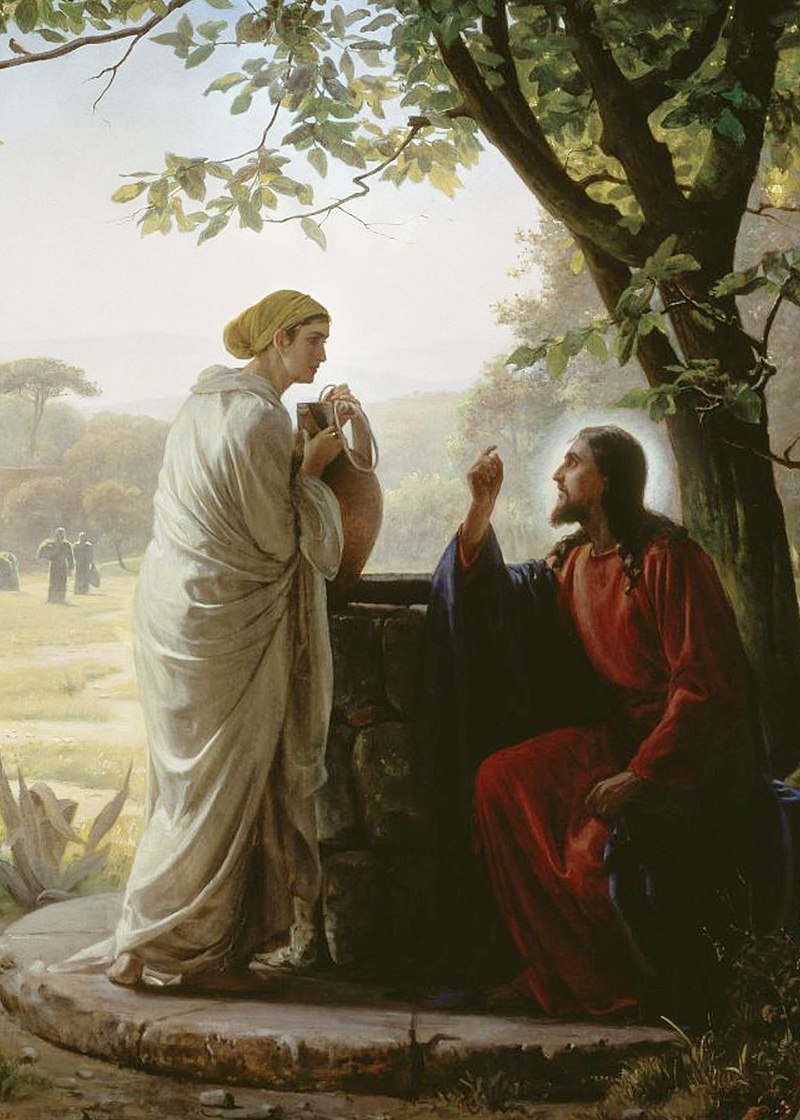
The Woman at the Well – Carl Heinrich Bloch
St. Photina, the biblical woman at the well, listened to Jesus tell her about her life. She drank of the Living Water. Then she hurried back to her Samaritan village, spread the Good News, and evangelized the entire town.
Evangelization involves many things. True evangelization begins with having a deep friendship with Jesus and a desire to introduce others to Him, your closest friend.
Spend at least thirty minutes a day quietly immersed and soaking in the presence of our Lord. Tell Him what’s on your mind and then listen for a response. When you hear His inspiration, resolve to act on it that day. Then repeat. Unlike the plants in my office, we need watering every day.
“Loving Lord, help us to draw closer to You by spending time with You, the One we love. Send us Your Spirit to open our hearts and minds to Your Word, and inspire us to act with virtue in carrying out Your will. Help us remove the shades from our lamps, the hang-ups we have in spreading the Good News. Amen.”
(Prayer and Potted Plants was first published on the blog Reflections of a Lay Catholic)
Sunday night I posted Road Trip Reflections: Technology and Time Zones in which I mentioned I’d spent the weekend helping my daughter, Grace, relocate from Memphis to Nashville, Tennessee. It was a busy weekend with lots of strenuous physical activity, lifting furniture and heavy boxes. It was also tiring from the mental awareness required for driving almost 1,200 miles. By the time I got home I was exhausted.
As tiring as it was, I have to say it was one of the most pleasurable and fulfilling three days I’ve spent in a long time. It was an opportunity to spend valuable time with Grace. For the most part, it was just she and I working side by side, spending eight hours together in my truck, and sharing meals and life for a couple of days. We talked and I got a glimpse or two of what’s on her mind, what her concerns are, and what makes her happy. Even when we weren’t working or in conversation, it was nice just to be in her presence.
Grace is the youngest of our four daughters. The others are all married with children. None of them live close to us and consequently we seldom get to see them or our grandchildren. When we are able to get together, the days are centered around the grandkids, leaving little time to simply reconnect with my daughters. I love my grandchildren dearly, but I do miss quality time and good conversation with their parents.
There is a certain loneliness that goes along with being a parent once all the kids have flown from the nest and are living their own adult lives. While my head tells me it’s the way it should be, my heart still desires that closeness.
This morning, as I entered into my daily prayer and meditation, I invited the Holy Spirit to open my mind and heart to the Word of God, and I placed myself in His presence. As always, I could sense Him asking me to open up and share with Him what’s on my mind and heart. In that moment, I felt His extreme love for me, a beloved son. It was a love that I could relate to, much deeper, I’m sure, but akin to the love I feel for my own children and the desire to spend time with them. God wants to spend time with me. He wants to know what is on my mind, what are my struggles, what makes me happy (am I happy?), and how He can help me.
In light of my weekend with Grace, I thought how God must long for those similar experiences with us when we get to spend time together. And, I thought how sad and lonely it must be when we are too busy to spend time with Him in prayer.
God gave His only Beloved Son, Jesus, so that we would know His love for us and find unity with Him. Jesus reflected that love from the crucifix when He uttered, “I thirst”.
God thirsts for your love. Love Him by spending time with Him in prayer and daily meditation.
“Heavenly Father, I love You. And, as an adult father, I know Your love for me. I thank You for the grace to spend time with You each morning in prayer, for the conversations we have, for your gentle promptings when I need help. But, I know, too, that the world I live in gets in the way sometimes, keeping me away from You. I pray for Your understanding. Amen.”
(A Father’s Love was first published on the blog Reflections of a Lay Catholic)
A month ago I posted Jesus, The Spiritual Roadmap in which I accused younger folks of not knowing what a road atlas or accordion-fold highway road map looks like because they simply plug in an address on their cell phone GPS, hit start and go where the cute voice tells them to go. Well, today, the hand that had one finger pointing and poking fun at their dependence on technology had three fingers pointing back at me.
I spent Friday and Saturday helping my daughter relocate to Nashville, Tennessee, from Memphis, hauling her furniture and other belongings to her new residence. Then, this morning I left Nashville to drive home to Ohio.
Before leaving her house, I checked the app MassTimes.org to see if there was a church nearby where I could attend mass before getting on the road. Today is the Solemnity of the Most Holy Trinity and I didn’t want to miss mass. All of the nearby Catholic churches had mass times at 7:00, 8:30 and 11:00 a.m. It was currently 9:10 a.m., so I decided to not wait until an 11:00 a.m. mass, thinking I’d find a convenient one somewhere between there and home.
Around Bowling Green, Kentucky I checked the app again and found no convenient masses near there. I checked Elizabethtown, Kentucky and, Aha!, I found one just eight miles from Elizabethtown. St. John the Baptist Catholic Church advertised an 11:30 a.m. mass. The app lets you get directions to the churches so I tapped on that and discovered I could get there about ten minutes early. Perfect!
I took the exit off of I-65 just as the cute little voice told me to do. I made several turns and with each one I seemed to be getting further into rural Kentucky. Eventually, the GPS told me I had reached my destination. I stopped on the narrow country road and looked to the right where “she” told me the church was. Miraculously, St. John the Baptist Catholic Church had either disappeared or became transfigured into a nice pasture of healthy looking angus cattle.
I drove another mile down the road and turned around. Coming back, the voice told me my destination was on the left. Still nothing but cattle. I went on down the road a couple miles to a convenience store/gas station and pulled in. I put in the actual address of St. John the Baptist Church and, lo and behold, it was about four miles further down the road. I concluded that somehow someone loaded the wrong X:Y coordinates of the church in the mapping program.
I thought, if I hurried I might be able to make it before the Gospel reading. It was then that I noticed the time on my phone said 12:31 p.m. And that’s when it hit me: the time zone line between Eastern and Central time runs along the western and southern borders of Hardin County in which Elizabethtown sits. St. John the Baptist Catholic Church was just inside the eastern time zone line…and mass was just ending!
I couldn’t help but laugh at the situation. I’d added at least a half hour to the day’s drive time and now, once I got home, I’d have to drive another half hour each way to St. Mary’s for 6:00 p.m. mass. I thought, okay, if that’s what God wants me to do, then that’s what I’ll do.
Before putting my truck in drive I checked my fuel gauge and saw that I was nearing empty. That’s when I noticed the price of gas at the station where I was parked was $2.99 per gallon…40 to 50 cents per gallon cheaper than any prices I’d seen along the interstate. My truck has a 32 gallon tank. I chuckled when I thought how divine providence may have just rewarded my unsuccessful effort to attend mass by saving me $15.00 on a fill-up.
“Heavenly Father, once again my plan was not Your plan. You had a better one that resulted in me not only saving money at the gas pump, but by allowing me to attend a beautiful mass where I ran into a friend who needed to talk to me about some matters. You saved us a phone call. Thank you for Your providence! Amen.”
(Roadtrip Reflections: Technology and Time Zones was first published on the blog Reflections of a Lay Catholic)
I went to a high school graduation party yesterday for a young friend of mine, Thomas, with whom I’ve had the pleasure of working side by side as a volunteer repairing people’s homes, and who has been a great help to me in maintaining my own property. After writing a note to him in the obligatory greeting card, I realized that my sentiments were not so much congratulatory as they were well wishes for the future and an affirmation that he will do well and go far. Thomas, is bright and hard working and I believe he will see his high school graduation not as the end of something, but as the beginning, or “commencement”, of a promising future; that his diploma is more than a confirmation of a job well done, but a conferring of responsibility to do something great.
While I was at the party, it occurred to me that it was my second event of the day to celebrate a “commencement”. The first was attending mass on Pentecost Sunday, the day on which the Apostles utilized the gifts of the Holy Spirit which had been conferred upon them in the upper room. It was the day they graduated from simply being disciples to becoming disciple-makers.
Unlike Thomas and other graduating seniors who will go on to college before they effectively utilize all that they’ve learned, the Apostles, didn’t waste any time. When the Holy Spirit descended on the Jews in Jerusalem, Peter became the first to accept the Great Commission to make disciples of all nations (Mt 28:19). With fortitude, he proclaimed the Gospel message of salvation through Jesus Christ. When he was done, three thousand Jews converted.
Pentecost serves as a reminder to all of us Catholics that, by virtue of our own Baptism and Confirmation, we have the right and duty to utilize the gifts which the Holy Spirit has conferred upon us to discover how to bring the message of salvation to other people.
It’s doubtful that we will experience a noise like a strong driving wind, or tongues as offire (Acts 2:2-3) that prompt us to take action, but we all do experience opportunities to begin the process of saving souls through Jesus. I’m not talking about evangelizing by standing on a street corner preaching through a bull horn. No, it’s much simpler than that. It begins with friendship and a love that desires good for the other person. And, there’s no greater good than to know Jesus Christ.
Our society today is starving for true friendship. We have what my friend, Dr. Mike Scherschligt of the Holy Family School of Faith, calls FDS – Friendship Deficit Syndrome. Virtual friendship through social media platforms isn’t working. Loneliness and depression caused by a lack of personal interaction and friendship are the leading causes of an alarming increase in suicides. People are lost. Many don’t know who they are or what they are. They don’t know what love is. They don’t know what brings happiness. And, they no longer know truth. They don’t know God. Souls are waiting to be saved through friendship.
Through friendship, meaningful conversation, and hospitality we build relationships. We get to know and understand each other and we build mutual trust. It takes time, but when a friendship develops to this level, the friend who is far away from our Lord is much more likely to accept an invitation from you to explore or go deeper in faith. The door is opened for you to arrange an encounter with Jesus. That encounter may come from inviting the person to a small group discussion, a bible study, to attend mass, spend an hour in Adoration, or pray a Rosary with you. As they get more comfortable, you walk as their companion on their journey while they establish their own relationship with Christ. It’s the ultimate win-win for everyone – they discover the love and mercy of our Lord, and you receive abundant graces for your effort.
It works. Two men, who, in honoring their duty, made it their mission to get to know me. They followed up by building a relationship with me based on trust. Then, they brought me to an encounter with Jesus. The rest is history.
“‘Come Holy Spirit, fill the hearts of Your faithful, enkindle in us the fire of Your love. Send forth Your Spirit so that we may be created, and You shall renew the face of the earth.’ Lord, open our hearts to Your Spirit so that we, like the Apostles at Pentecost, will boldly step out of our comfort zones and graduate from simply being disciples to being disciple-makers. Amen.”
(Evangelization Begins with Friendship was first published on the blog Reflections of a Lay Catholic)
When I graduated from college in 1979 with a Bachelor’s degree in Civil Engineering, my first job was working for a large contractor in central Missouri. Their specialty was earthwork, including building large earthen dams, municipal water and sewer systems, roads, etc. They used various types of large earthmoving equipment, and many of the projects involved drilling and blasting rock. All of this was new to me and I was fascinated by the equipment, the men who operated them, and how their movement seemed almost to be choreographed.
My boss, Ralph, was one of the owners of the company. He was a big man, kind and generous, with a good sense of humor. He treated me like his son. But, Ralph wouldn’t hesitate to speak his mind. He was a mover, he never stood still. He walked fast and drove faster. And if you didn’t keep up he’d let you know it. More than once he caught me standing idle watching the equipment work and he’d yell, “Hey, don’t just stand there, do something! You’re wasting time!” It didn’t take long for me to learn to keep on task and pay attention to my own work.
Ralph passed away about five years ago, I guess. I think about him from time to time. I thought about him this last Sunday as I meditated on the day’s Scripture passages.
Most dioceses celebrated the Solemnity of the Ascension on Sunday, although the actual forty days after Easter fell last Thursday. During those forty days, Jesus revealed Himself several times to His disciples. The first of those was in Galilee where the disciples were told to meet Him (Mt 28:7-10). In this first encounter, Jesus commissioned the Eleven to go andmake disciples of all nations, baptizing them in the name of the Father, and of the Son, and of the Holy Spirit, teaching them to observe all that I have commanded you. (Mt 28:19-20)
In another encounter, the disciples were instructed to return to Jerusalem and stay there until they received the Holy Spirit (Acts 1:4-5). Then, while in Jerusalem, Jesus returned His final time and told the disciples that they would be His witnesses in Jerusalem, throughout Judea and Samaria, and to the ends of the earth (Acts 1:8). Then, before the disciples’ eyes, Jesus was taken up into heaven.
Scripture tells us that the disciples were looking intently up at the sky. I imagine they were filled with awe and wonder, dumbstruck over what they were witnessing. Just then, two angels came, stood beside them, and interrupted their fascination with what they had just seen. One of them asked, why are you standing there looking at the sky? (Acts 1:10-11).
I’m sure the rest of what the angels said was left unrecorded but went something like this: “Didn’t Jesus just tell you that you would be his witnesses in Jerusalem, and throughout Judea and Samaria, and to the ends of the earth? Aren’t you supposed to go and make disciples of all nations, baptizing them and teaching them? Then why are you standing there gawking? You have work to do! Don’t just stand there, do something! You’re wasting time!”
I think that angel’s name was Ralph. And, back at my job today as Director of Evangelization for our parish, I sensed this larger than life angel named Ralph sitting on my shoulder, shouting in my ear with a sense of urgency, “You have people to teach and disciples to make! Don’t just stand there, do something! You’re wasting time!”
“Come Holy Spirit, help me to discern Your will each and every day in my mission to teach and make disciples. Help me to overlook the superfluous distractions that keep me from growing Your Kingdom. And, Lord, I pray for more of Your faithful to accept the same Great Commission. Amen.”
(Don’t Just Stand There, Do Something! was first published on the blog Reflections of a Lay Catholic)
Yesterday was the Feast of the Ascension of Jesus into Heaven. One of the last things Jesus spoke to the Apostles was to “Go, therefore, and make disciples of all nations” (Mt 28:19). In yesterday’s first reading from the Acts of the Apostles, Acts 18:1-8, we read about St. Paul once again doing just that, preaching the salvation of Jesus Christ to the Jews in the synagogue, “Every Sabbath, he entered into discussions in the synagogue, attempting to convince both Jews and Greeks” (Acts 18:4). We can tell from Scripture that evangelizing wasn’t a walk in the park for him and we can imagine how frustrating it must have been.
I try to imagine what it would have been like to be a fly on the wall during one of those “discussions” in the synagogue. Who did most of the talking? Was there dialogue or was it mostly one-sided? Were there questions and answers? Were the conversations civil or were they heated arguments?
Have you ever stopped and wondered why he continued to preach so fervently when it must have seemed he was beating his head against a wall? Why did he keep going back for more disappointment? I imagine that each and every conversion renewed his zeal, making it worth the struggle.
I don’t think his goal was to impress upon people that he was right and they were wrong for pride’s sake. No, I suspect he preached from a position of love. He had a love for the Lord, and a love for the well-being and salvation of the soul of every person he met. St. Paul may have never actually met Jesus, but he knew Jesus through the Holy Spirit and a deep life of prayer. He knew Christ’s love, and he took to heart the Great Commission of bringing that same love to other people.
We know that St. Paul was tenacious. He didn’t give up until he’d exhausted every effort to bring men to conversion. He persisted until the opposition and revilement (Acts 18:6) indicated he was at a hopeless juncture and it was obvious that he ought to move on and evangelize someone else.
With respect to our efforts to evangelize, what can we learn from St. Paul’s style? I think we have to be clear as to why we’re evangelizing in the first place. Are we trying to convince someone we’re right and they’re wrong? Or is our concern truly based on our love for them, wanting their good and the salvation of their soul?
When we operate from a position other than love for another person, when we focus on our rightness and their wrongness, effective dialogue becomes nearly impossible. Evangelizing becomes an argument. It prevents us from understanding and accepting that the other person’s perception of truth is based on their education and life experiences, things that may be totally different from our own. We lose sight that, for us to be believed, the other person must see us as authentic and trust-worthy. That trust can only be won through listening, which is often hard to do and sometimes even painful. Rather than make the effort to listen and understand the other’s story, we have a tendency to give up too soon when a conversion may only be one conversation away.
But, like St. Paul, we may have to eventually accept failure knowing that we gave it our best shot. We may have to take the attitude of a friend of mine, a committed disciple maker, who says, “Some will. Some won’t. I tried. Who’s next?”, and move on to the next person who is searching for, or open to, the love that can only come from Jesus Christ. We may need to give up on an individual, but we can never give up on the mission.
“Dear Jesus, today, on this feast of Your Ascension into Heaven, help me to realize the grace from the Advocate as you promised. With Your help, I resolve to grow my friendship with You through prayer. And, I commit myself to deeper friendships with others as a disciple maker, bringing them into a friendship with You. Amen.”
(Some Will. Some Won’t. I Tried. Who’s Next? was first published on the blog Reflections of a Lay Catholic)
At my holy hour of Adoration this week, I knelt before our Lord in the tabernacle and, as sometimes happens, my mind, after a while, began to wander. This time it drifted to a trip in July to Montana where I’ll have the opportunity to do something I love – fly fish. Although it’s two months away, I’m already excited about it because this will be a special trip as I’m taking a good friend with me who has never angled for trout in a mountain stream.
I dreamed about preparing my equipment, of examining my fly box, and wondered what will attract the fish this time. I visualized sections of streams where I’ve caught fish before and of making the perfect cast into the perfect spot. I sensed the patience and anticipation, and the sound of the rushing water as I stood in the stream with the beauty of the mountains surrounding me. It was an excellent daydream!
When I came out of it I felt guilty that I had been distracted from my adoration of Jesus. I know that distractions in prayer are sometimes the devil dividing my attention away from Him. But, I’ve also experienced times of distraction that left no doubt that it was the Holy Spirit Who had led me there. This, I believe was one of those cases.
In March I came out of retirement and began working as the Director of Evangelization in our parish family. It’s a job I am loving and excited about, and a challenge which, I hope, will help bring other people to Christ. As I was coming out of my daydream I was suddenly inspired by the parallels between fly fishing and evangelizing.
Intentionality – In most of America, you can’t just go fly fishing for trout at the drop of a hat. You have to be intentional about it and you have to plan for it. The trout stream doesn’t come to you, you have to go to it. Evangelization, I think, is like that. In most cases, someone who doesn’t know Christ isn’t going to come looking for you. Rather, you have to make yourself available to them. And, you have to go into it seeking to make a friend with whom you can build a trusting relationship.
Preparation – A successful fishing trip requires up front preparation: checking your equipment, your leaders and tippets, the flies in your fly box, your waders for leaks, etc. Preparation is required for successful evangelization, too. You need a firm relationship with Christ, the One Whom you are going to introduce to someone. You need to know how to respond to a few questions such as, “Why are you a Christian?”, “Why are you Catholic?”, “Who is Jesus?”, etc. And you need to be prepared to stay with a potential new friend on their journey.
Love – Angling, I believe, requires a real love for the sport. Anybody can thread a worm on a hook, put a bobber on a line and toss it in a pond. It doesn’t take a lot of love. But fly fishing is an art form that can only be truly appreciated with a love for the craft. Likewise, evangelization is an act of love. In evangelization, our love is expressed by truly desiring the good of the other person, and there’s no greater good to gift someone than a relationship with Christ.
Meet them where they are – Unlike pond fishing where you randomly toss your line out and hope something will bite, in fly fishing you have to read the water. You have to find that boulder, or the slot on the edge of the turbulence, where the fish are waiting. You have to meet a trout where he is because he’s not going to swim out of his way to take your fly. In evangelization, one needs to meet people where they are. Everyone is at a different place in their spiritual life, and it’s necessary to ask a few questions to understand where they are.
Feed them – Trout are always hungry but they are picky eaters. They won’t eat just anything. They know what’s common to the stream, they know what insects are emerging and coming off the water. Just any old fly won’t work. Similarly, someone looking to understand Christianity is looking for that one thing that will click with them, that will entice them to take a second look.
Presentation – You can pick the right fly and float it past a trout, but if it doesn’t look right, forget it, they’ll let it go. If it’s moving too slow, too fast, or in a different direction than everything else in the water, it’s suspicious to them. Presentation is important in evangelization, as well. Get too preachy and the person is turned off. Too nonchalant, and they won’t take you seriously. You have to be authentic, real, because they’re looking for someone they can trust.
Patience – Fly fishing requires patience and experimentation. Sometimes it takes time to find where the fish are lingering, what’s on the streams natural menu, and how you’re going to “plate” the fly. You may have to try different tactics to get that first strike. Evangelizing is no different, it takes time and patience to find that one thing that will catch a person’s attention.
Persistence – Fly fishing isn’t a lazy person’s sport. You have to work at it. You can’t sit on the bank and wait. You have to be active, wade in the stream, and risk slipping on a slimy rock. If you don’t, you’ll become discouraged and give up. Then you’ve failed. As Christians, it is our duty to evangelize. We’re not allowed to give up. We can take breaks, we may fail occasionally, but we can never give up.
Our Lord said to his disciples, “Go, therefore, and make disciples of all nations…” (Mt 28:19). If Jesus hadn’t had a lot of other things on His mind, I think He’d have told them to go and learn to fly fish for trout, too.
“Heavenly Father, I pray for the grace to listen to your Word, and to let the Holy Spirit lead me in building a culture of evangelization in our parish. Lord, inspire our faithful to grow closer to you and form an army of intentional disciples. Help us to be fishers of men and women. And, if it’s Your will, for a successful fly fishing trip in July. Amen.”
(Angling and the Art of Evangelization was first published on the blog Reflections of a Lay Catholic)