• About
  • Books I’m Reading
  • Links

Reflections of a Lay Catholic

Reflections of a Lay Catholic

Tag Archives: Virtue

Be Like the Thessalonians

25 Monday Aug 2025

Posted by Jerry Robinson in Evangelization

≈ 2 Comments

Tags

1 Thessalonians 1:1-5, 1 Thessalonians 8-10, Faith, Mass, Mt 23:13-22, Talk the Walk, Virtue, Walk the Talk

In today’s first reading, 1 Thessalonians 1:1-5, 8-10, St. Paul and company praise the Thessalonians for not only proclaiming the gospel to people in other cities and cultures, but for living lives of virtue that exemplify their faith.  This contrasts with today’s gospel, Mt 23:13-22, in which Jesus castigates the Pharisees and Scribes for their hypocrisy, for saying one thing and doing another, thus leading the people down a path of confusion that replaced worship of God with worshipping God’s gifts.

As faithful of Christians that we are, we can too easily fall into the same trap as the Pharisees and Scribes.  We can be seen going to church every Sunday, sitting in the pews and following the rubrics, yet let distractions keep us from fully participating in the Mass with our inner eye on the sacrifice that is taking place in front of us – the real reason we are there.  But, even if our full attention is focused on Jesus during the Mass, we may live separate and disconnected lives once we walk out the doors.  Or, we may do all the right things and live virtuous lives, but still fail to proclaim our faith in words. 

If we are to truly live our faith and spread the gospel as Jesus instructed us, we should endeavor to connect all the pieces together:  what others see in us and what they hear from us.    We need to walk the talk and talk the walk like the Thessalonians.  We could ask ourselves, “If St. Paul, Silvanus, and Timothy were observing me today, could they say the same about me as they did to the Thessalonians?  Have my actions become such a rote habit that I’ve lost the real meaning of Mass and purpose for worship, that is, to not only receive the Gift, but to worship the Giver of the Gift?  Am I experiencing the joy and thanksgiving in my faith that is necessary for others to want some of what I have?  Am I loving my ‘neighbor’ and desiring their  good by helping them establish a relationship with the One Who truly loves them for who they are?”

Maybe take a few moments and spend time with Jesus in prayer, asking Him what He thinks you can do to be more like the Thessalonians.

“Heavenly Father, today’s Psalm reminds me to sing songs of praise of You, the One Who loves me and takes delight in me, Your creation.  May I never forget the sacrifice of love You made for me.  Help me, Lord, to walk the talk and talk the walk so that others may come to praise you as well.  Amen.”

(Be Like the Thessalonians was first published on the blog Reflections of a Lay Catholic)

©2013-2025 Reflections of a Lay Catholic. Reposting and sharing of material in its full and original content is permitted, provided that full and clear credit is given to the author and Reflections of a Lay Catholic.

Trophies and Spiritual Atrophy

21 Wednesday May 2025

Posted by Jerry Robinson in Evangelization

≈ 6 Comments

Tags

8th Grade graduation, Adult Faith Formation, Confirmation, Evangelization, Faith, Holiness, OCIA, Spiritual Atrophy, trophies, Vice, Virtue, Youth Faith Formation

As I’m writing this, our parish school’s 8th grade class is having its graduation ceremony.  I’m sure our gym is filled with proud parents hardly believing their “baby” boys and girls will soon be high school freshmen; and those same sons and daughters, while also proud and excited, may be having some separation anxiety knowing that they and their friends will disperse to either our public high school or one of four or five nearby Catholic high schools.  

This has been a big year for these youths.  Tonight’s graduation is only two months after they received the Sacrament of Confirmation.  Unfortunately, many of them will consider their Confirmation to be synonymous with their “Catholic graduation”.  Now that they’re confirmed, they see no need for any additional catechesis, scripture study, or even prayer.  Many will begin to exhibit the onset of spiritual atrophy, and in four years, when they go on to college, many will cease practicing their faith.

Yesterday I attended a conference on evangelization at a nearby Catholic church which also has a school.  During a break I ventured into the hallway outside the meeting room and saw that school’s trophy case.  There were years of trophies representing championships and tournament wins for volleyball, basketball, soccer and other sports.  There were photographs, autographed volleyballs, and plaques with player’s names.  And as I admired this memorabilia, I wondered how many of those student athletes still practice their faith.  I thought, “Wouldn’t it be nice if a school had a trophy case that celebrated the graduates who continued to practice their faith in the years to come?  Perhaps they could display bronze medals or plaques for those who continued to be faithful for five years on, silver for ten years, and gold for twenty-five years.”

I was quick to tell myself, though, that the attrition in the faithful is not completely the fault of our Catholic schools or youth faith formation catechists.  Sure, some could be better.  They probably can improve at helping students build a loving and meaningful relationship with Jesus, a faith foundation upon which they will continue to build virtuous lives.  But, of course, there are other factors, as well, such as the pressures of the predominant secular culture that easily leads youths and young adults down paths of vice.  

And, then, there are the parents – what role have they played in instilling a strong faith in their children?  While it’s not a parent’s job to get their kids to heaven, it is their job, and in their control, to give their kids holy parents.  Have they provided an attractive example of how an adult lives a life of holiness?  Again, I checked myself so as to not put too much blame on the parents.  Many have good intentions.  The problem may not be with a lack of desire to lead their children deeper in faith, but that they can’t lead them past the point at where they are themselves.

I couldn’t help but see the hand of God in these thoughts.  There I was at a conference on how to evangelize adults, and because of a simple trophy case, I became fully aware that none of this is the kids fault, rather it is an adult problem.  Somewhere along the line we’ve lost the connection that the only way our children will develop and maintain a healthy life of faith is if us adults teach, guide, mentor and reinforce what that life looks like.  The teachers, the youth catechists, and the parents are all adults, and while youth faith formation is important, it is secondary to adult faith formation.  And to form adults who will form our youths, we need adult evangelists who will step forward and fill this void.  We need catechists for OCIA, competent leaders for Bible studies, willing facilitators to participate in adult faith formation programs, and spiritual mentors who will guide other adults to living lives of deeper prayer that will help them grow in holiness.  

I went back into the conference after the break with a renewed sense of determination.  I know I don’t have all the answers, but as our parish’s Director of Evangelization, there is an onus that goes with wearing that hat, a responsibility to put into place ways to lead people into a deeper relationship with Jesus that will move them along the pathway from minimal maintenance to missionary discipleship.

“Heavenly Father, I give You thanks for your trust in me, that my participation will bear fruit for Your Kingdom.  Inspire me, Lord, to evangelize other men and women to be Your disciples who will lead others closer to You.  And I pray that You will put in the lives of our children who have fallen away from the faith someone who will inspire them and bring them home.  Amen.”

Faith is Personal…but Should Never Be Private

26 Tuesday Mar 2024

Posted by Jerry Robinson in Evangelization

≈ 6 Comments

Tags

Catholicism, Confirmation, Evangelization, Friendship, Holy Spirit, Prayer, Virtue

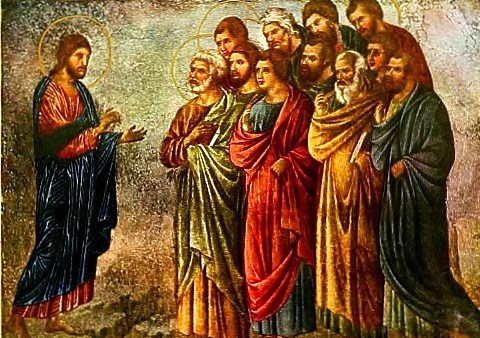
Jesus Sends the Apostles – Duccio di Buoninsegna, c.1300

We all know people who claim to believe in God but then won’t talk about it.  They clam up and say their faith is personal…end of discussion.  They are right, one’s faith is, and should be, personal.  But Jesus never intended for it to be private.  He tells us in the Gospels to go and be disciples.  How can we evangelize if we keep our faith private?

The most common excuse for keeping one’s faith private may be that the basics were never learned well enough in the first place to share it with, or defend it before, others.  One can easily deflect blame onto one’s teachers or parents, but to remain in this state is to succumb to the deadly vice of sloth, which is a laziness or a lack of love for the ways of God. The virtue opposing sloth is diligence, which may simply mean spending a little time each day learning more about one’s faith through daily prayer, reading scripture or other Catholic publications, or listening to Catholic television, radio, or podcasts, all of which can help us increase our understanding of our faith.

Another is our failure to fully understand and accept the graces we received at our Confirmation.  The infusion of the Holy Spirit supernaturally strengthened the virtue of fortitude within us, enabling us to share in the mission of Jesus Christ to spread and defend our faith.  Like a child who receives affirmation from a parent over a good behavior continues to improve in that behavior, we, too, simply have to believe we already possess what we need.

And, finally, the exigencies of modern life can make us forget that we need other people. Jesus didn’t live as a hermit.  He gathered family and friends with whom He shared life.  St. Paul urged the Corinthians to not live their faith privately but in community with one another.  Like an ember that falls away from a fire and dies out, we can grow cold if we don’t stay close to others who are on fire with their faith, and others can grow cold if we don’t bring our fire to them.

To effectively evangelize, we can’t be passive.  We have to actively learn, strengthen our relationship with Jesus through prayer and study, and build friendships with those whose fires need stoking.

“Lord Jesus, I pray for the grace to love You more dearly, and to exercise the grace which You’ve already bestowed on me in my Confirmation to bear fruit for Your Kingdom. Amen.”

(Faith is Personal…but Should Never be Private was first published on the blog Reflections of a Lay Catholic)

©2013-2024 Reflections of a Lay Catholic. Reposting and sharing of material in its full and original content is permitted, provided that full and clear credit is given to the author(s) and Reflections of a Lay Catholic.

Envy, Unfairness, and Grace

23 Wednesday Aug 2023

Posted by Jerry Robinson in Vice, Virtue

≈ Leave a comment

Tags

Envy, Grace, Mt 20:1-15, Tooth Fairy, Unfairness, Vice, Virtue

The Parable of the Laborers in the Vineyard, Andrey Mironov

As I sit down to write it occurs to me that it’s been two months since my last post.  Time flies when you’re having fun!  Since June I’ve road-tripped about seven thousand miles and I hope to write soon about some of the blessings received on both sides of the windshield.  But, mostly, I’ve been busy at my new job trying to find ways to evangelize and bring people to Jesus through other people.  I told a friend the other day that, for the first time in a couple decades, I look forward to going to work every morning!  I am blessed!

Just because I haven’t written doesn’t mean I’ve not been inspired through reading Scripture and daily meditation.  Quite the contrary, my prayer life has been amazing.  But, I’ve put other things of importance ahead of writing.  Let’s see if I can fix that tonight.

In today’s Gospel from Matthew, Mt 20:1-16, Jesus tells his disciples the parable of the landowner hiring the laborers for his vineyard.  He hires some in the morning and then more every three hours during the day.  The last hired, at five o’clock, received the same daily wage at six o’clock as those who were hired first thing in the morning.  Those laborers who worked all day grumbled about the unfairness of it all, comparing their labor to those who only worked one hour.  The landowner reminded them that they were paid what they had agreed on and asked them, “Am I not free to do as I wish with my own money?  Are you envious because I am generous?” 

Can you imagine that scene?  How would you feel if you were one of the laborers hired early and had worked hard all day only to be paid the same as someone who’d not yet broken a sweat?  If you’re like me, you’d have grumbled, too.  And we both would have succumbed to the deadly sin of envy.  

Envy is the vice of finding sorrow in the good fortune of someone else.  It can also be the feeling of joy at someone else’s misfortune.  It’s the vice associated with comparing one’s self to another.  And, when we grumble about the unfairness, we are directing our complaint to God.

As I read this passage this morning I recalled a moment some twenty-one or twenty-two years ago.  My youngest daughter, Grace, was five or six years old.  She had lost a tooth and placed it under her pillow in hopes of finding money left by the Tooth Fairy when she awoke the next morning.  The “Tooth Fairy” was, I think, very generous with the dollar he left under her pillow.  But, when Grace awoke and found the dollar, she threw it across the room and exclaimed, “Hannah (her best friend) got five dollars for her tooth!”, and, sobbing, buried her head back in her pillow.

Of course, Grace was too young to really understand the concept of finding joy in another’s good fortune; and too young to understand, appreciate and be grateful for the blessings generously bestowed upon her that others may not receive.  She was too young to understand that we have to combat the vice of envy with the virtues of gratitude and generosity. She was only five or six years old. 

Sadly, many folks haven’t improved much by the time they reach 25, or 40, or 65 years old.  They often still feel envious over someone’s larger and fancier house, of their new high performance car, of their luxurious vacation, or simply that they have more friends and get more likes on their social media account.  I think, though, that I’ve made some progress now that I’m 66.  I find that I am happy for another when they receive special recognition, or when it seems that luck has found them instead of me.  I’m happy with my state in life and don’t desire more than I need.  Through grace, I know that I am loved and that the Lord has been super generous to me, more so than I deserve.  And, I know it’s His business to decide the blessings He gifts to each one of us.  He’s free to do as He wishes with His own graces.  It’s not for me to compare what others receive to what He gives me.

Well, to be honest, maybe It’s more truthful to say that I feel that way most of the time. 

Oh, I didn’t mention that my daughter Grace not only received a dollar that morning for her tooth, but she also received the truth about the Tooth Fairy.

And the Easter Bunny.

And Santa Claus.

And then I went and had a talk with Hannah’s dad. 

“Gracious and loving God, thank You for all the blessings You so generously bestow on me. I know that I do not always say ‘thank You’.  Help me to always be joyful and sincerely grateful over another’s good fortune and the blessings they receive from You, knowing that You willed it out of love for them.  May I always rejoice in the many ways that You bless all Your children.  Amen.”

(Envy, Unfairness, and Grace was first published on the blog Reflections of a Lay Catholic)

©2013-2023 Reflections of a Lay Catholic. Reposting and sharing of material in its full and original content is permitted, provided that full and clear credit is given to the author(s) and Reflections of a Lay Catholic.

Follow The Star!

08 Sunday Jan 2023

Posted by Jerry Robinson in Faith

≈ 7 Comments

Tags

Bethlehem, Epiphany, Epiphany of the Lord, Hope, Impossible Dream, Jesus, Magi, Perseverance, Three Kings, Virtue, Wisemen

One of my memories as a pre-teen kid in the late sixties is of playing records (vinyl LPs) on my parent’s console stereo.  These stereos were large pieces of furniture with a sliding top, a record player on one side, an AM/FM radio in the middle and a well for storing albums on the other side.

My folks listened primarily to crooners popular at the time, one of which was Jack Jones.  In 1966, Jones recorded and released a popular song, The Impossible Dream.  My folks had that record and it was spun on that state of the art Hi-Fi quite often.  It was a good sing-a-long song that you could really get into.  I can still remember most of the lyrics:

To dream the impossible dreamTo fight the unbeatable foe

To bear with unbearable sorrow

To run where the brave dare not go

To right the unrightable wrong

To be better by far than you are

To try when your arms are too weary

To reach the unreachable star

This is my quest, to follow that star

No matter how hopeless, no matter how far

To be willing to give when there’s no more to give

To be willing to die so that honor and justice may live

And I know if I’ll only be true to this glorious quest

That my heart will lie peaceful and calm when I’m laid to my rest

And the world will be better for this

That one man scorned and covered with scars

Still strove with his last ounce of courage

To reach the unreachable star

The song encourages you to follow your dreams even when they seem unachievable, to persevere and never give up, and to do what is right in the face of adversity.  This dream, the ultimate goal, is the unreachable star.

This memory came to mind as I was meditating on the Epiphany of the Lord, which we celebrate today, in remembrance of the day the Three Kings reached Bethlehem and gazed upon the infant Jesus.  Three wise men, astronomers who saw the star, had the grace to interpret its meaning and the gumption to follow it. They had no idea of where the star would lead them but they knew they were called to follow it.

They came from afar and their journey had to be long and arduous.  I’m sure they encountered many dangers on their trek.  They weren’t the only people who saw the star.  But, they were the only ones who put their hearts and minds to the task of following it.  They probably faced much ridicule to undertake such a crazy quest, one that had no foreseeable promise at the other end.  But, they had hope for something magnificently good when they reached their destination.

I doubt that the Impossible Dream was written with much, if any, thought given to its relevance to this Christian tradition of ours.  But it suits it to a tee – with one exception.  Our dream is not impossible to achieve.  It may seem that way at times when we are struggling with our sin, with difficult relationships, and periods of dryness in our prayer lives.  Our quest is not hopeless – Jesus, our Star, has promised us that we will reach him if we persevere by living lives of virtue.  Sometimes it feels as though we are marching through Hell, but our Heavenly cause is to grow in faith.  Our faith tells us that if we stay true to our Lord, our souls will rest peacefully with Him in heaven after our time on earth is over.  And, finally, because we don’t give up, we will be better people, better disciples, better spouses, parents, children and friends, and we will make the world a better place.

Follow The Star!  Persevere.  You may get scorned and scarred along the way, but strive with every ounce of courage you have.  Like the Magi who gazed upon Jesus with unimaginable admiration, you will, too.

(Follow The Star! was first published on the blog Reflections of a Lay Catholic)

©2013-2023 Reflections of a Lay Catholic. Reposting and sharing of material in its full and original content is permitted, provided that full and clear credit is given to the author(s) and Reflections of a Lay Catholic.
From the Archives: Groundhog Day

02 Wednesday Feb 2022

Posted by Jerry Robinson in Virtue

≈ 4 Comments

Tags

Groundhog Day, Holiness, Malachi 3:1-4, Meditation, Prayer, Refinement, Vices, Virtue

Happy Groundhog Day!  I don’t know how it is where you live but if Punxsutawney Phil lived in Southwest Ohio, he would not have seen his shadow this morning!  We are facing the worst winter storm of the season with predicted ice accumulation and several inches of snow on top of that.

The weather forecast made me think of one of my favorite movies, Groundhog Day, and I remembered that I had previously written a post with that title.  Turned out it was from one year ago and it was a reflection connecting today’s first reading from the prophet Malachi (Mal 3:1-4) with the plot of the movie.  I re-read it and thought its message was worthy of reposting.  Thank you for taking the time to read it.  I hope its message will help you in your spiritual life.

_______________________________

It’s been two days since the world’s most renowned groundhog, Punxsutawny Phil, popped out of his burrow and saw his shadow, predicting six more weeks of winter. (For my international readers who are unfamiliar with Groundhog Day, go hereto learn more).  Personally, I can’t make it through the second day of February each year without thinking about the 1993 movie, Groundhog Day,one of my all-time favorites, starring Bill Murray and Andie MacDowell.

In it, actor/comedian Murray, plays the part of Phil Connors, an abrasive and self-centered television weatherman who is sent on assignment along with his producer and cameraman to cover the annual Groundhog Day celebration in Punxsutawny, Pennsylvania.  During the festivities, Phil records his news report on the celebrated groundhog’s prediction with all the contempt for the “rat” (and the people of the town) that fits his egotistical personality.

In a kind of karma, Phil and team are forced to spend the night in the small town because of a severe winter storm which he failed to predict.  The following morning, Phil awakes in his hotel room bed and discovers it is February 2nd all over again, a deja vu which only he experiences.    Then, every morning afterwards, for what seems like a lifetime, he wakes at 6:00 a.m. to the same song on the radio only to find it is still February 2nd.

As the film progresses, Phil’s life progresses from denial to rebellion to despair and then finally to acceptance of his situation.  With acceptance, he learns to replace his pride with humility, his lust with love, and greed with generosity.  He learns the importance of beauty in life and placing others before himself.  In a sense, he is being refined each and every day that he is stuck in the seemingly endless time loop which only he experiences.  In the end, when he finally experiences the true meaning of selfless love, he wakes up one morning and it is February 3rd.

On Tuesday as I was reading the daily Scripture during my daily meditation I thought of this movie again.  For the last four years I have hi-lighted in yellow pencil the passages I have read each day, and underlined in red those phrases which the Holy Spirit put on my heart that day.  And, next to each, in pencil, I have written the date I meditated on that passage.  I’ve now been doing this long enough to see that I’ve read that same passage on or about the same date in a previous year.  

Many Catholics don’t know that the Church repeats the daily readings on a two-year cycle for weekdays, and a three-year cycle for Sundays.  I knew this and always thought it was simply an effective way to read almost the entire Bible over a three year period.  But, on Tuesday, I saw it differently.

In the first reading from Scripture that day, I read in Malachi 3:1-4, “For He will be like a refiner’s fire…” so that their offerings, “will please the Lord.”  It struck me that the only way we can grow in holiness is to continually be refined; that our purpose on earth is to be refined to the point where our final offering will, indeed, please the Lord and we will be united with Him in heaven.  

As Catholics, we don’t wake up to the same song every morning like Phil did, but our two or three year cycle does give us the opportunity to grow in holiness and virtue every day.  

For one who does not spend time in daily meditation listening to the Word of God and asking what His will is for them every day, it can be a difficult journey.  Without prayer and trusting in God to help, you can easily do like Phil, that is deny, rebel and despair when life doesn’t seem to get any better.  But when you spend time daily in conversation with Jesus and you’re docile to the Holy Spirit, and you accept and take responsibility for your faults and weaknesses, it becomes much easier to resolve to grow in virtue knowing you can trust in Him for help.  One day He may show you where your pride is strong and how to replace it with humility.  The next day the Word of God may lead you to growing in love and charity and away from lust or selfishness.  Still another day you may decide that you need to be more generous, or less envious, less angry, more grateful, or stronger in your faith.  Some days it will seem like you’re stuck in your own Groundhog Day (movie) time loop because you didn’t get it the first time…or the second.  But, with each conviction, you can resolve to become better in a particular aspect of your life every single day until your vices have been refined into sustainable virtues that “will please the Lord”.

My goal in life is to become a saint.  I want you to become one, too.  I would much prefer our refinement take place day by day here during our time on earth than when we have no control of it in Purgatory.  Ask the Lord to show you each day how you can grow in holiness, and pray for the grace to resolve to take action daily.  Even if they’re just baby steps, they’re still steps forward towards your goal.  A lifetime of baby steps will get us there.

“Heavenly Father, thank You for this day and every day that I have to grow closer to You.  I pray for the grace to make the most of them by living my life as You would have me live it, with humility, prudence, fortitude, justice, temperance, faith, hope and love.  Amen.”

(From the Archives: Groundhog Day was first published on the blog Reflections of a Lay Catholic)

©2013-2022 Reflections of a Lay Catholic. Reposting and sharing of material in its full and original content is permitted, provided that full and clear credit is given to the author(s) and Reflections of a Lay Catholic.

Road Trip Reflections: Battles are Won From Within

22 Monday Feb 2021

Posted by Jerry Robinson in Virtue

≈ 5 Comments

Tags

Examination of Conscience, Lenten resolutions, Spiritual Warfare, St. Michael the Archangel, Temptation, Virtue

Icon of St. Michael the Archangel

Yesterday at the end of Mass we recited the prayer to St. Michael the Archangel before the final blessing.  As we prayed, “St. Michael, defend us in battle, be our protection against the wickedness and snares of the devil….”, I wondered how many of the faithful say this prayer with rote indifference, unaware that, in our world today, we truly are in a battle between good and evil.  The prayer implies that we are in the battle.  We are fighting for our souls and the souls of everyone we love.  We are the troops on the ground and when we call upon St. Michael it’s like we’re calling for close air support to assist us.  It doesn’t mean we sit back and let him do all the work.

At home after Mass, I packed my bags, loaded a U-Haul trailer and set out on a road trip to San Antonio, Texas.  The first leg was to my parent’s house in southeast Missouri for a quick visit.  On the way I saw a billboard with a photograph of a Marine running through a jungle with the caption, “Battles are won from within”, alluding to the interior fortitude required to be a Marine.  Reflecting on the morning’s Mass, I thought we could all benefit from some stronger moral interior fortitude to help resist the temptations of the world today. 

Shortly after seeing this billboard I turned on my stereo and Jerry Jeff Walker’s The Rain Song from his It’s About Time album began to play.  It contains the lyric, “The hardest thing a man can do is look inside and see the truth about himself.”  Still thinking about the spiritual warfare we are waging, it made sense that the place to start if we want to win this war is to look inside and see the truth about ourselves.

The hardest thing for a man to do is look inside and see the truth about himself.

A Marine discovers his or her weaknesses by repeatedly facing difficult challenges and, through sheer willpower, forcing themselves to overcome the obstacles that are inhibiting their confidence.  Similarly, we need to accept our challenges and suffer through our daily trials as training to resist the temptations that lead us to sin.  And, Lent is a perfect time to make this effort!

I include myself in that “we need to”.  With several hours of windshield time ahead of me I considered where to begin.  Unsure, I simply said out loud, “God, help me see the truth about myself, to uncover my faults and bad habits.”   I heard in reply, “Why not start with your roles in life and the responsibilities that go with them?  Are you being responsible and if not, why not?”

As though the Lord was sitting in the passenger seat I conversed out loud with Him.  I examined my roles as Self, Husband, Father, Son, Brother, Friend, and Disciple. I recognized both my good efforts and those with which I fall short and still had room for improvement. 

I was prompted to ask, “Why do I do the things I do?”, which forced me to look for root causes.  “That’s just the way I am” was not an acceptable answer. After making a pit-stop, I drew up a list of resolutions and made a note to break them down into concrete baby steps.

Getting back on the road it seemed like I was still missing something.  So, I turned to my “passenger” again and asked what other interior obstacles needed examining.  It was like the Lord knew I would need to keep my mind occupied on this long trip so He gave me a list:

“Consider your vices and how you can replace them with virtue.  How can you be more humble?  Maybe replace gluttony with a little temperance?  What about focusing on charity to others instead of being so selfish?  You know, don’t you, that strengthening one virtue improves the others?

“Take a look at any disordered attachments in your life.  What do you treasure that doesn’t bring you closer to Me?  Ask yourself why you want it.

“Examine the relationships in your life.  How can you improve them?  Hint:  Remember the two great commandments – how can you love more dearly?  

“Is your life balanced?  If it feels lop-sided, find out why?  What brings stress and anxiety into your life?  Is it something that you can change?  If so, change it.  If not, join your cross to mine and I’ll help you carry it.

And finally, “When you get around to it, come back and ask Me to help you with these.  I’ll be glad to.  I’ll be here.”

I pulled into my parent’s driveway and remembered reconciliation from Saturday during which I confessed I’d not done well at making a daily examination of conscience and needed to do better.  He took me for my word!

I know some sincere resolutions during Lent will help me through the desert of Satan’s temptations.  Could it help you, too?  Talk to God about it and don’t refuse to accept His help.  You can win the battle from within.  God bless you!

“Merciful Father, thank You for sending Your Holy Spirit into my life and strengthening my soul so that I may do my part at resisting temptations to sin.  Lord, I know that You and my guardian angel are there if I just place my trust in You and call on You for Your assistance.  Thank you for being my co-pilot yesterday.  Amen.”

Groundhog Day

04 Thursday Feb 2021

Posted by Jerry Robinson in Virtue

≈ 4 Comments

Tags

Groundhog Day, Holiness, Malachi 3:1-4, Meditation, Prayer, Refinement, Vices, Virtue

It’s been two days since the world’s most renowned groundhog, Punxsutawny Phil, popped out of his burrow and saw his shadow, predicting six more weeks of winter. (For my international readers who are unfamiliar with Groundhog Day, go here to learn more).  Personally, I can’t make it through the second day of February each year without thinking about the 1993 movie, Groundhog Day, one of my all-time favorites, starring Bill Murray and Andie MacDowell.

In it, actor/comedian Murray, plays the part of Phil Connors, an abrasive and self-centered television weatherman who is sent on assignment along with his producer and cameraman to cover the annual Groundhog Day celebration in Punxsutawny, Pennsylvania.  During the festivities, Phil records his news report on the celebrated groundhog’s prediction with all the contempt for the “rat” (and the people of the town) that fits his egotistical personality.

In a kind of karma, Phil and team are forced to spend the night in the small town because of a severe winter storm which he failed to predict.  The following morning, Phil awakes in his hotel room bed and discovers it is February 2nd all over again, a deja vu which only he experiences.    Then, every morning afterwards, for what seems like a lifetime, he wakes at 6:00 a.m. to the same song on the radio only to find it is still February 2nd.

As the film progresses, Phil’s life progresses from denial to rebellion to despair and then finally to acceptance of his situation.  With acceptance, he learns to replace his pride with humility, his lust with love, and greed with generosity.  He learns the importance of beauty in life and placing others before himself.  In a sense, he is being refined each and every day that he is stuck in the seemingly endless time loop which only he experiences.  In the end, when he finally experiences the true meaning of selfless love, he wakes up one morning and it is February 3rd.

On Tuesday as I was reading the daily Scripture during my daily meditation I thought of this movie again.  For the last four years I have hi-lighted in yellow pencil the passages I have read each day, and underlined in red those phrases which the Holy Spirit put on my heart that day.  And, next to each, in pencil, I have written the date I meditated on that passage.  I’ve now been doing this long enough to see that I’ve read that same passage on or about the same date in a previous year.  

Many Catholics don’t know that the Church repeats the daily readings on a two-year cycle for weekdays, and a three-year cycle for Sundays.  I knew this and always thought it was simply an effective way to read almost the entire Bible over a three year period.  But, on Tuesday, I saw it differently.

In the first reading from Scripture that day, I read in Malachi 3:1-4, “For He will be like a refiner’s fire…” so that their offerings, “will please the Lord.”  It struck me that the only way we can grow in holiness is to continually be refined; that our purpose on earth is to be refined to the point where our final offering will, indeed, please the Lord and we will be united with Him in heaven.  

As Catholics, we don’t wake up to the same song every morning like Phil did, but our two or three year cycle does give us the opportunity to grow in holiness and virtue every day.  

For one who does not spend time in daily meditation listening to the Word of God and asking what His will is for them every day, it can be a difficult journey.  Without prayer and trusting in God to help, you can easily do like Phil, that is deny, rebel and despair when life doesn’t seem to get any better.  But when you spend time daily in conversation with Jesus and you’re docile to the Holy Spirit, and you accept and take responsibility for your faults and weaknesses, it becomes much easier to resolve to grow in virtue knowing you can trust in Him for help.  One day He may show you where your pride is strong and how to replace it with humility.  The next day the Word of God may lead you to growing in love and charity and away from lust or selfishness.  Still another day you may decide that you need to be more generous, or less envious, less angry, more grateful, or stronger in your faith.  Some days it will seem like you’re stuck in your own Groundhog Day (movie) time loop because you didn’t get it the first time…or the second.  But, with each conviction, you can resolve to become better in a particular aspect of your life every single day until your vices have been refined into sustainable virtues that “will please the Lord”.

My goal in life is to become a saint.  I want you to become one, too.  I would much prefer our refinement take place day by day here during our time on earth than when we have no control of it in Purgatory.  Ask the Lord to show you each day how you can grow in holiness, and pray for the grace to resolve to take action daily.  Even if they’re just baby steps, they’re still steps forward towards your goal.  A lifetime of baby steps will get us there.

“Heavenly Father, thank You for this day and every day that I have to grow closer to You.  I pray for the grace to make the most of them by living my life as You would have me live it, with humility, prudence, fortitude, justice, temperance, faith, hope and love.  Amen.”

(Groundhog Day was first published on the blog Reflections of a Lay Catholic)

©2013-2021 Reflections of a Lay Catholic. Reposting and sharing of material in its full and original content is permitted, provided that full and clear credit is given to the author(s) and Reflections of a Lay Catholic.

How to Make a Thorough Examination of Conscience – Part 1: The “Checklist” Method

31 Tuesday Mar 2020

Posted by Jerry Robinson in Examination of Conscience, Reconciliation

≈ 7 Comments

Tags

Examination of Conscience, Mortal Sin, Precepts of the Church, Reconciliation, Sin, Ten Commandments, Venial Sin, Virtue

In yesterday’s post Spiritual Atrophy and the Need for an Examination of Conscience During Self-Isolation I promised to provide various methods of making a thorough examination of conscience. The first of the three ways I will offer is what I call the “Checklist” method. This, I believe, is the most common form used and the best for anyone who does not regularly make an examination, and for those just beginning.

However, before we look at this method, let’s take a more general look at why we should do an examination of conscience, and what to look for.

An examination’s main purpose is to help us see which actions and/or attitudes we have exhibited that are sinful or less than desirable so that we can make amends. We need to know these so we can stop sinning in a particular way and make changes to get better at obeying God’s Commandments and trying to live lives of virtue.

In making our examination, we particularly want to look at the sin and its gravity, that is, it’s seriousness – is it a mortal sin, a venial sin, or simply an imperfection.

Mortal sins are those sins which deplete our souls of sanctifying grace. Three things are necessary for a sin to be mortal:

  • It has to be serious (grave);
  • One has to have knowledge or a firm belief that the act is seriously wrong prior to committing the act;
  • One must commit the act with full consent of one’s will.

All three of these things must be present for a sin to be considered mortal. Thus, if you did not know the act was of serious nature, or if you did not will it, e.g. you were forced to commit it or it was committed in a dream, then you are not guilty of committing a mortal sin.

All mortal sins committed since one’s last confession must be confessed, both the nature of the sin and how many times it was committed. It’s important to remember that one needs to confess all mortal sins prior to receiving communion as receiving communion while not in a state of grace is itself a mortal sin.

Venial sins are those committed which are not grave in nature or were not committed knowingly such as those committed out of habit. Venial sins are not required to be confessed in the Sacrament of Reconciliation however it is good practice to do so. By bringing these into the light of Christ’s forgiveness, we more easily grow in the virtue of humility. It helps us pay attention to our actions so that we may refrain from sinful habits and, thus, grow in holiness.

Imperfections may include dispositions of one’s soul that are not necessarily sinful but which one would like to amend. It is not necessary to bring these to confession but it is a good idea to be aware of them and the habits from which they originate. These are areas that could become sinful if left unchecked. They could be those little things that weigh on the conscience of someone who is earnestly trying to grow in holiness. Examples of imperfections may include: trying to be controlling instead of seeking God’s will; being content with spiritual mediocrity; failing to defend the Church; failing to spend time in prayer; or taking your spouse or a parent for granted.

As I mentioned above, the most common method of examining one’s conscience is what I dub the “Checklist” method. This entails reading a printed list of questions that are based on the Ten Commandments, the Precepts of the Church, and the Cardinal, Theological, and Capital Virtues; and then reflecting on your actions from God’s perspective, to uncover one’s sinful instances. Below, I am providing links to various websites that offer these checklists, all of which, except for the last one, are printable. Note that they are all a little different. Some may frame a question in such a way that it helps to determine if a sin is mortal or venial. Some may not make the distinction but leave it up to you to decide.

Of course, it doesn’t do much good to do an examination of conscience if you don’t intend to try and amend your ways and refrain from sinning again or avoiding future near occasions of sin. That’s what it’s all about.

Tomorrow I will present a second method of examining one’s conscience: the CPR method.

God bless you all!

Links:

  • Examination of Conscience for Adults and Teens, The Fathers of Mercy
  • Detailed Examination of Conscience, Bulldog Catholic (University of Minnesota-Duluth Newman Center)
  • An Examination of Conscience, Loyola Press (short and sweet)
  • A Brief Examination of Conscience based on the Ten Commandments, USCCB
  • The Light is on for you, A guide to making a thorough examination of conscience and a good confession
  • An Examination of Conscience by Fr. Robert Altier, The Leaflet Company ($1.25 per copy, this is my preferred resource)

(How to Make a Thorough Examination of Conscience – Part 1: The “Checklist” Method was first published on the blog Reflections of a Lay Catholic)

©2013-2020 Reflections of a Lay Catholic. Reposting and sharing of material in its full and original content is permitted, provided that full and clear credit is given to the author(s) and Reflections of a Lay Catholic.

Believing Without Signs

23 Monday Mar 2020

Posted by Jerry Robinson in Faith

≈ 4 Comments

Tags

Blessed Sacrament, Catechism, CCC 1127, CCC 1128, Eucharist, Faith, Grace, John 4:43-54, John 6:54, Luke 22:19, Meditation, Prayer, Sacramental Grace, Spiritual Communion, Virtue

Yesterday was odd: a Sunday forced to be away from church and not be present for mass. In the seven years I’ve been Catholic I’ve missed mass twice. Once because I had the worst “man-cold” in the history of the world, and once on vacation in Arkansas when we were sixty miles from the nearest Catholic church. Other than that, I’ve fulfilled my Sunday obligation no matter where I’ve happened to be. I know most of you are the same and yesterday was difficult for you, too.

My wife and I tuned into a live-streamed mass from St. Peter in Chains Cathedral in Cincinnati. That was odd, too. The only people in the entire cathedral were the Archbishop, a deacon, an altar server, a lector and a cantor. The Archbishop gave a very good homily. I assume it was the Archbishop – it sounded like his voice but the camera was so far away it was impossible to tell for sure. At the moment we would have received Holy Communion had we been there in person, we recited the Prayer of Spiritual Communion.

As much as I desired the grace that comes with receiving the Sacrament of the Holy Eucharist in a state of grace, the circumstances with the Coronavirus pandemic weren’t going to allow it. I had to believe that Christ is still with me. I had to believe that the grace I received in receiving Him in the Eucharist the previous Sunday was enough to nourish my soul until I can receive Him again. I thought, “I can do that.”

This morning’s Gospel, Jn 4:43-54, The Second Sign at Cana, helped me to better come to terms with that resolution. Today we read about the royal official, a non-Jew, who traveled a long distance to ask Jesus to cure his dying son. Jesus, knowing that He would not win many hearts in Galilee, harshly replied to the man, “Unless you people see signs and wonders, you will not believe.” The man, in humble supplication, responded, “Sir, come down before my child dies.” Seeing the man’s faith without the need for a sign, Jesus replied, “You may go; your son will live.” John then tells us, “The man believed what Jesus said to him and left”, and during his two day journey home discovered that the fever had left his son the previous day at the exact time Jesus told him his son would live.

Most of Jesus’ miracles were performed in person and usually involved Him touching the one in need of healing followed by a required action on the receiver’s part. Since the recipient wasn’t present in this miracle, Jesus did neither in extending His healing grace because He sensed the father’s faith.

The Eucharist is the source and summit of our Catholic faith. We believe and take Christ for His word when He said, “Whoever eats my flesh and drinks my blood will have eternal life” (Jn 6:54). He instructed us to “Do this in memory of Me” (Lk 22:19), which we do every Sunday, and even, if we’re so inclined, every day of the week.

The Catechism of the Catholic Church tells us that “The sacraments are perceptible signs (words and actions) accessible to our human nature. By the action of Christ and the power of the Holy Spirit they make present efficaciously the grace that they signify.” (CCC 1127). It’s like a husband giving flowers with a sincerely spoken and affectionate “I Love You” to his wife as a sign of his love.

But, the Catechism goes on to say, “Nevertheless, the fruits of the sacraments also depend on the disposition of the one who receives them.” (CCC 1128).

What does this mean? It means that when you go to mass and receive the Sacrament of the Eucharist, you may not necessarily be receiving all the graces that are possible. Even though the Eucharist is always an infinite amount of grace, just because one goes to the Fount of Living Water doesn’t mean that one always drinks from it. Total refreshment comes only through a strong faith and living a life of prayer. Going back to the analogy of the flowers, the love felt by the wife is a function of the disposition of her heart and is independent of the love expressed by the husband.

So, where does this leave me? I know I cannot receive Jesus in the Eucharist at the present time nor the sacramental grace that goes with it. But, I can, with the help of the Holy Spirit, dispose my heart to loving Jesus more through deepening my faith, a deeper prayer life, living a life of virtue, and showing God more gratitude, thus receiving an increase in sanctifying grace.

How does one do this? Developing a deeper prayer life may mean spending 20 to 30 minutes a day reading daily Scripture and reflecting on it; meditating on the Word of God and asking the Holy Spirit to show you what His will is for you that day; and, then making a resolution to take action and follow His lead and do His will.

It may mean taking time for silence and solitude where you can simply love God more, feeling His presence, and trusting that His love will carry you through the day.

We can deepen our faith by seeing God around us in the people we meet, our family and friends; in the words and help offered by a kind person; by the phone call from someone you care about. We can imitate the virtue of Christ and serve others; call upon our loved ones; seek to serve the vulnerable elderly while they are shut-in.

And, we can pay attention to and give thanks for the circumstances of our lives: take pleasure in the flowers that are starting to bloom in our gardens; the birds who are feeding at the bird feeder; and the beautiful sunrises and sunsets (if there are such things in Ohio in the grayness of March!).

I believe our God is an understanding and loving God. He knows we long to receive Him in the Blessed Sacrament. But, in His infinite Wisdom, He has permitted the current situation. Maybe He’s giving us the opportunity to grow closer to Him, to show our faith without the sign that we cherish so much.

God bless and may the Peace of Christ be with you.

“Oh my Jesus, I believe that You are present in the Most Holy Sacrament. I love You above all things, and I desire to receive You into my soul. Since I cannot at this moment receive You sacramentally, come at least spiritually into my heart. I embrace You as if You were already there and unite myself wholly to You. Never permit me to be separated from You. Amen.”
(Prayer of Spiritual Communion)

(Believing Without Signs was first published on the blog Reflections of a Lay Catholic)

©2013-2020 Reflections of a Lay Catholic. Reposting and sharing of material in its full and original content is permitted, provided that full and clear credit is given to the author(s) and Reflections of a Lay Catholic.

← Older posts

Enter your email address to follow this blog and receive notifications of new posts by email.

Join 264 other subscribers
Follow Reflections of a Lay Catholic on WordPress.com

Recent Posts

  • Are You Ready to Proclaim the Gospel?
  • A Prayer for Continued Progress
  • Be Like the Thessalonians
  • Be Magnanimous Like Mary
  • Are You an Average Catholic?

Categories

Top Posts & Pages

  • O Holy Night
  • "I Am the Way and the Truth and the Life"
  • A Taste of Spiritual Warfare
  • Conversions
  • Are You Prepared for Lent?
  • Are You an Average Catholic?
  • Overflowing Love
  • God Bless Planned Parenthood
  • A Monday Morning Blessing
  • God Answers Prayers of Thanksgiving

Archives

  • September 2025
  • August 2025
  • July 2025
  • May 2025
  • April 2025
  • February 2025
  • January 2025
  • December 2024
  • November 2024
  • September 2024
  • July 2024
  • May 2024
  • April 2024
  • March 2024
  • February 2024
  • January 2024
  • December 2023
  • November 2023
  • October 2023
  • September 2023
  • August 2023
  • June 2023
  • May 2023
  • April 2023
  • March 2023
  • February 2023
  • January 2023
  • December 2022
  • November 2022
  • October 2022
  • September 2022
  • June 2022
  • May 2022
  • April 2022
  • March 2022
  • February 2022
  • January 2022
  • November 2021
  • July 2021
  • June 2021
  • May 2021
  • April 2021
  • March 2021
  • February 2021
  • January 2021
  • November 2020
  • October 2020
  • September 2020
  • August 2020
  • July 2020
  • May 2020
  • April 2020
  • March 2020
  • January 2020
  • December 2019
  • November 2019
  • September 2019
  • July 2019
  • June 2019
  • May 2019
  • April 2019
  • March 2019
  • January 2019
  • December 2018
  • November 2018
  • October 2018
  • September 2018
  • August 2018
  • July 2018
  • June 2018
  • May 2018
  • April 2018
  • March 2018
  • February 2018
  • January 2018
  • December 2017
  • September 2017
  • August 2017
  • July 2017
  • June 2017
  • May 2017
  • April 2017
  • March 2017
  • February 2017
  • December 2016
  • November 2016
  • October 2016
  • September 2016
  • August 2016
  • July 2016
  • April 2016
  • March 2016
  • January 2016
  • December 2015
  • November 2015
  • September 2015
  • August 2015
  • July 2015
  • June 2015
  • May 2015
  • April 2015
  • March 2015
  • February 2015
  • January 2015
  • December 2014
  • November 2014
  • October 2014
  • September 2014
  • August 2014
  • July 2014
  • June 2014
  • May 2014
  • April 2014
  • March 2014
  • February 2014
  • January 2014
  • December 2013
  • November 2013
  • October 2013
  • September 2013
  • August 2013
  • July 2013
  • June 2013
  • May 2013
  • April 2013
  • March 2013
  • February 2013

Meta

  • Create account
  • Log in
  • Entries feed
  • Comments feed
  • WordPress.com

©2013 – 2024 Reflections of a Lay Catholic. Reposting and sharing of material in its full and original content is permitted, provided that full and clear credit is given to the author(s) and Reflections of a Lay Catholic.

Blog at WordPress.com.

  • Subscribe Subscribed
    • Reflections of a Lay Catholic
    • Join 264 other subscribers
    • Already have a WordPress.com account? Log in now.
    • Reflections of a Lay Catholic
    • Subscribe Subscribed
    • Sign up
    • Log in
    • Report this content
    • View site in Reader
    • Manage subscriptions
    • Collapse this bar
 

Loading Comments...