
• About
  • Books I’m Reading
  • Links

Reflections of a Lay Catholic

Reflections of a Lay Catholic

Tag Archives: Faith

Peace in Knowing the Meaning of Easter

18 Monday Apr 2022

Posted by Jerry Robinson in Faith

≈ 6 Comments

Tags

Col 3:1-4, Easter, Faith, Hope, Love, Peace, Resurrection

(Editor’s note: In the original posting yesterday, the link to the included homily broadcast did not work. It has been corrected.)

Resurrection of Christ, Noel Coypel, c. 1700

Happy Easter, everyone!  Christ is risen today!  Alleluia! 

It’s been a beautiful day here in Southwest Ohio.  A perfect day to celebrate and be joyful.  It didn’t begin that way for me, though.  I caught my annual springtime cold on Thursday and it’s steadily worsened.  I did go to the Mass of the Lord’s Supper Thursday evening and coughed and sneezed my way through it.  And, as my cold got worse overnight, I knew better than to go to the Stations of the Cross and the Celebration of the Lord’s Passion on Good Friday, and  I decided to skip going to the Easter Vigil Mass as well.

After a fitful night’s sleep I poured myself out of bed this morning and made it to 9:00 a.m. Mass.   I managed to make it through with only a few coughs and no sneezes. But, between my head being stopped up and the additional noise from all the extra people, I didn’t understand a word of Father’s homily. 

In resignation, I closed my eyes and repeated Simon Peter’s words from the Transfiguration, “It’s good that I am here”, and gave thanks for the opportunity to offer up my suffering and unite it to His cross.

As I stood to go up to communion I recalled the words from the second reading, Col 3:1-4, “Think of what is above, not of what is on earth.  For you have died, and your life is hidden with Christ in God.”  With each step forward I was drawn to the glory of Christ resurrected, and away from the fogginess I’d been experiencing all morning.  By the time I reached the priest to receive the Eucharist, I felt an intense inner peace and knew I was smiling from ear to ear.  As I walked back to my seat, letting the Body of Christ dissolve on my tongue, I looked upwards, still smiling, thinking of what is above, and I spied above the entrance doors to the church the Risen Christ on the cross with His arms spread wide in love.  He was saying to me, “Your life is hidden here with Me.”  

As I knelt back at my seat and said my prayer of thanksgiving after communion, that feeling stayed with me.  I wasn’t focused on the way I felt, didn’t work to fend off a coughing fit or stifle a sneeze.  I just focused on Jesus, thankful for the hope that my destiny will be with him.  I knew that I will suffer things in my life much worse than a common cold, but in the end all of it will pale in comparison to the joy I will find when I find myself with Him.

I left Mass feeling pumped up spiritually yet drained physically, and still somewhat frustrated that I hadn’t heard well enough to understand Father’s homily.  I felt a little cheated.  Then, about two hours later, I received a message from a friend with a link to a homily from Fr. Ehli at the Cathedral of the Holy Spirit in Bismarck, North Dakota, where my friend’s daughter attends church.  It was like the Holy Spirit heard my grumblings and blessed me with what was probably an even better homily on which to meditate.  It hit home with me and I feel I need to share it with you here:  Fr. Ehli’s homily.  The homily begins at the 20:30 mark and ends at 31:30.  I won’t give his message away except to say that, between it and my experience at Mass, knowing what’s in store at the end makes the getting there, even with springtime colds and other struggles, much more peaceful.

I pray that your Easter has been a joyful one, that your Hope has found new life knowing that Christ defeated death and He is holding a place for you.  God bless you!

“Lord Jesus, You suffered and died for me and redeemed me of my sins.  Your resurrection defeated death and gave the world hope that, by following You, we may also defeat death and live with you for all eternity.  Thank you!  Amen.”

Resolution: I desire to sow the seeds of this Word today by making a concrete resolution to live with more peace in the present moment.

(Peace in Knowing the Meaning of Easter was first published on the blog Reflections of a Lay Catholic)

©2013-2022 Reflections of a Lay Catholic. Reposting and sharing of material in its full and original content is permitted, provided that full and clear credit is given to the author(s) and Reflections of a Lay Catholic.

Feed Your Flock

23 Wednesday Feb 2022

Posted by Jerry Robinson in Discipleship

≈ Leave a comment

Tags

1 Pt 5:1-4, Discipleship, Faith, Feed my lambs, Feed my sheep, Jesus, Jn 21:15-17, Lk 9:13, Tend my sheep

(A reflection on 1 Pt 5:1-4)

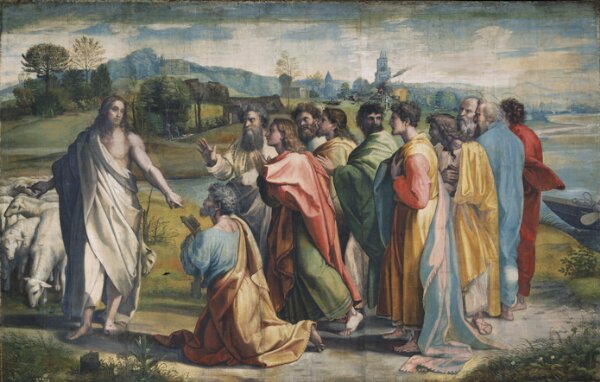
Christ’s Charge to Peter, Raphael, c. 1515

One of the most significant moments in Simon Peter’s relationship with Jesus was the third time Jesus revealed Himself to them after His resurrection when He asked Peter three times, “Simon, son of John, do you love Me?”  Peter answered three times, “Yes, Lord, You know that I love You!”.  And three times Jesus asked Peter to take care of His flock. (Jn 21:15-17)

Peter obviously took that request to heart and remembered it for the rest of his life.  In yesterday’s first scripture reading from 1 Pt 5:1-4, Peter writes to the Presbyters, the teachers of the faith, to tend to and be examples to the “flock of God”.

This passage struck me in a number of ways.  First, I recalled the many sentiments that were offered from comments at our deanery’s recent Synod on Synodality meeting.  Although those present were a mere microcosm of our Church, there seemed to be a general opinion that one of the problems in our Church today is that our bishops and priests are not adequately “feeding their sheep” or “tending their flock”. 

Secondly, it brought to mind that we are all called to be teachers of the faith in one way or another – through our vocations as a parent or friend, through our occupations, and our volunteerism in various ministries.  We only have to recall Jesus’ words to His disciples when He was faced with feeding the five thousand, “Give them some food yourselves” (Lk 9:13), to understand that He wants us to join with Him in His mission to save souls.

Today more than ever, our Lord needs us all, you and me, to help feed and tend His flock.  Too many are not being fed and are straying to what looks like “greener” pasture in today’s world of materialism, idealism and relativism.  Once they leap that fence they become easy prey for the wolves.  We need to fertilize our “Catholic” pasture so that the grazing sates their appetites.

How do we tend to the flock?  I think the first step is to set aside the idea that our faith is something that is done to us, that it’s someone else’s responsibility.  With too few priests and deacons to go around, the laity needs to take some ownership in their personal faith formation and that of those in their “pasture”.  We need to become better catechized, grow deeper in our relationships with Christ through prayer, and live virtuous lives that are examples of holiness to others.

Every person has an opportunity to be a witness to someone who is hungering for the Bread of Life and thirsting for the Living Water.  We need to remember that Jesus gave us one mission, to make disciples of all nations, and we need to make that a priority in our lives.  We don’t have to become missionaries or monks, we just need to live simply and find synergies in our everyday lives that will edify our families, friends and acquaintances.

We need to remember that the basic building block of our Church is not the parish, but rather our homes, the Domestic Church.  If we want to rebuild our Church we need to recall how the Apostles and the first disciples lived after Christ’s death.  Theirs was a two-pronged approach:  to stick together and build and protect their community, and to draw others into it by teaching them the truth of the Gospel.  We can do that with our families by practicing our faith with our children.  We can live hospitality and invite people into our homes for friendship and good conversation which may lead to opportunities to pray together.

We need to look for opportunities to be charitable to those in need by practicing the Corporal and Spiritual Works of Mercy.

We need to not be afraid to practice our faith in our work places as employers and employees; at school as educators and students; in athletics as fellow athletes and coaches; and where we volunteer.

Our faith ought to be personal but it should never be private.  We need to be bold and leave others with no doubt about our love for Jesus.

Put more succinctly, as laity, we need to step up our game, take ownership and not depend on just our clergy to feed the flock.  We need to survey our “pasture” of influence and determine who is grazing mindlessly in that pasture and on the verge of wandering off.  We need to provide them with “green grass” that will nourish and satisfy their souls.

What is your pasture?  Who is in your flock?  How can you feed and tend to them with the love of Christ?

“Dear Jesus, thank you for providing priests and friends who, through their gentle love and care, have shepherded me in my faith life.  I pray for the grace to do the same for those whom I mentor and lead to you through spiritual friendship.  Amen.”

(Feed Your Flock was first published on the blog Reflections of a Lay Catholic)

©2013-2022 Reflections of a Lay Catholic. Reposting and sharing of material in its full and original content is permitted, provided that full and clear credit is given to the author(s) and Reflections of a Lay Catholic.

Be Like Pope Saint Fabian

20 Thursday Jan 2022

Posted by Jerry Robinson in Prayer, Saints

≈ Leave a comment

Tags

Faith, Holy Spirit, Pope St. Fabian, Prayer, Resolutions, Word of God

Pope St. Fabian, stained glass window from the choir loft of St. Gratien church, Haussaire, Val d’ouse, Ile de France, France, artist unknown.

Today is the feast day of Pope Saint Fabian who was chosen as the 20th pope in 236 A.D., and who died as a martyr in 250 A.D.

St. Fabian’s story is an interesting one. Fabian was a layman farmer who happened to travel into Rome on the day a new pope was being elected to replace Pope Saint Anterus, who, after serving 40 days in his office, had been martyred.  Fabian wandered into the crowd which had assembled to select a new pope and suddenly a dove flew in, descended, and landed on Fabian’s head.  The gathered clergy and laity saw this, considered it a sign that the Holy Spirit was anointing Fabian, and unanimously chose him to be Pope by acclamation.  As Pope, Fabian helped bring Christianity to unconverted areas of Europe, fought heresies, worked to extend aid to the poor, and promoted and kept the faith in spite of certain persecution.

Think about that for a moment.  What would you have done had you been Fabian?  Run and hide?  Refuse the appointment?  To whom would your refusal be addressed, those gathered or the Holy Spirit?  Considering that the person before you had been killed because of his faith – would you have been afraid that, as leader of all Christians, you would meet the same fate?

Or would you have trusted in God the Father, God the Son and God the Holy Spirit that you were being called to serve Him to lead His people?  Certainly, Fabian, as a layman farmer, had no outstanding qualifications as a clergyman to justify his calling.  But, God knew he was the right man at the right time.  I’m sure the phrase, “God doesn’t call the qualified, He qualifies those whom he calls” had yet to be coined.  Fabian’s faith must have been strong, taking to heart Jesus’ words, “Do not be afraid”, as he placed his trust in God to lead him to do His will, each and every day, to the best of his ability.

Our culture may have evolved to where we don’t look at signs such as a dove landing on one’s head quite the same way.  Maybe that was the Holy Spirit’s way of catching people’s attention back then.  Today, most of us are literate and can read and, as such, we can receive the Holy Spirit through the sacred scripture of the Bible, God’s written Word, if we ask Him for it.  Through His Word, God is speaking to us, each individually, meeting us where we are at that moment, and giving us an idea of how He would like for us to be, or what we should do, to grow closer to Him that day.

These days we don’t have to fear for our lives quite like Fabian and other Christians did in the third century.  No, most of our fears revolve around losing worldly things to which we’ve become accustomed:  comfort, money and material possessions, power, status, social inclusion, deeply rooted vices, etc.  But, when we call upon the Holy Spirit to lead us each day as we hear the Word of God, we are often called to sacrifice one of those things that we hold near and dear so that we can grow in virtue, in holiness, and closer to Him.

Today, read or listen to the Word of God.  Ask the Holy Spirit to open your heart so that you can hear what God is asking of you today.  If His will for you is to lose a bad habit or make a change in behavior, ask Him for the strength and courage to make the change. Maybe He’s asking you to love someone more.  Trust that He is asking these things of you because He wants you to be closer to Him, that He wants you to find joy and happiness which you can only find in Him.  Then, resolve to carry out His will.

Be like Pope Saint Fabian.

“Heavenly Father, thank You for the desire to spend time with You in silence and solitude each day, to read Your Word, and to listen to the promptings of the Holy Spirit, and for the grace to do Your will with courage and trust.  Amen.”

(Be Like Pope Saint Fabian was first published on the blog Reflections of a Lay Catholic)

©2013-2022 Reflections of a Lay Catholic. Reposting and sharing of material in its full and original content is permitted, provided that full and clear credit is given to the author(s) and Reflections of a Lay Catholic.

It’s the Word that Matters

10 Monday Jan 2022

Posted by Jerry Robinson in Faith

≈ 6 Comments

Tags

Faith, Liturgy, The Word

I posted yesterday about my inspiring trip to reconciliation.  As I walked out of church I was pumped up, having just felt an extremely close encounter with the Holy Spirit.  As I walked to my truck in the parking lot a woman whom I had never seen before approached on her way into the church.  She looked at me and asked with what seemed to be a little attitude, “Who is it this evening?”

I initially assumed she was arriving a little early for 5:30 mass.  We have a pastor and a parochial vicar assigned to our parish, I’ll call them Father One and Father Two to protect their identity.  I told her that Father One was hearing confessions so he would also be saying mass.  The woman looked at me and replied, “Oh, I wish it was Father Two, I like his better.”  Not knowing exactly what to say, I offered my rejoinder, “Well, it’s the Word that matters.”  She looked at me kind of funny and then walked on past.   As I unlocked my truck I suddenly wished I could back time up a half a minute so she and I could have a little one on one conversation.  

I would have liked to ask her what it is about Father Two that she prefers.  Is it that she likes the dynamic homilies he occasionally gives, or some other personal quirk that appeals to her over Father One?  I wanted to ask her if she’s ever considered that Father One might have the time to prepare more edifying homilies if he didn’t have to manage and administer two parishes.

I would have liked to tell her that I hear homilies from a couple dozen priests during the course of a year and every priest has his own style of delivery.  Some are enlightening, some not so much.  It’s not so much what the priest is saying in his homily, it’s the Word that matters, and what we hear God saying to us.  It’s Jesus in the Word and in the Eucharist that we come to receive at mass, not the priest.  A less than kind me briefly thought it would be fun to suggest that if it’s a sermon that she comes to get fired up over, then maybe she’d be better off attending a Methodist service.  For that, I thought I might need to go back to confession.  Maybe next week.

I wondered if she knew that every Catholic church on earth reads the same scripture passages on any particular day.  No two priests have the same homily and there are no standard homilies.  The priest formulates his homily based on what the Holy Spirit is telling him.  Not every priest hears the same message.  Likewise, if there are 400 people in the congregation during a mass, then there are 400 different and unique messages being sent from the Holy Spirit, one to each person there.  The priest’s message might get you in the ballpark for understanding what God’s will is for you that day, but if that’s all you hear it might leave you in the cheap seats with a message that probably isn’t uniquely yours.  

Mentally chiding myself for that devilish thought from a moment ago, I thought if I were a true disciple I would be helpful instead of so snooty and teach her how to meditate on the daily scripture before attending mass. That way she could more readily hear God speak directly to her instead of second hand through the lector or priest.  Then, it wouldn’t matter who’s giving the homily.

Suddenly realizing that my know-it-all-pride had just displaced any humility I thought I had, I decided I was making a mountain out of a mole hill.  So I got in my truck, buckled up, turned the key and saw that it was only 4:25.  I thought maybe the lady was going to confession first.  Perhaps she was intending that she preferred Father Two over Father One to hear her confession.

Well, checking my pride didn’t last long as I thought of some new things I’d have liked to ask her.  Did she feel more comfortable going to one priest over another?  If so, why?  Not why as in, “Does Father Two make you feel less sorry for your sins?”, but rather, “Why does it matter?”  You don’t go to confession to be comforted.  You go to tell God you’re sorry you offended Him and that you’ll do everything in your power to keep from doing it again.  You go to be reconciled with God, not reconciled with the priest.  After all, it’s God working through the priest, In Persona Christi, Who is the forgiving, All Merciful One.

Once again dismounting from my high-horse, and sorry for being so judgmental, I knew I needed to back off. It’s not for me to judge what’s in someone’s heart by the tone of five simple words.  I realized my thoughts were a defensive reaction to protect the dignity of our priests.  I look up to them and am thankful they have devoted their lives to helping us on our journey to heaven.  Their’s is a demanding “you-can’t-please-all-the-people-even-some-of-the-time” job.  They are too often taken for granted and not often enough thanked for their goodness.  It seems we too often relegate our spiritual welfare to them instead of taking responsibility for it ourselves.  We need to realize there are too few priests as it is, and, as members of the Body of Christ, start carrying more of the load.

I think I know where I’ll be next Saturday afternoon.  

“Merciful Father, please forgive me for being so prideful and judgmental.  But, thank You for letting me see the value of our caring, generous, and hard-working priests, and accepting their uniqueness, flaws and all, just as You accept mine.  Amen.”  

(It’s the Word that Matters was first published on the blog Reflections of a Lay Catholic)

©2013-2022 Reflections of a Lay Catholic. Reposting and sharing of material in its full and original content is permitted, provided that full and clear credit is given to the author(s) and Reflections of a Lay Catholic.

Are You a Full-Time or Part-Time Catholic?

10 Wednesday Nov 2021

Posted by Jerry Robinson in Faith

≈ 2 Comments

Tags

Discipleship, Faith, Luke 14:25-33, Luke 16:9-15

The Dishonest Steward – Andrei Mironov

There were two days during the last week where the daily Scripture passages really struck me – last Wednesday and then again on Saturday.  Wednesday’s Gospel was from Luke 14:25-33, Sayings of Discipleship, and Saturday’s was from Luke 16:9-15, The Parable of the Dishonest Steward. 

In the first, Jesus lays out the conditions of discipleship:

  • In all our relationships, including those with our family, friends, and neighbors, our relationship with Jesus must always come first.
  • We must carry our own cross and follow Him even when it hurts.
  • We must know the cost of following Him and plan and prepare accordingly.  That cost will include being virtuous in the face of persecution and suffering, as well as requiring our effort to combat worldly indifference.
  • We must exercise prudence – do the right thing in any particular situation, choose our battles, and resist  foolishness, impetuosity, thoughtlessness, inconstancy, and negligence.
  • We must turn loose of any disordered attachments which we desire more than Him.

In Luke 16:13, Jesus tells us, “No servant can serve two masters.  He will either hate one and love the other, or be devoted to one and despise the other.  You cannot serve God and mammon.”  Our Lord is saying we can’t be a devoted servant to Him if we are a slave to another.

Together these spoke to me about total commitment to Christ.  Not just sometimes, not just when I feel like it, not just when I have time, but all the time, and especially when I’m suffering from something I don’t like, didn’t choose, can’t change or don’t understand.

As I meditated on these two passages, trying to understand the depth of their message and implications, my mind, as it all too often does, drifted in prayer.  I recalled my 36 year career in corporate middle management, how I survived several buy-outs and mergers, each with a change of leadership, and with each change a “new and improved” corporate vision, mission and culture.  

I recalled one particular newly promoted vice-president telling us that we needed to decide if we were going to be the “pig or the chicken” in the new company.  He went on to tell a story of how a pig and a chicken joined together to create a new restaurant business.  They discussed roles and responsibilities, and when they came to deciding what would be on the menu the chicken suggested they offer a variety of meals consisting of either ham, bacon or sausage with eggs.  The pig thought about that a while and retorted that the arrangement seemed quite unfair.  The chicken, thinking her idea made perfect sense asked the pig what he meant.  The pig answered, “Well, it seems to me that I am committing to give up my life for this endeavor while your involvement is only dedicating the occasional egg.”

In essence, that new exec was asking us to decide if we were going to be fully committed to the company’s direction or would our dedication be intermittent, jumping on board only when that which was being asked of us was in line with our opinions, made us feel good and satisfied our own desires.  As a manager I was expected to set an example for the employees who reported to me.  But, truth be known, there were many times I felt like balking, procrastinating, going a different direction, and objecting because toeing the line was simply too demanding of me.

Coming back to the present moment in my prayer, I thought I had been distracted with that crazy memory.  But, then, I realized that the Holy Spirit had led me to exactly the place He wanted me to go:  to examine and understand my level of commitment to being a disciple of Jesus.  Am I a full-time or part-time Catholic?  He asks that question of each of us.

A good place to start answering Him is to consider the depth of your love for God.  Do you  envision Him with loving eyes looking down upon you, His beloved son or daughter?  Do you realize that His great love has provided everything you have, including your family and friends?  Do you express your love by being grateful for all He has given you?  

Do you love Him by simply loving those around you, even your enemies, by doing what is right and just, by loving them as you should love yourself?

Do you love Him in the sacraments, especially the Sacraments of the Eucharist and Reconciliation?  During the liturgy of the Mass do you focus on trying to understand His will for you that day?  Is your attention completely captured during the epiclesis when the Holy Spirit is called down to sanctify the bread and wine making real the body and blood of Christ?  Do you frequent the Sacrament of Reconciliation out of love for God because you have offended Him, or is your motive to selfishly rid yourself of guilt?

Do you love Him in your suffering, by accepting your cross as an opportunity to grow closer to Him, to grow in virtue, and to aid Him in His redemptive mission to save souls?

Do you demonstrate commitment by defending your faith in the face of persecution from those who ridicule you for your belief?  Do you practice integrity when you are faced with tough choices by doing the right thing?

Do you love God by looking within yourself and identifying those things to which you are attached, those ingrained bad habits and vices which unnecessarily draw you away from Him, and resolve to change for the good by resisting their temptations?

Being fully-committed means living one life for God rather than giving only a part to God while reserving a second part for yourself.  Our commitment has to be more than giving an hour a week to Him when, out of habit, we attend Mass, or when we say grace before meals.  We have to live it every day, all day, in our relationships, our work, and our play for the mere glory of God.

A good way to begin moving towards living a life fully committed is to begin each day with gratitude, giving thanks for one more day to live and love Him, and for all that He provides.  Then, in prayer, offer to Him out of love all that you will do and experience that day – your work, prayer, joy and suffering – to aid in Christ’s salvific mission of saving souls.  Then, spend time with Jesus in prayer, asking Him to show you what His will is for you that day and resolve to do what He tells you.  And, finally, carry out your resolution.

Truthfully, none of us are perfect, we are all sinners to some degree.  We are all on an elevator somewhere between the basement of minimum involvement and the penthouse of full commitment.  Each day we move up and down in that elevator, yet the goal of our lives is to ascend more floors than we descend and ultimately reach the top floor, heaven.  The important thing to remember is that, while God keeps the elevator running, we are the ones pushing the buttons.

“Loving Father, I give You thanks for Your eternal love, and for the opportunity to love You each and every day.  As I operate this elevator of daily life, help me, Lord, to resist pushing the down buttons that move me away from You.  Amen.”

(Are You a Full-Time or Part-Time Catholic? was first published on the blog Reflections of a Lay Catholic)

©2013-2021 Reflections of a Lay Catholic. Reposting and sharing of material in its full and original content is permitted, provided that full and clear credit is given to the author(s) and Reflections of a Lay Catholic.

Bring a Friend to Christ

23 Saturday Jan 2021

Posted by Jerry Robinson in Evangelization

≈ 4 Comments

Tags

Discipleship, Faith, Friendship, Mark 3:13-19, Mark 3:8

Jesus Sends the Apostles – Duccio di Buoninsegna, c.1300

Yesterday, as I read the Gospel from Mark 3:13-19, I zeroed in on Jesus’ summoning of the twelve whom he appointed as His Apostles.  I tried to imagine what they felt when they realized they were being chosen to stand out from the hundreds of other disciples who were following Jesus at the time.  Were they overcome with joy?  Probably.  Did their chests swell with pride for being chosen?  I’m sure they did.  Later, in Mark 10:35-45, we discover James’ and John’s ambition to be placed above the others.  

And what about the hundreds of other people who had flocked to Him, followed Him, and became His disciples?  How did they feel?  Did they feel left out?  Or did the joy they had discovered from following Jesus infuse new life into their vocations as spouses and parents, and into their occupations?

Two thousand years later, not much has changed.  The Holy Spirit is still calling men to be apostles by calling them into the priesthood, and women into religious life.  Their love for Jesus prompts them to embrace lives of poverty, chastity and obedience and live by divine providence as the first Apostles learned to do.  I am grateful for their sacrifices that, through them, the rest of us are brought closer to Jesus.

The rest of us.  What about the rest of us?  Because we have not been summoned, does it mean that we can’t or shouldn’t help bring others to Jesus as well?  Absolutely not.  Those disciples not chosen for the Twelve didn’t just throw up their hands and say, “Okay, that’s it, I’m not on the A-team so I can go home now.”  No, they remained faithful followers.  And, so should we.  

But, our job is not just to follow Jesus.  It’s to tell others about Him, to introduce them to Him.  In, Thursday’s Gospel we read in Mark 3:8, “Hearing what He was doing, a large number of people came to him….”.  How did they “hear” what Jesus was doing?  They heard because those following Jesus told them about His saving grace.  And, then, they not only heard, but they saw with their own eyes the joy and excitement  displayed by those who had seen the Messiah.

I know what you’re thinking:  “The point Jerry’s trying to get across is that we need to evangelize, that we need to go out and tell others about Jesus.”  You’re right.  And, I know what you’re feeling:  “That’s not easy to do.  Anyhow, most of the people I know already go to church and those who don’t don’t care.  What if people push back and don’t want to hear about Jesus?  What if they ask me questions to which I don’t know the answers?  It makes me uncomfortable!”  I get it.  Been there.

You might be thinking, too, “You know, I lead a good Christian life, I’ll let my example speak for itself.”  Well, that’s all fine and good, but it’s too passive.  That’s like seeing the guy or girl of your dreams and thinking you don’t need to speak to him or her because your good looks or your fancy clothes are enough of an attraction when, instead, it’s a vivacious, outgoing and charming personality that’s needed.  No, you have to take action, you have to do something.  But, where do you start?

I will assume you have friends.  And, every one of those friends is in love with Christ, they look forward to going to Mass every Sunday (and during the week, if possible), and they consider receiving Communion the high point of their day, right?  What, no?  They aren’t all that way?  You mean you have some friends who are perhaps a little lukewarm?  Oh, and even a few who don’t profess any faith?  Okay, good, you’re not alone, then.

The operative phrase in the above is that you have friends.  We all have friends and family whom we love but whose faith is all across the board.  And, since we are all sinners, every single one of us has room to grow in virtue that only Christ can bring through a close relationship with Him. Our mission is to help that happen.

What makes for good friendship?  Usually, it begins with getting to know each other through good conversation.  Good conversation brings with it a certain intimacy which, in turn, brings a level of trust.  A deep and trusting friendship turns into a loving relationship that desires the best for each other.  And, how can we love someone more than to wish for them a relationship with God that will bring them joy for all eternity?

I know, it sounds good, but how do you make it happen?  Well, it usually won’t happen by itself, meaning you have to set it in motion.  There are various ways to begin.  And, it’s not by following a “friend” on social media.

An easy way is to sit in a different pew than you’re used to sitting in, or attend a different Mass, and meet someone new.  Strike up a conversation after Mass.  If that’s the Mass they usually attend, make it a point to go back and meet them again.

It may help to have a plan.  I have a friend who, at the beginning of the year, spends time in prayer asking the Holy Spirit to put on his heart three men whom he should try to bring closer to Christ.  Then, he makes it his mission for the year to help them get there.

You might think of a friend who is struggling in some way.  Perhaps someone who hasn’t been to Mass in a while due to the pandemic.  Give them a call to check up on them and see how they’re doing.  See if you can stop by and chat with them for a while.  If you can, follow up later and do it again.

Invite someone you’d like to know better out to dinner or for a drink at the local pub.  Sit around a campfire and share stories about your lives. Get together at your house for dinner and an evening of playing cards.  Then invite them to pray the Rosary with you.  Make plans to do it again soon.

Once you’ve come to know the person better, and they you, interject more of your faith into the conversation.  It can be done gently and unobtrusively.  Let them see your love for Christ.  Don’t worry if they don’t jump on board right away or reject your invitation, give it time.  You’ve planted the seed.  Keep watering and fertilizing that seed by following up.  It will grow.

If you meet with other men or women in a small faith sharing group or attend a Bible study, invite that friend, after a while, to come join you.  Perhaps invite someone to a Welcome, or Christ Renews His Parish weekend, or a Cursillo weekend.  Talk to them about how uplifted you are when you attend your Adoration hour and suggest they consider taking on an hour themselves.  

Above all else, PRAY.  You must pray for your friends.  Pray that they open their hearts fully to the Holy Spirit.  And, pray for your own docility to the Holy Spirit so that you will follow His lead.

You might think this sounds like manipulation.  It’s not.  It’s love.  Manipulation would be for the purpose of what you get out of it.  Through your love, you are helping someone find the love of Christ, for their own good, not yours.

Does it work?  Absolutely!  It’s what brought me to Christ and the Catholic faith almost nine years ago.  I was Agnostic, had no faith and didn’t care one way or the other.  But, two men, both strong in their faith, befriended me and slowly and gently led me to Jesus through friendship and good conversation.  They spent and invested time in me, invited me into their world, and in that world I found more love than I’d ever known.  Out of gratitude, I want to do the same.  Won’t you join me?

“Lord Jesus, thank You for placing friends in my life who, through their love of neighbor, took the time to patiently invest in me so that I would come to know You.  Lord, please help me bring those who do not know Your love, and those who have let their relationship with You become stagnant, to a full and eternal loving relationship with You.  Amen.”

(Bring a Friend to Christ was first published on the blog Reflections of a Lay Catholic)

©2013-2021 Reflections of a Lay Catholic. Reposting and sharing of material in its full and original content is permitted, provided that full and clear credit is given to the author(s) and Reflections of a Lay Catholic.

Believing Without Signs

23 Monday Mar 2020

Posted by Jerry Robinson in Faith

≈ 4 Comments

Tags

Blessed Sacrament, Catechism, CCC 1127, CCC 1128, Eucharist, Faith, Grace, John 4:43-54, John 6:54, Luke 22:19, Meditation, Prayer, Sacramental Grace, Spiritual Communion, Virtue

Yesterday was odd: a Sunday forced to be away from church and not be present for mass. In the seven years I’ve been Catholic I’ve missed mass twice. Once because I had the worst “man-cold” in the history of the world, and once on vacation in Arkansas when we were sixty miles from the nearest Catholic church. Other than that, I’ve fulfilled my Sunday obligation no matter where I’ve happened to be. I know most of you are the same and yesterday was difficult for you, too.

My wife and I tuned into a live-streamed mass from St. Peter in Chains Cathedral in Cincinnati. That was odd, too. The only people in the entire cathedral were the Archbishop, a deacon, an altar server, a lector and a cantor. The Archbishop gave a very good homily. I assume it was the Archbishop – it sounded like his voice but the camera was so far away it was impossible to tell for sure. At the moment we would have received Holy Communion had we been there in person, we recited the Prayer of Spiritual Communion.

As much as I desired the grace that comes with receiving the Sacrament of the Holy Eucharist in a state of grace, the circumstances with the Coronavirus pandemic weren’t going to allow it. I had to believe that Christ is still with me. I had to believe that the grace I received in receiving Him in the Eucharist the previous Sunday was enough to nourish my soul until I can receive Him again. I thought, “I can do that.”

This morning’s Gospel, Jn 4:43-54, The Second Sign at Cana, helped me to better come to terms with that resolution. Today we read about the royal official, a non-Jew, who traveled a long distance to ask Jesus to cure his dying son. Jesus, knowing that He would not win many hearts in Galilee, harshly replied to the man, “Unless you people see signs and wonders, you will not believe.” The man, in humble supplication, responded, “Sir, come down before my child dies.” Seeing the man’s faith without the need for a sign, Jesus replied, “You may go; your son will live.” John then tells us, “The man believed what Jesus said to him and left”, and during his two day journey home discovered that the fever had left his son the previous day at the exact time Jesus told him his son would live.

Most of Jesus’ miracles were performed in person and usually involved Him touching the one in need of healing followed by a required action on the receiver’s part. Since the recipient wasn’t present in this miracle, Jesus did neither in extending His healing grace because He sensed the father’s faith.

The Eucharist is the source and summit of our Catholic faith. We believe and take Christ for His word when He said, “Whoever eats my flesh and drinks my blood will have eternal life” (Jn 6:54). He instructed us to “Do this in memory of Me” (Lk 22:19), which we do every Sunday, and even, if we’re so inclined, every day of the week.

The Catechism of the Catholic Church tells us that “The sacraments are perceptible signs (words and actions) accessible to our human nature. By the action of Christ and the power of the Holy Spirit they make present efficaciously the grace that they signify.” (CCC 1127). It’s like a husband giving flowers with a sincerely spoken and affectionate “I Love You” to his wife as a sign of his love.

But, the Catechism goes on to say, “Nevertheless, the fruits of the sacraments also depend on the disposition of the one who receives them.” (CCC 1128).

What does this mean? It means that when you go to mass and receive the Sacrament of the Eucharist, you may not necessarily be receiving all the graces that are possible. Even though the Eucharist is always an infinite amount of grace, just because one goes to the Fount of Living Water doesn’t mean that one always drinks from it. Total refreshment comes only through a strong faith and living a life of prayer. Going back to the analogy of the flowers, the love felt by the wife is a function of the disposition of her heart and is independent of the love expressed by the husband.

So, where does this leave me? I know I cannot receive Jesus in the Eucharist at the present time nor the sacramental grace that goes with it. But, I can, with the help of the Holy Spirit, dispose my heart to loving Jesus more through deepening my faith, a deeper prayer life, living a life of virtue, and showing God more gratitude, thus receiving an increase in sanctifying grace.

How does one do this? Developing a deeper prayer life may mean spending 20 to 30 minutes a day reading daily Scripture and reflecting on it; meditating on the Word of God and asking the Holy Spirit to show you what His will is for you that day; and, then making a resolution to take action and follow His lead and do His will.

It may mean taking time for silence and solitude where you can simply love God more, feeling His presence, and trusting that His love will carry you through the day.

We can deepen our faith by seeing God around us in the people we meet, our family and friends; in the words and help offered by a kind person; by the phone call from someone you care about. We can imitate the virtue of Christ and serve others; call upon our loved ones; seek to serve the vulnerable elderly while they are shut-in.

And, we can pay attention to and give thanks for the circumstances of our lives: take pleasure in the flowers that are starting to bloom in our gardens; the birds who are feeding at the bird feeder; and the beautiful sunrises and sunsets (if there are such things in Ohio in the grayness of March!).

I believe our God is an understanding and loving God. He knows we long to receive Him in the Blessed Sacrament. But, in His infinite Wisdom, He has permitted the current situation. Maybe He’s giving us the opportunity to grow closer to Him, to show our faith without the sign that we cherish so much.

God bless and may the Peace of Christ be with you.

“Oh my Jesus, I believe that You are present in the Most Holy Sacrament. I love You above all things, and I desire to receive You into my soul. Since I cannot at this moment receive You sacramentally, come at least spiritually into my heart. I embrace You as if You were already there and unite myself wholly to You. Never permit me to be separated from You. Amen.”
(Prayer of Spiritual Communion)

(Believing Without Signs was first published on the blog Reflections of a Lay Catholic)

©2013-2020 Reflections of a Lay Catholic. Reposting and sharing of material in its full and original content is permitted, provided that full and clear credit is given to the author(s) and Reflections of a Lay Catholic.
Virtue: A Casualty of a Secular Culture

11 Wednesday Dec 2019

Posted by Jerry Robinson in Virtue

≈ 2 Comments

Tags

Book of Virtues, Cardinal Virtues, Charity, Faith, Fortitude, Hope, Justice, Love, Prudence, Romans 15:4-5, Temperance, Theoligical Virtues, Virtue

The Four Cardinal Virtues – The Strasbourg Cathedral, 13th Century

Several years ago, say around 1994, my daughter, Lisa, who was seven or eight years old at the time, did something she shouldn’t have done (today, I don’t even remember what it was) and I caught her at it. When confronted, she lied to me to try to keep from getting in trouble. So, to teach her a lesson about honesty, I had her read a story from William J. Bennett’s book, The Book of Virtues, and then write me a letter telling me what she learned and why it was important not to lie.

The story I had her read was, Matilda Who Told Lies, and Was Burned to Death by British writer, historian, and Catholic, Hilaire Belloc, which is sort of a “Boy Who Cried Wolf” kind of tale. The title sounds harsh but the story is actually more tame. Young Matilda had, it seemed, a tendency to lie and once telephoned the fire department claiming her house was on fire. The firemen responded and began to douse the house until Matilda’s aunt convinced them the house was not on fire. Then, one night just a few weeks later, while Matilda’s aunt was away….

“….a fire did break out –
You should have heard Matilda shout!
You should have heard her scream and bawl,
And throw the window up and call
To people passing in the street –
(The rapidly increasing heat
Encouraging her to obtain
Their confidence) – but all in vain!
For every time she shouted ‘Fire!’
They only answered ‘Little Liar!’
And, therefore, when her aunt returned
Matilda, and the house, were burned.”

Lisa’s letter to me read:

“To Daddy,
Well Daddy they could call you that [Little Liar] some day. And it tells me to always tell the truth and never tell a lie. Lisa”.

A few years later, her younger sister, Grace, was caught lying and was given the same punishment. Her letter read:

“To Mom and Dad,
It’s important to be honest so you don’t get in trouble and so people will trust you. If you aren’t honest people won’t trust you on anything so you won’t get to do much. Grace”.

These memories came to my mind last Sunday when I listened to the second reading of the Mass:

“For whatever was written previously was written for our instruction, that by endurance and by the encouragement of the scriptures we might have hope. May the God of endurance and encouragement grant you to think in harmony with one another, in keeping with Christ Jesus,” (Rom 15:4-5)

Bill Bennett, compiled The Book of Virtues from stories, old and new, with the intention for them to collectively be an instruction manual for right living, to teach us how to be people of virtue, how to live a moral life that brings, as St. Paul says, “harmony with one another”.

But, Paul’s words tell us that there is another book, even better than Mr. Bennett’s, which has been around for over two thousand years, with stories that have been the basis for virtuous and harmonious living to entire civilizations: the Bible, God’s instruction book on how to get to heaven, and, conversely, in many cases, how not to get there.

To learn about the Cardinal Virtues one only has to read Proverbs, the stories of Solomon, or the book of Sirach to understand how to apply the virtue of Prudence; or to read the stories of David to learn about Justice, Temperance and Self-Control (see 1 Sam 24:1-23). In the Old Testament books of Judith and Esther, one can find classic examples of Fortitude.

In Exodus, Moses sets the example for Perseverance and Leadership as he leads the Israelites out of Egypt towards the Promised Land. And, Job’s experience can teach us much about Patience.

The Theological Virtues are exemplified in Genesis through the Faith of Abraham as he nearly sacrificed his son, Isaac; and the Love (Charity) and Compassion of Joseph as he forgave his brothers who sold him into slavery. And, Hope can be found on nearly every page of the Psalms.

Other examples of virtues like Responsibility, Wisdom, Hard Work, Friendship, Loyalty, and Honesty are strewn throughout the Old Testament, as are other magnificent examples of how to live in right relation to one another.

When Paul wrote, “whatever was written previously”, in his letter to the Romans, he was referring to all the books of the Old Testament. The New Testament had not yet been written, but the virtuous life of Jesus Christ was indeed being told, retold and shared throughout the known world by the Disciples who witnessed it up close and personally. And, as they, like Paul, came to realize, all that had been “written previously” simply prefigured and pointed to the life of Christ.

Jesus was the perfect man – because He was also God. Thus, He is the One Who we should look to and imitate when we want to live a virtuous life. There has never been, nor ever will be, anyone better from whom to learn about living in right and harmonious relationships.

In the predominantly secular culture of the world today, a world that has turned its back on Christian morality and is rife with hedonism, individualism, relativism, and materialism, is it any wonder there is so much hatred, turmoil and erosion of relationships among people? The ultimate casualty has been the loss of virtue.

I wish I could snap my fingers and people (myself, included) would suddenly know that earned labels such as “Little Liar”; that relationships broken due to lack of trust from those we love; and other selfish acts and vices, are behaviors that destroy us as individuals and as society. But, I know I can’t. It’s not that easy. It requires the difficult task of personally living and exhibiting the virtues in a way that others see the good. It means reading Scripture and desiring to imitate Christ. And, it requires prayer, a lot of prayer. Because, we can’t do it ourselves. Our concupiscence won’t let us. We can only live a completely virtuous life by the grace of God. Without Him, as can be seen in much of the world today, it is impossible.

With which vices do you struggle every day? What changes can you make to replace those vices with virtues and grow in holiness so that you can be an example for others?

“Heavenly Father, I pray for the grace to grow in virtue, to become a better disciple, husband, father, son, brother and friend. As I am faced with trials and temptations throughout my day, help me, Lord, to keep Christ, the One Who I desire to imitate, at the center of my life, Through Your grace, I pray I may be an example for others to follow. Amen.”

(Virtue: A Casualty of a Secular Culture was first published on the blog Reflections of a Lay Catholic)

©2013-2019 Reflections of a Lay Catholic. Reposting and sharing of material in its full and original content is permitted, provided that full and clear credit is given to the author(s) and Reflections of a Lay Catholic.
I See It Because I Believe It

28 Thursday Mar 2019

Posted by Jerry Robinson in Faith, Trust

≈ 2 Comments

Tags

Annunciation of the Lord, Centurion, Faith, I see it because I believe it, I'll believe it when I see it, Luke 1:26-38, Mary's Fiat, Mt 8:8, Trust

The Annunciation, by Paolo de Matteis, 1712

Growing up with Southern roots I was privy to a plethora of colloquialisms, adages and idioms. I must have heard my mom say things like, “It costs an arm and a leg”, or, “If it had been a snake it would have bit me” a million times. My grandmother’s favorites were, “Goodness gracious” and “Bless his (or her) heart!”

Another idiom I often heard was, “I’ll believe it when I see it!” I thought about that line when I attended mass last Monday for the Solemnity of the Annunciation of our Lord.

In the day’s Gospel (Lk 1:26-38), the angel Gabriel came to Mary telling her to not be afraid, that she had found favor with God, and that she would conceive and bear a son. Mary’s response, “How can this be, since I have no relations with a man?” was both a profession of her virginity and, perhaps, some incredulous skepticism. I think if she had been a Southern girl she might have simply said, “Goodness gracious, Mr. Gabriel, sir, bless your heart, but I’ll believe it when I see it!”

Seeing that Mary wasn’t quite on board yet, the angel had to give her a Paul Harvey-ish “rest of the story”: the Holy Spirit would come upon her and she would be overshadowed by the power of the Most High, and the child would be holy, the Son of God. Then, as if the angel knew she still didn’t believe, he went on to tell her that, since nothing was impossible for God, her cousin Elizabeth, old and beyond child bearing age, was six months pregnant.

I used to wonder what Elizabeth’s pregnancy had to do with Mary accepting that she, although still a virgin, would bear a son. And then I figured out that it was a sign, something that supported the unbelievable by making it believable. It was God’s gentle nudge to have faith in Him. If God could make Elizabeth pregnant then why should she doubt Him? With that, Mary demonstrated her true faith and gave her fiat, “Behold, I am the handmaid of the Lord. May it be done to me according to your word.”

Faith. It’s a difficult concept to comprehend. It can be hard to believe that which we can’t see or understand. I think the author of the Letter to the Hebrews explained it best, “Faith is the realization of what is hoped for and evidence of things not seen.” (Heb 11:1)

The corollary to faith is Trust. With faith, we have the ability to trust in God, to believe that He has our back, that He is there for us in good times as well as bad. “But without faith it is impossible to please Him, for anyone who approaches God must believe that He exists and that He rewards those who seek Him.” (Heb. 11:6)

Searching my own heart, I know my faith is strong, but it could be stronger. It is trust with which I often struggle. Perhaps it’s a remnant of my pre-Christian life that still has a grip on me, a time when I trusted only in myself and certain others who had proved trustworthy. But, now, like Mary, I know God is with me because He has rewarded me many times with signs that proved His trustworthiness, especially those times when I had nowhere to go except to turn to Him. Still, I need to grow so that I trust in Him with every prayer, not just those made in desperation.

I wish I had the faith of the Centurion who said to Jesus, “Lord, I am not worthy to have You enter under my roof; only say the word and my servant shall be healed.” (Mt 8:8) The Centurion trusted totally and completely in Jesus. He had probably already seen one or more of Jesus’ miracles and, thus, the thought, “I’ll believe it when I see it”, never entered his mind. Rather, his plea was based on trust, a conviction of his faith that allowed him to think, instead, “I see it because I believe it!”

It must be frustrating for God, the One in Whom we live and move and have our being, to hear me and others think, “I’ll believe it when I see it.” What He longs for, instead, is for us to have the faith of Mary and the Centurion, a total trust in Him. He wants me to believe that He will answer all my prayers when I pray them, not to doubtfully think in the back of my mind, “I’ll put this out there and see what happens”. No, He wants me to visualize the outcome for that which I pray. He wants me to see it because I believe it.

When you pray do you trust in God totally and completely? Do you see it because you believe it?

“Good and gracious Jesus, as I journey closer to You, I know I still need Your help. Please, Lord, bless me with the grace to always trust in You, to never doubt but to always believe that You will answer my prayers. With this prayer, right now, I do believe You will transform me because, by that same grace, I have experienced a smidgeon of the joy I visualize that You have waiting for me in heaven. Amen.”

(I See It Because I Believe It was first published on the blog Reflections of a Lay Catholic)

©2013-2019 Reflections of a Lay Catholic. Reposting and sharing of material in its full and original content is permitted, provided that full and clear credit is given to the author(s) and Reflections of a Lay Catholic.

Conversions

26 Saturday Jan 2019

Posted by Jerry Robinson in Bible Reflections, Evangelization, Faith, Friendship, Love, Renewal

≈ 13 Comments

Tags

Acts 22:14-16, Acts 22:3-16, Apostles of the Interior Life, Christ Renews His Parish, Conversion of St. Paul, Faith, Spiritual Mentorship

It’s 11 degrees F., outside this morning (well, technically yesterday morning since this isn’t getting posted until after midnight). It’s always a good morning when I’m meditating on the daily scripture but it’s especially a good morning to be doing so while sitting by a warm wood fire in the fireplace.

The Conversion of St. Paul by Michelangelo Merisi de Caravaggio c. 1600

Today the Church celebrates the Feast of the Conversion of St. Paul. In the first reading from today’s Liturgy, Acts 22:3-16, I can clearly visualize St. Paul, bloody and bruised from a severe beating by the Jews for preaching against the law and for bringing Greeks into the temple, standing on the temple steps witnessing in his own defense how Jesus Christ had not so delicately called his name to follow Him. As I read, I underlined in red the words the Holy Spirit spoke through Ananias to Saul:

“The God of our ancestors designated you to know His will, to see the Righteous One, and to hear the sound of His voice, for you will be His witness before all to what you have seen and heard. Now, why delay? Get up and have yourself baptized and your sins washed away, calling upon His name.” (Acts 22:14-16)

With the warmth of the fire, the comfort of my favorite chair, and a cup of coffee in hand, my mind slipped back in time to exactly six years and ten months ago today when I heard Jesus call my name. His call to me was considerably more delicate and less dramatic than His call was to Saul, but no less effective.

I wasn’t persecuting the Church or anyone in particular. Although I’d been married to a faithful Catholic for thirty years, I was neither here nor there with respect to religion. No, at the time I was simply in a place where the pressures of life had me pinned down to the point of suffocation. My work was not satisfying and it was keeping me from enjoying time with my family. I didn’t know if they loved me or if they knew how much I loved them.

Looking back, I have to believe that, after 55 years, the Lord finally had me where He wanted me. It was also in His plan for two men to have befriended me, for those same two men to be on a Christ Renews His Parish giving team together, and for me to accept their invitation to attend the retreat thinking that I would find time to relax, get away from the stress, and reflect on my life. Little did I know my life was about to change.

I saw more praying that day at the retreat than I’d seen my entire life. For the first time ever I heard men witness how Christ had changed their lives. But, mostly, I saw happy men whose hearts were full of love for others and who felt loved by their families and by the Lord. I knew my life was missing something.

That night I couldn’t sleep. Something was happening to me that I couldn’t explain. Finally giving in, I got out of bed and went to my knees in prayer. Not knowing how to pray, I simply asked God to help me feel His love, to realize the love from my family and to know that they knew how much I loved them.

It didn’t take long for God to answer my prayer. By noon the next day I’d received affirmations of love from all my family along with acknowledgement that they knew my love for them. I realized their love had been there all along but the darkness surrounding me had blinded me to it. And, I discovered God’s manifestation of love for me through friends I didn’t even know I had – friends who have since become, as the saying goes, more precious than gold.

I don’t remember a friend ever speaking the words to me that Ananias said to Saul, but I felt them in my heart. I knew without being told that I needed to “get up and have myself baptized and my sins washed away”. So, without delay, I went to our Pastor the next day and asked to be taken into the Church.

I also knew that I was called to be His witness to all I’d seen and heard. Shortly after my initiation into the Church I began contributing to this blog as a way of evangelizing to others. I hoped to show how I saw God working in my life so that others might more easily see Him working in theirs, too.

I participated in subsequent Christ Renews His Parish retreats with the hope of seeing other men’s lukewarm, laissez faire faith catch on fire like mine had. And, through these experiences I discovered that many Catholic men yearn to grow in their faith but don’t know which way to turn nor to whom they can talk and, as a result, their fires often die. I prayed to find a way to help these men.

Again, God answered my prayers by bringing to my attention the concept of spiritual mentorship. And, it wasn’t long before He confirmed His call to me to pursue becoming a spiritual mentor by introducing me to the Apostles of the Interior Life and their Catholic Spiritual Mentorship Program. That was two years ago, and this month I completed the two year program of study for certification as a Spiritual Mentor. I realized today that i have more zeal for helping other men grow in their relationships with Christ and live lives of holiness than I ever had in any of my real jobs – because this job is born of love.

As a result of his conversion, St. Paul went on to convert entire civilizations and, from which, many individuals went on to become saints themselves. With God’s grace, I’ll just be happy if my conversion might become efficacious by bringing a handful of men closer to Him.

“Lord, I cracked open the door of my heart almost seven years ago and You blew it off the hinges! I pray, Lord, for the grace to let the Holy Spirit work through me to do Your will of helping others grow closer to You. May You accept my service as eternal gratitude for Your love and mercy. Amen.”

(Conversions was first published on the blog Reflections of a Lay Catholic)


©2013-2019 Reflections of a Lay Catholic. Reposting and sharing of material in its full and original content is permitted, provided that full and clear credit is given to the author(s) and Reflections of a Lay Catholic.

← Older posts
Newer posts →

Enter your email address to follow this blog and receive notifications of new posts by email.

Join 264 other subscribers
Follow Reflections of a Lay Catholic on WordPress.com

Recent Posts

  • Are You Ready to Proclaim the Gospel?
  • A Prayer for Continued Progress
  • Be Like the Thessalonians
  • Be Magnanimous Like Mary
  • Are You an Average Catholic?

Categories

Top Posts & Pages

  • The Cry Room Blues
  • Thoughts on the Total Solar Eclipse
  • Are You Hall of Fame Bound?
  • The Choosing
  • A Special Prayer Request
  • So Many Churches, Too Little Time
  • A Point of Reference
  • A Monday Morning Blessing
  • The Anti-Beatitudes
  • ASK A PRIEST - CAN ATHEISTS GO TO HEAVEN?

Archives

  • September 2025
  • August 2025
  • July 2025
  • May 2025
  • April 2025
  • February 2025
  • January 2025
  • December 2024
  • November 2024
  • September 2024
  • July 2024
  • May 2024
  • April 2024
  • March 2024
  • February 2024
  • January 2024
  • December 2023
  • November 2023
  • October 2023
  • September 2023
  • August 2023
  • June 2023
  • May 2023
  • April 2023
  • March 2023
  • February 2023
  • January 2023
  • December 2022
  • November 2022
  • October 2022
  • September 2022
  • June 2022
  • May 2022
  • April 2022
  • March 2022
  • February 2022
  • January 2022
  • November 2021
  • July 2021
  • June 2021
  • May 2021
  • April 2021
  • March 2021
  • February 2021
  • January 2021
  • November 2020
  • October 2020
  • September 2020
  • August 2020
  • July 2020
  • May 2020
  • April 2020
  • March 2020
  • January 2020
  • December 2019
  • November 2019
  • September 2019
  • July 2019
  • June 2019
  • May 2019
  • April 2019
  • March 2019
  • January 2019
  • December 2018
  • November 2018
  • October 2018
  • September 2018
  • August 2018
  • July 2018
  • June 2018
  • May 2018
  • April 2018
  • March 2018
  • February 2018
  • January 2018
  • December 2017
  • September 2017
  • August 2017
  • July 2017
  • June 2017
  • May 2017
  • April 2017
  • March 2017
  • February 2017
  • December 2016
  • November 2016
  • October 2016
  • September 2016
  • August 2016
  • July 2016
  • April 2016
  • March 2016
  • January 2016
  • December 2015
  • November 2015
  • September 2015
  • August 2015
  • July 2015
  • June 2015
  • May 2015
  • April 2015
  • March 2015
  • February 2015
  • January 2015
  • December 2014
  • November 2014
  • October 2014
  • September 2014
  • August 2014
  • July 2014
  • June 2014
  • May 2014
  • April 2014
  • March 2014
  • February 2014
  • January 2014
  • December 2013
  • November 2013
  • October 2013
  • September 2013
  • August 2013
  • July 2013
  • June 2013
  • May 2013
  • April 2013
  • March 2013
  • February 2013

Meta

  • Create account
  • Log in
  • Entries feed
  • Comments feed
  • WordPress.com

©2013 – 2024 Reflections of a Lay Catholic. Reposting and sharing of material in its full and original content is permitted, provided that full and clear credit is given to the author(s) and Reflections of a Lay Catholic.

Create a free website or blog at WordPress.com.

  • Subscribe Subscribed
    • Reflections of a Lay Catholic
    • Join 264 other subscribers
    • Already have a WordPress.com account? Log in now.
    • Reflections of a Lay Catholic
    • Subscribe Subscribed
    • Sign up
    • Log in
    • Report this content
    • View site in Reader
    • Manage subscriptions
    • Collapse this bar
 

Loading Comments...