Praying for Help

Tags

, ,

Do you ever pray for help?

I try to, at least every morning and evening. It usually goes something like this, “Heavenly Father, please help me to be a better husband, father, son, brother, and friend today. Oh, and please help me to grow closer to you, too.”

One morning a few weeks ago it struck me that I was starting and ending each day with prayers that sounded pretty much like the ones from the day before, and the day before that. And, in spite of those prayers, I realized I was not becoming a better husband, father, son, brother or friend. At least not noticeably. In fact, it felt as though for every step forwards I was taking a step backwards. It seemed I was getting worse in those roles and, especially when I was acutely aware of my sins, I felt like I was moving away from God.

I have been trying to stay in touch with my spirituality and it bothers me when things like this happen. There is a certain amount of frustration that goes along with wondering what I’m doing wrong. There is a measure of guilt that is due to knowing I’m not quite living as Christ would have me live. I want to get it right but I often feel I am failing miserably. Thus, I pray more earnestly for His help. And the cycle continues.

Then, over the course of a few days, I made two observations which caused me to back up and reconsider my situation and my methods. The result was one more epiphany for me in this process of understanding and practicing my faith.

The first of those two came during a bible study gathering with some of my friends even though I didn’t comprehend the full meaning of it until the second instance came along. In our opening prayer for the evening my friend, Bob, asked God, “Please give us the prudence, courage and the strength to do your will….” I remember thinking how his was a little different than my normal daily prayer but I didn’t understand the significance of it until later.

The second observance came from re-reading a short passage in the Lenten “Little Black Book” from Wednesday, 19 March, in which the topic was how difficult it is to accept the Father’s will. The author asks, “Ever try to help a bird get out of your house? You’re trying to give it freedom, and it resists as though you were trying to harm it.” This is something I can relate to because I often have birds get trapped in my chimney and, even when I open the flue and the window to let them out, they don’t always go where I want them to go.

The author continued, “Sometimes it’s the same thing with me and God. I get into some problems, God tries to lead me to freedom, and I resist.”

My “Ah-ha” moment occurred when I combined these two instances. Finally, after all this time, I came to see and accept that God is always there for me and offering His help regardless if I ask Him for it or not. He has given me all the knowledge, skills and tools I need to be a better husband, father, son, brother and friend if only I will do His will. He has given me the prudence or the common sense to know what is right, and He has given me the wherewithal for when I choose to act on those right decisions.

On the other hand, I understand that God has also given me the free will to do otherwise – to turn my back to Him and act according to my own will, not His. Recently, I have felt as though I am getting pretty good at doing just this.

So, what am I trying to do differently to right my ship? Well, when I pray I am trying to be more contemplative and specific about the things for which I need His help. I try to consider what is in a right relation to His will regardless of my own desires at the moment, and I try to follow through on those thoughts. Am I always successful? No, my stubbornness and concupiscence still get in the way. But, I think I’m on the right track. And, God has given me the gift of hope that I will continue to get better. So, for now, the best way for me to exercise this gift of hope is to follow Bob’s example and pray for that which I really need: “Please, Lord, give me the prudence, courage and strength to do your will.”

Thank you, Lord, for friends like Bob.

Isaiah 40:29-31

(29) “He gives power to the faint, abundant strength to the weak. (30) Though young men faint and grow weary, and youths stagger and fall, (31) they that hope in the Lord will renew their strength, they will soar on eagles’ wings; they will run and not grow weary, walk and not grow faint.”

Thank you, Lord, for my friend, Jerry, who forwarded this verse to me just when I needed it.

(The post Praying For Help was first published on Reflections of a Lay Catholic)

Loving Others Is Not A Sacrifice

Tags

, , ,

In my last post Why Do Catholics Give Things Up for Lent? I left you hanging over what I finally decided to “give up” by following the advice in Matthew 6:1-4 and not toot my own horn. I will tell you, though, it involved what I thought would be a daily sacrifice on my part and which I hoped would result in bringing some joy to others.

Photo courtesy of Gypsynesters Photo courtesy of Gypsynesters

A few kind folks have given me some feedback saying that I have, indeed, brought them some joy through my effort.

But, I found that as I repeatedly made this daily sacrifice, I started to look forward to it. Now, it’s no longer a sacrifice. I enjoy it. If I miss a day, I feel it.

This morning it struck me that I shouldn’t be surprised over my change in perception.

When I intentionally express my love and try to bring joy through prayer to God, my time isn’t a sacrifice at all. I enjoy it, I look forward to it and, if I miss a day, I feel it.

Lesson learned: Loving others is not a sacrifice.

(The post Loving Others Is Not A Sacrifice first appeared in Reflections of a Lay Catholic)

Why Do Catholics Give Things Up For Lent?

Tags

, , ,

It’s been almost a year since I officially became Catholic, and two extraordinary, life changing years since that amazing weekend when I made up my mind to join the Church.

Last week during Ash Wednesday mass it occurred to me that that particular mass was the beginning of my first real Lent.  Last year I was wrapped up in the details of the Sacraments of Initiation and, I think, much of Lent got lost in the shuffle in preparing for baptism, confirmation and first communion.  And, while I was kneeling there in church I remembered that, besides fasting and abstinence on the prescribed days, I was expected to sacrifice something, or “give something up” for the next seven weeks.  Having not spent much time planning for the season I wasn’t sure what that something would be, and I vowed to sleep on it overnight with the hope that maybe something would pop into my mind.

The next day found a co-worker and me driving to southern Indiana on business.  The conversation turned to Friday night’s fish fry at my church and my co-worker asked me, “Why do Catholics give things up for Lent?”  I replied that it represented Jesus’ sacrifice during His forty days in the desert.  But, then, it struck me that I really didn’t answer his question.  There had to be an answer much deeper than that and so, after humming and hawing a bit, I embarrassingly admitted to him that I really didn’t know.

This was, to say the least, bothersome for me.  I ought to have known and been able to give an adequate explanation straight off the cuff.  I did remember from last year that the season of Lent for me as a catechumenate was focused on preparing for my renewal through baptism.  Beyond that my knowledge was on shaky ground.  I knew it would drive me crazy if I didn’t settle this and get it straight in my mind so I could rapid-fire it back to the next person who might ask me.  I needed to get to the bottom of it.

Not wanting to admit my ignorance any more than I had to, I chose not to ask anyone for their opinion until I had done some research on my own.  I Googled the subject and found several sites whose authors tried to give explanations but, with vocabularies much more advanced than mine,  I didn’t understand what they were trying to tell me.  I needed it to be dumbed down a little.  I also noticed that different articles seemed to emphasize different reasons for observing Lent.  I was getting more confused by the moment.  Confused but also more determined.

Finally, on Monday I broke down and confided in some friends about my dilemma.   One was as confounded as I was and couldn’t explain it any better than I did.  A couple more offered their opinions in words I could understand.  Their explanations sounded good but they still didn’t quite agree with each other.

That night found me away from home in a hotel room and in the usual uncomfortable hotel room bed.  So, I had a few hours of tossing and turning in bed to toss and turn this idea of Lent around in my head.  Getting nowhere, I rolled out of bed in desperation and knelt on the floor on one of the extra pillows and prayed to God for some relief – either let me sleep or let me figure out this Lent business in terms that make sense to me.

God didn’t disappoint me.  And, it wasn’t sleep that I was afforded.  It seemed that once I began praying for understanding I started seeing the big picture more clearly.  It wasn’t long before the bits and pieces from all my sources started fitting together and making sense in a way that I knew I could defend:

  • God doesn’t need us to give up anything for Him.  But, He does want us to become closer to Jesus by emulating Him.
  • Lent is a period of renewal, of dying to ourselves so that we may rise again, like Jesus died and rose from the dead.
  • Lent is a time to shed destructive tendencies and commit to new, positive lives.
  • Like Jesus sacrificed in the desert, we, too, should sacrifice through fasting as a form of self-discipline.
  • Through this self-discipline, we become stronger and more successful at denying Satan’s daily temptations.
  • That same self-discipline helps us become closer to Jesus by improving our prayer time.
  • By focusing on our spiritual lives during Lent, we have the opportunity to reflect and seek reconciliation and do penance as a form of sacrifice in reaching that state of renewal.
  • And, Lent is a period of increased charity (alms in the form of giving to those less fortunate), and becoming Christ-like by focusing on loving our neighbors and less on ourselves.

The experts may tell me there is more to it than this but, you know what, these are good enough answers for me, ones I think I can remember.

Satisfied, I climbed back in bed and the rest of my prayer was answered.  I fell asleep.

On Tuesday, while at my office near Somerset, Ohio, I was still pondering Lent.  I felt I had answered the “Why” question but I realized the “What” and “How” questions as they applied to my life were still unanswered.

Last September I posted The Cradle of Faith In Ohio and I mentioned the oldest Catholic church in Ohio is only a about a half mile as the crow flies from my Somerset office.  I have stopped in to St. Joseph’s a couple times and prayed in the quiet solitude of that beautiful church.  And, so, I decided I would stop again and pray for discernment of what I could do to make the most impact in my life and on the lives of others this Lent.  Unfortunately, St. Joseph’s was locked up and I was bummed to think I would have to stew on this during the two hour ride home.  I left St. Joseph’s via a different route than normal that took me through the half of the village of Somerset in which I had never been.  To my surprise and delight I discovered another Catholic church, Holy Trinity, a beautiful church built in the mid-1800’s.  And, it was open!

Holy Trinity Church, Someset, Ohio

Holy Trinity Church, Someset, Ohio

I walked in and took a pew about half way down on Mary’s side.  I sat alone in the perfect silence of this old and beautiful church, contemplating Lent, and praying about what I should do.

Holy Trinity Church, Somerset, Ohio

Holy Trinity Church, Somerset, Ohio

Fifty minutes later I had my answers and my Lenten commitment was solidified.  I could now get on with life and experience Lent the way it should be experienced.

Oh, I didn’t tell you what I decided to do, did I?  Well, I’m going to follow the words of Jesus as recounted in Matthew 6:1-4 and 6:16-18 and “not blow the trumpet before me” and keep my plans for fasting and almsgiving a “secret”.  Sorry folks.

Have a blessed and meaningful Lenten season!

(The post Why Do Catholics Give Things Up for Lent? first appeared in Reflections of a Lay Catholic)

Are you in the Garden or in the Desert?

Tags

, , ,

Since I wrote and posted How’s Your Spirituality? last week, I have tried to pay more attention to how I feel about my relationship with Christ, and to how I have shown, through my actions, the value I place on my relationship with Him.  I have reflected and tried to assess whether each day has been lush with hope, or spiritually dry from a poor or indifferent attitude, and whether or not there was any particular aspect of my feelings or behavior that I could improve.

For the most part I had a good week.  I was happy with the way I had shown charity to others and for the way I kept my cool in some tense situations. But, I felt I could have done better by taking my prayer time more seriously and so I gave my hour of adoration on Monday a little kick in the butt to make up for it.

Then Tuesday rolled around.  It started off on a good note but turned into a hectic morning at the office.  There was a particular issue that arose, one of those situations where you can choose to do nothing and let the pieces fall where they may, or you can step in and fix it as quickly as possible to stem the bleeding, so to speak.  I chose to do the latter.  Wrong decision.

Actually, it felt like the right decision for about four hours.  Then it turned sour and it became obvious that it had been the wrong one.  Big time wrong.  It wasn’t like a mortal sin, rather, it was just a major bone-head moment that included poor judgment that resulted in a serious leadership faux-pas that would impact things outside of my realm of responsibility. By the end of the day I was bewildered.  I was absolutely convinced when I made the decision that it was the right one and, so, it was disturbing when it finally sunk in how wrong I was.  I went home that evening and barely talked to my family.  I hardly slept that night.  I profusely apologized to my boss the next morning and sincerely hoped that what may have been the worst mistake I had ever made in my career wouldn’t be my last one.

While I was licking my wounds and pondering what went wrong and why, I thought about turning to God and praying for understanding and that things could be made right.  But, I just didn’t feel like doing it.  I didn’t have the right words or thoughts in me.  And, because I didn’t feel I could do the exact thing I knew I ought to do – turn to Him – I felt even more frustrated.  I suddenly felt like I had been transported to Yuma, Arizona in the middle of the summer – kind of a spiritually bone-dry desert with no hope of survival.

Then, God-moment number one appeared.

On Wednesday morning, after I had diligently worked all morning to round up the cats and stuff them back in the bag, I took a moment during my lunch break to go to a blog site I visit from time to time by Father Robert Barron, founder of the global ministry, Word on Fire, and the Rector/President of Mundelein Seminary.  The subject of his blog post for the day, believe it or not, was “How should we address spiritually dry periods?”

He quoted Sir Winston Churchill when he was asked by someone, “What do you do when you’re going through Hell?” to which Churchill responded by saying, “You keep going!”  You get through it, and get it behind you.

Fr. Barron went on to say that when God draws us in, he allows us to feel uplifted, excited and enthusiastic about the experience.  But then, God will often withdraw that feeling from us to show us that we’re not supposed to fall in love with the experience, we’re meant to fall in love with Him.

According to Fr. Barron, God puts us in a desert that can feel like a time of pure desolation.  So, what do you do?  You hang in there, you keep going, you don’t give up, you get through it.  You keep your eyes focused on God, not on your good feelings or your bad feelings.

He used the analogy of a marriage.  After the wedding day, the euphoria goes away.  You’re not supposed to fall in love with your feelings, you’re supposed to fall in love with each other, through good times and bad, for better or for worse, and so on.  “It’s the same way with religion, you’re either in the garden or you’re in the desert.  But, that’s life.  You keep your eyes focused on God.”

This was a whole new perspective worth considering.  I had to ask myself if, in the newness of my faith, I have been in love with the feeling and with the activity of being Christian?  I truly love being Catholic, but am I truly loving, and keeping my eyes focused on, God?

Enter God-moment number two.

After leaving Fr. Barron’s blog site, I continued to surf around on-line.  I came across a passage from the book That Tremendous Love by Archbishop Fulton J. Sheen.  To be honest, I didn’t, and still don’t, know much about Archbishop Sheen but I have often seen references to him and to profound things he’s said.  I thought I would finally actually read something attributed to him so I read the passage:

“At the beginning one loves God for only his gifts or for the emotions He sends us. He treats us then, ‘like a young woman who is being courted.’ If gifts are no longer given in abundance after true marriage has occurred it is not because the husband’s love is less, but because it is greater. For now he gives himself. It is not the husband’s gifts that his wife loves nor his compliments, nor even the thrill of pleasure she gets from his company. She loves him. The moment the Lover is loved for Himself, then the nature of the gifts ceases to matter. If God withdraws all sensible gifts it is only because He wants the union between the soul and Himself to be more personal and less dependent on His generosity.”

Now, what do you think the chances were that I would, in the state of mind that I was in at the moment, find not one but two articles, in two totally separate locations on the internet, directly related to my acute spiritual condition of the day?  Slim to none is my first guess.  No, I believe God intended for me to find those.  He intended for me to ponder our relationship and for me to ask if I was in love with him or if I was in love with the feeling of being new in Him.  He was telling me I need to focus on Him even when I feel small and incapable of doing so.  He was telling me to not give up when the going gets tough and the environment gets dry, but to keep on going and to turn to Him for help.  He was telling me it’s nicer in the garden than it is in the desert.

Where are you, in the Garden or in the Desert?

“O my God, I have no idea where I am going. I do not see the road ahead of me … Therefore, I will trust You always though I may seem to be lost I will not fear, for You are always with me, O my dear God.” – Thomas Merton

(The post, “Are You in the Garden or in the Desert?” first appeared in Reflections of a Lay Catholic.)

How’s Your Spirituality?

Tags

, , , ,

Every six weeks or so when I see my friend, Tim, I get asked the question, “Hey, Jer, how’s your spirituality?”  The neat thing is he’s not just making small talk, he’s sincerely interested in knowing how I’m doing spiritually and is willing to jump in and give me a boost if I need it. 

The first time he asked me I was taken by surprise and didn’t know what to say, so I gave him an automatic, “Great, everything’s wonderful!” response.  The next time I was a little better prepared and, fortunately for me, I was being truthful when I said, “Man, it couldn’t be better.”  The third time he asked, I hesitated because, although I wanted to tell him everything was fantastic, I would have been lying.  Instead, I gave him a tentative look and said, “Well, actually, I’ve been going through a little dry spell lately.”  And then, true to form, he helped me talk through it and helped me get back on track.

Tim’s concern for not necessarily just my physical well being but, instead, for my spiritual health, is a good example of the type of friend I’ve made since becoming a Christian.  I have been blessed with many friends just like him. 

At some point a couple months ago I started thinking seriously about his question. “Why should I wait for him to ask me?  Why not ask myself from time to time?  And, if I take time for reflection and do a self-evaluation, how do I describe and qualify my spiritual life?  What makes it great as opposed to being only mediocre or not good at all?”

First, I thought I needed to define Spirituality.  So, I Googled the word hoping to find a dictionary but the first hit that came up was a link to the Student Wellness Center at Ohio State University (go figure?).  Their definition of Spirituality started out like this, “Spirituality is not religion and is not even necessarily affiliated with religion.”  I thought, “Hmm, the heck you say!”  Obviously, this was not going to get me close to the spirit (pun intended) of what Tim was asking.  Finally, in checking Webster’s dictionary, I found a suitable definition – “Spirituality:  The sensitivity or attachment to religious values”.  I thought, “Now, I can work with that!”.

The word “Sensitivity” lends itself towards how I feel about my religious values.  Generally, from one day to the next, I feel grateful, excited and full of hope about my faith in God, my acceptance of Jesus Christ as my Savior, and my desire to live life as He wants me to live – full of charity for, and service to, others.  It feels good to acknowledge and accept His love, and to recognize and proclaim my love in return. 

But, I have so-so days at times, too.  These are when I feel overwhelmed trying to understand everything; feeling confounded that I can’t get the pieces to fit together, which causes me to doubt; and days when life simply gets in the way and keeps me from those precious prayer moments.

Then, there are the bad days:  the days when I let my concupiscence get the upper hand; days when I let stress and aggravation cause me to feel less charitable than I ought to be and I don’t realize it until it is too late

The second part of the definition is, “Attachment to religious values”.  Unlike the feelings related to sensitivity, “Attachment” conjures up the idea of putting that acceptance into action.  Again, there seem to be different levels of qualification to this aspect.

The best days seem to include some element of showing kindness to others – there’s not much that feels better than that. I admit I feel pleased with myself when I go out of my way to help others.  Same thing for sacrificing for others – there’s just something special about it.  And then there’s prayer.  The act of telling and showing Him my love, and accepting His love, definitely produces a spiritual high.  I’ve noticed, too, the wonderful feeling, the positive self-affirmation, when I do something that appears to influence and lead others toward Christ.  I feel like I’ve earned my pay for the day.

In business it’s often said, “Some days they pay me too much and others they don’t pay me nearly enough.”  The same goes with spirituality, I think.  There are days I just don’t earn the right to feel very spiritual.  Days when I don’t act with love to others.  Times when I take out frustrations either intentionally or unintentionally on others.  And, worst of all, when I sin and I know I’m sinning but I do it anyway.  I’m thankful this doesn’t happen often but when it does it feels devastating.  When I look at those actions in retrospect, I know that Jesus is weeping for me. 

When I became Catholic, many caring friends, Tim and others, cautioned me to take it easy, to accept a certain slowness to the learning process.  Sometimes I just don’t want to go slow.  But, I think they’re right.  It’s easy to put the cart before the horse, as the saying goes, and get ahead of myself in trying to understand Christianity and trying to live it like a saint.  I kind of feel like a newbie golfer who is just learning the game but gets frustrated because he can’t shoot par.  It’s easy to lose sight of the fact that even the pros don’t always shoot par.

During this exercise of examining my spirituality I’ve learned a few other things, too.  I’ve found that when I pray, when I read the scriptures, study the bible, and associate with other men and women who do the same, I begin to understand what was in Jesus’ mind and I think I’m starting to think more like he did.  My mind is becoming renewed.  Instead of just existing in the flesh like I did for years, I have begun existing in Spirit, too.  I think my mind has reached a higher level because of its connection with the Holy Spirit. 

So whoever is in Christ is a new creation: the old things have passed away;  behold, new things have come. – 2 Corinthians 5:17

I am so very grateful to all the people who have gently pushed me, pulled me, guided me, offered insight along the way, and waited at each way-point with open arms and a knowing smile.  I appreciate friends like Tim, the guys in my bible study group, the men and women on the Christ Renews His Parish teams, and my family who care enough about me to ask about my spirituality, my walk with God.  It’s heartening to know that, as I move ahead, you will be there for me.  God bless you all.

(The post How’s Your Spirituality? appeared first on Reflections of a Lay Catholic)

Eucharistic Adoration: One Hour of Peace, Hope and Love

Tags

, , ,

It’s been a while since I posted anything about prayer and I think it’s about time to bring the subject up again.  I’ve been praying a lot lately for guidance and strength to get me through some difficult tasks, and for the health and well being of some people I know.  Tonight, I’m particularly looking forward to 6:00 p.m. tomorrow when I go to church for my hour of Eucharistic Adoration, that special one hour of the week when it’s just me and Jesus.

I tend to do my best praying when I’m in church and the best time to do that, I’ve found, is during that one hour a week I set aside to pray in front of the tabernacle during Eucharistic Adoration.  I look forward to the quiet time and the feeling that I am in His presence.

I mentioned in an older post that I was still getting used to praying.  I still am today.  I tend to ramble.  I need to be more succinct so I can fit it all in when I only have a short amount of time.  I have found, though, that my time in prayer is tremendously more satisfying with less pressure on myself to get it all just right when I schedule a full hour in Eucharistic Adoration once a week and take my time. 

As a Catholic I believe the bread and wine, the consecrated Hosts, are actually the Body, Blood, Soul, and Divinity of Christ – combined, they are the real presence of Christ.  The basis for this belief is found in Matthew 26:26-28:

“While they were eating, Jesus took bread, said the blessing, broke it, and giving it to his disciples said, ‘Take and eat; this is my body.’  Then he took a cup, gave thanks, and gave it to them, saying, ‘Drink from it, all of you, for this is my blood of the covenant, which will be shed on behalf of many for the forgiveness of sins.’”

For me, tomorrow is not just any night of Eucharistic Adoration.  It’s Adoration with the Blessed Sacrament exposed, which, in my opinion, is the most profound and satisfying way to pray.  Exposition is when the Blessed Sacrament is removed from the tabernacle and exposed for Adoration in a monstrance, a sculpture with a glass enclosure that reveals the Host. 


Pope Francis 1 with a monstrance

Pope Francis 1 with a monstrance

When I pray during Adoration, whether it is when the Host is exposed or not (reposed), I genuflect for most of that hour.  What is significant about an hour, you ask?  Well, that comes from when Jesus, after agonizing in the Garden of Gethsemane, finds his disciples asleep.  Upon waking them, He asks Peter, “So you could not keep watch with me for one hour?” – Matthew 26:40.                            

The glory of Eucharistic Adoration is best described in the words of Blessed Pope John Paul II, “The Eucharist is a priceless treasure:  by not only celebrating it (at Mass) but also by praying before it outside of Mass we are enabled to make contact with the very wellspring of grace…We must understand that in order ‘to do’, we must first learn ‘to be’, that is to say, in the sweet company of Jesus in adoration.”

When I am in adoration I always feel a sense of calmness, of comfort, and my thoughts come to me more clearly.  I find when I am laying it all on the line to Jesus, or just having a casual one-sided conversation with Him, my thoughts flow much easier than at any other time of prayer.  Sometimes I catch myself doing all the “talking” and I have to quiet myself down and simply try to soak up the joy of being in His presence.  In author Kathleen Carroll’s words, “The best kind of friend is the one with whom you can spend time without having to say anything.  You can just share the moment and enjoy each other’s company, knowing your relationship is deeper than the spoken word.  That kind of silent communication is what takes place between you and Jesus when you participate in Eucharistic Adoration.” 

The first couple times I spent an hour in adoration I knelt the whole time and actually spent the entire hour having a one-sided conversation with Jesus.  I would run out of things to say so I would repeat myself which made me feel a little stupid. But, the more I went, the more I observed that other adorers would spend about half their time kneeling in prayer and the other half sitting and contemplating.  I asked and learned that it was okay to do that.  I also learned that it is okay to spend time simply gazing at the Host and soaking up being in the presence of Jesus.  It is okay to sit and consider the life of Christ and what he might say to you in light of your circumstances in life.  And, it is okay to just sit and listen – listen for that still small voice, that bit of clarity that will give you the direction for which you’ve been searching.  It’s okay to bring your bible and read passages from it, or your prayer book from which you might recite some prayers special to the moment.  It’s okay to write in your journal about how it feels, what is on your mind, and to record the specific things for which you are praying.  And, I have found the more I spend that one hour a week in the presence of Jesus I tend to agree more and more with Mother Teresa’s sentiments, “The time you spend with Jesus in the Blessed Sacrament is the best time you will spend on earth.  Each moment that you spend with Jesus will deepen your union with Him and make your soul everlastingly more glorious and beautiful in Heaven, and will help bring about everlasting peace on earth.”

Most adults I know are married, have a significant other, and/or have children.  Imagine the sadness we would have if we couldn’t spend at least one hour a week with them, the ones we love more than any others on earth.  Then, imagine the ridiculousness of accepting that it would be okay to not schedule at least one hour a week to devote to the one’s you love the most.  Now convey that thought over to our relationship with Christ.  Can we not spend one hour per week getting to know Him better and letting Him help us get to know ourselves better?  By doing so, will we not be able to love our families and friends here on earth more fully?

If you have not had or taken the opportunity to pray during Eucharistic Adoration, I hope you give it a try.  Many parishes have Perpetual Eucharistic Adoration with continuous exposure of the Blessed Sacrament, and some, like ours, offer exposure one day per week with each week having a different day.  I’m sure you will find your hour well spent and that it will be a special time filled with the Lord’s peace, hope and love.  For those of you reading this who do participate in weekly Adoration, I pray that you will encourage others who don’t by inviting them to join you to see what they are missing.  As Fr. Sean Davidson, of the Missionaries of the Most Holy Eucharist, who visited our parish to help us get Perpetual Adoration up and running, said, “The adoration of Jesus in the Eucharist also leads to greater reverence at Mass, a deeper desire for personal holiness, and a stronger sense of union with the parish and the whole Church.”

Good night, God Bless, and may you find His Grace through your hour of Eucharistic Adoration.

(Eucharistic Adoration:  One Hour of Peace, Hope and Love, was first published on Reflections of a Lay Catholic.  Portions of this post were excerpted from Finding Grace Through Eucharistic Adoration)

Saints in a Confessional Box

February 7, 2014

Saints in a Confessional Box

By Robert Barron

The Catholic Church is often criticized as rigorist, unrealistic, and unbending, especially in regard to its teaching on sexuality. How could anyone, we hear over and again, possibly live up to the Church’s demands concerning masturbation, artificial contraception, or sex outside of marriage? Moreover, every poll that comes out suggests that increasing numbers of Catholics themselves don’t subscribe to these moral demands. Few expect the Church to acquiesce to the moral laxity of the environing culture, but even many faithful Catholics think that it ought at least to soften its moral doctrine, adjust a bit to the times, become a tad more realistic.

I wonder whether I might address these questions a bit obliquely, shifting the focus from the sexual arena into another area of moral concern. The Church’s teaching on just war is just as rigorist as its teaching on sexuality. In order for a war to be considered justified, a number of criteria have to be simultaneously met. These include declaration by a competent authority, a legitimating cause, proportionality between the good to be attained and the cost of the war, that military intervention is a last resort, etc. Furthermore, in the actual waging of a war, the criteria of proportionality and discrimination have to be met. The latter means, of course, that those engaged in the war must distinguish carefully between combatants and non-combatants, targeting only the former. If these criteria are strictly applied, it is difficult indeed to find any war that is morally justifiable.

Many would hold that the Second World War met most if not all of the criteria for entering into a war, but even its most ardent moral defenders would have a difficult time justifying, in every detail, the waging of that war. For example, the carpet bombings of Dresden, Frankfurt, and Tokyo, which resulted in the deaths of hundreds of thousands of innocents, certainly violated the principles of discrimination and proportionality. Even more egregious examples of this violation, of course, were the atomic bombings of Hiroshima and Nagasaki. Catholic moral theology would characterize all of these actions as intrinsically evil, that is to say, incapable of being justified under any circumstances.

In the wake of the atomic bombings in 1945, the English moral philosopher Elizabeth Anscombe made the Catholic case vociferously in a number of public debates. She went so far as to protest President Harry Truman’s reception of an honorary degree at Oxford, on the grounds that a great university should not honor a man responsible for the deaths of hundreds of thousands of innocents. In answer to Anscombe’s criticisms, many Americans — Catholics included — used frankly consequentialist forms of moral reasoning, arguing that the atomic bombings undoubtedly saved untold numbers of lives, both American and Japanese, and effectively brought a terrible war to an end. And I am sure that a poll of American Catholics conducted, say, in late 1945 would have revealed overwhelming support for the bombings.

But does anyone really think that the Church ought to lower its standards in regard to just war? Does anyone really think that the difficulty of following the Church’s norms in this arena should conduce toward a softening of those norms?

Here is the wonderful and unnerving truth: the Catholic Church’s job is to call people to sanctity and to equip them for living saintly lives. Its mission is not to produce nice people or people with good intentions; its mission is to produce saints, people of heroic virtue. Are the moral demands regarding warfare extravagant, over the top, or unrealistic? Well, of course they are! They are the moral norms that ought to guide those striving for real holiness. To dial down the demands because they are hard and most people have a hard time realizing them is to compromise the very meaning and purpose of the Church.

Now let us move back to the Church’s sexual morality. Is it exceptionally difficult to live up to all of the demands in this arena? Do the vast majority of people fall short of realizing the ideal? Do polls of Catholics consistently reveal that many if not most Catholics would welcome a softening of sexual norms? Sure. But none of these data prove much of anything, beyond the fact that living a heroically virtuous life is difficult. As in regard to just war, a compromising of the ideal here would represent an abdication of the Church’s fundamental responsibility of equipping the saints.

However, here is the flip-side. The Catholic Church couples its extraordinary moral demand with an extraordinarily lenient penitential system. Suppose the pilot of the plane that dropped the atomic bomb on Hiroshima (I believe he was a Catholic) came into a confessional box and, in an attitude of sincere repentance, confessed the sin of contributing to the deaths of 100,000 innocent people. The priest would certainly give him counsel and perhaps assign a severe penance, but he would then say, “I absolve you of all your sins, in the name of the Father, and of the Son, and of the Holy Spirit.” And that man’s sins, before God, would be wiped away. Period.

The Church calls people to be not spiritual mediocrities, but great saints, and this is why its moral ideals are so stringent. Yet the Church also mediates the infinite mercy of God to those who fail to live up to that ideal (which means practically everyone). This is why its forgiveness is so generous and so absolute. To grasp both of these extremes is to understand the Catholic approach to morality.

Father Robert Barron is the founder of the global ministry, Word on Fire, and the Rector/President of Mundelein Seminary.

Saints in a Confessional Box.

Writing to Learn: The St. Augustine Way

Tags

,

When I posted On Second Thought, I Did Have a God-Moment, I discovered it was my twenty-fifth post on Reflections of a Lay Catholic.  I doubt my two friends who invited me to participate ever thought I would be quite this prolific.  It’s possible that, with each successive post, they shake their heads and utter, “There he goes again”.

I occasionally receive comments from readers who express their appreciation to me for writing the things I write.  But, I’m sure the reality of it all is that there are some who aren’t quite as enamored with my writing.  Even in my own opinion I know there are some posts that are just plain better than others.

Nevertheless, I do enjoy writing and posting. Rather, I enjoy the challenge of coming up with something about which to write – something that might be interesting and meaningful for others.  But, mostly, I enjoy coming up with something meaningful to me.

They say to be a successful blogger one has to post frequently, say several times a week.  Well, I’m sorry, I’m not that quick.  The thoughts I have take time to incubate.  They take time to develop into something that makes sense to me, and then I have to wordsmith those thoughts into something that makes sense to others.  This last piece is easy for me.  It’s the first part, the making sense to me, that is difficult.

The difficulty is a consequence of being new to the faith.  I haven’t even been Catholic a year yet and so much is still new.  I feel like I have a lot of catching up to do.  I have surrounded myself with holy people from whom I glean tidbits of insight, knowledge and, occasionally, wisdom.  It takes me time to process these.  In addition, I try to read as often as the exigencies of life will allow:  the Bible, devotionals, books by inspirational authors and Catholic apologists, all to try to increase my understanding of not only my Catholic faith but Christianity as a whole.  Sometimes I feel I am drowning in newness.  I have to sort through the minutiae to find what’s really important. There are a million dots that have to be connected.  Being an engineer and an analytical thinker, I find myself trying to arrange it all into some kind of elaborate and logical process flow chart, with a beginning and an end, and with “If/Then” statements throughout.

I know I am probably making my personal faith development much harder than it needs to be.  It’s like I’ve unleashed a previously undiscovered ADD part of me that wants to jump around from one new experience to another without first fully understanding the prior experience.  On the other hand, my real self is saying, “Whoa up, pardner, let’s understand this over here before we race off in that direction.”

In my writing I intentionally steer clear of “hot topics” that are in the news.  I tried once.  In my post God Bless Planned Parenthood (which was not, as it sounds, in favor of that organization and it’s beliefs) I found that I couldn’t yet adequately defend myself or my position in the face of disagreement from readers and, thus, decided to leave those kinds of issues to others more knowledgeable and braver than me.  Maybe someday I will get past the mere processing and understanding of ideas and into the synthesis of them such that I can organize what I have learned into an argument and feel comfortable enough to venture into that territory again.  Until then, I will stick with writing about simpler ideas, the little revelations which, through my process of reasoning, become clear to me.  I’ll stick to writing about those times when I find God has graced me in some particular way.  But, mostly, I will write for my own understanding and learning, with my posts being the end result of my internal process of breaking down information, asking questions and generating suitable answers.

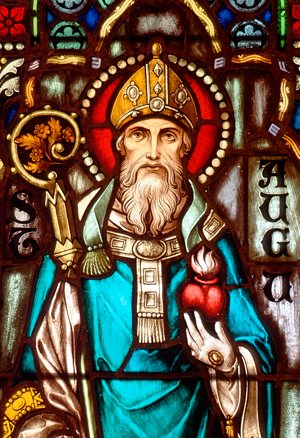
Having long felt this way, I was thrilled yesterday to have found the following in my daily devotional of writings from my personal saint, St. Augustine, Bishop and Doctor of the Church:

“It is also necessary – may God grant it! – that in providing others with books to read I myself should make progress, and that in trying to answer their questions I myself should find what I am seeking.  Therefore, at the command of God our Lord and with His help, I have undertaken not so much to discourse with authority on matters known to me as to know them better by discoursing devoutly of them.”  – The Trinity 1,8


St. Augustine of Hippo

St. Augustine of Hippo

 Imagine what St. Augustine could have accomplished today with electronic media at his fingertips!

It is heartening for me to know that St. Augustine also found the real value of writing to be better personal understanding rather than simply a way of preaching to others.  And, like I’m sure St. Augustine did, I too find some satisfaction in the evangelizing aspect of writing.  For if, by organizing and compiling my muddled thoughts, I cause you, the reader, to think deeply about one of my personal experiences and relate it to yourself, or if I am instrumental in helping you understand and increase your faith, then I have compounded the singular value of my effort many times over.  And that makes it all the more worthwhile.

Please know that I appreciate you taking the time to read my monologues, and that I am very grateful for your comments and feedback.  So many of you have helped me see my faith in new light, you’ve shown me where I’ve put pieces of the puzzle in the wrong places, and all of you have been there patiently listening while I, with God’s grace, try out loud to figure things out for myself.

God Bless You.

Prayer to the Holy Spirit


Breathe into me, Holy Spirit

            That my thoughts may all be holy.

Move in me, Holy Spirit,

            That my work, too, may be holy.

Attract my heart, Holy Spirit,

            That I may love only what is holy.

Strengthen me, Holy Spirit,

            That I may defend all that is holy.

Protect me, Holy Spirit,

            That I always may be holy.

 –       St. Augustine


On Second Thought, I Did Have a God-Moment

Tags

, ,

It’s been over a month since I sat down to write.  December found Melinda and I a little busy with preparing for Christmas and for my daughter Mary’s wedding the Saturday after Christmas, and driving to and from Lake Charles, Louisiana for both.

In spite of all that activity, I tried to stay focused on the “Reason for the Season”.  These were my first Advent and Christmas seasons as a Catholic and I wanted to make sure I experienced the difference between the two. 

Although I didn’t miss a Mass or Holy day of obligation during the almost two weeks we were down South, there was so much activity that my daily prayer routine was seriously interrupted.  By the time we returned home I desperately needed to get back into my faith.

Back at home, I made it to the New Year’s Eve vigil Mass but by the time Epiphany Sunday rolled around I came down with a case of bronchitis and was struck with fits of such violent coughing that I decided to stay home and not ruin other folks’ worship that morning.  It was a little disappointing to me because it was the first Mass I had missed since becoming Catholic last Easter and only the second time since my decision to convert in April 2012.

But, by the next Wednesday I was feeling well enough to get with the men’s bible study group I meet with every two weeks.  After the scripture discussion we went around the room and, as always, volunteered our “God-moments” – those times when God shows up in your life and graces you unexpectedly.  I told the guys that over the two weeks I was gone I really hadn’t noticed any God-moments – none had jumped out at me.  Then, as the others related their God-moments, I began to think back and I realized, again, that I didn’t see them because I wasn’t looking for them.  In fact, I wasn’t just not looking for them, I had instead been so occupied with other things that I had literally closed my mind and heart to them.  And, as I relived our trip, I came to see how there were many God moments that passed undetected right under my nose:

Jesus was with us in our car that first day of driving as we struggled through eight hours of torrential rain and storms between Ohio and Southeast Missouri where we spent Saturday night at my folks. 

Attending the only Sunday Mass at Sacred Heart Catholic Church in Dexter, Missouri would have put us in Lake Charles very late that night.  So, we skipped it and hoped to find someplace else along the way.  Looking ahead, I estimated we could be near Hammond, Louisiana around 5:00 p.m., so I checked masstimes.org to see if there were any Sunday evening masses in that neighborhood.  I don’t think it was dumb luck that there happened to be a Mass at the Holy Ghost Catholic Church in Hammond at 5:00 p.m.  I plugged the address into my GPS and nine hours later we arrived at 4:50 p.m.

God was speaking to me through Fr. Robert Merced, pastor at Holy Ghost Church, when he elaborated on the Gospel reading, Matthew 1:18 – 24, for this 4th Sunday of Advent.  In it, Matthew describes, “…how the birth of Jesus came about.”  I had already spent much time marveling at the caliber of man Joseph must have been to forgive his betrothed and marry her instead of “divorcing her quietly” or, worse, having her stoned.  But Fr. Merced opened my eyes to the fact that Mary’s faith was equally strong.  As a young woman, she knew that to be unmarried and be with child was an offense against the Jewish laws punishable by stoning until death.   Yet, through her faith, she still said, “Yes”.

On our first morning in town we met a friend for breakfast at a local café.  We briefly chatted over coffee about children, but then our friend moved right into a heartfelt discussion about preparing our hearts for Christmas and not getting caught up in the busyness and commercialization of the season.  With only two days to go until Christmas, and a wedding looming just three days later, she somehow knew what we needed to curb our mounting anxiety.

The next morning, Christmas Eve, found me, my soon to be son-in-law, Michael, his father, and a fishing guide skimming across the marsh hoping to slay some redfish.  It turned out to be one of the best fishing trips I had ever been on.  We limited out on reds, and caught several speckled trout and flounder as well.  I won’t be so bold as to say that Jesus helped us catch fish like he helped Peter, but His love was there in an unexpected way through the opportunity for Michael and I to get to know each other much better.  I caught a bunch of keepers that day but I also confirmed I was catching a keeper son-in-law.

We wrapped up Christmas Eve by enjoying a traditional Christmas Eve dinner with our close friends who were graciously putting us up in their home for the week, and then attending the Christmas Vigil Mass at the Cathedral of the Immaculate Conception in Lake Charles.  It was a beautiful Mass and celebration of the birth of our Lord, in a beautiful church, with an angelic A cappella choir.

Christmas day was a relaxing one with the morning spent in the company of Mary and Michael, Michael’s parents and the three of us opening gifts and having fun, followed by a wonderful dinner in the afternoon with more relatives, and with plenty of time to contemplate why we were celebrating in the first place.

On Thursday, we were blessed with the safe arrival of our other two daughters and their husbands, my parents, my brother and sister and their families for another round of gift giving and a delicious fish fry from the fruits of our catch two days earlier.  We gave sincere thanks for everyone’s safe travel and “…these Thy gifts…which we… received, from Thy bounty”.

When Friday rolled around the wedding preparation activities picked up speed.  Since Mary is my third daughter to get married, I knew what I needed to do:  stay out of the way, do what I was told and be an efficient gopher.  I know some dads who have found the role of being the Father of the Bride daunting.  I have found it to be immensely pleasurable.  It gives me a chance to see the joy and hope in my daughters’ eyes and in their smiles, and one last chance to get comfortable with the idea that life is turning out like God intended – that they found someone to love and spend the rest of their lives with.  Did I get sentimental?  Yes, but my happiness for her far outweighed any last moment feelings of selfishness.

Friday also saw dozens of other relatives arrive safely into town from around the country.  When we finally assembled that evening for the rehearsal dinner, Mary and Michael had about sixty relatives surrounding them.  God was there in the hearts of everyone as there were many reunions that night.  And He was there in the smile on the face of my 15 month old, first and only, great-niece when I met her for the first time.

Saturday, the day of Mary’s “big event” arrived and it seemed to fly by without a hitch.  We arrived at the church at the appointed time, and before I knew it I was walking down the aisle, arm and arm with Mary looking as beautiful as I’d ever seen her.  My only thought as they opened the doors for us to process in was a prayer of thanks to God for blessing me with such a wonderful loving daughter and the opportunity to be her father and make this walk down the aisle with her arm in mine.

God was there with us as we reached the altar and I turned to Mary, hugged and kissed her, and told her I love her, and she replied with, “I love you, too, Dad”.  And, He was there with us when I turned to hug Michael and asked him to please take care of her, and he replied with a sincere, “Yes sir, it will be my pleasure.”  Lots of dreams came true in that moment, and not just for the bride and groom.

Unexpectedly, the priest revealed to us that that particular weekend was the celebration of the Feast of the Holy Family, a fitting time to become united in the first step to starting a new family.  It also struck me that both the bride and groom have good role models in their parents and grandparents.  Both sets of parents have been married for a total of about 65 years, and for Mary, at least, her grandparents for 110 years.

Following the wedding ceremony, everyone reconvened at the reception venue where the first order of business was the traditional first dance by the bride and groom.  God was here, too.  As they began to dance to the song, I Won’t Give Up by Jason Mraz, I looked up onto the DJ’s stage to see my youngest daughter, Grace, with microphone in hand and performing the song live, unassisted by any lyrics on a karaoke machine, singing her heart out in front of about 350 people.  I knew she had a pretty voice but I didn’t know how beautiful it really is because I had never heard her sing like this before.  This was her debut and she looked and sounded like an experienced professional.  I had earlier fought back tears when I entrusted Mary to Michael, but I couldn’t hold them back listening to Grace sing.  It was a beautiful moment.

I was able to curb the tears before honoring the next place on Mary’s dance card – the father/daughter dance.  For years Mary told me she wanted us to dance to Paul Simon’s Fathers and Daughters, and we did.  I think the only thing that kept me from losing it was that my happiness for her overcame my own sentimentality. Still, we both knew, “As long as one and one are two, there could never be a father who loved his daughter more than I love you”.  That kind of love can only be a gift from God.

So, to my bible study buddies, “Sorry, guys, I lied.  On second thought, I did have a God-moment….or two…or fifteen”.

A Man of Mercy

Tags

, , ,

About this time last year I was listening to a new CD I had purchased by my new favorite singer/songwriter, Jason Gray.  The CD is called Christmas Stories: Repeat the Sounding Joy.  One particular song on it, “Forgiveness Is A Miracle (A Song For Joseph)”, caught my attention because it was so different from any other Christmas song I had ever heard.  Plus, its subject was something which I had never considered:  what was going through Joseph’s mind and heart prior to, and during, his wife giving birth to not his son, but Jesus, the Son of God?

I discovered that Jason Gray had written an article for The Rabbit Room describing the story behind the song and he explores this difficult situation in which Joseph found himself.  I have re-posted his article below and included a link to The Rabbit Room’s website.  I hope you find it as thought provoking as I did.

http://www.rabbitroom.com/2012/10/the-story-behind-forgiveness-is-a-miracle/

Joseph manger stained glass

The Story Behind “Forgiveness Is a Miracle”

by Jason Gray on October 16, 2012

As I approached writing songs for each of the characters in the Christmas story, I felt particularly protective of Joseph, who I think sometimes doesn’t get the attention he’s due. At the very least I know that I’ve been guilty of not really “seeing” him for the remarkable man that he was, and I wanted to amend that. I enlisted my friend Andy Gullahorn, one of the most masterful storytellers I know, to explore a particular moment in Joseph’s story with me.

Taking my cue from Frederick Buechner’s book, “Peculiar Treasures,” in which he breathes new life into biblical characters who have grown so familiar to us that we no longer experience them as real human beings, I hoped to recapture some of the humanity of the people in the Christmas narrative. It was also important to me to try and write songs that were relevant beyond the four weeks between Thanksgiving and Christmas day. I wanted to tell timeless human stories, and with Joseph we have the makings of just that with a love triangle, a question of revenge or forgiveness, and the age old drama of fathers and sons.

As I read his part in the narrative, I found that more than just a foster parent without much to do (as he was often relegated to in my mind), Joseph is revealed as a man after God’s own heart. Faced not only with the news that his fiancée is pregnant, but also with her incredulous story of how it was God’s doing, Joseph’s character is tested and laid out for all of us to see. What will he do? Will he hurt the one who has hurt him? Will he forgive? This is his moment, and all of history waits and watches in wonder.

There are few things more painful than the betrayal and rejection by the one you love most, so we know it must have deeply wounded him—shattering the dreams he may have had of a future with the girl he loved. Pain is like a lightning bolt striking with a violent energy that can’t be held in the human heart for long. It looks for a way out. The way it usually passes through us is in the all too common progression of hurt turning into anger and then into vengeance. Unless the miracle of forgiveness takes place in a person’s heart to absorb it, the pain we experience will pass through us and be visited upon others.

There is debate as to whether it was within Joseph’s power to have her stoned—while Jewish custom might have allowed it, Roman rule did not. However, if not to her body, we know he still could have done violence to her reputation and her heart. But I believe that Joseph did the hard work of bringing his pain to God rather than letting it pass through him, and that God graced him with the miracle of forgiveness. The narrative tells us he was a “godly man” and that instead of doing her harm, “he decided to dismiss her quietly” so that she wouldn’t be publicly shamed. He took the full force of the blow and–acting as the husband he might have been–became a covering over her supposed sin.

It’s hard for us to experience the tension in Joseph’s story since, as the reader, we know from the start that she isn’t guilty of what he naturally supposes and that God is up to something beautiful that the world has never seen before. But to see Joseph for who he is, I have to remember that he couldn’t know these things in real time. It was only after he had given himself to the work of forgiveness that the angel appeared to him in a dream to tell him that what Mary had said was true after all, and that he should marry her.

It occurred to me that perhaps this is where Joseph’s heart was proven—if not to God who already knew his heart, then perhaps to himself. (I haven’t met a man yet who isn’t daunted by the responsibility of being a father, let alone a father to the Son of God. Maybe this was a test to reveal to Joseph what kind of man he could be.) In this moment he is found to be a man of mercy, which I imagine to be just the kind of man that God was looking for to be the earthly father of his son Jesus. In a way, we see that Joseph carries in his heart the same world changing power of forgiveness that Mary carried in her womb.

It’s also meaningful to me to think of how Joseph forgiving Mary is part of the story that leads to the birth of the savior in whom Joseph would find forgiveness for his own sins. Perhaps it’s the narrative form of Jesus’ teaching that as we forgive we find ourselves forgiven.

As we wrote the song, it was good to be reminded that forgiveness is a kind of miracle. I could be wrong, but I’m not sure that we can muster up forgiveness on our own. It seems to me to be a supernatural force of renewal that we participate in as we point our hearts toward it, pray for it, and make room for it in our lives, but that ultimately we receive it as a gift from God, in his due time.

Forgiveness Is A Miracle (A Song For Joseph)
Jason Gray / Andy Gullahorn
from Christmas Stories: Repeat the Sounding Joy

Love can make a soul come alive
Love can draw a dream out of the darkness
And blow every door open wide
But love can leave you broken hearted

Did she dare to look you in the eye
Did her betrayal leave you raging?
Did you let her see you cry
When she said the child was not your baby?

Pain can turn to anger then to vengeance
It happens time and again
Even in the best of men
It takes a miracle to save us

When love is like an open wound
There’s no way to stop the bleeding
Did you lose sleep over what to do?
Between what’s just and what brings healing

Pain can be a road to find compassion
When we don’t understand, and bring a better end
It takes a miracle to show us

Forgiveness is a miracle
A miracle
And a miracle can change your world
Forgiveness is a miracle

An angel in a dream spoke into your darkest night
So you trusted in the Lord and you took her as your wife
But the forgiveness that you gave would be given back to you
Because you carried in your heart what she was holding in her womb

Love was in a crowded barn
There you were beside her kneeling
You held it in your arms
As the miracle started breathing

Forgiveness is the miracle
The miracle
And a miracle will change your world
Forgiveness is the miracle
The miracle
A miracle will save the world
Forgiveness is the miracle

Blessed Joseph
Your heart is proven
And through you the Kingdom has come
For God delights in a man of mercy
And has found an earthly father for his son