A Love That’s True

Tags

, , , , , , ,

John 13 34

Today’s post is something new for Reflections of a Lay Catholic! I’m entering into uncharted territory, laying myself bare before you. I am posting an original poem I wrote yesterday. Well, actually, it’s more like song lyrics but I can’t tell you the tune, of course. I was on an airplane between Chicago and Houston and I kind of had a tune running through my head. Then, the first line of the chorus popped into my mind and I thought, “Hey, let’s see where this goes.” So, without further ado, let’s see where this goes:

A Love That’s True

I don’t deserve the blessings in my life,

But through His love God graced me with my wife.

Our love was meant to never be apart,

He gave us kids to love with all our hearts.


A love that’s true, a love that’s real,

The kind of love you live for every day,

A love that’s new, a love you feel,

The kind of love you hope for when you pray.


I got good friends I like to be around.

They lift me up whenever I am down.

In hope and faith we meet each week to share,

And through their love I know how much they care.


A love that’s true, a love that’s real,

The kind of love you live for every day,

A love that’s new, a love you feel,

The kind of love you hope for when you pray.


I don’t watch the news or HBO., instead

I got a book I like to read each night ‘fore bed,

‘Bout a man Who died for me that I might live,

All He asked me is to love and to forgive


With a love that’s true, a love that’s real,

The kind of love I live for every day,

A love that’s new, a love I feel,

The kind of love I hope for when I pray.


Oh, His love is true, His love is real,

His love is what we live for every day,

His love is new, His love we feel,

His love is what He gives us when we pray.

This morning at St. Martin de Porres Catholic Church in Lake Charles, Louisiana, I heard Monsignor Jace Eskind read the Gospel, John 13:34:

 “I give you a new commandment, says the Lord: love one another. As I have loved you, so you also should love one another.”

Yesterday when I wrote my song lyrics, I didn’t know this would be the subject of today’s Gospel. I love little “God moments” like this!

“Lord Jesus, thank You for being our example of the Father’s love. I pray that You help us to always reach out to others, to love them for who they are and where they are at that moment of their lives, and to be fully present in our love for them. Amen.”


(A Love That’s True was first published on the blog Reflections of a Lay Catholic. Reproducing, reposting and/or sharing of A Love That’s True is not permitted without express written consent of its author, Jerry Robinson.)

©2016 Reflections of a Lay Catholic. Reposting and sharing of material in its full and original content is not permitted without express written consent of the author(s) and Reflections of a Lay Catholic.


God, I Can’t Hear You

Tags

, , , , , , , ,

christ-the-shepherd

Christ the Shepherd

The Gospel reading for Monday, the 18th was John 10:1-10. When I read it Monday morning it struck an uncomfortable chord. I zeroed in on verses 3, 4, 7 and 9:

1“Amen, amen, I say to you, whoever does not enter a sheepfold through the gate but climbs over elsewhere is a thief and a robber. 2But whoever enters through the gate is the shepherd of the sheep. 3The gatekeeper opens it for him, and the sheep hear his voice, as he calls his own sheep by name and leads them out. 4When he has driven out all his own, he walks ahead of them, and the sheep follow him, because they recognize his voice.”….7So Jesus said again, “Amen, amen, I say to you, I am the gate for the sheep….9I am the gate. Whoever enters through me will be saved and will come in and go out and find pasture.”

It seemed I had been too long without hearing His voice call my name. I wasn’t even sure in which direction to look for the “Gate”.

Since Monday afternoon, I’ve spent about eleven hours on the road behind the wheel. It was welcome time to contemplate His message and why I was feeling lost.

I asked myself why I haven’t felt close to Jesus these past few weeks. Why has He been absent when I especially needed Him? Why have I not heard His voice? My engineer’s analytical mind started trouble-shooting. First, I know I’ve been running hard the last month, burning the candle at both ends you might say. I don’t think its coincidence that my spiritual dry spell corresponds with my busy-ness.

I recalled my baptism and being told, “Ephphatha, be open and hear the Word of God!” I know that God commanded, “This is my beloved Son. Listen to Him.” (Mark 9:7) He wouldn’t have issued that command if He didn’t give us the ability to hear Jesus. So, why am I not hearing him?

I reasoned that, not only does God want us to listen to His beloved Son, He wants us to have a relationship with Him. Good relationships require good communication. Then it hit me, “Effective communication has to be two-way: I not only have to listen but I have to speak to Him!” I realized therein lay the problem: I hadn’t been speaking to Him through my prayers. I remembered how, when I did pray, it seemed difficult, as if the words wouldn’t come. I couldn’t seem to focus and offer up my desires and gratitude into intelligible thoughts and words. And, I knew why. I had put my daily grind ahead of Christ. With my inconsistent and ineffective prayers, He had been supplanted by my negativity, stress and worry over worldly things. By putting Him second, I wasn’t going to be passing through the Gate even if I could find it.

Irony is always a bitter pill to swallow but doing so usually cures what ails me. Had I simply trusted in Him to help me, I either wouldn’t have felt the way I’ve been feeling, or at least I’d have been able to bear my cross a little easier.

Accepting that I needed to rejuvenate my daily piety, I still thought about how it is often difficult for me to hear His voice even when my prayer life is hitting on all cylinders. Sometimes I think I hear God, but I’m not sure if it is His voice, my own, that of other people, or even the devil.

Putting myself in a quiet place sometimes helps, especially at Eucharistic Adoration. I realized this was more of the problem: because of my traveling, I missed my last two hours of Adoration. But, even then, I recalled my last two trips to the Adoration chapel and how, when I finally cleared my head of the voices, I simply fell asleep. (I know, “He said to Peter, ‘So you could not keep watch with me for one hour?’” [Matthew 26:40]). Ouch!

I also know that I don’t just hear God in the silence of Adoration. He talks to me through Sacred Scripture. Maybe if I’d be more consistent with my daily reading I could hear Him.

I recalled, too, that He often talks to me through other holy people, especially those from within our parish community. And, then, another probable cause for my situation came to me: although I haven’t missed Sunday mass in years, I have only been to mass at my parish church once in the last five weeks. The other four Sundays have found me out of town where I’ve attended mass at other churches.

In addition to missing my parish family, my travels have caused me to miss meeting with my friends for our regular faith sharing, something which I look forward to. Meeting with them to talk about how God is working in our lives, what we are doing to stay close to Him, what we are doing to learn more about and grow our faith, and what we’re doing to bring Christ to others, has become an important part of my life. I know He talks to me through these men and women during our get-togethers. And I miss it.

I thought, “I don’t just miss meeting with them, I miss them.” The image of the flock of sheep popped into my mind. I know from herding sheep on a farm in England when I was a kid that they feel safe in numbers. But, they can be really stupid, too. When one wanders away and loses sight of the rest of the flock it is truly lost. I think that has been me. I wandered off over the hill out of sight and out of ear shot.

In that analogy I saw the truth in the parable: a flock of sheep is like our Christian Community. Not only do we need one-on-one communication with God, we need each other, we need to stick together, and we need to hear His voice together.

Then, somewhere between Paducah, Kentucky and Nashville, Tennessee on I-24, I had an epiphany. With all these hours of driving in silence without distractions, had I created the environment I finally needed to hear Him call my name? I wondered if I was actually smart enough to have reasoned all this myself or if all my thoughts were not God talking to me instead? The more I think about it, I can’t take the credit.

“Dear God, thank You for these hours we have spent together, for the gift of reason and for the gift of perseverance to find my way back to You.  Lord, help me to never lose sight of the Gate and help me to always lead others through the Gate as well.  I pray that no matter how far I wander and how unworthy I may feel, I may always recognize Your voice and never again say, ‘God, I can’t hear You.’  Amen.”

(God, I Can’t Hear You was first published on the blog Reflections of a Lay Catholic)

©2016 Reflections of a Lay Catholic. Reposting and sharing of material in its full and original content is permitted, provided that full and clear credit is given to the author(s) and Reflections of a Lay Catholic.

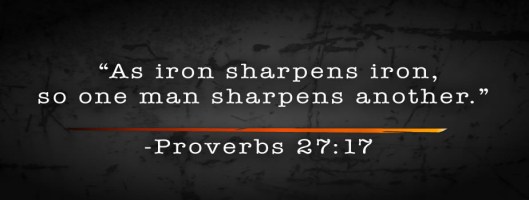
As Iron Sharpens Iron

Tags

, , , , ,

As-Iron-Sharpens-Iron-924x3501

It’s just another day but I have the privilege of adding one number to the age I was yesterday. As Jimmy Buffet would say, I’ve made “one more trip around the sun.”

Birthdays have taken on a new meaning for me over the last few years. My birthday now serves to remind me of not just how old I am, but how long I’ve accepted Christ Jesus as my Lord and Savior. Four years and five days ago marks the event during which I came to know Him. My life hasn’t been the same since.

I was especially reminded of His love and the love of my fellow Christians today when I read the dozens of birthday well-wishes I received through Facebook and emails (I’m away from home on business so if I received any cards at home via regular mail, I don’t know of them yet). Disregarding the whole concept of “Facebook friends”, I was struck by the realization that four years and six days ago I could count my true close friends on both hands plus a few extra fingers. Since then, that number has grown exponentially to hundreds of men and women whom I love and who I know love me – men and women who, because of our love for the Father, I now call Brothers and Sisters. They helped drive that realization home by their sincere desires for God’s blessings to be bestowed upon me today. Wow, I know I am truly blessed!

Dear friends, through your examples, you have enriched my life. I am reminded of Proverbs 27:17, “As iron sharpens iron, so one person sharpens another.” I am still on the dull side, but by allowing me to learn from you, you are helping to hone me into the person Christ wants me to be. Your faith and your actions have allowed me to see Jesus in you and brought me closer to Him. I can only hope you can say the same about me.

God Bless you all.


(As Iron Sharpens Iron was first published on the blog Reflections of a Lay Catholic)

©2016 Reflections of a Lay Catholic. Reposting and sharing of material in its full and original content is permitted, provided that full and clear credit is given to the author(s) and Reflections of a Lay Catholic.

A Confessional Curveball

Tags

, , ,

A confessional curveball

In yesterday’s post, Tomorrow May Not Come, I mentioned how, when examining my conscience before our parish communal penance service, I couldn’t think of any sins I had committed since my confession last Saturday. But, through a God-moment, I remembered there are two types of sins – Sins of Commission, things I’ve done wrong, and Sins of Omission, things I should have done but failed to do.

In the relatively short time I’ve been Catholic, I confess to you that I have never really understood the aspect of Sins of Omission until this last weekend when the two types were explained to me by a deacon. So, for the first time ever, I took time to examine my conscience in light of “what I had failed to do”. I didn’t come up with much but what I did find made the exercise worth doing.

I went to reconciliation last night and, to one of the four priests there, I confessed my sins of omission. And, I learned something interesting: most people focus on their wrong actions, their sins of commission, but very few take time to think about what they should have done but didn’t, their sins of omission. For when I told the priest the what and the why of the two things for which I was sorry, he said, “Whoa, wait a minute, it’s been years since anyone confessed to me what they have failed to do! Let me consider for a second what to do about this!” After a few moments he continued, “I’ll tell you what, it sounds like you know what you ought to do, so your penance is to go and do those things.” I think I heard a sigh of relief.

My guess is that most of you, when examining your own consciences, probably don’t think about your sins of omission. Maybe you ought to. Rise up and separate yourself from the crowd.  It feels good to recognize those areas where you need to do better. And, as always, it feels good to receive forgiveness for them. But, there is something else: there’s just a touch of satisfaction in pitching a change-up and have the priest take it looking.

So, folks, when you take time for an examination of your conscience, consider your sins of omission.  Broaden your repertoire.  Then, instead of your usual fastball, go throw your priest a Confessional Curveball. He may appreciate it as much as you will.

God bless.

(A Confessional Curveball was first published on the blog Reflections of a Lay Catholic)

©2016 Reflections of a Lay Catholic. Reposting and sharing of material in its full and original content is permitted, provided that full and clear credit is given to the author(s) and Reflections of a Lay Catholic.

A Monk’s Chronicle: 14 March MMXVI — The Bible’s in Our Bones

Friends, I always enjoy Fr. Eric’s blog, but wanted to share this weeks because it is a great reflection as we near Holy Week.

monkschronicle's avatarA Monk's Chronicle

IMG_0113_2The Bible’s in Our Bones

Several years ago I ran across a story about Temple Emanuel in New York.  The congregation had commissioned a new Torah scroll, and the leaders had decided to make it something that everyone could participate in.  Rather than isolate the scribe in his studio, however, synagogue officials invited people to put their hand on the scribe’s shoulder as he carefully put quill to vellum to create the Hebrew letters.

To no one’s surprise but that of the scribe, this turned out to be a deeply moving experience, and many of the participants burst into tears.  Naturally this irritated the scribe to no end, until he finally realized what was happening.  For him the creation of a Torah scroll was both a sacred ritual and a job.  But for first-time observers this was the awesome realization that in one brief moment they were helping to create…

View original post 1,011 more words

Tomorrow May Not Come

Tags

, , , ,

P35

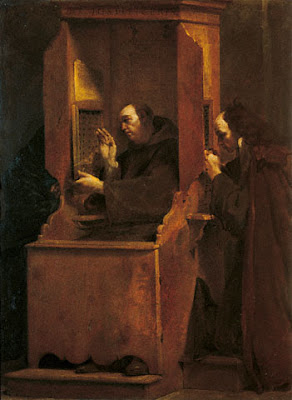
The Confession, Crespi, 1712

The last few days have been extremely busy for me: out of town travel, nights away from home, meetings, extended conference calls, training, and the like. This morning on my way to work I thought, “Man, I’m looking forward to a quiet evening at home tonight, just my wife and me.” Then, about five minutes later when I got to work and checked my weekly calendar, I realized that tonight is already spoken for: we have our parish Lenten Communal Penance Service at 7:00 p.m. I had completely forgotten about it.

My reaction to this was, of course, to consider whether I’ve committed any sins since my last confession last Saturday. Thinking that I am in pretty good spiritual shape at the moment, I thought, “Nah, I’m good.”

At my mid-morning break I opened my daily devotional of writings of Saint Augustine. I was looking for today’s date but the little ribbon that marked the page of my last reading was on the previous page. Before flipping the page I casually perused what was written there, and then, smiling, I once again accepted that He often gives me the direction I need exactly when I need it. I read:

“God is not now so long-suffering in putting up with you that He will fail to be just in punishing. Do not say then: ‘Tomorrow I shall be converted, tomorrow I shall please God, and all that I shall have done today and yesterday will be forgiven me.’

“What you say is true: God has promised forgiveness if you turn back to Him. But, what He has not promised is that you will have tomorrow in which to achieve your conversion.”  – Saint Augustine, Commentary on Psalm 144,11

I thought, “Okay, I hear You, God, you’re telling me I ought to perhaps rethink my plans for tonight.”

I suspect that wasn’t quite the reaction God was looking for because the very next thought that came to mind was the confession we make at the beginning of mass:

“I confess to almighty God, and to you, my brothers and sisters, that I have sinned through my own fault, in my thoughts and in my words, in what I have done, and in what I have failed to do….”

My mind zeroed in on the line, “….and in what I have failed to do”. My idea that I haven’t committed any sins in the last five days may be true, but I failed to consider my sins of omission, those things which I should have done but failed to do.

Have I given my whole heart to God this week? Yeah, I think so.”

Have I prayed as often as I should? Have my prayers been sincere and a true conversation with God? I’d say my piety has been better than normal lately.”

Have I loved my family as I should and let them know my love for them? Ah ha! Because I’ve been so busy, I haven’t talked to my daughters this week and told them how much I love them! I need to do that.”

In the absence of committing an unkind act, have I omitted intentionally showing kindness to others? No, I think I did pretty well in this category.”

Have I been productive when I could have been, or have I been lazy instead? Hmmm, okay, you’ve got me there, that important thing I’ve been procrastinating about needs my serious attention!”

I guess I know where I’ll be tonight. But, that’s okay. As I often hear people say, “It’s all good”. I’ve never been to reconciliation without coming away feeling relieved, as though my load is lightened. I always feel God’s presence and feel strengthened by His forgiving Love.

This is the season of Lent. And, if your parish has a Lenten Penance Service, take advantage of it and let God’s mercy lift some of that excess baggage off of you. If you’ve let your parish Penance Service pass you by, you still have time before Holy week to take advantage of your regularly scheduled reconciliation opportunity. Make time for it. Open your heart and let God’s presence and His Healing Light shine into the dark recesses of your soul, and be renewed. God is constantly ready to forgive us if we just turn to Him. Do it soon. Your “tomorrow” may not come.

God bless you all.

(Tomorrow May Not Come was first published on the blog Reflections of a Lay Catholic)

©2016 Reflections of a Lay Catholic. Reposting and sharing of material in its full and original content is permitted, provided that full and clear credit is given to the author(s) and Reflections of a Lay Catholic.
The Jubilee Year of Mercy – Biblical Jubilee

Tags

, , , ,

Year of Mercy

I am truly blessed to have many friends who go out of their way to help me in my faith journey. After my post on Monday, The Jubilee Year of Mercy – The Basics, a good friend emailed me about an article she read in the December 7-14, 2015 edition of America magazine about the Jubilee Year of Mercy. It is a very informative article; I’m sorry I missed it in my research, and I’m glad she cared enough to send it to me.

The article, Proclaim the Jubilee by Marc Tumeinski, gives a biblical account of why there are jubilee years, how jubilee years were tradition in the Jewish culture, and what they ought to mean to us today. It is an excellent article worthy of being read in its entirety.  It provides much more background and insight into the “whats” and “whys” of Jubilee. To access the article, click on the article title link above.

If anyone would like to comment and share anything they are doing in particular to celebrate the Jubilee Year of Mercy, please do so. I look forward to hearing from you.

God bless.

The Jubilee Year of Mercy – The Basics

Tags

, , , ,

Year of Mercy

For the last few months I’ve occasionally seen in Catholic publications and on social media that we are in the Jubilee Year of Mercy. But, not much has been preached from the pulpit, nor has anything serendipitously crossed my path and grabbed my attention, to offer sufficient insight and explanation about what the Jubilee Year of Mercy actually is and why Pope Francis declared it to be this year.

The name itself, The Jubilee Year of Mercy, implies it to be an important event about which we Catholics ought to know at least the basics. Obviously, I needed to learn more about it which meant I needed to do some research. In this post, I hope to summarize the basics of what I have learned and break it down to be not only informative but easy to understand. Then, in upcoming posts, I will get deeper into the details. My hope is that I will bring some clarity to those of you who are in the situation I was in.

What is a Jubilee Year?

A Jubilee year is when the Catholic Church devotes a year to a special intention that focuses on healing and forgiveness. It is intended to help Catholics strengthen their faith, grow spiritually, and unite with other Catholics and non-Catholics in encouraging service.

Jubilees normally occur every 25 years. They include pilgrimages and special celebrations, and the faithful are called to receive God’s grace through the sacraments of Reconciliation and Holy Communion.

Occasionally, there is an Extraordinary Jubilee Year, such as our current Year of Mercy. These may be declared more frequently than 25 years but offer the same opportunities for additional grace. The last Extraordinary Jubilee year was in 1983 when St. Pope John Paul II honored the 1,950th anniversary of Jesus’ death. It is only the fourth Extraordinary Jubilee since the tradition began 700 years ago.

Why is this the Year of Mercy?

Pope Francis called for this Year of Mercy because he saw the urgent need for mercy and healing in the world. It is his hope that Catholics around the world will take this time to ask for and reflect on receiving God’s mercy, focus on forgiveness to others, and be “Witnesses of Mercy” by practicing corporal and spiritual works of mercy.

In Pope Francis’ homily on Divine Mercy Sunday last year, he answered the why question:

“Here, then, is the reason for the Jubilee: because this is the time for mercy. It is the favorable time to heal wounds, a time not to be weary of meeting all those who are waiting to see and to touch with their hands the signs of the closeness of God, a time to offer everyone, everyone, the way of forgiveness and reconciliation. May the Mother of God open our eyes, so that we may comprehend the task to which we have been called; and may she obtain for us the grace to experience this Jubilee of Mercy as faithful and fruitful witnesses of Christ.”(1)

When is the Jubilee Year of Mercy?

The Jubilee Year of Mercy began on December 8, 2015, the Solemnity of the Immaculate Conception, and it will end on November 20, 2016, the Solemnity of Christ the King.

Where will the Jubilee Year of Mercy be celebrated?

Unlike most jubilees, this is the first to be celebrated world-wide instead of only in Rome. Pope Francis desired that it be celebrated in every diocese in the world thereby making it more easily accessible to all Catholics.

What does the Church do to celebrate the Year of Mercy?

In Rome, there will be more than a dozen celebrations scheduled for the Jubilee Year of Mercy in 2016, giving pilgrims the chance to celebrate their own holy year with Pope Francis. The year-long extraordinary jubilee will include a number of individual jubilee days, such as for consecrated men and women, catechists, the sick and disabled, [children], and prisoners.(2)

Pilgrimages by the faithful are encouraged during jubilee years. To facilitate these pilgrimages, the Church has opened “Holy doors” at churches in each diocese around the world to serve as destinations for one’s journey. “The open holy doors are an invitation to all the faithful to come and enter into the compassion, love, mercy, and consolation of God. They become a Door of Mercy through which anyone who enters will experience the love of God who consoles, pardons, and instills hope.”(1)

In addition, Pope Francis will focus monthly on the 14 “Works of Mercy”, acts which are intended to serve as forms of both penance and charity. These works of mercy consist of the seven “corporal” works of mercy and the seven “spiritual” works of mercy (more about these in another post).

Is there anything special about making a pilgrimage?

Those making pilgrimages during the jubilee year, whether it’s a pilgrimage to Rome or passing through the Holy Doors in your own diocese, will receive a plenary indulgence which, provided the recipient goes to confession, receives Communion and prays for the pope, will remove all temporal punishment due to sins committed up to that time.

What’s next?

So, those are the basics – the purpose, actions, and effects of observing and participating in the Jubilee Year of Mercy. In future posts I will: discuss what mercy is and how one can show mercy; explore and clarify plenary indulgences and the remission of temporal sin; examine the corporal and spiritual works of mercy; and any other nuggets of knowledge I pick up from my research that I think you would like to know.

Parting thoughts

The best way to sum up what I’ve learned so far is to quote Pope Francis. He said, “This jubilee is to be a journey that starts with a spiritual conversion….a journey of walking closer with God and discovering moments of grace and spiritual renewal”(1).

What it isn’t is a process or event to replace our everyday piety, study and action. Rather, it is a supplement which, when understood and practiced, will bring us, and those with whom we interact, additional mercy and grace from God.

I don’t know about you, but I can use a little more of that in my life.

_________________


Sources:

(1) United States Conference of Catholic Bishops

(2) Apostles of the Holy Spirit, Bulletin, Winter 2015-16

(3) The Catholic Telegraph, Archdiocese of Cincinnati, February and March 2016

________________

(The Jubilee Year of Mercy: Part 1 – The Basics, was first published on the blog Reflections of a Lay Catholic)

©2016 Reflections of a Lay Catholic. Reposting and sharing of material in its full and original content is permitted, provided that full and clear credit is given to the author(s) and Reflections of a Lay Catholic

Listen to Your Mother!

Tags

, , , ,

Wedding Feast at Cana Large

Wedding Feast at Cana – Bartolome’ Esteban Murillo, circa 1675

How many of you remember hearing the words, “Listen to your mother!” from your dad or other adult when you were growing up? Most of you, I’m sure. They were words of sound advice based on experience. My mother, and the moms of the kids I hung around with, seemed to possess an uncanny sixth sense. They knew when we were about to do wrong or make a bone-head mistake that would cost us down the road. It hurt to heed that advice but we usually knew it was in our best interest.

We know very little about the early life of Jesus Christ, those years before He began His public ministry. We know He probably gave His mother and father fits from time to time, such as hanging around the temple and missing His ride home. I can imagine Him bristling up, perhaps not wanting to do His chores. And, I can imagine Joseph saying, “Son, listen to your mother and do as she says!”

Throughout the New Testament the Scripture hints that Jesus had a respectful and loving relationship with His mother, Mary. We know that she was a disciple and stayed close to Him throughout His adult life. The first account of this is the story of the wedding at Cana, which was yesterday’s Gospel reading:

1On the third day there was a wedding in Cana in Galilee, and the mother of Jesus was there. 2Jesus and his disciples were also invited to the wedding. 3When the wine ran short, the mother of Jesus said to him, “They have no wine.” 4Jesus said to her, “Woman, how does your concern affect me? My hour has not yet come.” 5His mother said to the servers, “Do whatever he tells you.” (John 2:1-5, NAB)

I’m imagining standing there near Jesus and listening to this conversation. Mary, in her foresight, sees that running out of wine will be an embarrassing social disaster for the bride and groom and, in her kindness, wants to prevent it. She turns to her son, whom I’m sure she knows is more than an ordinary young man, and subtly suggests he do something about it. Jesus alludes that He may not be ready to start performing miracles. Not quite yet.

Then, in my mind’s eye, I imagine her leaning over and whispering to Jesus, “Son, you have to start sometime and it might as well be now.” And, then, without further discussion, she tells the server to, “Do whatever he tells you.”

In my imagination I see Jesus is in a predicament. It’s either put up or make his mother look bad. Even though He may roll His eyes, He listens to His mother:

6Now there were six stone water jars there for Jewish ceremonial washings, each holding twenty to thirty gallons. 7Jesus told them “Fill the jars with water.” So they filled them to the brim. 8Then he told them, “Draw some out now and take it to the headwaiter.” So they took it. 9And when the headwaiter tasted the water that had become wine, without knowing where it came from (although the servers who had drawn the water knew), the headwaiter called the bridegroom 10and said to him, “Everyone serves good wine first, and then when people have drunk freely, an inferior one; but you have kept the good wine until now.” 11Jesus did this as the beginning of his signs in Cana in Galilee and so revealed his glory, and his disciples began to believe in him. (John 2:6-11, NAB)

Jesus listened to His mother because of His great love for her, a love so great that He created a place for her in Heaven next to Him. And, He still loves and listens to her. That is why I often ask Mary, our Blessed Mother, to intercede for me and personally deliver my most sincere prayers to her son, Jesus. What better way can there be to have my prayers heard and obtain God’s grace?


(Listen to Your Mother! was first published on the blog Reflections of a Lay Catholic)

©2016 Reflections of a Lay Catholic. Reposting and sharing of material in its full and original content is permitted, provided that full and clear credit is given to the author(s) and Reflections of a Lay Catholic.

The Protestant Achilles’ Heel

Reposted from Catholic Answers, by Tim Staples, I thought this was a good reflection on Sola Scriptura.

sola scripturaIII

According to ancient Greek legend, the great warrior, Achilles, was invulnerable against attack, except for one area of weakness—his heel. That weakness would be exploited near the end of the Trojan War by Paris. As the story goes, he shot Achilles in the heel with an arrow, killing his seemingly undefeatable foe.

Okay, so referring to Sola Scriptura as the Protestant Achilles’s Heelis not a perfect analogy. There are many weak spots in Protestant theology. But the use of the image of “Achilles’s Heel” in prose today is employed not only to accentuate a singular weakness in an otherwise impenetrable person or institution, but a particularly acute weakness. It is in that sense that I think the analogy fits.

Sola Scriptura was the central doctrine and foundation for all I believed when I was Protestant. On a popular level, it simply meant, “If a teaching isn’t explicit in the Bible, then we don’t accept it as doctrine!” And it seemed so simple. Unassailable. And yet, I do not recall ever hearing a detailed teaching explicating it. It was always a given. Unchallenged. Diving deeper into its meaning, especially when I was challenged to defend my Protestant faith against Catholicism, I found there to be no book specifically on the topic and no uniform understanding of this teaching among Protestant pastors.

Once I got past the superficial, I had to try to answer real questions like, what role does tradition play? How explicit does a doctrine have to be in Scripture before it can be called doctrine? How many times does it have to be mentioned in Scripture before it would be dogmatic? Where does Scripture tell us what is absolutely essential for us to believe as Christians? How do we know what the canon of Scripture is using the principle of sola scriptura? Who is authorized to write Scripture in the first place? When was the canon closed? Or, the best question of all: where is sola scriptura taught in the Bible? These questions and more were left virtually unanswered or left to the varying opinions of various Bible teachers.

The Protestant Response

In answer to this last question, “Where is sola scriptura taught in the Bible?” most Protestants will immediately respond as I did, by simply citing II Tm. 3:16:

All scripture is inspired by God and profitable for teaching, for reproof, for correction, and for training in righteousness, that the man of God may be complete, equipped for every good work.

“How can it get any plainer than that? Doesn’t that say the Bible is all we need?” Question answered.

The fact is: II Timothy 3—or any other text of Scripture—does not even hint at sola scriptura. It says Scripture is inspired and necessary to equip “the man of God,” but never does it say Scripture alone is all anyone needs. We’ll come back to this text in particular later. But in my experience as a Protestant, it was my attempt to defend this bedrock teaching of Protestantism that led me to conclude: sola scriptura is 1) unreasonable 2) unbiblical and 3) unworkable.

Sola Scriptura is Unreasonable

When defending sola scriptura, the Protestant will predictably appeal to his sole authority—Scripture. This is a textbook example of the logical fallacy of circular reasoning which betrays an essential problem with the doctrine itself. One cannot prove the inspiration of a text from the text itself. The Book of Mormon, the Hindu Vedas, writings of Mary Baker Eddy, the Koran, and other books claim inspiration. This does not make them inspired. One must prove the point outside of the text itself to avoid the fallacy of circular reasoning.

Thus, the question remains: how do we know the various books of the Bible are inspired and therefore canonical? And remember: the Protestant must use the principle of sola scriptura in the process.

II Tim. 3:16 is not a valid response to the question. The problems are manifold. Beyond the fact of circular reasoning, for example, I would point out the fact that this verse says all Scripture is inspired tells us nothing of what the canon consists. Just recently, I was speaking with a Protestant inquirer about this issue and he saw my point. He then said words to the effect of, “I believe the Holy Spirit guides us into all truth as Jesus said in Jn. 16:13. The Holy Spirit guided the early Christians and helped them to gather the canon of Scripture and declare it to be the inspired word of God. God would not leave us without his word to guide us.”

That answer is much more Catholic than Protestant! Yes, Jn. 16:13 does say the Spirit will lead the apostles—and by allusion, the Church—into all truth. But this verse has nothing to say about sola scriptura. Nor does it say a word about the nature or number of books in the canon. Catholics certainly agree that the Holy Spirit guided the early Christians to canonize the Scriptures because the Catholic Church teaches that there is an authoritative Church guided by the Holy Spirit. The obvious problem is my Protestant friend did not use sola scriptura as his guiding principle to arrive at his conclusion. How does, for example, Jn. 16:13 tell us that Hebrews was written by an apostolic writer and that it is inspired of God? We would ultimately have to rely on the infallibility of whoever “the Holy Spirit” is guiding to canonize the Bible so that they could not mishear what the Spirit was saying about which books of the Bible are truly inspired.

In order to put this argument of my friend into perspective, can you imagine if a Catholic made a similar claim to demonstrate, say, Mary to be the Mother of God? “We believe the Holy Spirit guides us into all truth and guided the early Christians to declare this truth.” I can almost hear the response. “Show me in the Bible where Mary is the Mother of God! I don’t want to hear about God guiding the Church!” Wouldn’t the same question remain for the Protestant concerning the canon? “Show me in the Bible where the canon of Scripture is, what the criterion for the canon is, who can and cannot write Scripture, etc.”

Will the Circle be Unbroken?

The Protestant response at this point is often an attempt to use the same argument against the Catholic. “How do you know the Scriptures are inspired? Your reasoning is just as circular because you say the Church is infallible because the inspired Scriptures say so and then say the Scriptures are inspired and infallible because the Church says so!”

The Catholic Church’s position on inspiration is not circular. We do not say “the Church is infallible because the inspired Scriptures say so, and the Scriptures are inspired because the infallible Church says so.” That would be a kind of circular reasoning. The Church was established historically and functioned as the infallible spokesperson for the Lord decades before the New Testament was written. The Church is infallible because Jesus said so.

Having said that, it is true that we know the Scriptures to be inspired because the Church has told us so. That is also an historical fact. However, this is not circular reasoning. When the Catholic approaches Scripture, he or she begins with the Bible as an historical document, not as inspired. As any reputable historian will tell you, the New Testament is the most accurate and verifiable historical document in all of ancient history. To deny the substance of the historical documents recorded therein would be absurd. However, one cannot deduce from this that they are inspired. There are many accurate historical documents that are not inspired. However, the Scriptures do give us accurate historical information whether one holds to their inspiration or not. Further, this testimony of the Bible is backed up by hundreds of works by early Christians and non-Christian writers like Suetonius, Tacitus, Pliny the Younger, Josephus, and more. It is on this basis that we can say it is an historical fact that Jesus lived, died, and was reported to be resurrected from the dead by over 500 eyewitnesses. Many of these eyewitnesses went to their deaths testifying to the veracity of the Christ-event (see Lk. 1:1-4, Jn. 21:18-19, 24-25, Acts 1:1-11, I Cr. 15:1-8).

Now, what do we find when we examine the historical record? Jesus Christ—as a matter of history–established a Church, not a book, to be the foundation of the Christian Faith (see Mt. 16:15-18; 18:15-18. Cf. Eph. 2:20; 3:10,20-21; 4:11-15; I Tm. 3:15; Hb. 13:7,17, etc.). He said of his Church, “He who hears you hears me and he who rejects you rejects me, and he who rejects me rejects him who sent me” (Lk. 10:16). The many books that comprise what we call the Bible never tell us crucial truths such as the fact that they are inspired, who can and cannot be the human authors of them, who authored them at all, or, as I said before, what the canon of Scripture is in the first place. And this is just to name a few examples. What is very clear historically is that Jesus established a kingdom with a hierarchy and authority to speak for him (see Lk. 20:29-32, Mt. 10:40, 28:18-20). It was members of this Kingdom—the Church—that would write the Scripture, preserve its many texts and eventually canonize it. The Scriptures cannot write or canonize themselves. To put it simply, reason clearly rejects sola scriptura as a self-refuting principle because one cannot determine what the “scriptura” is using the principle of sola scriptura.

Sola Scriptura is Unbiblical

Let us now consider the most common text used by Protestants to “prove” sola scriptura, II Tm. 3:16, which I quoted above:

All scripture is inspired by God and profitable for teaching, for reproof, for correction, and for training in righteousness, that the man of God may be complete, equipped for every good work.

The problem with using this text as such is threefold: 1. Strictly speaking, it does not speak of the New Testament at all. 2. It does not claim Scripture to be the sole rule of faith for Christians. 3. The Bible teaches oral Tradition to be on a par with and just as necessary as the written Tradition, or Scripture.

1. What’s Old is Not New

Let us examine the context of the passage by reading the two preceding verses:

But as for you, continue in what you have learned and have firmly believed, knowing from whom you learned it and how from childhood (italics added) you have been acquainted with the sacred writings which are able to instruct you for salvation through faith in Jesus Christ.

In context, this passage does not refer to the New Testament at all. None of the New Testament books had been written when St. Timothy was a child! To claim this verse in order to authenticate a book, say, the book of Revelation, when it had most likely not even been written yet, is more than a stretch. That is going far beyond what the text actually claims.

2. The Trouble With Sola

As a Protestant, I was guilty of seeing more than one sola in Scripture that simply did not exist. The Bible clearly teaches justification by faith. And we Catholics believe it. However, we do not believe in justification by faith alone because, among many other reasons, the Bible says, we are “justified by works and not by faith alone” (James 2:24, emphasis added). Analogously, when the Bible says Scripture is inspired and profitable for “the man of God,” to be “equipped for every good work,” we Catholics believe it. However, the text of II Tim. 3:16 never says Scripture alone. There is no sola to be found here either! Even if we granted II Tm. 3:16 was talking about all of Scripture, it never claims Scripture to be the sole rule of faith. A rule of faith, to be sure! But not the sole rule of faith.

James 1:4 illustrates clearly the problem with Protestant exegesis of II Tim. 3:16:

And let steadfastness (patience) have its full effect, that you may be perfect and complete, lacking in nothing.

If we apply the same principle of exegesis to this text that the Protestant does to II Tm. 3:16 we would have to say that all we need is patience to be perfected. We don’t need faith, hope, charity, the Church, baptism, etc.

Of course, any Christian would immediately say this is absurd. And of course it is. But James’s emphasis on the central importance of patience is even stronger than St. Paul’s emphasis on Scripture. The key is to see that there is not a sola to be found in either text. Sola patientia would be just as much an error as is sola scriptura.

3. The Tradition of God is the Word of God

Not only is the Bible silent when it comes to sola scriptura, but Scripture is remarkably plain in teaching oral Tradition to be just as much the word of God as is Scripture. In what most scholars believe was the first book written in the New Testament, St. Paul said:

And we also thank God… that when you received the word of God which you heard from us, you accepted it not as the word of men but as what it really is, the word of God… (I Thess. 2:13)

II Thess. 2:15 adds:

So then, brethren, stand firm and hold to the traditions you have been taught by us, either by word of mouth or by letter.

According to St. Paul, the spoken word from the apostles was just as much the word of God as was the later written word.

Sola Scriptura is Unworkable

When it comes to the tradition of Protestantism—sola scriptura—the silence of the text of Scripture is deafening. When it comes to the true authority of Scripture and Tradition, the Scriptures are clear. And when it comes to the teaching and governing authority of the Church, the biblical text is equally as clear:

If your brother sins against you go and tell him his fault, between you and him alone … But if he does not listen, take one or two others with you … If he refuses to listen … tell it to the church; and if he refuses to listen even to the church, let him be to you as a Gentile and a tax collector. (Mt. 18:15-17)

According to Scripture, the Church—not the Bible alone—is the final court of appeal for the people of God in matters of faith and discipline. But isn’t it also telling that since the Reformation of just ca. 480 years ago—a reformation claiming sola scriptura as its formal principle—there are now over 33,000 denominations that have derived from it?

For 1,500 years, Christianity saw just a few enduring schisms (the Monophysites, Nestorians, the Orthodox, and a very few others). Now in just 480 years we have this? I hardly think that when Jesus prophesied there would be “one shepherd and one fold” in Jn. 10:16, this is what he had in mind. It seems quite clear to me that not only is sola scriptura unreasonable and unbiblical, but it is unworkable. The proof is in the puddin’!

If you liked this post and you would like to dive deeper into this topic and more, click here.


Tim Staples is Director of Apologetics and Evangelization here at Catholic Answers

Source: The Protestant Achilles’ Heel