Jesus, the Divine Physician – St. James Catholic Church, Duluth, MN
In today’s Gospel, Luke 6:12-19, Luke tells of the great multitude of people who sought out Jesus to be healed of their diseases and to be cured of the torment of unclean spirits. Luke doesn’t elaborate on how this great multitude of people learned about Jesus’ healing. But, I suspect it happened by word of mouth, by those who heralded the healing and curing power of Jesus to their family and friends.
Reflecting on this passage, I related to the poor tormented souls as I recalled a time when I was overwhelmed by stress and the exigencies of life which brought so much unhappiness. I wasn’t looking for Jesus to cure me, but I let friends who knew I needed Him carry me to His emergency room, an ER with zero wait time!
So, I ask myself today, have I been one of those friends who, after being cured, or having witnessed His healing, made the effort to tell others who need Him? I can say “Yes”, but reservedly. This blog is one way I get the word out. I evangelize through spiritually mentoring other men to develop their interior lives and their relationships with Jesus. I share my faith in small groups with other men who already have a strong faith. But, do I reach out effectively and proclaim the Good News to those who have not heard it or are indifferent to it? Is my faith contagious? I think I can do better.
How about you? Is your faith contagious? In what ways do you tell others about Jesus and His saving grace? How might you do better?
“Lord Jesus, I thank You for Your constant presence in my life. Lord, open my heart to new ways to bring others to You, and, through Your grace, help me to realize the virtue of fortitude I need to be outgoing in bringing Your Word to others. Help me, Jesus, to live my life in a way that others want some of what I have. Amen.”
(Is Your Faith Contagious? was first published on the blog Reflections of a Lay Catholic)
Yesterday’s Gospel, Jn 10:1-10, brought back memories from long ago. Like 53 years ago when I was 12 years old living in the small village of High Ham, Somerset, England. My friend, John, a year older than me, lived a few hundred yards down the road. John and his family were dairy farmers with a fine herd of Holstein cows. And, they had a large flock of sheep which they raised for the wool. I spent every moment I could down on John’s farm helping with anything his dad would let me. I learned to milk and feed cows, deliver calves, shovel manure, cut, bale and pitch hay, drive a tractor and a car, and herd and shear sheep.
To the best of my recollection, I enjoyed every aspect of it – some more than others. Perhaps my least favorite was herding the sheep. I think I preferred shoveling manure to messing with those unruly critters. Driving the flock from one pasture to another was always a challenge. If one sheep got a notion to jump through a hedge or over a low spot in a rock wall into someone’s yard, they all followed the leader. I did not have what it took to herd sheep. But John, he was the good shepherd. He had the knack. When he was herding them down the main road through the village they were perfect darlings. He loved those fluffy ovines and they loved him. He treated them gently and kindly, and spoke to them softly. With John, they were happy sheep. Me, I just wanted them to do what I wanted them to do – go from point A to point B without detouring to points C, D, E and F along the way. But, they wouldn’t listen to what I had to say.
In the 53 years since then I’ve learned that people can be the same way. We know who loves us and who doesn’t, who cares for us and who has our best interest at heart. Just like sheep, we can sense the difference between someone who is loving, caring, and sincere, and someone who is trying to control us for their own purposes. We become friends with the former and turn our backs on the latter.
Or not. Some folks decide they don’t need any help making it through life. They can do it on their own. Wander where they will with no concern for anyone else. They’ll jump the hedge when something spooks them, and poop in someone else’s yard and think nothing of it. Their actions are driven by fear, or because it feels good, or because it’s convenient, or to simply show they can. But, they’re never really happy.
Still others let other people lead them to places they shouldn’t go, and they blindly follow. Often these are unhealthy relationships based on false love. Some idolize entertainers, politicians, or athletes thinking happiness will be found if they can be like them.
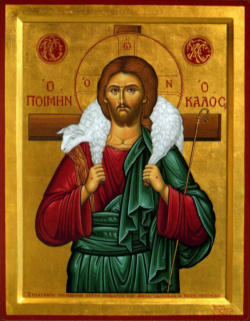
For my part, since I began to follow Jesus ten years ago, I’ve learned that no one loves and cares for me more than He does. It’s His voice I listen for each morning as I sit in the solitude and silence of my daily meditation, conversing with Him, asking Him what His will is for me each day. He is my Good Shepherd. I know where He is leading me, to heaven, and I want to get there virtuously without detouring and ending up in other places that He doesn’t want me to go. Why? Because I hear His voice and follow Him out of love. It’s where I find true happiness.
To whom do you listen? Is it the Good Shepherd? Or is it the harsh and demanding voice of today’s world that invokes anxiety; or the inviting call of pride; or the sexy but illusory whisper of self-pleasure that beckons you?
“Lord Jesus, You are my Good Shepherd. I find peace and consolation each day knowing that You are watching over me, that You know what is best for me, and that You will lead me there. All I have to do is listen to and follow You. Amen.”
(The Good Shepherd was first published on the blog Reflections of a Lay Catholic)
(Editor’s note: In the original posting yesterday, the link to the included homily broadcast did not work. It has been corrected.)
Resurrection of Christ, Noel Coypel, c. 1700
Happy Easter, everyone! Christ is risen today! Alleluia!
It’s been a beautiful day here in Southwest Ohio. A perfect day to celebrate and be joyful. It didn’t begin that way for me, though. I caught my annual springtime cold on Thursday and it’s steadily worsened. I did go to the Mass of the Lord’s Supper Thursday evening and coughed and sneezed my way through it. And, as my cold got worse overnight, I knew better than to go to the Stations of the Cross and the Celebration of the Lord’s Passion on Good Friday, and I decided to skip going to the Easter Vigil Mass as well.
After a fitful night’s sleep I poured myself out of bed this morning and made it to 9:00 a.m. Mass. I managed to make it through with only a few coughs and no sneezes. But, between my head being stopped up and the additional noise from all the extra people, I didn’t understand a word of Father’s homily.
In resignation, I closed my eyes and repeated Simon Peter’s words from the Transfiguration, “It’s good that I am here”, and gave thanks for the opportunity to offer up my suffering and unite it to His cross.
As I stood to go up to communion I recalled the words from the second reading, Col 3:1-4, “Think of what is above, not of what is on earth. For you have died, and your life is hidden with Christ in God.” With each step forward I was drawn to the glory of Christ resurrected, and away from the fogginess I’d been experiencing all morning. By the time I reached the priest to receive the Eucharist, I felt an intense inner peace and knew I was smiling from ear to ear. As I walked back to my seat, letting the Body of Christ dissolve on my tongue, I looked upwards, still smiling, thinking of what is above, and I spied above the entrance doors to the church the Risen Christ on the cross with His arms spread wide in love. He was saying to me, “Your life is hidden here with Me.”
As I knelt back at my seat and said my prayer of thanksgiving after communion, that feeling stayed with me. I wasn’t focused on the way I felt, didn’t work to fend off a coughing fit or stifle a sneeze. I just focused on Jesus, thankful for the hope that my destiny will be with him. I knew that I will suffer things in my life much worse than a common cold, but in the end all of it will pale in comparison to the joy I will find when I find myself with Him.
I left Mass feeling pumped up spiritually yet drained physically, and still somewhat frustrated that I hadn’t heard well enough to understand Father’s homily. I felt a little cheated. Then, about two hours later, I received a message from a friend with a link to a homily from Fr. Ehli at the Cathedral of the Holy Spirit in Bismarck, North Dakota, where my friend’s daughter attends church. It was like the Holy Spirit heard my grumblings and blessed me with what was probably an even better homily on which to meditate. It hit home with me and I feel I need to share it with you here: Fr. Ehli’s homily. The homily begins at the 20:30 mark and ends at 31:30. I won’t give his message away except to say that, between it and my experience at Mass, knowing what’s in store at the end makes the getting there, even with springtime colds and other struggles, much more peaceful.
I pray that your Easter has been a joyful one, that your Hope has found new life knowing that Christ defeated death and He is holding a place for you. God bless you!
“Lord Jesus, You suffered and died for me and redeemed me of my sins. Your resurrection defeated death and gave the world hope that, by following You, we may also defeat death and live with you for all eternity. Thank you! Amen.”
Resolution: I desire to sow the seeds of this Word today by making a concrete resolution to live with more peace in the present moment.
(Peace in Knowing the Meaning of Easter was first published on the blog Reflections of a Lay Catholic)
In today’s Gospel we find Peter, James and John atop Mount Tabor where Jesus is transfigured before them. Elijah and Moses appear to them and converse with Jesus, terrifying the three disciples. Peter, with deep respect, amazement, and, uncharacteristically, at a loss for words, tells Jesus, “Rabbi, it is good that we are here!”
As we attend mass this weekend, or any day when we receive communion, let us remember that Jesus is truly present in the Eucharist in all his divine glory. Let us remember to tell Him, “Jesus, it is good that I am here!”
When we make a Holy hour of Adoration, let us remember that Jesus is truly present in the Eucharist whom we adore, and let us remember to tell Him, “Jesus, it is good that I am here!”
And, any time we enter a church, let us remember that Jesus is alive and at home in the Tabernacle and is welcoming us in. Let us remember to tell Him, “Jesus, it is good that I am here!”
“Dear Jesus, You are my Savior, my Redeemer. You love me more than I can ever imagine. You are always by my side. May I never forget Your presence and to love You in return. Amen.”
(It Is Good That We Are Here! was first published on the blog Reflections of a Lay Catholic)
I posted yesterday about my inspiring trip to reconciliation. As I walked out of church I was pumped up, having just felt an extremely close encounter with the Holy Spirit. As I walked to my truck in the parking lot a woman whom I had never seen before approached on her way into the church. She looked at me and asked with what seemed to be a little attitude, “Who is it this evening?”
I initially assumed she was arriving a little early for 5:30 mass. We have a pastor and a parochial vicar assigned to our parish, I’ll call them Father One and Father Two to protect their identity. I told her that Father One was hearing confessions so he would also be saying mass. The woman looked at me and replied, “Oh, I wish it was Father Two, I like his better.” Not knowing exactly what to say, I offered my rejoinder, “Well, it’s the Word that matters.” She looked at me kind of funny and then walked on past. As I unlocked my truck I suddenly wished I could back time up a half a minute so she and I could have a little one on one conversation.
I would have liked to ask her what it is about Father Two that she prefers. Is it that she likes the dynamic homilies he occasionally gives, or some other personal quirk that appeals to her over Father One? I wanted to ask her if she’s ever considered that Father One might have the time to prepare more edifying homilies if he didn’t have to manage and administer two parishes.
I would have liked to tell her that I hear homilies from a couple dozen priests during the course of a year and every priest has his own style of delivery. Some are enlightening, some not so much. It’s not so much what the priest is saying in his homily, it’s the Word that matters, and what we hear God saying to us. It’s Jesus in the Word and in the Eucharist that we come to receive at mass, not the priest. A less than kind me briefly thought it would be fun to suggest that if it’s a sermon that she comes to get fired up over, then maybe she’d be better off attending a Methodist service. For that, I thought I might need to go back to confession. Maybe next week.
I wondered if she knew that every Catholic church on earth reads the same scripture passages on any particular day. No two priests have the same homily and there are no standard homilies. The priest formulates his homily based on what the Holy Spirit is telling him. Not every priest hears the same message. Likewise, if there are 400 people in the congregation during a mass, then there are 400 different and unique messages being sent from the Holy Spirit, one to each person there. The priest’s message might get you in the ballpark for understanding what God’s will is for you that day, but if that’s all you hear it might leave you in the cheap seats with a message that probably isn’t uniquely yours.
Mentally chiding myself for that devilish thought from a moment ago, I thought if I were a true disciple I would be helpful instead of so snooty and teach her how to meditate on the daily scripture before attending mass. That way she could more readily hear God speak directly to her instead of second hand through the lector or priest. Then, it wouldn’t matter who’s giving the homily.
Suddenly realizing that my know-it-all-pride had just displaced any humility I thought I had, I decided I was making a mountain out of a mole hill. So I got in my truck, buckled up, turned the key and saw that it was only 4:25. I thought maybe the lady was going to confession first. Perhaps she was intending that she preferred Father Two over Father One to hear her confession.
Well, checking my pride didn’t last long as I thought of some new things I’d have liked to ask her. Did she feel more comfortable going to one priest over another? If so, why? Not why as in, “Does Father Two make you feel less sorry for your sins?”, but rather, “Why does it matter?” You don’t go to confession to be comforted. You go to tell God you’re sorry you offended Him and that you’ll do everything in your power to keep from doing it again. You go to be reconciled with God, not reconciled with the priest. After all, it’s God working through the priest, In Persona Christi, Who is the forgiving, All Merciful One.
Once again dismounting from my high-horse, and sorry for being so judgmental, I knew I needed to back off. It’s not for me to judge what’s in someone’s heart by the tone of five simple words. I realized my thoughts were a defensive reaction to protect the dignity of our priests. I look up to them and am thankful they have devoted their lives to helping us on our journey to heaven. Their’s is a demanding “you-can’t-please-all-the-people-even-some-of-the-time” job. They are too often taken for granted and not often enough thanked for their goodness. It seems we too often relegate our spiritual welfare to them instead of taking responsibility for it ourselves. We need to realize there are too few priests as it is, and, as members of the Body of Christ, start carrying more of the load.
I think I know where I’ll be next Saturday afternoon.
“Merciful Father, please forgive me for being so prideful and judgmental. But, thank You for letting me see the value of our caring, generous, and hard-working priests, and accepting their uniqueness, flaws and all, just as You accept mine. Amen.”
(It’s the Word that Matters was first published on the blog Reflections of a Lay Catholic)
In the first, Jesus lays out the conditions of discipleship:
In all our relationships, including those with our family, friends, and neighbors, our relationship with Jesus must always come first.
We must carry our own cross and follow Him even when it hurts.
We must know the cost of following Him and plan and prepare accordingly. That cost will include being virtuous in the face of persecution and suffering, as well as requiring our effort to combat worldly indifference.
We must exercise prudence – do the right thing in any particular situation, choose our battles, and resist foolishness, impetuosity, thoughtlessness, inconstancy, and negligence.
We must turn loose of any disordered attachments which we desire more than Him.
In Luke 16:13, Jesus tells us, “No servant can serve two masters. He will either hate one and love the other, or be devoted to one and despise the other. You cannot serve God and mammon.” Our Lord is saying we can’t be a devoted servant to Him if we are a slave to another.
Together these spoke to me about total commitment to Christ. Not just sometimes, not just when I feel like it, not just when I have time, but all the time, and especially when I’m suffering from something I don’t like, didn’t choose, can’t change or don’t understand.
As I meditated on these two passages, trying to understand the depth of their message and implications, my mind, as it all too often does, drifted in prayer. I recalled my 36 year career in corporate middle management, how I survived several buy-outs and mergers, each with a change of leadership, and with each change a “new and improved” corporate vision, mission and culture.
I recalled one particular newly promoted vice-president telling us that we needed to decide if we were going to be the “pig or the chicken” in the new company. He went on to tell a story of how a pig and a chicken joined together to create a new restaurant business. They discussed roles and responsibilities, and when they came to deciding what would be on the menu the chicken suggested they offer a variety of meals consisting of either ham, bacon or sausage with eggs. The pig thought about that a while and retorted that the arrangement seemed quite unfair. The chicken, thinking her idea made perfect sense asked the pig what he meant. The pig answered, “Well, it seems to me that I am committing to give up my life for this endeavor while your involvement is only dedicating the occasional egg.”
In essence, that new exec was asking us to decide if we were going to be fully committed to the company’s direction or would our dedication be intermittent, jumping on board only when that which was being asked of us was in line with our opinions, made us feel good and satisfied our own desires. As a manager I was expected to set an example for the employees who reported to me. But, truth be known, there were many times I felt like balking, procrastinating, going a different direction, and objecting because toeing the line was simply too demanding of me.
Coming back to the present moment in my prayer, I thought I had been distracted with that crazy memory. But, then, I realized that the Holy Spirit had led me to exactly the place He wanted me to go: to examine and understand my level of commitment to being a disciple of Jesus. Am I a full-time or part-time Catholic? He asks that question of each of us.
A good place to start answering Him is to consider the depth of your love for God. Do you envision Him with loving eyes looking down upon you, His beloved son or daughter? Do you realize that His great love has provided everything you have, including your family and friends? Do you express your love by being grateful for all He has given you?
Do you love Him by simply loving those around you, even your enemies, by doing what is right and just, by loving them as you should love yourself?
Do you love Him in the sacraments, especially the Sacraments of the Eucharist and Reconciliation? During the liturgy of the Mass do you focus on trying to understand His will for you that day? Is your attention completely captured during the epiclesis when the Holy Spirit is called down to sanctify the bread and wine making real the body and blood of Christ? Do you frequent the Sacrament of Reconciliation out of love for God because you have offended Him, or is your motive to selfishly rid yourself of guilt?
Do you love Him in your suffering, by accepting your cross as an opportunity to grow closer to Him, to grow in virtue, and to aid Him in His redemptive mission to save souls?
Do you demonstrate commitment by defending your faith in the face of persecution from those who ridicule you for your belief? Do you practice integrity when you are faced with tough choices by doing the right thing?
Do you love God by looking within yourself and identifying those things to which you are attached, those ingrained bad habits and vices which unnecessarily draw you away from Him, and resolve to change for the good by resisting their temptations?
Being fully-committed means living one life for God rather than giving only a part to God while reserving a second part for yourself. Our commitment has to be more than giving an hour a week to Him when, out of habit, we attend Mass, or when we say grace before meals. We have to live it every day, all day, in our relationships, our work, and our play for the mere glory of God.
A good way to begin moving towards living a life fully committed is to begin each day with gratitude, giving thanks for one more day to live and love Him, and for all that He provides. Then, in prayer, offer to Him out of love all that you will do and experience that day – your work, prayer, joy and suffering – to aid in Christ’s salvific mission of saving souls. Then, spend time with Jesus in prayer, asking Him to show you what His will is for you that day and resolve to do what He tells you. And, finally, carry out your resolution.
Truthfully, none of us are perfect, we are all sinners to some degree. We are all on an elevator somewhere between the basement of minimum involvement and the penthouse of full commitment. Each day we move up and down in that elevator, yet the goal of our lives is to ascend more floors than we descend and ultimately reach the top floor, heaven. The important thing to remember is that, while God keeps the elevator running, we are the ones pushing the buttons.
“Loving Father, I give You thanks for Your eternal love, and for the opportunity to love You each and every day. As I operate this elevator of daily life, help me, Lord, to resist pushing the down buttons that move me away from You. Amen.”
(Are You a Full-Time or Part-Time Catholic? was first published on the blog Reflections of a Lay Catholic)
As I read today’s Scripture for the Feast of the Conversion of Saint Paul during my morning prayer I recalled having posted a reflection on this passage sometime in the past. Looking back, I found I had written Conversions on this date in 2019. Immersing myself in that memory, I relived my own conversion experience and, once again, recalled the immense love I felt when I let myself hear God calling my name.
I also recalled this morning I had a similar recollection two weeks ago on the Feast of the Baptism of the Lord about which I wanted to write but didn’t have the time. This happens frequently – I get an inspiration but then don’t have the time to put it down in coherent form. It can be a little frustrating but then I’m sure it’s all part of God’s plan. But, over the last few days I’ve been confined to an upstairs bedroom/office with that little thing called Covid so I have some extra time to reflect and write. (Don’t be concerned, it seems to be a very mild case.)
That Sunday, two weeks ago, I was at the Savior Pastoral Center in Kansas City, Kansas attending Catholic Spiritual Mentorship Week. As Deacon Tom Schumer read from the Gospel of Mark (Mk 1:7-11) at Mass, I was drawn back to that day eight years and ten months ago when I knew and felt in my heart for the first time that I was also a beloved son of God. As it always is when I slip back to that life changing moment, I felt an intense warmth and an overwhelming sense of gratitude for having received His love and being called to this life.
As Fr. Steve Sotiroff delivered his homily on the Gospel and related it to the Holy Spirit filling our hearts at our own baptisms, I naturally recounted my baptism almost a year after my conversion experience. It seemed as though my heart had, over the previous year, already become enflamed to the point of being on fire for the Lord, such that my actual baptism was more an experience of intense gratitude (and a sigh of relief) for my sins having been forgiven.
It crossed my mind how truly blessed I was to have had my conversion experience at the age of fifty-five. I was able to not only remember it but to wrap it around me like a warm and comfortable blanket! Although I truly believe it is essential for Catholics to baptize their children as infants, I thought what a difference there would be if every Catholic could have a “re-conversion” experience like mine, how we could, collectively, light the world on fire. But, then, it occurred to me that they can have one, and many do, when men and women like you and me invite them to simply crack open the door to let the Holy Spirit come sweeping in, rekindling the fire that has been allowed to die down since their baptism.
A familiar prayer that I’ve recited hundreds of times came to mind:
“Come Holy Spirit, fill the hearts of Your faithful. Enkindle in us the fire of Your love. Send forth Your Spirit and we shall be created and You shall renew the face of the earth. Amen.”
The Communion hymn at Mass that Sunday was a favorite, but one that, unless you’ve been in the Mentoring program would not know. It is an original composition entitled Your Spirit, written and composed by Sr. Ruth Kuefler, AVI. It is a truly beautiful song, especially when she graces it with an excellent in-person performance on her violin, which she did that day. Ever since I first heard it four years ago it has pierced me like a sword and brought me to tears, so powerful are the lyrics. The chorus particularly hit home that day:
“Send us Your Spirit we’ll hear the Father say: ‘My son, you are beloved, daughter you are my delight, I will care for you, and you will live in my love.’”
After Mass I caught Sr. Ruth’s attention and told her for the umpteenth time how beautiful her song is, how it strikes me, and suggested that she ought to copyright it and publish it. To my surprise, she told me she had finally done that just the day before and published it as a YouTube video. I feel honored to be able to share Your Spirit with you here (if you like it, please give it a thumbs up and share with others).
“Lord Jesus, thank You for Your love. Thank You for sending the Holy Spirit, the love between You and the Father, into my heart. Thank You for showing me through the people You’ve placed in my life, and the beauty of this world, like this song, that I am Your beloved son. I pray for the grace to help others come to know the same. Amen.”
(Come Holy Spirit was first published on the blog Reflections of a Lay Catholic)
In today’s Gospel, Luke 9:7-9, we hear King Herod Antipas ask about Jesus, “Who then is this about whom I hear such things?” I don’t think Herod wanted to simply see Jesus to identify Him, rather, I think he wanted to know more about Him. Certainly, his ego probably made him feel threatened by the attention Jesus was receiving, but he could also have been curious to know what made Him so popular. What was it about Him that enthralled so many?
As I meditated on this passage this morning, my mind wandered back a few years, to Saturday, 14 April 2012, when I attended a Christ Renews His Parish weekend. I was present not because I felt I needed to grow in my spiritual life – I didn’t have a spiritual life – rather, I was there to find some rest and solace from the grind which my life had become; to seek clarity on what I needed to do to improve my relationships with those whom I loved; and, possibly, to meet new men and make new friends.
My life had recently become almost oppressive from difficulties at work and work related travel that kept me away from home and family. Like it was for Qoheleth, the author of today’s first scripture reading, Ecclesiastes 1:2-11, life seemed to be just vanity with little hope nor purpose. I was working and making good money, but coming up empty on the happiness meter. Life had become just a “chase after wind” (Eccl 1:14).
Each day was a dread and, if I had been a Christian, the prayer from today’s psalm, “Fill us at daybreak with your mercy, that all our days we may sing for joy” (Ps 90:14), might have been my mantra.
As I listened to men talk and give witness that day, I, like Herod, began to wonder who this Jesus was about Whom I was hearing such things? Listening attentively, I heard how they found happiness through their faith in Jesus in spite of many trials and tribulations, and even in the midst of severe tragedy, that made my problems in life seem insignificant. The love they had for Jesus, Whom they could not see much less hug, as well as the friendship they shared with each other, made me envious.
The men presenting that retreat were infected with something I did not have. It was something good and I hoped it was contagious. These were regular guys like me – they had jobs and families, heartbreaks and headaches, struggles and deep seated desires – but they had something more. They had prayer. They talked to Jesus like they knew Him, like He was their best friend, someone in whom they could confide and trust.
That night, bedded down in the church undercroft, sleep would not come. My mind was racing from what I’d experienced during the day. I knew that the only way I might catch their disease was to talk to Jesus myself, to pray and ask Him to help me. So, I rolled off my cot and went upstairs into the sanctuary. I took the third pew from the back on Joseph’s side and I knelt and truly prayed for the first time in my life. I spoke to Jesus and I called Him by name. I prayed to feel loved and that my family would know my love for them. Even though I got no response, I thanked Him for listening to me, and I went back to bed and let sleep overtake me.
The next day, I received dozens of cards and letters from my wife, children, parents, siblings and people I didn’t even know but who would soon become some of my closest friends. Each letter was one of love and encouragement, and the ones from my wife and children let me know that they felt my deep love for them as well. I had received all I had prayed for, plus some. In His mercy, God showed me His love for me, totally unexpected but as tangible as the love letters I held in my hand. I had never heard the scripture that is today’s Alleluia, John 14:6, but in that first inkling of naive faith I knew that Jesus is, “the way and the truth and the life”, and that I would follow Him from that day forward.
“Dearest Jesus, thank You for patiently waiting for me all those years. Thank You for revealing Yourself to me when I finally sought You and knew I needed You. Thank You for showering me with more love than I knew was possible, and for the grace to love You more every day. Thank You! Amen.”
(I Am the Way and the Truth and the Life was first published on the blog Reflections of a Lay Catholic)
Visit of Nicodemus to Christ, John La Farge, 1880, Smithsonian American Art Museum
Ever since Easter the first readings of daily Scripture have been from the Acts of the Apostles and have been accounts of Peter speaking and healing in the name of Jesus. In healing the man who had been crippled from birth, he and John astonished the other Jews who were going into the temple for their three o’clock prayer (Acts 3:1-10).
Filled with the Holy Spirit (Acts 4:8), Peter went on to speak with great confidence to the people of Jerusalem and converted thousands in the process. In spite of being arrested by the Sanhedrin, thrown in jail, and almost sentenced to death by them, he continued to speak boldly (Acts 4:13,29, 31) and bear witness with great power to Christ’s resurrection (Acts4:33).
Certainly, seeing Jesus twice since His death; having Jesus explain the purpose of His crucifixion (Lk 24:45-47); and committing to follow Jesus by being reminded that he denied Him three times (Jn 21:15-17), brought about Peter’s complete conversion. His heart was fully convicted and his will completely committed to obeying the Lord to “go into the whole world and proclaim the gospel to every creature.” (Mk 16:15). Any fear he and the Apostles might have had was replaced with fortitude to speak boldly, and to rejoice when they were persecuted and suffered dishonor for the sake of the name [of Jesus]. (Acts 5:41).
In addition to this recounting in the Acts of the Apostles, we have also, this week, been reading about Jesus’ encounter with Nicodemus (Jn 3:1-21), a Pharisee and the teacher of Israel (Jn 3:10). Nicodemus came to Jesus one night after hearing about Him driving the money-changers out of the temple, and, more than likely, about His miracle at Cana. He questioned Jesus about His miracles, or signs, because he knew that they could only come from God. Jesus explains that the only way to enter the kingdom of God is to be born again by being baptized and receiving the Holy Spirit. Nicodemus doesn’t understand the concept of being born again and questions, “How can this happen?”
As many times as I’ve read this I always saw Nicodemus’ questioning as trying to catch Jesus in blasphemy so that He could be imprisoned. I had a vision of the learned Nicodemus on an ego trip, and, when the conversation was over, him walking away shaking his head in frustration and disbelief. But, I’m wondering if I was wrong. Maybe Nicodemus actually believed Jesus was who He said He was but his questions were simply an attempt to better understand.
At the end of the Gospel on Good Friday, we read in Jn 19:39 that, Nicodemus, the one who had first come to Him at night, also came bringing a mixture of myrrh and aloes weighing about one hundred pounds, and, along with Joseph of Arimathea, helped bury Jesus’ body. Why would he do that? A hundred pounds of myrrh and aloe must have been worth a significant sum. A hundred pounds seems to be a measure that might be fit for a King. Could Nicodemus have come, through faith, to accept Jesus as the Messiah?
Nicodemus appears one other time in Scripture, in Jn 7:50. The Pharisees had sent officers to arrest Jesus but they came back empty handed because they, too, were amazed at the way He taught. They were reprimanded and accused of being deceived by Jesus like they perceived the crowds had been. Nicodemus stepped up and asked his fellow Pharisees, “Does our law condemn a person before it first hears him and finds out what he is doing?”, to which he is ridiculed for forgetting that “no prophet arises from Galilee.” Could Nicodemus have been making an attempt to stand up for Jesus and protect Him?
I’m not a theologian and I haven’t consulted one on this subject. But, for the moment, I am going to assume that Nicodemus secretly believed, like Joseph of Arimathea, that Jesus was the Messiah. Maybe after that first encounter with Jesus and seeing the miracles He subsequently performed, Nicodemus came to believe that He was the Son of God. And, I’m going to suppose that he followed the doings of the Apostles after the resurrection and the Lord’s ascension and heard their witnesses. If that were true, then what would Nicodemus have said if he’d been asked if he believed in Jesus?
I think the fact that Nicodemus is never again mentioned in the New Testament indicates that he either never gave anyone a reason to ask him, or, if they did, he denied his belief. Admitting his belief would have been at odds with the rest of the Pharisees and certainly the Sanhedrin. He was a leader, a prominent figure in Jerusalem, and taking sides with Jesus and his rag-tag band of followers would have turned their entire law upside down. Believing in Jesus would have been tantamount to blasphemy and could have meant his death. He was, I’m sure, a wealthy man and, at a minimum, he would have forfeited many material possessions besides just his status and reputation.
Thus, as I pondered this all week, I concluded that if he did come to believe in Jesus as the Messiah, he kept it to himself. Whereas Peter, who had nothing to lose but his life, spoke boldly with courageous faith, Nicodemus could never even whisper a word for fear of losing the things of this world which he so esteemed.
And, therein lies the question I have to ask myself – at the risk of losing everything, would I be Peter and boldly proclaim Christ as my Savior and rejoice in the prospect of persecution, or would I be Nicodemus and, out of fear, remain silent?
What would you do?
“Lord Jesus, thank You for Your love. You know I love You. I pray that my love for You will always grow stronger. I pray that if the day ever comes that I may have to choose between life and my faith in You, that I have, like Peter, the courage to choose You. But, I know I’m weak, so mostly I pray that I am never put to that test. Amen.”
(Speak Boldly Like Peter was first published on the blog Reflections of a Lay Catholic)
Yesterday was odd: a Sunday forced to be away from church and not be present for mass. In the seven years I’ve been Catholic I’ve missed mass twice. Once because I had the worst “man-cold” in the history of the world, and once on vacation in Arkansas when we were sixty miles from the nearest Catholic church. Other than that, I’ve fulfilled my Sunday obligation no matter where I’ve happened to be. I know most of you are the same and yesterday was difficult for you, too.
My wife and I tuned into a live-streamed mass from St. Peter in Chains Cathedral in Cincinnati. That was odd, too. The only people in the entire cathedral were the Archbishop, a deacon, an altar server, a lector and a cantor. The Archbishop gave a very good homily. I assume it was the Archbishop – it sounded like his voice but the camera was so far away it was impossible to tell for sure. At the moment we would have received Holy Communion had we been there in person, we recited the Prayer of Spiritual Communion.
As much as I desired the grace that comes with receiving the Sacrament of the Holy Eucharist in a state of grace, the circumstances with the Coronavirus pandemic weren’t going to allow it. I had to believe that Christ is still with me. I had to believe that the grace I received in receiving Him in the Eucharist the previous Sunday was enough to nourish my soul until I can receive Him again. I thought, “I can do that.”
This morning’s Gospel, Jn 4:43-54, The Second Sign at Cana, helped me to better come to terms with that resolution. Today we read about the royal official, a non-Jew, who traveled a long distance to ask Jesus to cure his dying son. Jesus, knowing that He would not win many hearts in Galilee, harshly replied to the man, “Unless you people see signs and wonders, you will not believe.” The man, in humble supplication, responded, “Sir, come down before my child dies.” Seeing the man’s faith without the need for a sign, Jesus replied, “You may go; your son will live.” John then tells us, “The man believed what Jesus said to him and left”, and during his two day journey home discovered that the fever had left his son the previous day at the exact time Jesus told him his son would live.
Most of Jesus’ miracles were performed in person and usually involved Him touching the one in need of healing followed by a required action on the receiver’s part. Since the recipient wasn’t present in this miracle, Jesus did neither in extending His healing grace because He sensed the father’s faith.
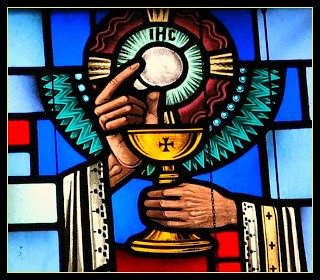
The Eucharist is the source and summit of our Catholic faith. We believe and take Christ for His word when He said, “Whoever eats my flesh and drinks my blood will have eternal life” (Jn 6:54). He instructed us to “Do this in memory of Me” (Lk 22:19), which we do every Sunday, and even, if we’re so inclined, every day of the week.
The Catechism of the Catholic Church tells us that “The sacraments are perceptible signs (words and actions) accessible to our human nature. By the action of Christ and the power of the Holy Spirit they make present efficaciously the grace that they signify.” (CCC 1127). It’s like a husband giving flowers with a sincerely spoken and affectionate “I Love You” to his wife as a sign of his love.
But, the Catechism goes on to say, “Nevertheless, the fruits of the sacraments also depend on the disposition of the one who receives them.” (CCC 1128).
What does this mean? It means that when you go to mass and receive the Sacrament of the Eucharist, you may not necessarily be receiving all the graces that are possible. Even though the Eucharist is always an infinite amount of grace, just because one goes to the Fount of Living Water doesn’t mean that one always drinks from it. Total refreshment comes only through a strong faith and living a life of prayer. Going back to the analogy of the flowers, the love felt by the wife is a function of the disposition of her heart and is independent of the love expressed by the husband.
So, where does this leave me? I know I cannot receive Jesus in the Eucharist at the present time nor the sacramental grace that goes with it. But, I can, with the help of the Holy Spirit, dispose my heart to loving Jesus more through deepening my faith, a deeper prayer life, living a life of virtue, and showing God more gratitude, thus receiving an increase in sanctifying grace.
How does one do this? Developing a deeper prayer life may mean spending 20 to 30 minutes a day reading daily Scripture and reflecting on it; meditating on the Word of God and asking the Holy Spirit to show you what His will is for you that day; and, then making a resolution to take action and follow His lead and do His will.
It may mean taking time for silence and solitude where you can simply love God more, feeling His presence, and trusting that His love will carry you through the day.
We can deepen our faith by seeing God around us in the people we meet, our family and friends; in the words and help offered by a kind person; by the phone call from someone you care about. We can imitate the virtue of Christ and serve others; call upon our loved ones; seek to serve the vulnerable elderly while they are shut-in.
And, we can pay attention to and give thanks for the circumstances of our lives: take pleasure in the flowers that are starting to bloom in our gardens; the birds who are feeding at the bird feeder; and the beautiful sunrises and sunsets (if there are such things in Ohio in the grayness of March!).
I believe our God is an understanding and loving God. He knows we long to receive Him in the Blessed Sacrament. But, in His infinite Wisdom, He has permitted the current situation. Maybe He’s giving us the opportunity to grow closer to Him, to show our faith without thesign that we cherish so much.
God bless and may the Peace of Christ be with you.
“Oh my Jesus, I believe that You are present in the Most Holy Sacrament. I love You above all things, and I desire to receive You into my soul. Since I cannot at this moment receive You sacramentally, come at least spiritually into my heart. I embrace You as if You were already there and unite myself wholly to You. Never permit me to be separated from You. Amen.” (Prayer of Spiritual Communion)
(Believing Without Signs was first published on the blog Reflections of a Lay Catholic)







 Reflections of a Lay Catholic