It’s Wednesday, May 15th, but I know this won’t get posted until tomorrow. I’m writing this right after my morning meditation on today’s Gospel, John 17:11-19. After Jesus informed his disciples that he is going away (Jn 16) and they will have to take over from Him, He warns them of the trouble they will encounter from the world, but to have courage because He has conquered the world. Now (Jn 17), He prays to God before them to consecrate them to the truth, sends them forth into the world to continue His mission, and prays, “for those who will believe in me through their word”.
As I put myself in that scene as one of the disciples, I feel anxious. I am alarmed and sad that my Messiah, the One I love, is leaving me, and I am fearful because I now have a tremendous responsibility to carry on His mission even though I am hopelessly inadequate. At the same time, I think about all the good He has brought to the world – the miracles, the lessons about right living, the healing, the interior peace – lessons that simply cannot be set aside and forgotten. I have a decision to make: do I just remember Jesus as a friend, teacher, and miracle worker, or do I continue His work, sharing this beautiful life, and help others come to know Him?
I realize that it’s really a no-brainer. Up until now, I’ve just been tagging along on His robe-tail, letting Him do all the work. Now He’s asking me, and trusting in me, to step up and take command. He’s even asked God directly to help me…and I have no reason to believe His prayer won’t be answered no matter how afraid I am. I have never felt more loved than when I’ve been with Him. He has asked me to love others as He has loved me. How can I do otherwise?
My decision: I’m in. I know it won’t be easy but I trust that He will be with me. I’ll make mistakes. I’ll fall occasionally. He told me the world will work against me. I’ll accept that, but I’ll find ways to deal with it and evangelize nevertheless.
What’s your decision? Are you in or out?
“Lord Jesus, thank You for inviting me to adeep relationship with You, and Your trust in me to lead others to You. Thank You for the gifts You give when I receive You in Communion, the gifts of love for others, and of courage and strength to overcome my fear of evangelizing as I bring that love to them. Amen.
(Are You In or Out? was first published on the blog Reflections of a Lay Catholic)
My southern-raised grandmother had a saying when she received something good over and above what she expected: “Well, isn’t that just gravy on the biscuit!”. This Lent our parish offered a faith-filled “biscuit” and got a heaping ladle of “gravy” thrown in.
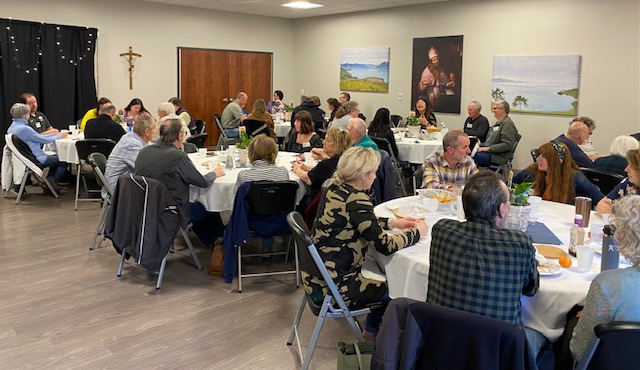
Approximately ninety parishioners and parishioners-to-be gathered to experience The Rescue Project, a faith-building/evangelization program. Participants sat at the same table of eight, and, over eight weeks, filled their bellies with good food and their minds and souls with delicious “biscuits” – an expected deeper understanding of our Catholic faith.
The “gravy” came in the form of evangelizing through developing friendships. Many at the tables were strangers to each other, so table leaders had to be intentional about creating an inviting atmosphere for everyone to comfortably share their personal insights and what they received from the presentations. This intentionality had to stem from a genuine interest in the other person and a desire to get to know their story. With each successive week, participants became more comfortable and trusting, laughed and cried together, and became close friends. Since the program ended, table members have arranged to meet for meals, for prayer, and have stayed in touch supporting each other in their daily walk with Christ.
Everyone who attended The Rescue Project came to be inspired in their faith, and they left with much more – new friends with whom they could share their love for Jesus. But, those ninety folks are not unique in the world. There are millions just like them eager for friendship and the chance to tell their story if only someone is interested enough to listen. They are in our parishes, our neighborhoods, and our workplaces. They are the people sitting next to you in the church pew, or the new parishioner who’s just moved to town and doesn’t know anyone. They could be someone who is lost and despairing, who is blindly looking for salvation. God put you in their path on purpose.
To be missionary disciples, we need to intentionally seek opportunities to be friends who can bring others to Christ. We need to be welcoming and hospitable, and help others find joy in the world by delighting in them and helping them feel relevant, that they are beloved sons and daughters of God. God made us for each other. He shows His love for us through other people. Your next best friend may just be the person you’re about to meet. Delight in them. Be the “gravy” on their “biscuit”.
“Heavenly Father, thank You for the gift of faith, for the gift of friendship, and the opportunity to bring the two together. Thank You for Fr. John Riccardo and his ACTS XXIX team for developing The Rescue Project. Thank you for putting it on the hearts of so many in our parish to participate and bring the love of Christ to others. Amen.”
(Biscuits and Gravy was first published on the blog Reflections of a Lay Catholic)
This Saturday morning, Easter Saturday, I will have the pleasure of leading eighteen adults and youths in the final rites before they are baptized and enter into full communion with the Church that evening at the Easter Vigil Mass. One of those rites is the Ephphatha Rite, the opening of the ears and mouth of the Elect to help them more clearly hear and proclaim the Word of God. The Rite is based on the curing of the deaf and mute man in Mark’s Gospel (Mk 7:31-37).
Saturday will be exactly eleven years to the day since I received this rite, the day I was baptized and became a Catholic Christian. A remembrance of this came back to me this morning as I read today’s first reading:
The Lord God has given me a well-trained tongue, that I might know how to answer the weary a word that will awaken them. Morning after morning he wakens my ear to hear as disciples do; the Lord God opened my ear, I did not refuse, did not turn away. – Is 50:4-5
More happened that day than my conversion becoming official. God truly opened my ears and my tongue as well as allowing the words to flow from my brain through my hand to pen or computer keys. I was never one to journal or record my thoughts on paper, in fact, I abhorred writing, was terrible with grammar and punctuation, and, most of all, didn’t dare say anything about a belief with which someone else might contend. Yet, within two weeks, I began writing articles on this blog as a means to evangelize and lead others to a better understanding of their faith in hopes that they would grow closer to Jesus. Now, eleven years and 300 blog posts later, I still feel the call.
On March 30, 2013, I would have said you were crazy if you’d prophesied the future and said I would retire, go back to school to become a certified Catholic Spiritual Mentor mentoring dozens of men, and eventually be re-employed as Director of Evangelization and Adult Faith Formation within our parish. Miracles happen, and, with God, all things are possible.
“Good and gracious God, by Your grace, You joined me with holy people who accompanied me on this journey ever since I chose to follow You. Through them, You taught me how to pray, how to converse with You, how to tell You what is on my heart, how to listen to Your promptings, and, especially, how to help others do the same so that their interior lives can flourish. You opened my ears and loosened my tongue so that others may hear Your Word. I give You thanks every day that when I heard Your calling, ‘I did not refuse, did not turn away.’ Amen.”
(Ephphatha! was first published on the blog Reflections of a Lay Catholic)
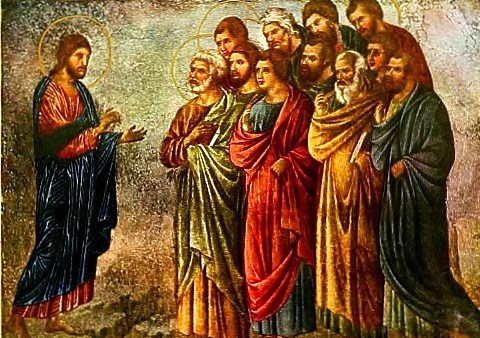
Jesus Sends the Apostles – Duccio di Buoninsegna, c.1300
We all know people who claim to believe in God but then won’t talk about it. They clam up and say their faith is personal…end of discussion. They are right, one’s faith is, and should be, personal. But Jesus never intended for it to be private. He tells us in the Gospels to go and be disciples. How can we evangelize if we keep our faith private?
The most common excuse for keeping one’s faith private may be that the basics were never learned well enough in the first place to share it with, or defend it before, others. One can easily deflect blame onto one’s teachers or parents, but to remain in this state is to succumb to the deadly vice of sloth, which is a laziness or a lack of love for the ways of God. The virtue opposing sloth is diligence, which may simply mean spending a little time each day learning more about one’s faith through daily prayer, reading scripture or other Catholic publications, or listening to Catholic television, radio, or podcasts, all of which can help us increase our understanding of our faith.
Another is our failure to fully understand and accept the graces we received at our Confirmation. The infusion of the Holy Spirit supernaturally strengthened the virtue of fortitude within us, enabling us to share in the mission of Jesus Christ to spread and defend our faith. Like a child who receives affirmation from a parent over a good behavior continues to improve in that behavior, we, too, simply have to believe we already possess what we need.
And, finally, the exigencies of modern life can make us forget that we need other people. Jesus didn’t live as a hermit. He gathered family and friends with whom He shared life. St. Paul urged the Corinthians to not live their faith privately but in community with one another. Like an ember that falls away from a fire and dies out, we can grow cold if we don’t stay close to others who are on fire with their faith, and others can grow cold if we don’t bring our fire to them.
To effectively evangelize, we can’t be passive. We have to actively learn, strengthen our relationship with Jesus through prayer and study, and build friendships with those whose fires need stoking.
“Lord Jesus, I pray for the grace to love You more dearly, and to exercise the grace which You’ve already bestowed on me in my Confirmation to bear fruit for Your Kingdom. Amen.”
(Faith is Personal…but Should Never be Private was first published on the blog Reflections of a Lay Catholic)
In many previous posts I’ve mentioned the need to develop a close personal relationship with Jesus through prayer, especially mental prayer or mediation, in order to make our evangelizing authentic. In prayer, we spend time with Jesus, we converse, and we build a friendship with Him that becomes so exciting that we want to introduce Him and share Him with others!
As Catholics, we are fortunate to be able to claim two thousand years of tradition in our lineage. We are the original Church, instituted by Christ Himself, and built on the rock of Peter. We have thousands of saints to whom we can look as role models: men and women who performed incredible acts of charity, who evangelized savage cultures at the risk of losing their lives, and who staunchly defended their faith and were martyred. Our faith is deep, and we have a plethora of books, magazines, podcasts, television, videos, and speakers to help us learn and go deeper into the finer details of Catholicism. It’s all good and exciting stuff and we can easily get lost in it. So lost, in fact, that we can begin to think that our religion, our Catholicity, is first and foremost. And, when we do, Jesus gets relegated to the back seat. Our excitement about Catholicism becomes a hinderance to actually promoting Jesus.
If we read the Gospels closely, we see the popularity of Jesus. People heard of his miracles, and they flocked to Him. They were cured of sickness and demons, and, as they told more people about Him, more and more people followed Him everywhere He went. During Jesus’ public ministry, His disciples didn’t tell people to come join them in a new religion. The term Christianity was not coined until a few decades later. Rather, they simply invited them to encounter Jesus. People got excited about Jesus and not some new religion.
If we’re not careful, we can fall into the trap of thinking we are evangelizing when, instead, we are selling Catholicism rather than sharing our love for Jesus, and hoping that an interest in Him will ensue. We have it backwards. We ought to follow the example of the Apostles and invite people to meet Jesus. Once they find and get excited about Him, then we can introduce them to the beauty and truth of our Catholic faith.
How do I know this? Because it worked on me.
“Dear Jesus, thank You for Your love, for drawing me closer to You each day. I love You, and in our friendship, Your love overflows so that I may offer it to others who may not know You…yet. Amen.”
(Relationship vs. Religion was first published on the blog Reflections of a Lay Catholic)
I’ve been in my position as Director of Evangelization for our parish family for about a year now. The role has turned out to be more than I originally imagined it would be. I wear several hats during the course of a day, and I often hear, “I saw your truck at the parish office late last night.” To them I respond, “Yep, I’m loving it! For the first time in twenty years I get up in the morning and look forward to going to work!”
Ministry work is as distinct as night and day to the corporate life I endured for thirty-six years before I retired. While I may have grown weary of the grind, I enjoyed the hundreds of people with whom I worked and led, especially helping them learn how to perform their jobs well and understand why it was necessary. Understanding the “why” behind a directive can inspire someone to move from poor or mediocre performance to high performance. I think this principle applies to evangelization, as well.
The directive to evangelize came from Jesus, “Go, therefore, and make disciples of all nations, baptizing them in the name of the Father, and of the Son, and of the holy Spirit, teaching them to observe all that I have commanded you.” (Mt 28:19-20). Jesus didn’t explicitly answer the “why” question in this order, but He did give us inferences in the Gospels and inspired letters of the New Testament as to why he commanded this of us:
“because I came down from heaven not to do my own will but the will of the one who sent me…for this is the will of my Father, that everyone who sees the Son and believes in him may have eternal life…” (Jn 6:38-40)
“This is good and pleasing to God our savior, who wills everyone to be saved and to come to knowledge of the truth.” (1 Tm 2:3-4)
Jesus laid out the conditions of discipleship when he said we must deny ourselves and follow Him, that is, to do as He does and as He commands. (Mt 16:24-26)
Just like an employee who wonders “why?” might ask the question, “What’s in it for me?”, before he does something, it’s easy for us Christians to ask the same, especially when it comes to the often difficult task of evangelizing. The real question should not be, “What’s in it for me?”, but “What’s in it for someone else?”. Jesus made this inference when he explained the second Great Commandment, “Love your neighbor as yourself!” (Mt 22:39)
So, the answer to, “What’s in it for someone else?”, is that they will find a relationship with Jesus, the One Who redeems us and leads us to “God [who}, infinitely perfect and blessed in Himself, in a plan of sheer goodness freely created man to make him share in His own blessed life.” (CCC1).
And the answer to, “What’s in it for me?”, is the grace in knowing that correctly answering, “What’s in it for someone else?”, might simply be your salvation!
“Heavenly Father, thank You for Your love and presence in my life, for the desire to place myself in Your presence, and to bring others into Your presence, as well. Amen.”
(Why You Should Evangelize was first published on the blog Reflections of a Lay Catholic)
Today, we celebrate the Feast of the Conversion of St. Paul. As I meditated on today’s Scripture, I had a deja vu feeling I had been there before. Looking back, I discovered I’d offered a reflection four years ago today, and decided it was worth sharing again.
We are all called to proclaim the Gospel. How we do that begins with each of us asking the question:
What Shall I Do, Lord?
On this Feast of the Conversion of St. Paul we hear St. Paul ask, “What shall I do, Lord?”, after he is blinded on his way to Damascus to arrest Christians. His question is proof of his instant conversion to follow Christ.
It’s a good question for each ofus to ask every day, as well, if we desire to follow Christ and grow in holiness. There’s no better way to begin one’s day than through meditation asking the Lord to reveal His will for us. It’s our job, then, to listen and make a resolution to go do it.
“Heavenly Father, through St. Paul and the other Apostles, the faith was spread throughout the world. As I celebrate his conversion today, I pray that I may follow his witness in at least my little part of the world. Amen.”
(From the Archives: What Shall I Do, Lord?, was first published on the blog Reflections of a Lay Catholic)
In last Wednesday’s Gospel, Jesus told His disciples that they were not to prepare their defense before hand because He Himself would give them a wisdom in speaking. (Lk 21:14). I know Jesus was alluding to their legal defense when they would eventually be persecuted, but today I had an opportunity to pray for wisdom in speaking in an unexpected situation.
I had gone to my office at the parish center to wrap up some unfinished business. Upon entering the building I noticed someone was using one of the conference room. Not long after settling in at my desk I was interrupted by a woman, a friend of mine, knocking at my door. She is Hispanic, was the one using the conference room, and she was leading six fourteen and fifteen year old girls, along with three moms, in preparation for their Quinceaneras, their cultural right-of-passage into womanhood at the age of fifteen.
My friend asked me if I would come talk to the girls about their faith obligations once they make this transition into young adulthood. I’m sure I had a scared, deer-in-the-headlights look on my face because: one, I stink at extemporaneous speaking; and, two, all I knew about this celebration is what I just wrote in italics above. I had no idea what new faith obligations they might have once they “officially” become young women, and no time to ask or research it. What could I say? She is my friend and she asked because I am the parish’s Director of Evangelization. She was trusting in me to enlighten these young ladies.
It is about twenty steps from my office to the conference room. With the first ten or so steps I tried to think of what to say but, getting no inspiration, I paced the last ten steps simply praying for the Holy Spirit to lead me.
My friend had the girls introduce themselves and I congratulated them on their upcoming milestone and asked if they were looking forward to it. They smiled and nodded. I made an awkward momentary pause, still not knowing what to say, but continued with, “Growing up can be exciting but it also brings more responsibility as you know. One of those responsibilities is to not only stay strong in your faith but to pass that faith along to others. We call that evangelizing.” Mostly blank looks followed.
“How many of you have tattoos?” That produced a smile or two and, thankfully, none had received one. “That’s good”, I added with my own smile, “but you actually have a tattoo, an invisible one. It’s the mark you received at your baptism, the mark that identifies you as a beloved daughter of God, and one who has the Spirit of Christ in you!” Quizzical looks.
You’re fourteen or fifteen so I suspect you’ve all been Confirmed, right?” All nods. “You may not know it but you were given another gift at your Confirmation, the courage and strength to tell others about your love for Jesus. Is that kind of a scary thought, talking about your faith?” More nods.
“Well, it’s really not that hard. The best way to do that is to just be friendly with other people, especially those whom you don’t know well. And, because you have the love of Christ in you, you will radiate a joy that they find different than in other people. They will begin to want some of what you have. They will want to be your friend. It’s much easier to share your feelings with friends, isn’t it?” Nods.
“But you have to be open to making new friends, which means that you have to intentionally reach out to meet new people. And that can be kind of scary. But, remember, you have been given the strength and courage you need to do that. What’s the best way to make good new friends? Well, the best way is to put your phones down and greet people person to person and have conversations face to face. This is how you really get to know someone and they get to know you. And, it’s the best way to share life and share your faith and introduce a new friend to Jesus. It’s the adult way to have a relationship with someone else.” Funny looks.
“Jesus told all of us to go and tell others about Him. It’s our responsibility. And it’s a responsibility that we have to accept as adults. I love that you’re all so excited about this next step in your life! it can be really exciting, too, to share your faith with other people, especially when you see them learning to love Jesus, too.
“I wish you all well, and that your Quinceanera celebrations are amazing! And, I hope you all embrace your young adulthood and the challenges and responsibilities it will bring. God bless you all.” Smiles and nods.
It’s difficult to tell what’s going on in a stoic young person’s mind. Everything I said may have gone in one ear and out the other. My friend and the moms seemed to love my comments, though. Someday I may have the opportunity to look back on this and see whether or not my advice stuck with them. If a connection was made with just one of those young women, and she someday puts those ideas into play, then all of my situational uneasiness will have been worth it. But, for now, I will simply trust in the Holy Spirit, the One Who gave me the wisdom to speak those words, to take it from here.
“Dear Lord, thank You for this opportunity that literally came knocking on my door today. You may have been testing me, or You may have been simply showing me that You believe in me, that I actually can evangelize when I need to. Either way, I thank You, and I thank You for giving me the words to speak. Lord, I pray for those young ladies, that they may keep the faith and that they will lead others closer to You. Amen.”
(Wisdom in Speaking was first published on the blog Reflections of a Lay Catholic)
I’ve been settling into my new office in our parish center and trying to make it functional for my use. My computer and phone are conveniently located, files are arranged in the file cabinet, and books are in the bookcase. I have a crucifix and a cast figure of the Blessed Mother holding the child Jesus hanging on the walls, and I hope to get some pictures hung soon. Finally, I’ve adorned it with a couple house plants to make things look more inviting.
My wife has exclusive ownership of a ‘green thumb’ in our family and I had to ask her advice for how often to water the plants. She told me in a not so endearing tone of voice, “If the soil feels dry, water it!” From experience, I know that if you pour water on the soil from the top, it often comes out the hole in the bottom of the pot and makes a mess on whatever surface it’s sitting. So, my master gardener better-half gave me a shallow plastic tray in which to set the potted plants and then told me to fill the tray with water. She said the soil in the pot would soak up the water through the hole in the bottom of the pot.
The other morning, when I checked, the soil was somewhere between dry and parched. It needed a drink. I heeded her advice, filled the tray with water, and set the pot in it.
I then went about my business of sketching out a plan of how to create an evangelizing culture in our parish, to wit: how to develop a more welcoming and hospitable community where people will intentionally build relationships with each other; how to grow an attitude of charity towards “neighbors”; and how to encourage people to not be afraid to share their faith with others.
After an hour or so, I noticed that the half inch of water I’d poured into the tray had disappeared. Just as I was told, the soil had soaked it up. I envisioned the water molecules defying gravity as they flowed upwards, saturating the soil. I thought about how thirsty that plant must have been.
Then it struck me – plants aren’t the only thing that thirst for water, we humans do, too. Except, our thirst is for the Living Water (Jn 4:10). We may not understand it, but our souls yearn for it. Our deepest desire, and the only true way of living a spiritually healthy life, is to seek God, the one in Whom we live and move and have our being (Acts 17:28). It is God Incarnate, Jesus, that sustains our life.
I had omitted from my notes the most crucial element about a culture of evangelization – a deep relationship with our Lord. Without it, evangelizing amounts to a worthless attempt. If the ultimate reason for evangelizing anyone is to bring them into a relationship with Christ, we are hypocrites if we try to evangelize without having our own personal relationship with Jesus. How can we lead someone to a place which we haven’t been ourselves?
What is a deep and loving relationship with Christ? Well, what makes up a deep and loving relationship with anyone? Basically, it’s friendship. The essence of friendship is spending time with each other, getting to know each other, having enlightening conversations, and loving and wanting the other’s good. Friendship with Jesus is really no different. We do that through prayer.
Us Catholics are good at Vocal prayer, that is, prayers of petition, thanksgiving, intercession and praise (CCC2700-04). And, we’re good at rote prayers that have been memorized and recited since childhood. But, there are two other expressions of prayer that are mostly overlooked – Meditation, or Mental prayer (CCC 2705-08), and Contemplation (CCC 2709-19). Vocal prayer is talking to God. Meditation, on the other hand, is using our God-given intellect and imagination in seeking to understand what God is asking of us. Meditation is often accomplished by reading Sacred Scripture, especially the Gospels, reading about the lives of the saints, and other spiritual writing.
Contemplation takes meditation one step further. St. Teresa of Avila said, “Contemplation is nothing else than a close sharing between friends; it means taking time frequently to be alone with Him Who we know loves us.” During this time of Contemplative prayer, we draw very close to Jesus; we tell Him what’s on our minds and we listen to Him telling us how we can grow closer to Him by becoming more virtuous disciples, spouses, parents, children, and friends.
If you are a married person, you know how important it is to listen to your spouse. A relationship in which one person does all the talking but never listens is doomed for failure. In Meditation and Contemplation, we quiet our minds and relish just being with Him, ready to respond to whatever He says.
Meditation and Contemplation is immersing ourselves into the font of Living Water. It is soaking up His Word and seeing how we can follow Him more nearly and love Him more dearly. It is this Living Water we desire to drink. But, have you ever tried talking and drinking at the same time? It doesn’t work very well.
The Woman at the Well – Carl Heinrich Bloch
St. Photina, the biblical woman at the well, listened to Jesus tell her about her life. She drank of the Living Water. Then she hurried back to her Samaritan village, spread the Good News, and evangelized the entire town.
Evangelization involves many things. True evangelization begins with having a deep friendship with Jesus and a desire to introduce others to Him, your closest friend.
Spend at least thirty minutes a day quietly immersed and soaking in the presence of our Lord. Tell Him what’s on your mind and then listen for a response. When you hear His inspiration, resolve to act on it that day. Then repeat. Unlike the plants in my office, we need watering every day.
“Loving Lord, help us to draw closer to You by spending time with You, the One we love. Send us Your Spirit to open our hearts and minds to Your Word, and inspire us to act with virtue in carrying out Your will. Help us remove the shades from our lamps, the hang-ups we have in spreading the Good News. Amen.”
(Prayer and Potted Plants was first published on the blog Reflections of a Lay Catholic)
I went to a high school graduation party yesterday for a young friend of mine, Thomas, with whom I’ve had the pleasure of working side by side as a volunteer repairing people’s homes, and who has been a great help to me in maintaining my own property. After writing a note to him in the obligatory greeting card, I realized that my sentiments were not so much congratulatory as they were well wishes for the future and an affirmation that he will do well and go far. Thomas, is bright and hard working and I believe he will see his high school graduation not as the end of something, but as the beginning, or “commencement”, of a promising future; that his diploma is more than a confirmation of a job well done, but a conferring of responsibility to do something great.
While I was at the party, it occurred to me that it was my second event of the day to celebrate a “commencement”. The first was attending mass on Pentecost Sunday, the day on which the Apostles utilized the gifts of the Holy Spirit which had been conferred upon them in the upper room. It was the day they graduated from simply being disciples to becoming disciple-makers.
Unlike Thomas and other graduating seniors who will go on to college before they effectively utilize all that they’ve learned, the Apostles, didn’t waste any time. When the Holy Spirit descended on the Jews in Jerusalem, Peter became the first to accept the Great Commission to make disciples of all nations (Mt 28:19). With fortitude, he proclaimed the Gospel message of salvation through Jesus Christ. When he was done, three thousand Jews converted.
Pentecost serves as a reminder to all of us Catholics that, by virtue of our own Baptism and Confirmation, we have the right and duty to utilize the gifts which the Holy Spirit has conferred upon us to discover how to bring the message of salvation to other people.
It’s doubtful that we will experience a noise like a strong driving wind, or tongues as offire (Acts 2:2-3) that prompt us to take action, but we all do experience opportunities to begin the process of saving souls through Jesus. I’m not talking about evangelizing by standing on a street corner preaching through a bull horn. No, it’s much simpler than that. It begins with friendship and a love that desires good for the other person. And, there’s no greater good than to know Jesus Christ.
Our society today is starving for true friendship. We have what my friend, Dr. Mike Scherschligt of the Holy Family School of Faith, calls FDS – Friendship Deficit Syndrome. Virtual friendship through social media platforms isn’t working. Loneliness and depression caused by a lack of personal interaction and friendship are the leading causes of an alarming increase in suicides. People are lost. Many don’t know who they are or what they are. They don’t know what love is. They don’t know what brings happiness. And, they no longer know truth. They don’t know God. Souls are waiting to be saved through friendship.
Through friendship, meaningful conversation, and hospitality we build relationships. We get to know and understand each other and we build mutual trust. It takes time, but when a friendship develops to this level, the friend who is far away from our Lord is much more likely to accept an invitation from you to explore or go deeper in faith. The door is opened for you to arrange an encounter with Jesus. That encounter may come from inviting the person to a small group discussion, a bible study, to attend mass, spend an hour in Adoration, or pray a Rosary with you. As they get more comfortable, you walk as their companion on their journey while they establish their own relationship with Christ. It’s the ultimate win-win for everyone – they discover the love and mercy of our Lord, and you receive abundant graces for your effort.
It works. Two men, who, in honoring their duty, made it their mission to get to know me. They followed up by building a relationship with me based on trust. Then, they brought me to an encounter with Jesus. The rest is history.
“‘Come Holy Spirit, fill the hearts of Your faithful, enkindle in us the fire of Your love. Send forth Your Spirit so that we may be created, and You shall renew the face of the earth.’ Lord, open our hearts to Your Spirit so that we, like the Apostles at Pentecost, will boldly step out of our comfort zones and graduate from simply being disciples to being disciple-makers. Amen.”
(Evangelization Begins with Friendship was first published on the blog Reflections of a Lay Catholic)