
• About
  • Books I’m Reading
  • Links

Reflections of a Lay Catholic

Reflections of a Lay Catholic

Monthly Archives: April 2025

Curious Like Nicodemus

29 Tuesday Apr 2025

Posted by Jerry Robinson in Evangelization

≈ 1 Comment

Tags

christianity, Evangelization, Faith, Fear, Friendship, Grace, Jesus, Jn 3:1-15, Nicodemus, Prayer

Jesus and Nicodemus, Crijn Hendricksz Volmarijn, c. early 1600s

The Gospels for yesterday and today (Jn 3:1-15), put us in the scene with Jesus and the renowned Pharisee, Nicodemus, who came to Jesus under the cover of darkness to ask questions about his ministry.  We are led to believe that Nicodemus must have seen or heard of Jesus’ healing miracles and wanted to learn more about him.  We know that Nicodemus eventually converted to be a secret follower of Jesus, so we can surmise that his curiosity was genuine and not a ploy to trap Jesus.

The fact that he came to meet Jesus at night may also give us a clue about his intentions.  A nighttime rendezvous would be less conspicuous.  If he was genuinely interested about Jesus, he may have feared being observed by other Pharisees that could result in his condemnation and rejection.  In his position, he would have accumulated wealth that supported a luxurious lifestyle, which would have been jeopardized if his clandestine meeting had been discovered.

When I placed myself in this scene, I pondered Nicodemus’ motive and his dilemma.  He had to satisfy his curiosity for truth, but the answer could result in his ruin.  His fear of the environment and exterior influences would ultimately cause him to lead a secret and unfulfilled life.

There are millions of Nicodemuses in our world today – men, women, and teens, who are searching for truth, who are curious about Christianity, and who would like to know more but, because of negative social influences, balk at publicly asking questions for fear of what others will think or what they might lose.  They are hiding out there in our workplaces, our schools, and our neighborhoods.  We should be looking and waiting for them with intentionality, ready to answer their questions and allay their fears.

When a modern day Nicodemus does muster the courage to step out and seek answers, he may simply want to learn more about Jesus, or he’s aware that there’s possibly a different set of beliefs and a better way to live than he’s ever experienced.  His curiosity may manifest itself by privately asking questions to a Christian friend or acquaintance.  When he does, he is giving us an opportunity to evangelize, and we need to respond utilizing good listening skills.  His questions may be phrased in ways that hide their real intent, and we may have to look behind the words.  We should not make stuff up, nor answer questions with excess theology.  He needs simple answers, and if we don’t know an answer, we should say so and endeavor to find the answer for him.  We should try to avoid vocabulary that is foreign to non-Catholics.

Like Nicodemus, his questions may appear antagonistic but probably aren’t meant to be so.  Instead, they are likely due to his personal cynicism and relativism that has developed over years.  He’s not ready to reveal that he’s on any kind of spiritual quest.  He is curious but cautious, and still needs to feel safe and unthreatened when asking questions.  We should respond in a friendly manner to increase the trust that has allowed him to ask questions in the first place.

Our gentle evangelizing should have an eye towards bringing this person from a a place of curiosity to being open to exploring the idea that God is a personal God rather than a concept, and that we can have a relationship with Him.  We can introduce him to Jesus and the story of His passion, death, and resurrection in atonement for our sins.  And we should be patient and pray for him, being grateful that, while he may not yet be making a commitment to spiritual or personal change, he no longer rejects the idea. 

“Heavenly Father, I thank You for the virtue of fortitude given to me with my Confirmation that has prepared me to proclaim the saving message of salvation of Your Son, Jesus.  May I ever be vigilant and prepared to welcome anyone who is curious about our Christian faith.  I pray that Your Spirit affords me the grace to respond to them lovingly with humility and gentleness.  Amen.”

(Curious Like Nicodemuswas first published on the blog Reflections of a Lay Catholic)

©2013-2025 Reflections of a Lay Catholic. Reposting and sharing of material in its full and original content is permitted, provided that full and clear credit is given to the author(s) and Reflections of a Lay Catholic.
The Lord’s Supper

18 Friday Apr 2025

Posted by Jerry Robinson in Bible Reflections

≈ 1 Comment

Tags

Christ's Passion, Easter, Eucharist, Evangelization, Fear, Hope, Jesus, Mass, The Last Supper, The Lord's Supper, The Resurrection, The Twelve Apostles

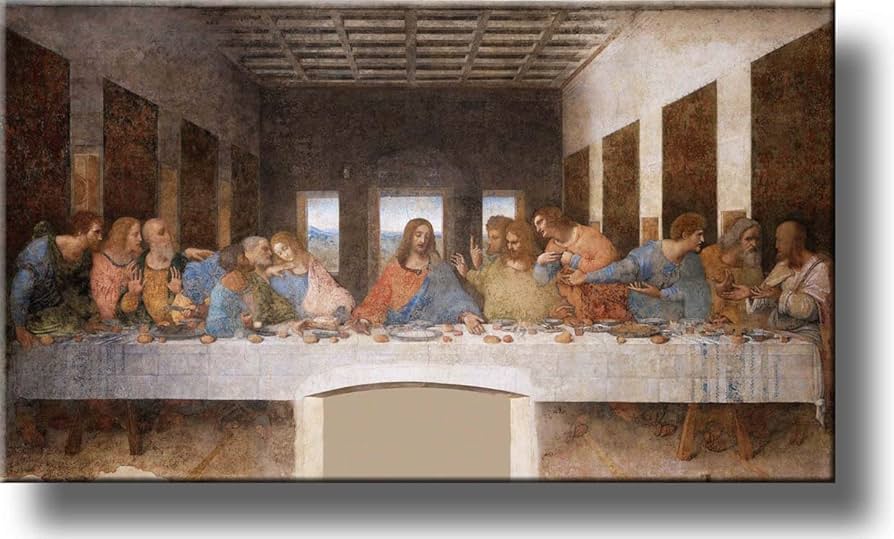
The Last Supper – Leonardo DaVinci

I attended our parish’s Mass of the Lord’s Supper tonight and, as always, it was especially beautiful and reverent.  During the reading of the Gospel (Jn 13:1-15), I envisioned myself in the scene, sitting around the supper table with Jesus and the Apostles.  Nobody seemed to notice a fourteenth person there.  When Jesus washed the feet of his Apostles, I recalled the first time I had my feet washed by our priest as he performed the Mandatum Rite, and what a humbling experience that was for me.

Then during the Liturgy of the Eucharist, as our pastor held aloft the Body of Christ, my mind drifted.  (I know that’s not supposed to happen, but it did).  My thoughts turned to a disagreement my wife and I often have.  We both like to read, and she frequently flips to the last chapter, spoiling the story by learning how it turns out.  Me, well, you couldn’t pay me ten bucks to cheat.  I delight in seeing the story unravel.  I want to be surprised, and I certainly don’t want her to spoil the story for me by telling me how it ends before I’ve read the book.

And then it dawned on me that I was the only one sitting at that supper table who knew what was to come in just a few hours.  I knew that Judas the Iscariot would soon leave to go bargain for his thirty pieces of silver in return for his betrayal of Jesus.  I knew Jesus would soon be arrested and tried, and of the pain he would endure being tortured and crucified, and I knew our beloved teacher would die.  I could see all these horrendous events.  

But, I also knew the happy ending: that Jesus would be lifted up after three days, that His resurrected self would join and encourage His friends in the upper room, and that at Pentecost, He would ascend into heaven.  

But I couldn’t tell any of this to the other twelve reclining at table there with me.  And I wondered if, through some twist of time and it was even possible for me to tell them, would they be like me and not care to know how it all plays out, or would they be like my wife and want to know what the future held in store?

I’ve been mulling this conundrum for the last couple hours.  I’ve decided this is one case in which I’m glad I know the story has a happy ending.  It gives me hope, takes away my fears, and makes me want to give a spoiler alert to the whole world!  

How about you?  Won’t you join me?

“My dear Jesus, You know and I know what You’re about to experience.  At every Mass, I am filled with both tears of joy and sadness as I reflect on Your Passion.  I know You gave it all for me…sinful me.  I am so deeply grateful for Your love.  Thank you!  Amen.”

(The Lord’s Supper, was first published on the blog Reflections of a Lay Catholic)

©2013-2025 Reflections of a Lay Catholic. Reposting and sharing of material in its full and original content is permitted, provided that full and clear credit is given to the author(s) and Reflections of a Lay Catholic.

I AM

10 Thursday Apr 2025

Posted by Jerry Robinson in Bible Reflections

≈ Leave a comment

Tags

Abraham, Accompanyment, Eucharist, Friendship, I AM, Jesus, John 8:51-59, Meditation, Prayer, Present moment, Reconciliation, Sacraments

From 1968 to 1971 I spent my junior high and first year of high school in English grammar schools in the U.K.  My typical weekly class schedule was a far cry from what I’d received in American grade schools.  It included:  math, biology, chemistry, physics (not just one but all three), history, geography (not social studies), English, and one or more foreign languages.  I took French all three years, plus German as an 8th grader, and Latin in the 9th grade.  Unfortunately, none of it stuck with me.  One thing I do remember clearly, though, is conjugating verbs – first, second, and third person singular and plural, in past, present and future tenses.  In any language, we always began with the verb “To Be”, i.e., “I am” (first person singular present tense); “You were” (second person singular/plural past tense); and “They will” (third person plural future tense).  

I recalled this today while meditating on today’s Gospel from John 8:51-59, in which Jesus had an altercation with a group of Jews over the identity of their fathers:  God as the Father of Jesus, and Abraham as the father of the Jews.  Jesus states, “Amen, amen, I say to you, before Abraham came to be, I AM.”, effectively claiming that He was equal to God, (see Ex 3:14-15).  Because this was blasphemous to the Jews, they attempted to stone Him to death.

“I AM” – the first person singular present tense of the verb “To Be”.  Jesus speaks about Himself.  If we were talking to Jesus, we would say, “YOU ARE”.  If we were talking about Jesus to someone else, we would say, “HE IS”.  Jesus doesn’t say, “I WAS”, or “I WILL BE”, in the past or future tenses, and we can’t say about Him, “HE WAS”, or, “HE WILL BE”.  Jesus is simply, “I AM” day after day, moment after moment, with every tick of the second hand.  HE IS now, and HE IS again in the next moment.

We can’t think that Jesus was with us once, or that He will be with us one day to come.  No, He is with us only NOW, at this present moment, and every present moment to come. He is there with us in every present moment regardless if the circumstances of that moment are to our liking or not.

Don’t we often forget this, especially when times are tough?  When remembering events from the past that caused you grief, don’t you sometimes wonder, “Why was He not there when I needed Him?”  But, we forget that HE IS there, and if we had remembered this, we would have found comfort in His presence.  When we unite our crosses with His cross, He helps us carry ours.

Or, consider some dream you have of the future and how you will pat yourself on the back for thinking, “Wow, look what I accomplished!”  We forget that HE IS with us then, too, and that it is only through His grace that we will find that joy and satisfaction we now imagine.  

Whether it’s in good times or bad, when we lose the feeling of closeness with Jesus, we open a doorway allowing the Enemy to lead us down the wrong path.

How do we keep in mind that Jesus is with us at every moment, ready to answer our call?  The first and best way is through prayer.  Developing a habit of daily prayer keeps Him close to us. Prayers of praise, thanksgiving, and asking for His intercession are all ways to acknowledge His presence.  More effective yet is meditative prayer, when we take time to sit in silence and solitude, lovingly conversing with Him, telling Him what’s on our minds and hearts, and listening for His loving reassurance.  In this way, we readily remember all the times we’ve felt His presence, and reinforce our trust in Him in the present moment.  

Reading scripture, especially the Gospels, before entering into prayerful meditation is an excellent way to relate to Jesus and His love for us.  During this time of closeness, we receive the graces and mercy we need to persevere through our anxieties.  And when we act on these promptings of grace by adopting a resolution to change or accept our situation, we again grow in trust with Him.

When we receive the Sacraments of the Eucharist and Reconciliation, we immediately feel His presence. The Eucharist gives us supernatural strength to combat sin in our lives.  But then, when we fall and regret our actions, we can turn back to Him in the Sacrament of Reconciliation, be restored and experience His merciful love.  

Remembering that our Lord works in us through our interpersonal relationships helps us feel His presence, also.  A network of faithful friends accompanying each other provides a source of encouragement and support when times get tough.  It can keep us grounded, reminding us to be grateful to God.

“Dear Jesus, I know deep in my heart that You are always by my side.  My faith can get clouded when the world challenges me, and even when everything is going my way.  Help me, Lord, to remember You, to meet You each and every day through prayer and frequent reception of the Sacraments.  I love You, Jesus, and I know You love me.  Amen.” 

(I AM was first published on the blog Reflections of a Lay Catholic)

©2013-2025 Reflections of a Lay Catholic. Reposting and sharing of material in its full and original content is permitted, provided that full and clear credit is given to the author(s) and Reflections of a Lay Catholic.

Enter your email address to follow this blog and receive notifications of new posts by email.

Join 264 other subscribers
Follow Reflections of a Lay Catholic on WordPress.com

Recent Posts

  • Are You Ready to Proclaim the Gospel?
  • A Prayer for Continued Progress
  • Be Like the Thessalonians
  • Be Magnanimous Like Mary
  • Are You an Average Catholic?

Categories

Top Posts & Pages

  • O Holy Night
  • "I Am the Way and the Truth and the Life"
  • God is a Techie....and I'm Not
  • A Taste of Spiritual Warfare
  • Conversions
  • Are You an Average Catholic?
  • Finding Peace In The One Who Is Really In Charge
  • Without Cost You Have Received; Without Cost You Are To Give
  • A Monday Morning Blessing
  • Peace Be With You

Archives

  • September 2025
  • August 2025
  • July 2025
  • May 2025
  • April 2025
  • February 2025
  • January 2025
  • December 2024
  • November 2024
  • September 2024
  • July 2024
  • May 2024
  • April 2024
  • March 2024
  • February 2024
  • January 2024
  • December 2023
  • November 2023
  • October 2023
  • September 2023
  • August 2023
  • June 2023
  • May 2023
  • April 2023
  • March 2023
  • February 2023
  • January 2023
  • December 2022
  • November 2022
  • October 2022
  • September 2022
  • June 2022
  • May 2022
  • April 2022
  • March 2022
  • February 2022
  • January 2022
  • November 2021
  • July 2021
  • June 2021
  • May 2021
  • April 2021
  • March 2021
  • February 2021
  • January 2021
  • November 2020
  • October 2020
  • September 2020
  • August 2020
  • July 2020
  • May 2020
  • April 2020
  • March 2020
  • January 2020
  • December 2019
  • November 2019
  • September 2019
  • July 2019
  • June 2019
  • May 2019
  • April 2019
  • March 2019
  • January 2019
  • December 2018
  • November 2018
  • October 2018
  • September 2018
  • August 2018
  • July 2018
  • June 2018
  • May 2018
  • April 2018
  • March 2018
  • February 2018
  • January 2018
  • December 2017
  • September 2017
  • August 2017
  • July 2017
  • June 2017
  • May 2017
  • April 2017
  • March 2017
  • February 2017
  • December 2016
  • November 2016
  • October 2016
  • September 2016
  • August 2016
  • July 2016
  • April 2016
  • March 2016
  • January 2016
  • December 2015
  • November 2015
  • September 2015
  • August 2015
  • July 2015
  • June 2015
  • May 2015
  • April 2015
  • March 2015
  • February 2015
  • January 2015
  • December 2014
  • November 2014
  • October 2014
  • September 2014
  • August 2014
  • July 2014
  • June 2014
  • May 2014
  • April 2014
  • March 2014
  • February 2014
  • January 2014
  • December 2013
  • November 2013
  • October 2013
  • September 2013
  • August 2013
  • July 2013
  • June 2013
  • May 2013
  • April 2013
  • March 2013
  • February 2013

Meta

  • Create account
  • Log in
  • Entries feed
  • Comments feed
  • WordPress.com

©2013 – 2024 Reflections of a Lay Catholic. Reposting and sharing of material in its full and original content is permitted, provided that full and clear credit is given to the author(s) and Reflections of a Lay Catholic.

Create a free website or blog at WordPress.com.

  • Subscribe Subscribed
    • Reflections of a Lay Catholic
    • Join 264 other subscribers
    • Already have a WordPress.com account? Log in now.
    • Reflections of a Lay Catholic
    • Subscribe Subscribed
    • Sign up
    • Log in
    • Report this content
    • View site in Reader
    • Manage subscriptions
    • Collapse this bar
 

Loading Comments...