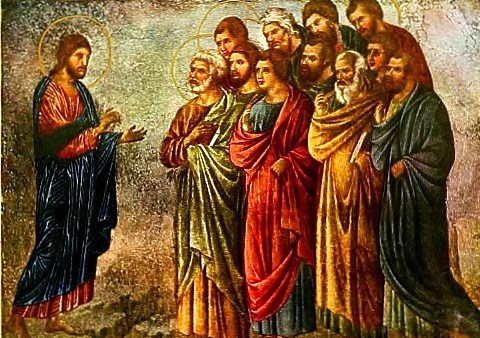
Jesus Sends the Apostles – Duccio di Buoninsegna, c.1300
We all know people who claim to believe in God but then won’t talk about it. They clam up and say their faith is personal…end of discussion. They are right, one’s faith is, and should be, personal. But Jesus never intended for it to be private. He tells us in the Gospels to go and be disciples. How can we evangelize if we keep our faith private?
The most common excuse for keeping one’s faith private may be that the basics were never learned well enough in the first place to share it with, or defend it before, others. One can easily deflect blame onto one’s teachers or parents, but to remain in this state is to succumb to the deadly vice of sloth, which is a laziness or a lack of love for the ways of God. The virtue opposing sloth is diligence, which may simply mean spending a little time each day learning more about one’s faith through daily prayer, reading scripture or other Catholic publications, or listening to Catholic television, radio, or podcasts, all of which can help us increase our understanding of our faith.
Another is our failure to fully understand and accept the graces we received at our Confirmation. The infusion of the Holy Spirit supernaturally strengthened the virtue of fortitude within us, enabling us to share in the mission of Jesus Christ to spread and defend our faith. Like a child who receives affirmation from a parent over a good behavior continues to improve in that behavior, we, too, simply have to believe we already possess what we need.
And, finally, the exigencies of modern life can make us forget that we need other people. Jesus didn’t live as a hermit. He gathered family and friends with whom He shared life. St. Paul urged the Corinthians to not live their faith privately but in community with one another. Like an ember that falls away from a fire and dies out, we can grow cold if we don’t stay close to others who are on fire with their faith, and others can grow cold if we don’t bring our fire to them.
To effectively evangelize, we can’t be passive. We have to actively learn, strengthen our relationship with Jesus through prayer and study, and build friendships with those whose fires need stoking.
“Lord Jesus, I pray for the grace to love You more dearly, and to exercise the grace which You’ve already bestowed on me in my Confirmation to bear fruit for Your Kingdom. Amen.”
(Faith is Personal…but Should Never be Private was first published on the blog Reflections of a Lay Catholic)
In many previous posts I’ve mentioned the need to develop a close personal relationship with Jesus through prayer, especially mental prayer or mediation, in order to make our evangelizing authentic. In prayer, we spend time with Jesus, we converse, and we build a friendship with Him that becomes so exciting that we want to introduce Him and share Him with others!
As Catholics, we are fortunate to be able to claim two thousand years of tradition in our lineage. We are the original Church, instituted by Christ Himself, and built on the rock of Peter. We have thousands of saints to whom we can look as role models: men and women who performed incredible acts of charity, who evangelized savage cultures at the risk of losing their lives, and who staunchly defended their faith and were martyred. Our faith is deep, and we have a plethora of books, magazines, podcasts, television, videos, and speakers to help us learn and go deeper into the finer details of Catholicism. It’s all good and exciting stuff and we can easily get lost in it. So lost, in fact, that we can begin to think that our religion, our Catholicity, is first and foremost. And, when we do, Jesus gets relegated to the back seat. Our excitement about Catholicism becomes a hinderance to actually promoting Jesus.
If we read the Gospels closely, we see the popularity of Jesus. People heard of his miracles, and they flocked to Him. They were cured of sickness and demons, and, as they told more people about Him, more and more people followed Him everywhere He went. During Jesus’ public ministry, His disciples didn’t tell people to come join them in a new religion. The term Christianity was not coined until a few decades later. Rather, they simply invited them to encounter Jesus. People got excited about Jesus and not some new religion.
If we’re not careful, we can fall into the trap of thinking we are evangelizing when, instead, we are selling Catholicism rather than sharing our love for Jesus, and hoping that an interest in Him will ensue. We have it backwards. We ought to follow the example of the Apostles and invite people to meet Jesus. Once they find and get excited about Him, then we can introduce them to the beauty and truth of our Catholic faith.
How do I know this? Because it worked on me.
“Dear Jesus, thank You for Your love, for drawing me closer to You each day. I love You, and in our friendship, Your love overflows so that I may offer it to others who may not know You…yet. Amen.”
(Relationship vs. Religion was first published on the blog Reflections of a Lay Catholic)
Today, we celebrate the Feast of the Conversion of St. Paul. As I meditated on today’s Scripture, I had a deja vu feeling I had been there before. Looking back, I discovered I’d offered a reflection four years ago today, and decided it was worth sharing again.
We are all called to proclaim the Gospel. How we do that begins with each of us asking the question:
What Shall I Do, Lord?
On this Feast of the Conversion of St. Paul we hear St. Paul ask, “What shall I do, Lord?”, after he is blinded on his way to Damascus to arrest Christians. His question is proof of his instant conversion to follow Christ.
It’s a good question for each ofus to ask every day, as well, if we desire to follow Christ and grow in holiness. There’s no better way to begin one’s day than through meditation asking the Lord to reveal His will for us. It’s our job, then, to listen and make a resolution to go do it.
“Heavenly Father, through St. Paul and the other Apostles, the faith was spread throughout the world. As I celebrate his conversion today, I pray that I may follow his witness in at least my little part of the world. Amen.”
(From the Archives: What Shall I Do, Lord?, was first published on the blog Reflections of a Lay Catholic)
This is the year our three married daughters spend Christmas with their in-laws. Our youngest daughter, Grace, who is unmarried, and who has traditionally came home for Christmas, informed us a couple weeks ago that she is scheduled to work both Christmas Eve and the day after Christmas and, thus, would be staying in Nashville for Christmas. Then, much to our surprise and delight, she told us last weekend that she would be off work Tuesday and Wednesday of this week and would be coming home Monday night!
Unfortunately, thinking I had no reason to do otherwise, I scheduled work related meetings for Tuesday and Wednesday that prevented me from spending any quality time with Grace while she was home. But, before she left early Wednesday afternoon, I decided to take a couple hours off and come home for lunch and spend at least a little time with her. On the drive home I prayed, “Lord, I am thankful that Grace could come home for a couple days, and I’m thankful for the little time I’ve been able to spend with her. I just wish we’d been able to have more quality “father/daughter” time together. Amen.”
Pulling into our driveway, I saw her car and remembered she had mentioned that her driver’s door window would not roll down. I thought the problem was perhaps simply a blown fuse. So, I unlocked her car and found the fuse box under the steering column. and, after getting down on the ground and contorting my body into an unnatural position, I determined that the fuse was not blown. I reinstalled the cover, and then began the process of reversing my motions to get up off the ground.
Well, at my age (and size), that’s no longer easy to do. I suppose I used the door arm rest to leverage myself up and, in doing so, I hit the door lock button. Without thinking, I shut the door and, of course, the keys were in the car. Grace’s spare key was in Nashville, Tennessee.
Having paid outrageously for a locksmith in the past, I turned to YouTube for advice on how to unlock a locked car door without a key. Obviously, there must be many Subaru Outback owners who have locked their keys in their cars because there were several videos to view. I learned all I needed were two tools: an inflatable pillow called an air jack, which, when deflated, can be inserted between the door post and the door, and then inflated by pumping a bulb by hand; and a long crooked rod with a hook on the end, and “presto”, the door is opened.
Obviously, Grace wasn’t going anywhere soon so I invited her to go to the hardware store with me and purchase the air jack. Forty minutes later we were back home. She inserted and inflated the pillow while I crafted a coat hanger with a hook to fit between the gap. The coat hanger was about six inches too short and too flexible. I found four one-foot long, one-eighth inch diameter rods that I had saved from somewhere (because you never know when you might need something like that), and I connected them with electrical tape. But, they were too stiff to make a hook on the end.
Grace’s keys had slid off the console onto the passenger’s seat and the buttons on the fob were facing upwards. Grace had the ingenious idea that we try to use the rod to push the unlock button on the fob. We relocated to the passenger side and reinserted and inflated the air jack. The rod reached the fob with about three inches remaining on the outside of the door – too little to hold onto and control the rod’s movement – but still enough to grab onto with a pair of pliers. After another thirty minutes of maneuvering, getting just the right kinks in the rod, and taking turns, I was able to land the end of the rod on the fob’s unlock button and apply enough downward pressure to release the lock! Hallelujah! Amen!
Grace had a five hour drive ahead of her so she hurried and packed her things into her car. After hugs and goodbyes, she headed home and I headed back to the office. On the way in, I thought about the grace I’d just received, about how I’d spent an unexpected extra two and a half hours with my daughter, working together solving a problem, each of us gaining some experience and, best of all, some valuable “father/daughter” time together. I had prayed for that time, and God delivered, not in a way that I could have expected, but He delivered none the less.
“Heavenly Father, thank You for answering prayers in unexpected ways. Thank You for this opportunity for Grace and I to work together, for the time to talk and enjoy each other’s company. And, thank You for the grace to know of Your presence in the moment. Amen.”
(Unexpected Grace was first published on the blog Reflections of a Lay Catholic)
Back in 1971 singer/songwriter, Carly Simon, released her song Anticipation. The song’s chorus went, “Anticipation, anticipation, you’re makin’ me late, you’re keepin’ me waitin’.” The song was a hit and I remember playing it over and over on my 8-track tape player. A few years later in 1976, the Heinz ketchup people used the chorus from the song to advertise and tout the thickness of their ketchup, how slowly it poured out of the bottle, and how it was worth the wait. The commercial showed a child with her grandmother eagerly anticipating the enjoyment of her favorite condiment while waiting patiently for it to ooze out of the bottle onto her burger.
Call me crazy but this memory came back to me after reading last Thursday’s Gospel, Mt 4:18-22, on the Feast of St. Andrew, Apostle. The Gospel told the account of Jesus seeing Andrew and Simon fishing, and telling them, “Come after me and I will make you fishers of men.”
But, if we only consider Matthew’s Gospel, we might think this was Andrews’s first time to meet Jesus. We’d probably be wrong. In the Gospel of John, chapter 1, we’re told that Andrew was a disciple of John the Baptist who preached and prophesied that “a man is coming after me who ranks ahead of me because he existed before me.” This could only have been the promised Messiah whom Andrew, like any good Israelite, had been anticipating would deliver them from the Romans.
Andrew believed the Messiah was coming. His imagination tasted the sweetness of freedom and he sought the Messiah as he waited in eager anticipation.
Then John heightened the anticipation by adding, “I saw the Spirit come down like a dove from the sky and remain upon him.…now I have seen and testified that he is the Son of God.” John pointed out to Andrew, “Behold the Lamb of God, who takes away the sins of the world.”
This is what Andrew had been waiting for! The Messiah was right there in front of him, he could see Him, he could touch Him! And, then, Jesus invited him to come and spend the day with him! The ketchup was now out of the bottle and on the burger! Could it get any better than this? Yes, it could, and it did the next day when Jesus told Simon and Andrew to follow Him. Andrew was being called to follow his Messiah! His search and faithful anticipation finally paid off and his joy must have been a thousand times better than that little girl’s when she finally took a bite of her ketchup covered burger.
Today is the first day of Advent, the season of waiting and anticipating the coming of our Lord, Jesus Christ. We wait for His return, His second coming, and we wait for His birth at Christmas. Waiting, however, is difficult, it’s uncomfortable. Most of us want instant gratification. In our culture, we hurry and scurry in these final weeks before Christmas frantically shopping for gifts, planning meals or trips to visit family, or completing end-of-year business. Most people spend very little time, if any, thinking about and anticipating Christ’s coming. We want to fill our waiting time with other productive stuff.
In today’s Gospel, (Mk 13:33-37), Jesus cautions us to be watchful and alert because we do not know when He will be coming back. We should be prepared, ready, waiting and seeking Him with joyful anticipation. Our attention should be on the object of our desire, not on less important things that will steal the joy of the anticipation. We should be like Andrew.
Patience is a virtue, and joyful anticipation makes patience possible. We can all wait for something we are looking forward to. We can wait patiently for the ketchup to flow out of the bottle because we know how good it will be. The catch phrase in the Heinz commercial was, “It’s slow good!” Rather than fill your time with stuff just to be productive, spend that time seeking Jesus. Spend time in prayer with Jesus each day during Advent, telling Him what’s on your heart, and listen to Him in the silence of your heart. It is extremely “slow good.”
Slow down during this Advent. Make time for your loved ones. Give them the best gifts they could ever receive – your time and your love. And make time for Jesus. Enjoy the blessings and graces that God provides as you patiently anticipate Christ’s birth and His eventual second coming.
“Heavenly Father, thank You for this season of Advent, this precious time to slow down and reconnect with the most important things in life: You and our families. Thank You for the grace to grow in virtue as we seek You and patiently wait to celebrate Your birth, and await Your return. Amen.”
(Anticipation was first published on the blog Reflections of a Lay Catholic)
Every now and then I recall from my morning meditation something about which I’ve already written. Today’s Gospel from Luke 8:4-15, the Parable of the Seed and the Sower, rang a bell. I found what I was looking for from January 2018, except that it was a reflection from Mark’s Gospel, Mark 4:1-20. As I re-read it, I thought the message from over five years ago was still as relevant as ever, if not more so, and it needed to be shared again. I hope it will lead you to a fuller prayer life.
Peace and blessings to you all!
Soil Conditioning for the Heart
In my previous life (pre-2012 and pre-Catholic) I would occasionally crack a Bible and read a passage or two before losing interest and closing it up. This didn’t happen often, mostly when I was traveling, alone and bored in a hotel room somewhere and there was a Gideon Bible in the nightstand drawer. I remember reading from the Gospels and wondering why Jesus talked to the people in parables. As far as I could tell, it was all a riddle that nobody in their right mind could understand. It made no sense.
This recollection came back to me today as I read and meditated on today’s Gospel, Mark 4:1-20, the Parable of the Sower. A lot has changed over the last six years. I understand this parable today – that Jesus is the sower, the Word of God is the seed, and the different types of soil are the dispositions of the diversity in our faith. Or at least I think that’s what it’s about.
But, as I meditated on this today, my thoughts were more on why Jesus spoke in parables rather than the message in the parable.
I have learned that the Jewish rabbis and teachers in Jesus’ time, taught using stories with familiar images and experiences to which the learner could relate. The messages in these stories were not explicit but, instead, were designed to make one think. The answers were complex and seldom simple. If you thought you had it figured out, you probably didn’t. You needed to think about it more, and think more deeply.
Jesus’ parables were similar to what we call allegory today. He always had a hidden complex spiritual meaning or moral lesson embedded within his parable. And, depending on one’s level of faith, you either got it, partially got it, or you were totally lost.
Even Jesus’ disciples and His chosen Apostles didn’t always understand. In today’s Gospel, His disciples questioned Him about the parables. Jesus answered them, “The mystery of the kingdom of God has been granted to you. But to those outside everything comes in parables so that they may look and see but not perceive, and hear and listen but not understand, in order that they may not be converted and be forgiven.” Jesus continued, “Do you not understand this parable? Then how will you understand any of the parables?” (Mk 4:11-13)
We often think that the Apostles were all totally on board and on the same page as Jesus. But, the reality was that they never did quite figure it out until Jesus’ resurrection and eventual ascension into heaven. No, they were quite often lost regarding the mysteries of Christ’s life (e.g. Mk 8:32-33, Peter’s response to the first prediction of Jesus’ Passion; and, Mk 9:28-29, the healing of a boy with a demon).
Jesus wanted everyone, His disciples included, to think deeply about His message. He wanted them to look beyond the obvious, below the surface, and outside of the box. He challenged them to compare and relate His stories, His parables, with their own lives. The extent of their understanding and ability to relate often depended on their faith.
Nothing has changed. It still depends on faith. The reason I didn’t understand the Gospel as I read while lounging on a hotel room bed was because I had no faith. The difference between then and now for me is that I now believe the Word of God to be the truth. I have a deep desire to understand it so that I can apply it to my life.
Jesus still challenges us to understand God’s Word within the context of our own lives, our own experiences. He wants to sow the Seed on fertile soil so that it may grow and produce fruit. How do we prepare that garden plot in preparation for His sowing?
First, we need to create an atmosphere in which we can listen to God through His Word in the scripture, an atmosphere of silence and solitude that is conducive to deep thought without distractions. Author Henri J.M. Nouwen in his book, The Way of the Heart, describes silence as, “not not speaking, but listening to God”; and solitude as, “not being alone, but being alone with God.” Finding that time and place is critical.
Once you’re there, open up your heart in prayer. Give thanks to God for the opportunity to be with Him in that moment. Ask the Holy Spirit to open your heart and mind to receive the Word of God, and for the grace to understand His Word as you read and reflect upon it.
As you read the scripture, think deeply about what it is God is telling you at that moment. Maybe there is a verse or a phrase or just a couple words that jump out at you. Stop and reflect on that which catches your attention and let the Holy Spirit take you deeper to reveal God’s unique message for you. Say a prayer of thanksgiving once you’ve absorbed His revelation.
Next, ask yourself how that message relates to your life today. Is there something you can do to change? What can you do today to be more virtuous, to grow in holiness, and to become a better disciple, spouse, parent, and friend? How can you condition your soil to make it more fertile? The Holy Spirit will convict you and show you the way!
Finally, take that one thing, that one change for the better, and write a concrete resolution that will effect an improvement that day. Make it easy but make it concrete. Think baby steps instead of leaping tall buildings. Something that you can, at the end of the day, look back on and say with a sense of accomplishment, “Yes! I did it!”
And then go do it.
This is how you grow in faith. This is how you begin to understand the Word of God and not get confused in the complexity of the parables. And, this is how you gradually grow in holiness on your way to becoming a saint just like the Apostles.
“Heavenly Father, thank You for giving me the deep desire to understand Your Word, and for Your Son, Jesus, to sow that Seed in my heart. Thank You, Holy Spirit, for the gift of faith that has conditioned my heart to be fertile ground for producing fruit for Your kingdom. I pray that, through Your grace, the harvest is abundant. Amen.”
(Soil Conditioning for the Heart was first published on the blog Reflections of a Lay Catholic)
In today’s first reading from Paul’s letter to the Church in Colossae (Col 1:1-8), St. Paul writes that he and Timothy offer prayers of thanksgiving for them because of their faith in Jesus and their hope for heaven.
We say prayers of petition asking for God’s help, often for the intentions of someone we love to grow deeper in their faith. We say prayers of thanksgiving for all the grace and mercy we receive but don’t deserve. But, how often do we give thanks and pray for those who already know the love of Christ, who follow Him, and who proclaim the Gospel at every chance? Do we tell them and affirm them that, by glorifying God with their words and in their actions, they are making the world a better place, that they are doing their part to grow His Kingdom? Maybe not so much.
We are one Church, one Body, and, if we practice the theological virtue of charity as we ought, we look outside of ourselves to other people. Usually our focus is on the poor and needy, the sick, and those who are far from our Lord. But, we can’t forget to recognize the good that people do, especially the good that results from those who have a deep faith and love for Jesus. Without them, there would be no proclamation of the Gospel and no propagation of the faith.
Our world today presents us with endless disorder and distractions that work to diminish the faith of even the strongest among us. Couple this with the natural force of entropy, and the faithful are faced with a constant uphill battle. Is there any wonder why Christianity, and especially Catholicism, in America is on the decline? Perhaps one reason is that we do not affirm, accompany, and pray specifically for continued courage and strength for all of our holy brothers and sisters, especially our priests, who are committed to making disciples and bringing the love of Christ to all people.
“Heavenly Father, I give You thanks for all the holy priests, deacons, religious, lay leaders and evangelists, and spiritual directors who proclaim the Gospel in their words and deeds. I don’t encourage them and pray for them nearly as much as I should. Thank You for opening my heart and mind to Your Word today. I resolve to sow the seeds of this Word by making a concrete resolution to pray daily for, and give thanks for all those who are leading the charge in the battle to win souls. Amen.”
(Pray Like Saints Paul and Timothy was first published on the blog Reflections of a Lay Catholic)
I’ve been settling into my new office in our parish center and trying to make it functional for my use. My computer and phone are conveniently located, files are arranged in the file cabinet, and books are in the bookcase. I have a crucifix and a cast figure of the Blessed Mother holding the child Jesus hanging on the walls, and I hope to get some pictures hung soon. Finally, I’ve adorned it with a couple house plants to make things look more inviting.
My wife has exclusive ownership of a ‘green thumb’ in our family and I had to ask her advice for how often to water the plants. She told me in a not so endearing tone of voice, “If the soil feels dry, water it!” From experience, I know that if you pour water on the soil from the top, it often comes out the hole in the bottom of the pot and makes a mess on whatever surface it’s sitting. So, my master gardener better-half gave me a shallow plastic tray in which to set the potted plants and then told me to fill the tray with water. She said the soil in the pot would soak up the water through the hole in the bottom of the pot.
The other morning, when I checked, the soil was somewhere between dry and parched. It needed a drink. I heeded her advice, filled the tray with water, and set the pot in it.
I then went about my business of sketching out a plan of how to create an evangelizing culture in our parish, to wit: how to develop a more welcoming and hospitable community where people will intentionally build relationships with each other; how to grow an attitude of charity towards “neighbors”; and how to encourage people to not be afraid to share their faith with others.
After an hour or so, I noticed that the half inch of water I’d poured into the tray had disappeared. Just as I was told, the soil had soaked it up. I envisioned the water molecules defying gravity as they flowed upwards, saturating the soil. I thought about how thirsty that plant must have been.
Then it struck me – plants aren’t the only thing that thirst for water, we humans do, too. Except, our thirst is for the Living Water (Jn 4:10). We may not understand it, but our souls yearn for it. Our deepest desire, and the only true way of living a spiritually healthy life, is to seek God, the one in Whom we live and move and have our being (Acts 17:28). It is God Incarnate, Jesus, that sustains our life.
I had omitted from my notes the most crucial element about a culture of evangelization – a deep relationship with our Lord. Without it, evangelizing amounts to a worthless attempt. If the ultimate reason for evangelizing anyone is to bring them into a relationship with Christ, we are hypocrites if we try to evangelize without having our own personal relationship with Jesus. How can we lead someone to a place which we haven’t been ourselves?
What is a deep and loving relationship with Christ? Well, what makes up a deep and loving relationship with anyone? Basically, it’s friendship. The essence of friendship is spending time with each other, getting to know each other, having enlightening conversations, and loving and wanting the other’s good. Friendship with Jesus is really no different. We do that through prayer.
Us Catholics are good at Vocal prayer, that is, prayers of petition, thanksgiving, intercession and praise (CCC2700-04). And, we’re good at rote prayers that have been memorized and recited since childhood. But, there are two other expressions of prayer that are mostly overlooked – Meditation, or Mental prayer (CCC 2705-08), and Contemplation (CCC 2709-19). Vocal prayer is talking to God. Meditation, on the other hand, is using our God-given intellect and imagination in seeking to understand what God is asking of us. Meditation is often accomplished by reading Sacred Scripture, especially the Gospels, reading about the lives of the saints, and other spiritual writing.
Contemplation takes meditation one step further. St. Teresa of Avila said, “Contemplation is nothing else than a close sharing between friends; it means taking time frequently to be alone with Him Who we know loves us.” During this time of Contemplative prayer, we draw very close to Jesus; we tell Him what’s on our minds and we listen to Him telling us how we can grow closer to Him by becoming more virtuous disciples, spouses, parents, children, and friends.
If you are a married person, you know how important it is to listen to your spouse. A relationship in which one person does all the talking but never listens is doomed for failure. In Meditation and Contemplation, we quiet our minds and relish just being with Him, ready to respond to whatever He says.
Meditation and Contemplation is immersing ourselves into the font of Living Water. It is soaking up His Word and seeing how we can follow Him more nearly and love Him more dearly. It is this Living Water we desire to drink. But, have you ever tried talking and drinking at the same time? It doesn’t work very well.
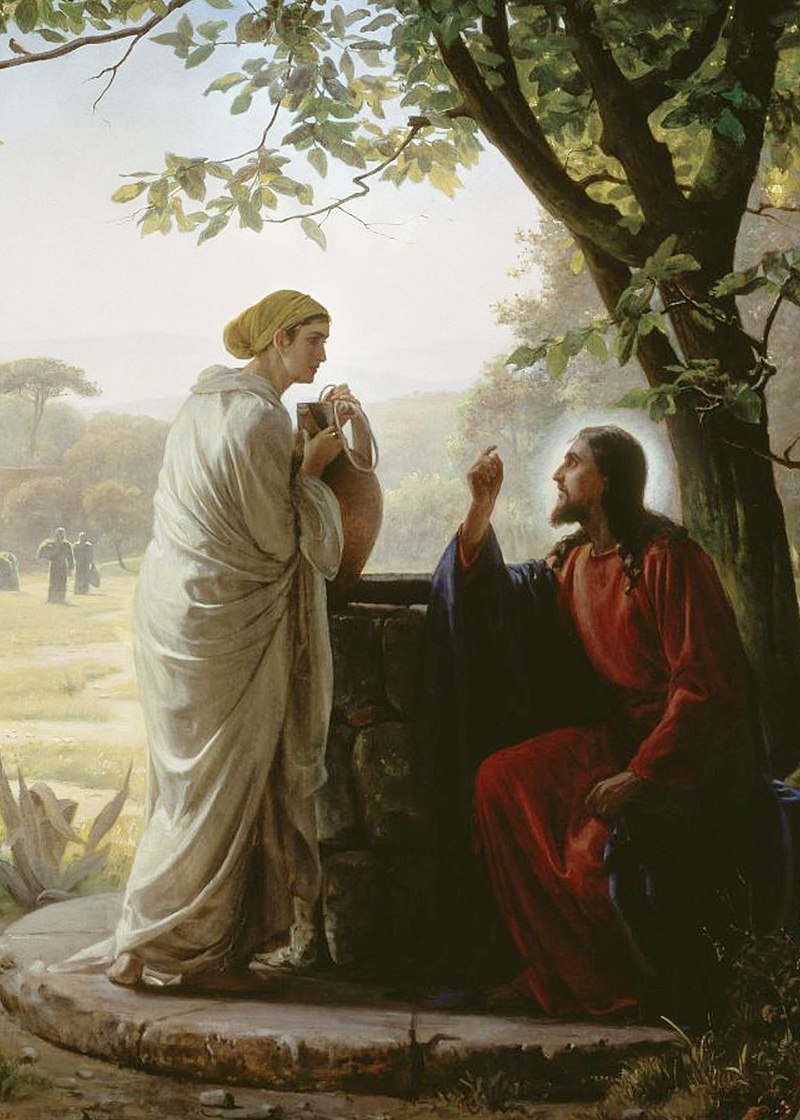
The Woman at the Well – Carl Heinrich Bloch
St. Photina, the biblical woman at the well, listened to Jesus tell her about her life. She drank of the Living Water. Then she hurried back to her Samaritan village, spread the Good News, and evangelized the entire town.
Evangelization involves many things. True evangelization begins with having a deep friendship with Jesus and a desire to introduce others to Him, your closest friend.
Spend at least thirty minutes a day quietly immersed and soaking in the presence of our Lord. Tell Him what’s on your mind and then listen for a response. When you hear His inspiration, resolve to act on it that day. Then repeat. Unlike the plants in my office, we need watering every day.
“Loving Lord, help us to draw closer to You by spending time with You, the One we love. Send us Your Spirit to open our hearts and minds to Your Word, and inspire us to act with virtue in carrying out Your will. Help us remove the shades from our lamps, the hang-ups we have in spreading the Good News. Amen.”
(Prayer and Potted Plants was first published on the blog Reflections of a Lay Catholic)
Sunday night I posted Road Trip Reflections: Technology and Time Zones in which I mentioned I’d spent the weekend helping my daughter, Grace, relocate from Memphis to Nashville, Tennessee. It was a busy weekend with lots of strenuous physical activity, lifting furniture and heavy boxes. It was also tiring from the mental awareness required for driving almost 1,200 miles. By the time I got home I was exhausted.
As tiring as it was, I have to say it was one of the most pleasurable and fulfilling three days I’ve spent in a long time. It was an opportunity to spend valuable time with Grace. For the most part, it was just she and I working side by side, spending eight hours together in my truck, and sharing meals and life for a couple of days. We talked and I got a glimpse or two of what’s on her mind, what her concerns are, and what makes her happy. Even when we weren’t working or in conversation, it was nice just to be in her presence.
Grace is the youngest of our four daughters. The others are all married with children. None of them live close to us and consequently we seldom get to see them or our grandchildren. When we are able to get together, the days are centered around the grandkids, leaving little time to simply reconnect with my daughters. I love my grandchildren dearly, but I do miss quality time and good conversation with their parents.
There is a certain loneliness that goes along with being a parent once all the kids have flown from the nest and are living their own adult lives. While my head tells me it’s the way it should be, my heart still desires that closeness.
This morning, as I entered into my daily prayer and meditation, I invited the Holy Spirit to open my mind and heart to the Word of God, and I placed myself in His presence. As always, I could sense Him asking me to open up and share with Him what’s on my mind and heart. In that moment, I felt His extreme love for me, a beloved son. It was a love that I could relate to, much deeper, I’m sure, but akin to the love I feel for my own children and the desire to spend time with them. God wants to spend time with me. He wants to know what is on my mind, what are my struggles, what makes me happy (am I happy?), and how He can help me.
In light of my weekend with Grace, I thought how God must long for those similar experiences with us when we get to spend time together. And, I thought how sad and lonely it must be when we are too busy to spend time with Him in prayer.
God gave His only Beloved Son, Jesus, so that we would know His love for us and find unity with Him. Jesus reflected that love from the crucifix when He uttered, “I thirst”.
God thirsts for your love. Love Him by spending time with Him in prayer and daily meditation.
“Heavenly Father, I love You. And, as an adult father, I know Your love for me. I thank You for the grace to spend time with You each morning in prayer, for the conversations we have, for your gentle promptings when I need help. But, I know, too, that the world I live in gets in the way sometimes, keeping me away from You. I pray for Your understanding. Amen.”
(A Father’s Love was first published on the blog Reflections of a Lay Catholic)
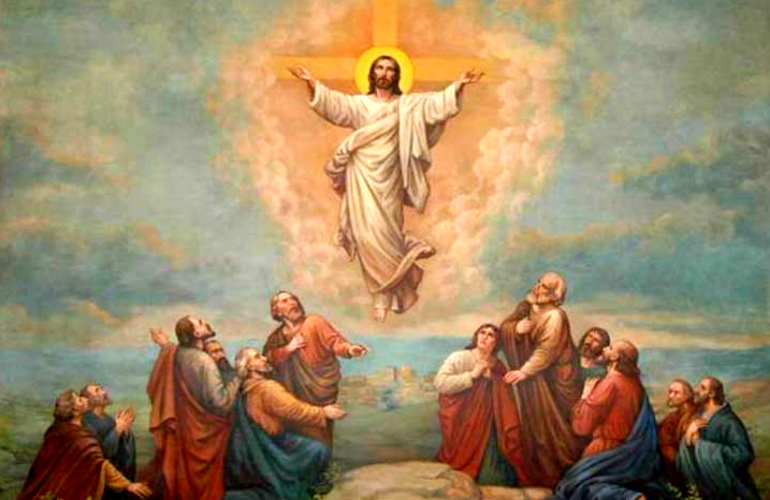
Yesterday was the Feast of the Ascension of Jesus into Heaven. One of the last things Jesus spoke to the Apostles was to “Go, therefore, and make disciples of all nations” (Mt 28:19). In yesterday’s first reading from the Acts of the Apostles, Acts 18:1-8, we read about St. Paul once again doing just that, preaching the salvation of Jesus Christ to the Jews in the synagogue, “Every Sabbath, he entered into discussions in the synagogue, attempting to convince both Jews and Greeks” (Acts 18:4). We can tell from Scripture that evangelizing wasn’t a walk in the park for him and we can imagine how frustrating it must have been.
I try to imagine what it would have been like to be a fly on the wall during one of those “discussions” in the synagogue. Who did most of the talking? Was there dialogue or was it mostly one-sided? Were there questions and answers? Were the conversations civil or were they heated arguments?
Have you ever stopped and wondered why he continued to preach so fervently when it must have seemed he was beating his head against a wall? Why did he keep going back for more disappointment? I imagine that each and every conversion renewed his zeal, making it worth the struggle.
I don’t think his goal was to impress upon people that he was right and they were wrong for pride’s sake. No, I suspect he preached from a position of love. He had a love for the Lord, and a love for the well-being and salvation of the soul of every person he met. St. Paul may have never actually met Jesus, but he knew Jesus through the Holy Spirit and a deep life of prayer. He knew Christ’s love, and he took to heart the Great Commission of bringing that same love to other people.
We know that St. Paul was tenacious. He didn’t give up until he’d exhausted every effort to bring men to conversion. He persisted until the opposition and revilement (Acts 18:6) indicated he was at a hopeless juncture and it was obvious that he ought to move on and evangelize someone else.
With respect to our efforts to evangelize, what can we learn from St. Paul’s style? I think we have to be clear as to why we’re evangelizing in the first place. Are we trying to convince someone we’re right and they’re wrong? Or is our concern truly based on our love for them, wanting their good and the salvation of their soul?
When we operate from a position other than love for another person, when we focus on our rightness and their wrongness, effective dialogue becomes nearly impossible. Evangelizing becomes an argument. It prevents us from understanding and accepting that the other person’s perception of truth is based on their education and life experiences, things that may be totally different from our own. We lose sight that, for us to be believed, the other person must see us as authentic and trust-worthy. That trust can only be won through listening, which is often hard to do and sometimes even painful. Rather than make the effort to listen and understand the other’s story, we have a tendency to give up too soon when a conversion may only be one conversation away.
But, like St. Paul, we may have to eventually accept failure knowing that we gave it our best shot. We may have to take the attitude of a friend of mine, a committed disciple maker, who says, “Some will. Some won’t. I tried. Who’s next?”, and move on to the next person who is searching for, or open to, the love that can only come from Jesus Christ. We may need to give up on an individual, but we can never give up on the mission.
“Dear Jesus, today, on this feast of Your Ascension into Heaven, help me to realize the grace from the Advocate as you promised. With Your help, I resolve to grow my friendship with You through prayer. And, I commit myself to deeper friendships with others as a disciple maker, bringing them into a friendship with You. Amen.”
(Some Will. Some Won’t. I Tried. Who’s Next? was first published on the blog Reflections of a Lay Catholic)







 Reflections of a Lay Catholic