• About
  • Books I’m Reading
  • Links

Reflections of a Lay Catholic

Reflections of a Lay Catholic

Category Archives: Uncategorized

Happy Thanksgiving!

25 Wednesday Nov 2015

Posted by Jerry Robinson in Christian Community, Eucharist, Prayer, Thanksgiving, Uncategorized

≈ 1 Comment

Tags

Bread of Life, Eucharist, Prayer, Thanksgiving

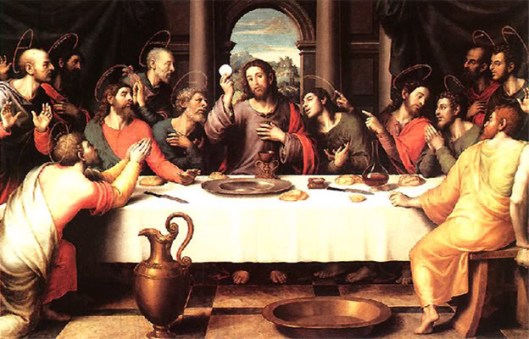
eucharist-1

As the day begins to break on this frosty morning of the eve of Thanksgiving Day, I am already anticipating a joyful and restful four days spent with family and friends. My “Thanksgiving” actually began last night with the arrival of one daughter, her husband, and my grandson. It will continue today when another daughter arrives home from college. The only way it could be better would be if all my children and their families could make it home for the holiday.

Having a day of thanksgiving is not a uniquely American event. Like the origin of our holiday, many cultures celebrate successful harvests and give thanks in advance for the sustenance they bring. I do believe, however, that a roasted turkey as the temporary centerpiece of a dining room table probably is uniquely American.

It seems our culture has developed other traditions that are now commonly associated with this holiday: frenzied Christmas shopping, watching hours of football on television, Thanksgiving day parades, and “Turkey Trot” charity foot races. And, I’m happy to see that the spirit of giving is a growing tradition for many families by serving the less fortunate in our communities.

But, there is one thanksgiving tradition that many Americans, and millions of others around the world, have been observing for about two millennia. The difference between it and the others is that it is a tradition observed every day of the week, including Thanksgiving Day. It is the receiving of the Body, Blood, Soul and Divinity of Jesus Christ in the Holy Eucharist. In fact, the very name “Eucharist” comes from the Greek word for “Thanksgiving”.

The perfect way to begin your Thanksgiving Day celebration is by first attending Mass and celebrating the feast that Jesus Christ Himself prepares for us. In it you will enjoy food, wine, celebration in the form of singing, offering thanks through prayers, and communion not only with your immediate family but with your extended family in Christ, the Church.

So, tomorrow, before you give thanks for your bountiful Thanksgiving Day dinner and before you ask for blessings on those who prepared it; before praying that your football team beats the pants off the other team; and before going head-to-head with over-aggressive shoppers, won’t you take an hour and give thanks to Him by making your spiritual sustenance the Bread of Life, the Holy Eucharist? Won’t you join me?

I am looking forward to being in communion with each of you tomorrow morning. I know it will be the perfect start to a perfect day of gratitude and praise.

God bless you.

(Happy Thanksgiving! was first published on the blog Reflections of a Lay Catholic)

©2015 Reflections of a Lay Catholic. Reposting and sharing of material in its full and original content is permitted, provided that full and clear credit is given to the author(s) and Reflections of a Lay Catholic.

A Monk’s Chronicle: 10 August MMXV — Peserverance Until Death

10 Monday Aug 2015

Posted by richbrewers in Uncategorized

≈ Leave a comment

Tags

Book of Honor, St. John's Bible

What an increadible undertaking this project has been–it is something right out of the monastic tradition that brought us The Book of Kells. Thank you, your monsastic brothers, Donald Jackson and his team, SJU and all who contributed for this piece of history that brings us the Word.

monkschronicle's avatarA Monk's Chronicle

imagePerseverance Until Death

On November 27, 1995, I sat down to lunch with Donald Jackson, whose day job at the time was scribe to the Queen of England.  He and I had just spoken at The Newberry Library in Chicago, and we were dining at a restaurant called The Italian Village — which still exists, I believe.

Normally lunch should not count as a big deal, and there’s no reason anyone should remember a particular lunch nearly twenty years later.  To my credit, I can’t recall what I ate that day, save that it was probably Italian.  But I do recall the substance of our conversation.  That day Donald Jackson proposed what eventually would become The Saint John’s Bible.

That lunch no longer matters that much, save for the fact that last week I put a little bit of closure on a venture that began at that meal.  That…

View original post 1,137 more words

Father Don Talafous, OSB

30 Monday Mar 2015

Posted by richbrewers in Uncategorized

≈ 1 Comment

When I was a freshman student at Saint John’s many years ago, I was walking across campus one day and I was stopped by one of the monks. He looked at me, called me by name and asked if I was from Ghent. I had never met him before, but that was Father Don. He would memorize the pictures of all the incoming freshmen and call us by name when he met us. During my time at SJU, he never forgot my name, and I never forgot his.

I believe Father Don found Christ in each of us, and in some small way, his act of taking the time to know us, meant a lot. Fr. Don Talafous is being honored with the SJU President’s Medal and Citation. Fr. Don has been a part of the Saint John’s community for more than 70 years. As a monk, professor, university chaplain and faculty resident, he has touched the lives of thousands of students, alumni, parents and friends. He shows us how being fully present and attentive to those around us, makes a difference in their lives. Below is a short video about Father Don.

–Rich

Will You Follow?

02 Monday Feb 2015

Posted by richbrewers in Uncategorized

≈ Leave a comment

A great video on vocations

Conquering Temptations

29 Tuesday Apr 2014

Posted by Jerry Robinson in Uncategorized

≈ 3 Comments

Tags

Perseverance, Sin, Temptation

“Blessed is he who perseveres in temptation, for when he has been proven he will receive the crown of life that he promised to those who love him.  No one experiencing temptation should say, “I am being tempted by God”; for God is not subject to temptation to evil, and he himself tempts no one.  Rather, each person is tempted when lured and enticed by his desire.  Then desire conceives and brings forth sin, and when sin reaches maturity it gives birth to death.”

James 1:12-15

At a recent men’s group, I was asked to pick the bible verse to discuss. Coincidently, at one of the daily masses that week, this passage from James was read. I imagine we all struggle with some kind of temptation in our lives. A few years ago, through prayer (both my wife’s and mine) and God’s grace, I broke free from one that was damaging our marriage.  Because of this and our commitment to live an Ephesians 5 relationship, our marriage is stronger today. However, that was only one of my many temptations.

I have struggled with my weight since I was a teenager. Going up and down in weight (mostly up), trying all the fad diets out there. In 1999-2000, I lost a bunch of weight through Weight Watchers. However, when we moved to Texas, I discovered how much I loved Texas BBQ and Mexican food. The weight quickly returned.

The other primary temptation I had succumbed to was a 30-year love affair with Diet Coke. I averaged 6-8 cans a day most days and bought them by the case full at every sales opportunity.   At just six cans a day, that works out to be 91 cases a year. That does not include the bottles I would buy out of the vending machine for my drive home from work every day. That is a lot of pop/soda for one guy.

On October 31, 2013, I turned 48. Not normally one to care about my age, this one bugged me. Probably because 48 is awfully close to 50 (with apologies to my aged friends and family who have passed the 50 mark). Consequently, I decided that I wanted to gain better control of myself. Not just for health reasons, but because I no longer wanted “things” to control me. Food controlled me. Diet Coke controlled me. I was determined that I would gain discipline over my desires. If I could do that, 50 would not seem so bad (again, apologies to you seasoned citizens).

On November 5, 2013 I committed to lose and maintain a 50-pound weight loss by the time I turned 50. I called it my 50×50 plan. Holidays seem like a crazy time to start a weight loss program but I did not want to wait. I got back on Weight Watchers and followed it strictly every day. Nothing I ate went unrecorded. As I write this, I have lost 49.4 pounds and should reach that 50-pound milestone this week or next. I have gone from a 42 waist to a comfortable 38. A 50R suit coat to a 46R coat. I have spent a bunch of money on new suits and clothes but it has been the best money I have ever spent. Weight Watchers says I should lose another 20 pounds and I am going to try to do so. Mostly, though, now that the weather is finally better, I am going to get outside and get some exercise. Physical laziness will be the next temptation I will conquer.

Now, what about that Diet Coke addiction? On the Friday after Thanksgiving, I drank my last Diet Coke. I had a week of headaches and then another week of fatigue as the caffeine got out of my system. I haven’t touched it since and I feel great. I now drink water and Crystal Light exclusively at home and work. I do miss it at times, but controlling the temptation is building up my “discipline muscles.”

“Blessed is he who perseveres in temptation, for when he has proven he will received the crown of life that he promised to those who love him.” All things are possible with God, even beating food and Diet Coke addictions.

What tempts you each day? What can you do to conquer those temptations?


A Man of Mercy

05 Thursday Dec 2013

Posted by Jerry Robinson in Uncategorized

≈ 3 Comments

Tags

Christmas, Forgiveness, Jason Gray, Saint Joseph

About this time last year I was listening to a new CD I had purchased by my new favorite singer/songwriter, Jason Gray.  The CD is called Christmas Stories: Repeat the Sounding Joy.  One particular song on it, “Forgiveness Is A Miracle (A Song For Joseph)”, caught my attention because it was so different from any other Christmas song I had ever heard.  Plus, its subject was something which I had never considered:  what was going through Joseph’s mind and heart prior to, and during, his wife giving birth to not his son, but Jesus, the Son of God?

I discovered that Jason Gray had written an article for The Rabbit Room describing the story behind the song and he explores this difficult situation in which Joseph found himself.  I have re-posted his article below and included a link to The Rabbit Room’s website.  I hope you find it as thought provoking as I did.

http://www.rabbitroom.com/2012/10/the-story-behind-forgiveness-is-a-miracle/

Joseph manger stained glass

The Story Behind “Forgiveness Is a Miracle”

by Jason Gray on October 16, 2012

As I approached writing songs for each of the characters in the Christmas story, I felt particularly protective of Joseph, who I think sometimes doesn’t get the attention he’s due. At the very least I know that I’ve been guilty of not really “seeing” him for the remarkable man that he was, and I wanted to amend that. I enlisted my friend Andy Gullahorn, one of the most masterful storytellers I know, to explore a particular moment in Joseph’s story with me.

Taking my cue from Frederick Buechner’s book, “Peculiar Treasures,” in which he breathes new life into biblical characters who have grown so familiar to us that we no longer experience them as real human beings, I hoped to recapture some of the humanity of the people in the Christmas narrative. It was also important to me to try and write songs that were relevant beyond the four weeks between Thanksgiving and Christmas day. I wanted to tell timeless human stories, and with Joseph we have the makings of just that with a love triangle, a question of revenge or forgiveness, and the age old drama of fathers and sons.

As I read his part in the narrative, I found that more than just a foster parent without much to do (as he was often relegated to in my mind), Joseph is revealed as a man after God’s own heart. Faced not only with the news that his fiancée is pregnant, but also with her incredulous story of how it was God’s doing, Joseph’s character is tested and laid out for all of us to see. What will he do? Will he hurt the one who has hurt him? Will he forgive? This is his moment, and all of history waits and watches in wonder.

There are few things more painful than the betrayal and rejection by the one you love most, so we know it must have deeply wounded him—shattering the dreams he may have had of a future with the girl he loved. Pain is like a lightning bolt striking with a violent energy that can’t be held in the human heart for long. It looks for a way out. The way it usually passes through us is in the all too common progression of hurt turning into anger and then into vengeance. Unless the miracle of forgiveness takes place in a person’s heart to absorb it, the pain we experience will pass through us and be visited upon others.

There is debate as to whether it was within Joseph’s power to have her stoned—while Jewish custom might have allowed it, Roman rule did not. However, if not to her body, we know he still could have done violence to her reputation and her heart. But I believe that Joseph did the hard work of bringing his pain to God rather than letting it pass through him, and that God graced him with the miracle of forgiveness. The narrative tells us he was a “godly man” and that instead of doing her harm, “he decided to dismiss her quietly” so that she wouldn’t be publicly shamed. He took the full force of the blow and–acting as the husband he might have been–became a covering over her supposed sin.

It’s hard for us to experience the tension in Joseph’s story since, as the reader, we know from the start that she isn’t guilty of what he naturally supposes and that God is up to something beautiful that the world has never seen before. But to see Joseph for who he is, I have to remember that he couldn’t know these things in real time. It was only after he had given himself to the work of forgiveness that the angel appeared to him in a dream to tell him that what Mary had said was true after all, and that he should marry her.

It occurred to me that perhaps this is where Joseph’s heart was proven—if not to God who already knew his heart, then perhaps to himself. (I haven’t met a man yet who isn’t daunted by the responsibility of being a father, let alone a father to the Son of God. Maybe this was a test to reveal to Joseph what kind of man he could be.) In this moment he is found to be a man of mercy, which I imagine to be just the kind of man that God was looking for to be the earthly father of his son Jesus. In a way, we see that Joseph carries in his heart the same world changing power of forgiveness that Mary carried in her womb.

It’s also meaningful to me to think of how Joseph forgiving Mary is part of the story that leads to the birth of the savior in whom Joseph would find forgiveness for his own sins. Perhaps it’s the narrative form of Jesus’ teaching that as we forgive we find ourselves forgiven.

As we wrote the song, it was good to be reminded that forgiveness is a kind of miracle. I could be wrong, but I’m not sure that we can muster up forgiveness on our own. It seems to me to be a supernatural force of renewal that we participate in as we point our hearts toward it, pray for it, and make room for it in our lives, but that ultimately we receive it as a gift from God, in his due time.

Forgiveness Is A Miracle (A Song For Joseph)
Jason Gray / Andy Gullahorn
from Christmas Stories: Repeat the Sounding Joy

Love can make a soul come alive
Love can draw a dream out of the darkness
And blow every door open wide
But love can leave you broken hearted

Did she dare to look you in the eye
Did her betrayal leave you raging?
Did you let her see you cry
When she said the child was not your baby?

Pain can turn to anger then to vengeance
It happens time and again
Even in the best of men
It takes a miracle to save us

When love is like an open wound
There’s no way to stop the bleeding
Did you lose sleep over what to do?
Between what’s just and what brings healing

Pain can be a road to find compassion
When we don’t understand, and bring a better end
It takes a miracle to show us

Forgiveness is a miracle
A miracle
And a miracle can change your world
Forgiveness is a miracle

An angel in a dream spoke into your darkest night
So you trusted in the Lord and you took her as your wife
But the forgiveness that you gave would be given back to you
Because you carried in your heart what she was holding in her womb

Love was in a crowded barn
There you were beside her kneeling
You held it in your arms
As the miracle started breathing

Forgiveness is the miracle
The miracle
And a miracle will change your world
Forgiveness is the miracle
The miracle
A miracle will save the world
Forgiveness is the miracle

Blessed Joseph
Your heart is proven
And through you the Kingdom has come
For God delights in a man of mercy
And has found an earthly father for his son

Interesting Reflection from Dr. Gregory Popcak on Pope Francis

25 Friday Oct 2013

Posted by Jerry Robinson in Uncategorized

≈ Leave a comment

http://www.patheos.com/blogs/faithonthecouch/2013/09/papa-francis-the-prodigal-and-the-good-son/

Papa Francis, The Prodigal, and “the Good Son.”

September 24, 2013 By Dr. Greg 35 Comments

How do you feel about Pope Francis’ style?

I’ve been praying a lot about my reactions to Pope Francis as well the reactions I have read from my fellow Catholic culture warriors.    I have friends–sometimes of the more liberal persuasion (but not all)–who think Pope Francis is an incredible breath of fresh air.  I have other friends–usually more conservative–who can’t believe how much this guy is, in their minds, stinking up the joint.

Ambivalence Observed

As for me, well, I’ve been ambivalent–and honestly, I’ve been troubled and a little ashamed–of my reactions.  In the first place, I have always thought of myself as “the Pope’s man.”  I was 11 when Pope John Paul II was elected to the Throne of Peter and 38 when he died.  I loved him.   I have largely formed my life according to his teachings.    I grew up challenging myself to see marriage and family life through the lens of his Theology of the Body and to do my best to both live out and promote the Church’s vision of life and love.    The same went for Benedict, who was at least a continuation of JPII’s thinking if not his style.  I was fascinated by their minds, intrigued by what I could learn at their feet, and eager to put into practice everything I learned from them, because even though living out their words didn’t necessarily win me any popularity contests by the world’s standards, their counsel taught me how to live a truly blessed life filled with love and faith and joy.  Because of all this, I have, as long as I can remember, had a strong appreciation for the office of the pope.

But…

Which is why my reactions to Pope Francis have bothered me so much.  On the one hand, I find much to admire.  His simplicity.  His heart.  His genuine love for people.  His obvious love for Christ.  On the other hand, I have been genuinely put off–sometimes even angered–by a lot of things he has said that, frankly, have made my job harder.

Remember, most of what I do all day in counseling and on the radio is try to help people live out the Catholic vision of love, sex, and marriage.   In the last several weeks alone, I have had people challenge me in ways I haven’t encountered before.  It used to be that when I made some statement about the Church’s positions on marriage, love and sex, people would accept it.  They wouldn’t always like it, but they knew it was true.   They knew it was true, because even if they didn’t exactly get it, they knew what I was saying at least sounded like what they heard Pope JPII or Pope Benedict say.    But now, all of a sudden, I’m getting a kind-of push back I haven’t experienced before.  “Well, the POPE, said…”  Or,  ”That’s not what Pope FRANCIS said the other day….”  As if I haven’t read the same interviews.   Then, when I try to explain what the Pope actually said, for the first time, people are accusing me not of trying to faithfully represent Church teaching, but of engaging in “conservative spin.”    It’s particularly frustrating for me, because the contexts for these discussions are often not some bar or church basement where I’m having a friendly argument with someone to pass the time, but counseling sessions where marriages and families and lives are at stake.    For heaven’s sake, I recently had a client who was struggling with serious faith issues and depression quit counseling with me a few weeks ago because, in his words, “I’m much more of a Pope Francis/Nancy Pelosi Catholic and you’re an old-school, Pope John Paul II Catholic.”

Ouch.  How did that sting me?  Let me count the ways….

So, yes.  I’ve been…disturbed by a lot of what Pope Francis has been saying–or, perhaps more accurately, by how people have too easily been twisting what he has been saying.  At the same time, I believe in the papacy.  I believe the Holy Spirit has a great deal to do with who sits in the Chair of Peter.  I believe that God knows what he is doing in the Church and even if the papal election is a very human process, I believe that God wants to use whomever is elected to teach us–to teach me–something important about being Catholic at this time in history.  And so, unlike a lot of other people who have been openly angry about Pope Francis, I have tried to stay quiet, to talk through my feelings with a few mature Christians I trust, and, most importantly, to pray.  A lot.

The Return of the Prodigal

The past weekend, God smacked me upside the head with an insight that has been convicting me hard ever since.  As I was praying, I was suddenly reminded–or, really, more like slapped in the face with the memory of–the Prodigal Son.  Well, not the prodigal son, exactly. That would have been OK.  I’m fine being the Prodigal Son.  But no.  That wasn’t who God was reminding me of.  Suddenly, it was like God took my face in his hands and pointed me at a mirror, and I saw…the good son.  The good kid who stayed behind, did everything his father told him to do, was probably a little glad to see his annoying, pain-in-the-ass brother leave in the first place,  and was more than a little upset to see him come back.  You know, the one with the stick up his rear-end whom everyone acknowledges but no one wants to be like.

God showed me that I was being the “good son.”  And I heard a voice say, “My lost children are coming home.  And you are angry.”

And I remembered the words of the story…

Meanwhile, the older son was in the field. When he came near the house, he heard music and dancing.  So he called one of the servants and asked him what was going on. ‘Your brother has come,’ he replied, ‘and your father has killed the fattened calf because he has him back safe and sound.’ The older brother became angry and refused to go in. So his father went out and pleaded with him. But he answered his father, ‘Look! All these years I’ve been slaving for you and never disobeyed your orders. Yet you never gave me even a young goat so I could celebrate with my friends.  But when this son of yours who has squandered your property with prostitutes comes home, you kill the fattened calf for him!’

And I started to cry.

Convicted

Here, in Francis, my Papa was running out into the street to meet my brothers and sisters who were lost but now found.   He was killing the fatted calf and putting the finest robes on them.  He was giving them his ring.   And here I was, stuck doing the same damn thing I’ve always been doing and getting even less thanks for it.   People who left the Church, who hated the Church (and yes, hated and sometimes abused me for loving it), who wouldn’t give the Church a second glance were suddenly realizing that God loved them, that the Church welcomed them, and all I could do was feel bitter about it.  Because it was a fricking inconvenience to me.   I didn’t feel bitter because I don’t love them.   I do.  It wasn’t that I don’t want them to know how much they are loved and welcome.  I do.  But I was bitter because, to be perfectly honest, having to love them the way they are today makes my life harder than I would like it to be.   It isn’t enough for me to  just make statements and then sit in my rightness and be right.   All of a sudden, I have to really listen, to deal with the mess of their lives and put up with–no, actually respect– their “who do you think YOU are?” attitudes.    Yes, I loved them,  truly, but not enough.  Pope Francis was showing me that for all my brave words and self-congratulatory thoughts about my commitment to love my neighbor, I loved my comfort zone a little more than I loved my brother and sister who were coming home after a long time of suffering and loneliness.

And I felt ashamed.

Love and Truth

None of this is to say that the Church’s teachings on love, sex and marriage aren’t true.  And I think Pope Francis is showing us this too.   Likewise, none of this is to say that I have to pretend that the Church’s vision of life shouldn’t be upheld, taught, and proclaimed boldly.  But it is to say that preaching to an empty house, or limiting myself to too easy conversations with only the brothers and sisters who agree with me is useless.  I can still have those discussions I love so much, fight for those causes that matter so much, but first I have to get past the pride and joy I get from “being right.”  From being “the right kind of Catholic.”  From being “the good son.”  I have to show my brothers and sisters that I love them–first and always.  That I want them sitting next to me even though we don’t see eye-to-eye.   I have to be willing to learn from them as much as teach.  To acknowledge that they have things to offer me and that I am glad to be related to them even though we make each other uncomfortable sometimes.   If I can do that, if I can show them the love that Jesus has truly placed in my heart,  then I can have all the family arguments I want–and heck, maybe even win a few of them.  But if they don’t feel the love of Jesus radiating out of me, what’s the use in any of it?  Without love, I am no prophet.  I am just a clanging gong.  A noisy cymbal.

I think I’m starting to get it.  I think God, through Pope Francis, is reminding me that being right is fine, but I need to be even more committed to love because it is love that wins men’s hearts.  It goes back to what Pope Benedict said in Caritas in Veritatem, that taken together, love and truth prevent love from being reduced either to mere sentimentality or fideism.  God is reminding me that I still  have a way to go before I have mastered that art.

“Everything I Have is Yours…”

I guess I’m still processing all this, but in the last few days, I find myself a lot less disquieted by Pope Francis words and even the ways people are trying to twist them.  Let Papa bring my brothers and sisters home.  I love them and I will welcome them.  And I will be happy to continue the family arguments with them, because now that they are coming back home, I can.

Finally, to all my  brothers and sisters who are also my fellow “good sons and daughters” who feel as if their legs have been cut out from underneath them as the very people Pope Francis is running to meet accept his love but twist his words, perhaps we can all take a little comfort along with God’s conviction as we meditate on the Father’s words to the good son at the end of the story.

“‘My son,’ the father said, ‘you are always with me, and everything I have is yours.”

And more importantly,  perhaps we “good sons and daughters” in the family can yet find a place in our hearts for our  returning brothers and sisters and even happily join the party our Papa is throwing for them.
Reflections on Daily Mass

23 Monday Sep 2013

Posted by Jerry Robinson in Uncategorized

≈ 2 Comments

Tags

Mass

The requirement to attend mass on Sundays and holy days of obligation is the first precept of the Catholic Faith:

“You shall attend Mass on Sundays and on holy days of obligation and rest from servile labor” requires the faithful to sanctify the day commemorating the Resurrection of the Lord as well as the principal liturgical feasts honoring the mysteries of the Lord, the Blessed Virgin Mary, and the saints; in the first place, by participating in the Eucharistic celebration, in which the Christian community is gathered, and by resting from those works and activities which could impede such a sanctification of these days.  (2042)

About 2 years ago, I began to faithfully fulfill this minimal obligation.  Prior to that, I did attend mass frequently, but if I missed every now and then, it was OK with me.  In fact, I used to volunteer to stay home with the twins when they were much younger so that my wife and oldest daughter could go to mass in peace.  Wasn’t that nice of me?  Anyway, it wasn’t that I hated going to mass, I just didn’t “enjoy” myself.  I was like many who believed that the mass was about me and my needs rather than an opportunity to “commemorate the resurrection of the Lord.”  If I wasn’t entertained or didn’t “get anything out of it,” I didn’t see the point in attending.  However, thanks to several blessings, not the least of which is the example shown by my wife, I rediscovered the true meaning of the mass and don’t miss a Sunday, even on vacation.  I even sacrificed by attending an evening mass once at a neighboring parish which has a showy band for its music.  I really don’t like it when I attend a mass and a rock concert breaks out.  But that is a topic for another time.  Weekly mass has become, for me, an opportunity to worship our Lord and receive the gift of the Eucharist.  I now get as much from the weekly mass as I put into it and it is such a blessing to attend every week.

After I started to understand the mass and all its gifts, I would occasionally attend a weekday mass at either St. Francis de Sales in Lebanon or at St. Peter in Chains Cathedral in downtown Cincinnati, close to my office at UC.  I actually made my first confession in 30 years to a priest at the Cathedral so it will always have a special place in my heart.  I attended daily mass when the mood struck me but with no consistency or compelling urge to do so.  However, just over 9 weeks ago I looked at my calendar for the week and saw two glorious things.  First, my boss was out of town all week.  Second, because she was out of town, all my morning meetings were cancelled.  I decided on the spur of the moment that I would attend daily mass every day that week and see how I liked it.

During that week I attended the 7 a.m. mass at St. Gertrude church in Madeira.  I was surprised by how many people were at mass.  There were probably over 30 people every day, mostly the same ones day after day.  The next week, I decided to continue morning mass but was challenged one day with a meeting away from my office that interfered with 7 a.m. mass.  Using www.masstimes.org, I found a church near my meeting location that had a 6:30 a.m. mass.  I went there instead that day and returned to St. Gertrude for the rest of the week.  I next found that I could still get to mass before a 7 a.m. meeting if I went to 6 a.m. mass at St. Xavier in downtown Cincinnati.  I figured, “what kind of nut goes to 6 a.m. mass in the middle of the week?”  Evidently, there are about 25-35 nuts who get up that early every day and I had become one of them.

After I figured out that I could leave my house by 6:15 every day and still get to the Cathedral before 7 a.m., I have consistently attended mass there along with the same 20-25 people.  There is the women who reads the entrance and communion antiphons every day.  There is the guy who always comes in with his backpack and the lady with her rustling Wal-Mart bags.  There is the woman who wears a mantilla, sits right up front and, for some reason, holds a small doll throughout the mass.  They are all there, every day, worshipping God through the mass.

There are all kinds of ways to build your relationship with God.  I have found that attending daily mass has brought me closer to Him and is a great way to start my day.  Try it for a week and let me know what you think.

ASK A PRIEST – CAN ATHEISTS GO TO HEAVEN?

05 Wednesday Jun 2013

Posted by richbrewers in Uncategorized

≈ 1 Comment

Tags

Pope Francis

ASK A PRIEST – CAN ATHEISTS GO TO HEAVEN?

reposted from http://www.xt3.com

Image

I’m not sure I understand the remarks Pope Francis recently made about Athiests being redeemed as long as they’re good people and do good things. Doesn’t the bible clearly state that only those who believe in Christ have redemption?

Answer:

There is nothing new in what the Pope said. The Church has always taught that Christ redeemed the whole of humanity through his sacrifice on the Cross. Christ died for all. If you look at theCatechism it says:

“605 At the end of the parable of the lost sheep Jesus recalled that God’s love excludes no one: “So it is not the will of your Father who is in heaven that one of these little ones should perish.”410 He affirms that he came “to give his life as a ransom for many”; this last term is not restrictive, but contrasts the whole of humanity with the unique person of the redeemer who hands himself over to save us.411 The Church, following the apostles, teaches that Christ died for all men without exception: “There is not, never has been, and never will be a single human being for whom Christ did not suffer.”412”

If you look at what the Pope said he merely affirmed what is in the Catechism.

Whether or not we accept this gift of our redemption then depends on our own decisions. The Church accepts that those who are not formal members can still acheive salvation, even though it is more difficult without the help of the sacraments and the guidance of Church teaching.

If you look at the last section of paragraph 19 of the Vatican II document Guadium et Spes it says that in some cases the lack of faith can in some cases be due to external factors that make it difficult for some to believe.

“Moreover, atheism results not rarely from a violent protest against the evil in this world, or from the absolute character with which certain human values are unduly invested, and which thereby already accords them the stature of God. Modern civilization itself often complicates the approach to God not for any essential reason but because it is so heavily engrossed in earthly affairs.

Undeniably, those who willfully shut out God from their hearts and try to dodge religious questions are not following the dictates of their consciences, and hence are not free of blame; yet believers themselves frequently bear some responsibility for this situation. For, taken as a whole, atheism is not a spontaneous development but stems from a variety of causes, including a critical reaction against religious beliefs, and in some places against the Christian religion in particular. Hence believers can have more than a little to do with the birth of atheism. To the extent that they neglect their own training in the faith, or teach erroneous doctrine, or are deficient in their religious, moral or social life, they must be said to conceal rather than reveal the authentic face of God and religion.”

Christ is indeed the only mediator and the Church is the means to salvation, but for those outside the Church salvation is still possible. This was explained in a document published by the Congregation for the Doctrine of the Faith, Dominus Jesus. First, it affirms the role of Christ and the Church.

“20. From what has been stated above, some points follow that are necessary for theological reflection as it explores the relationship of the Church and the other religions to salvation.

Above all else, it must be firmly believed that “the Church, a pilgrim now on earth, is necessary for salvation: the one Christ is the mediator and the way of salvation; he is present to us in his body which is the Church. He himself explicitly asserted the necessity of faith and baptism (cf. Mk 16:16; Jn 3:5), and thereby affirmed at the same time the necessity of the Church which men enter through baptism as through a door”.77 This doctrine must not be set against the universal salvific will of God (cf. 1 Tim 2:4); “it is necessary to keep these two truths together, namely, the real possibility of salvation in Christ for all mankind and the necessity of the Church for this salvation”.78″

Then, it explains how some can be saved even though they are not in the Church.

“For those who are not formally and visibly members of the Church, “salvation in Christ is accessible by virtue of a grace which, while having a mysterious relationship to the Church, does not make them formally part of the Church, but enlightens them in a way which is accommodated to their spiritual and material situation. This grace comes from Christ; it is the result of his sacrifice and is communicated by the Holy Spirit”;81 it has a relationship with the Church, which “according to the plan of the Father, has her origin in the mission of the Son and the Holy Spirit”.82”

The pope didn’t go into much detail, but you need to take into account that his words came during the Gospel reflection at daily mass. He is giving these reflections as part of the mass and they are not formal declarations of Church teaching, with all the footnotes and doctrinal explanations, merely a brief exhortation based on the readings of the day.

Further Reading:

  • Click here for an explanation by Fr. Lombardi about the Pope’s daily homilies.


No room for self-promoters in God’s kingdom, Pope says

22 Monday Apr 2013

Posted by richbrewers in Uncategorized

≈ 2 Comments

VATICAN CITY, April 22 (CNA/EWTN News) .- Pope Francis warned that some people, even in the Church, are “social climbers” that try to promote themselves, instead of seeking to glorify Christ.

“These social climbers exist even in the Christian communities, no? Those people who are looking out for themselves … and consciously or unconsciously pretend to enter but are thieves and robbers,” he said at an April 22 Mass for Vatican press office and Vatican Radio employees.
 
“Why? Why steal the glory from Jesus? They want glory for themselves and this is what (Jesus) said to the Pharisees: ‘You seek for each other’s approval,’” the Pope responded.
 
The result of this approach is that the faith becomes “something of a ‘commercial’ religion,” he reflected.
 
“I give glory to you and you give glory to me. But these people did not enter through the true gate. The (true) gate is Jesus and those who do not enter by this gate are mistaken.”
 
Christians can know which way or gate is Jesus’ by looking for the marks of the Beatitudes, he said.

There are many paths that we can follow, he explained, some perhaps more advantageous than others in getting ahead, but they are “misleading, they are not real; they are false. The only path is Jesus. ”

“Some of you may say, ‘Father, you’re a fundamentalist!’” Pope Francis recalled.
 
“No, simply put, this is what Jesus said: ‘I am the gate,’ ‘I am the path.’ … It is a beautiful gate, a gate of love, it is a gate that does not deceive, it is not false. It always tells the truth, but with tenderness and love.”
 
But, he noted, “we still have … the source of original sin within us, is not it so? We still desire to possess the key to interpreting everything, the key and the power to find our own path, whatever it is, to find our own gate, whatever it is.”

“And this is the temptation to look for other gates or other windows to enter the Kingdom of God.

We can only enter by the gate whose name is Jesus,” he emphasized, reminding the congregation that any other path of entering is for ‘thieves and robbers.’
 
“He is simple, the Lord. His words are not complex. He is simple.”

Pope Francis concluded by encouraging every to ask for “the grace to always knock on that gate.”

“Sometimes it’s closed: we are sad, we feel desolation, we have problems with knocking, with knocking at that gate. Do not go looking for other gates that seem easier, more comfortable, more at hand. Always the same one: Jesus. Jesus never disappoints, Jesus does not deceive, Jesus is not a thief, not a robber. He gave his life for me. Each of us must say this: ‘And you who gave your life for me, please, open, that I may enter.’”Image

← Older posts
Newer posts →

Enter your email address to follow this blog and receive notifications of new posts by email.

Join 264 other subscribers
Follow Reflections of a Lay Catholic on WordPress.com

Recent Posts

  • Are You Ready to Proclaim the Gospel?
  • A Prayer for Continued Progress
  • Be Like the Thessalonians
  • Be Magnanimous Like Mary
  • Are You an Average Catholic?

Categories

Top Posts & Pages

  • The Anti-Beatitudes
  • The Cry Room Blues
  • A Monday Morning Blessing
  • Thoughts on the Total Solar Eclipse
  • Saints Joachim and Anne: The Perfect Grandparents
  • Are You Hall of Fame Bound?
  • The Choosing
  • A Special Prayer Request
  • A Point of Reference
  • The Big Stuff

Archives

  • September 2025
  • August 2025
  • July 2025
  • May 2025
  • April 2025
  • February 2025
  • January 2025
  • December 2024
  • November 2024
  • September 2024
  • July 2024
  • May 2024
  • April 2024
  • March 2024
  • February 2024
  • January 2024
  • December 2023
  • November 2023
  • October 2023
  • September 2023
  • August 2023
  • June 2023
  • May 2023
  • April 2023
  • March 2023
  • February 2023
  • January 2023
  • December 2022
  • November 2022
  • October 2022
  • September 2022
  • June 2022
  • May 2022
  • April 2022
  • March 2022
  • February 2022
  • January 2022
  • November 2021
  • July 2021
  • June 2021
  • May 2021
  • April 2021
  • March 2021
  • February 2021
  • January 2021
  • November 2020
  • October 2020
  • September 2020
  • August 2020
  • July 2020
  • May 2020
  • April 2020
  • March 2020
  • January 2020
  • December 2019
  • November 2019
  • September 2019
  • July 2019
  • June 2019
  • May 2019
  • April 2019
  • March 2019
  • January 2019
  • December 2018
  • November 2018
  • October 2018
  • September 2018
  • August 2018
  • July 2018
  • June 2018
  • May 2018
  • April 2018
  • March 2018
  • February 2018
  • January 2018
  • December 2017
  • September 2017
  • August 2017
  • July 2017
  • June 2017
  • May 2017
  • April 2017
  • March 2017
  • February 2017
  • December 2016
  • November 2016
  • October 2016
  • September 2016
  • August 2016
  • July 2016
  • April 2016
  • March 2016
  • January 2016
  • December 2015
  • November 2015
  • September 2015
  • August 2015
  • July 2015
  • June 2015
  • May 2015
  • April 2015
  • March 2015
  • February 2015
  • January 2015
  • December 2014
  • November 2014
  • October 2014
  • September 2014
  • August 2014
  • July 2014
  • June 2014
  • May 2014
  • April 2014
  • March 2014
  • February 2014
  • January 2014
  • December 2013
  • November 2013
  • October 2013
  • September 2013
  • August 2013
  • July 2013
  • June 2013
  • May 2013
  • April 2013
  • March 2013
  • February 2013

Meta

  • Create account
  • Log in
  • Entries feed
  • Comments feed
  • WordPress.com

©2013 – 2024 Reflections of a Lay Catholic. Reposting and sharing of material in its full and original content is permitted, provided that full and clear credit is given to the author(s) and Reflections of a Lay Catholic.

Blog at WordPress.com.

  • Subscribe Subscribed
    • Reflections of a Lay Catholic
    • Join 264 other subscribers
    • Already have a WordPress.com account? Log in now.
    • Reflections of a Lay Catholic
    • Subscribe Subscribed
    • Sign up
    • Log in
    • Report this content
    • View site in Reader
    • Manage subscriptions
    • Collapse this bar
 

Loading Comments...