
• About
  • Books I’m Reading
  • Links

Reflections of a Lay Catholic

Reflections of a Lay Catholic

Category Archives: Bible Reflections

From the Archives: Soil Conditioning for the Heart

23 Saturday Sep 2023

Posted by Jerry Robinson in Bible Reflections, Faith, Prayer, Scripture

≈ Leave a comment

Tags

Faith, Jesus, Luke 8:4-15, Mark 4:1-20, Parables, Prayer, Reflection, Resolution, silence, solitude, The Parable of the Sower

The Angelus, Jean-Francois Millet, 1859

Every now and then I recall from my morning meditation something about which I’ve already written.  Today’s Gospel from Luke 8:4-15, the Parable of the Seed and the Sower, rang a bell.  I found what I was looking for from January 2018, except that it was a reflection from Mark’s Gospel, Mark 4:1-20.  As I re-read it, I thought the message from over five years ago was still as relevant as ever, if not more so, and it needed to be shared again. I hope it will lead you to a fuller prayer life.

Peace and blessings to you all! 

Soil Conditioning for the Heart

In my previous life (pre-2012 and pre-Catholic) I would occasionally crack a Bible and read a passage or two before losing interest and closing it up. This didn’t happen often, mostly when I was traveling, alone and bored in a hotel room somewhere and there was a Gideon Bible in the nightstand drawer. I remember reading from the Gospels and wondering why Jesus talked to the people in parables. As far as I could tell, it was all a riddle that nobody in their right mind could understand. It made no sense.

This recollection came back to me today as I read and meditated on today’s Gospel, Mark 4:1-20, the Parable of the Sower. A lot has changed over the last six years. I understand this parable today – that Jesus is the sower, the Word of God is the seed, and the different types of soil are the dispositions of the diversity in our faith. Or at least I think that’s what it’s about.

But, as I meditated on this today, my thoughts were more on why Jesus spoke in parables rather than the message in the parable.

I have learned that the Jewish rabbis and teachers in Jesus’ time, taught using stories with familiar images and experiences to which the learner could relate. The messages in these stories were not explicit but, instead, were designed to make one think. The answers were complex and seldom simple. If you thought you had it figured out, you probably didn’t. You needed to think about it more, and think more deeply.

Jesus’ parables were similar to what we call allegory today. He always had a hidden complex spiritual meaning or moral lesson embedded within his parable. And, depending on one’s level of faith, you either got it, partially got it, or you were totally lost.

Even Jesus’ disciples and His chosen Apostles didn’t always understand. In today’s Gospel, His disciples questioned Him about the parables. Jesus answered them, “The mystery of the kingdom of God has been granted to you. But to those outside everything comes in parables so that they may look and see but not perceive, and hear and listen but not understand, in order that they may not be converted and be forgiven.” Jesus continued, “Do you not understand this parable? Then how will you understand any of the parables?” (Mk 4:11-13)

We often think that the Apostles were all totally on board and on the same page as Jesus. But, the reality was that they never did quite figure it out until Jesus’ resurrection and eventual ascension into heaven. No, they were quite often lost regarding the mysteries of Christ’s life (e.g. Mk 8:32-33, Peter’s response to the first prediction of Jesus’ Passion; and, Mk 9:28-29, the healing of a boy with a demon).

Jesus wanted everyone, His disciples included, to think deeply about His message. He wanted them to look beyond the obvious, below the surface, and outside of the box. He challenged them to compare and relate His stories, His parables, with their own lives. The extent of their understanding and ability to relate often depended on their faith.

Nothing has changed. It still depends on faith. The reason I didn’t understand the Gospel as I read while lounging on a hotel room bed was because I had no faith. The difference between then and now for me is that I now believe the Word of God to be the truth. I have a deep desire to understand it so that I can apply it to my life.

Jesus still challenges us to understand God’s Word within the context of our own lives, our own experiences. He wants to sow the Seed on fertile soil so that it may grow and produce fruit. How do we prepare that garden plot in preparation for His sowing?

First, we need to create an atmosphere in which we can listen to God through His Word in the scripture, an atmosphere of silence and solitude that is conducive to deep thought without distractions. Author Henri J.M. Nouwen in his book, The Way of the Heart, describes silence as, “not not speaking, but listening to God”; and solitude as, “not being alone, but being alone with God.” Finding that time and place is critical.

Once you’re there, open up your heart in prayer. Give thanks to God for the opportunity to be with Him in that moment. Ask the Holy Spirit to open your heart and mind to receive the Word of God, and for the grace to understand His Word as you read and reflect upon it.

As you read the scripture, think deeply about what it is God is telling you at that moment. Maybe there is a verse or a phrase or just a couple words that jump out at you. Stop and reflect on that which catches your attention and let the Holy Spirit take you deeper to reveal God’s unique message for you. Say a prayer of thanksgiving once you’ve absorbed His revelation.

Next, ask yourself how that message relates to your life today. Is there something you can do to change? What can you do today to be more virtuous, to grow in holiness, and to become a better disciple, spouse, parent, and friend? How can you condition your soil to make it more fertile? The Holy Spirit will convict you and show you the way!

Finally, take that one thing, that one change for the better, and write a concrete resolution that will effect an improvement that day. Make it easy but make it concrete. Think baby steps instead of leaping tall buildings. Something that you can, at the end of the day, look back on and say with a sense of accomplishment, “Yes! I did it!”

And then go do it.

This is how you grow in faith. This is how you begin to understand the Word of God and not get confused in the complexity of the parables. And, this is how you gradually grow in holiness on your way to becoming a saint just like the Apostles.

“Heavenly Father, thank You for giving me the deep desire to understand Your Word, and for Your Son, Jesus, to sow that Seed in my heart. Thank You, Holy Spirit, for the gift of faith that has conditioned my heart to be fertile ground for producing fruit for Your kingdom. I pray that, through Your grace, the harvest is abundant. Amen.”

(Soil Conditioning for the Heart was first published on the blog Reflections of a Lay Catholic)

©2013-2023 Reflections of a Lay Catholic. Reposting and sharing of material in its full and original content is permitted, provided that full and clear credit is given to the author(s) and Reflections of a Lay Catholic.

Jesus, the Spiritual Roadmap

07 Sunday May 2023

Posted by Jerry Robinson in Bible Reflections, Christian Life

≈ 1 Comment

Tags

I Am the Way the Truth and the Life, John 14:1-12, Meditation, Prayer, Roadtrips

US Rte. 66 – The Mother Road

I once was lost.  Once.  Back in 1991.  I had to go to a gas well site in extreme Southwest Kansas.  I was new to the area and I’d never been to that site before so I asked a fellow worker for directions.  He told me to go down this road, turn left on another road and then turn right when you get to the big tree and it’s a couple miles from there.  I couldn’t miss it, he said.  I thought, that’s easy enough, I don’t need a map.  

I found the first road and turned left but then I never saw the big tree.  I kept driving looking for the big tree.  I finally realized I was lost when I came to an intersection of two highways in Oklahoma, thirty miles south of where I was supposed to be.  I found a pay phone (this was before cell phones), and called my associate.  I told him I never found the big tree (there aren’t many trees nor much else in Southwest Kansas).  His response….”Oh, that’s right, the tree fell down about five years ago but everybody knows where it was.”  Everybody except me.

People who know me know that I like to drive.  Ever since I was a young boy, I’ve been making long, cross-country roadtrips with my family.  Some of my earliest memories include sitting in the front seat of our ’62 Chevy Bel Air somewhere between California and Missouri, studying a road atlas, and telling my dad how far it was to the next town down Route 66.  

Younger folks these days might not know what an atlas or an accordion-fold state highway road map looks like.  With GPS on cell phones, most people simply plug in an address, hit start and go where the cute voice tells them to go.

A few years ago, my daughter and her husband drove from Kansas to Middle Tennessee to meet us for a family reunion.  They put the address in their GPS and relied on it to get them there.  It took them through back country roads to the Tiptonville ferry which crosses the Mississippi River between Missouri and Tennessee.  It’s a nine car ferry.  When they arrived at the landing the ferry had just left.  By the time the ferry returned and they got to the Tennessee side they’d lost about two hours.  If they’d looked at a map they’d have seen a much better and quicker route. 

Studying a map gives you the big picture.  You have an idea of where you’re going, and what towns and scenery you can expect to see between here and there.  You get an idea of waypoints and you can track your progress.  A GPS, well, it just takes all the fun out of it.  

Call me strange, but these memories came to mind this morning as I entered into prayer, meditating on today’s Gospel passage, John 14:1-12.  Jesus said, “…’Where I am going you know the way.’”  Thomas said to Him, ‘Master, we do not know where you are going; how can we know the way?’  Jesus said to him, ‘I am the way and the truth and the life.  No one comes to the Father except through me.’”(Jn 14: 4-6).

Thomas (nor any of the Apostles, actually) had not been paying attention.  He followed his Master all around Galilee but hadn’t studied his roadmap, Jesus.  He hadn’t looked out the window at the scenery.  He didn’t know where he was going nor where he had been.  He was lost and confused.  

Living eternally with our Father in heaven is our destination.  Jesus is the Way.  He is the Roadmap.  Studying Jesus and His life in the Scriptures, and following His directions, is the shortest and quickest route to heaven.  He showed us the route:  in the Beatitudes, in His works of mercy, in His love for the Father, and in His sacrifice for our personal salvation.

Jesus is the Truth.  He will not lead you astray.  You can depend on Him for a safe and enriching journey.

Jesus is the Life.  He will fill your life with infinite graces, let you see along the way all the beauty that God created, and give you opportunities to live your life to the fullest with peace and happiness.

Study His map.  Follow His directions.  The joy experienced on the journey will only be exceeded by the awe and wonder when you arrive. 

“Dear Jesus, send Your Holy Spirit into my heart that I might have the grace to consistently turn to you in prayerful meditation, study Your life in the Gospels, and apply what I learn in daily resolutions so that I make all the right turns.  Amen.”  

(Jesus, the Spiritual Roadmap was first published on the blog Reflections of a Lay Catholic)

©2013-2023 Reflections of a Lay Catholic. Reposting and sharing of material in its full and original content is permitted, provided that full and clear credit is given to the author(s) and Reflections of a Lay Catholic.
Teachable Moments

22 Saturday Apr 2023

Posted by Jerry Robinson in Bible Reflections

≈ 5 Comments

Tags

Do Not Fear, Jesus, John 6:16-21, Prayer, Spiritual Direction, Spiritual Mentoring, Teachable Moment

Thirty years ago when I was a middle manager in operations with an interstate natural gas pipeline company I had a vice president who intimidated me to no end.  He didn’t do it intentionally, rather it was my pride, and perhaps lack of confidence, that permitted the anxiety I felt whenever I had to meet with or give a presentation to him.

His name was Theopolis (which I didn’t realize until I looked up the etymology of that name a few minutes ago that it means “Loved by God”).  Theo was actually a kind man, a faith-filled man, soft spoken, and he usually wore a smile on his face and had a gleam in his eye.  And he was intelligent – super intelligent – and experienced.  He had worked his way up through the ranks, had previously been in my position and knew everything there was to know about my role and those of the engineers who reported to me.

It was impossible to slide something new past Theo, or to hide some mistake.  He knew the ropes.  In a regulated and safety conscious industry, there was little leeway to color outside the lines.  But, he wasn’t averse to one doing so if there was a good reason and a good plan for improving something.  His method of determining whether one’s intentions were good enough, or to get to the bottom of something that didn’t go as expected, was to gently question the poor unfortunate soul to see if they had thoroughly thought through the process.  When the root cause of a problem or the glitch in a plan eventually surfaced, Theo would smile and say, “What we have here is a teachable moment.”  He would then help you realize what could have been done differently or better based on his knowledge and experience.  

Theo passed away ten years or so ago and I probably haven’t thought about him since I retired six years ago….until this morning when I read and meditated on today’s Gospel passage, John 6:16-21.  This morning I saw him as not always being critical of what I did, but as a mentor and teacher.

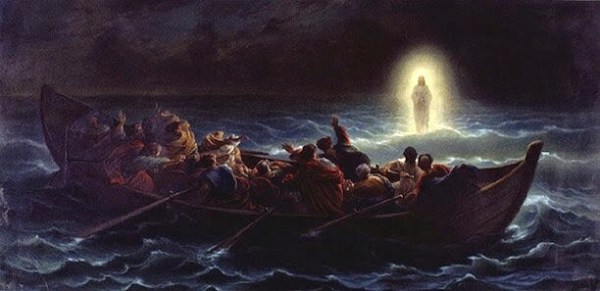
After feeding the five thousand, Jesus went up the mountain to pray and the Apostles got in their boat and set out across the sea to Capernaum.  On the way, the wind and seas picked up causing the crew to have some heightened anxiety.  Jesus, foreseeing their fears, then came to them walking on the water, which, to the crew of experienced fishermen, may have been an embarrassment before their master and teacher.  Jesus, told them, “It is I. Do not be afraid”.

Whether you’re a young engineer and middle manager or an experienced fisherman, it’s good to have someone who’s been there and done that, who can help you through the rough times.  Someone who can see beyond the immediate situation and find “teachable moments” to ease the tension and dispel the anxiety.

It’s a beautiful thing to learn from the experiences of those who have gone before us, from their mistakes and successes.  The Apostles and early Christians were, in a sense, just trying to figure things out.  They pioneered the New Way with Jesus as their leader.  They had no prior experience or self-study history books on which to fall back.  Their’s was a new learning experience every day.  And, Jesus, as their mentor, found “teachable moments” around every corner, especially when his followers, in their anxiety, needed to be told, “Do not fear.”

We still struggle with anxiety born from trying to do everything on our own.  We forget that Jesus is with us always, even in the midst of life’s storms.  We are fortunate in our faith, however, that the lessons learned by the Apostles and the early Christians have been captured for us in Scripture and in the sacred writings of the saints.  We need to remember that every time we pick up and read from our Bible or the spiritual writings of the saints, we are in the middle of a “teachable moment”.

Even then, trying to learn under our own power can be difficult and frustrating.  As Catholics, we are also fortunate to have available to us Spiritual Mentors who will walk with us on our journey of living a Holy life.  Spiritual Mentors are trained to ask questions that help us see what we can’t see for ourselves, and to gently provide “teachable moments” that help us steer around the difficulties of life.  

If you are interested in learning more about spiritual mentorship, or receiving spiritual mentorship from a trained mentor, or interested in becoming a Spiritual Mentor yourself, please leave me a comment, and I’ll be happy to help you.

“Lord Jesus, too often do I try to navigate rough waters on my own, forgetting that You are always with me.  In my times of prayer, Lord, give me the grace to realize Your presence, be attentive to Your gentle guidance, and learn from those “teachable moments”.  Help me also, Lord, as a Spiritual Mentor of other men, to help them find peace in their lives by relying on Your help. Amen.”

(Teachable Moments was first published on the blog Reflections of a Lay Catholic)

©2013-2023 Reflections of a Lay Catholic. Reposting and sharing of material in its full and original content is permitted, provided that full and clear credit is given to the author(s) and Reflections of a Lay Catholic.
Leftovers

22 Saturday Apr 2023

Posted by Jerry Robinson in Bible Reflections

≈ 2 Comments

Tags

Faith, Feeding the 5000, Holy Eucharist, Jesus, John 6:1-15, Leftovers, Living Water, Meditation, Multiplication of the Loaves, Prayer

There are plusses and minuses to being married empty nesters.  One positive is saving money on groceries, but an associated negative is the difficulty in preparing meals for only two people.  Most recipes are designed for at least four which, when followed, means there are usually leftovers.  That can be a problem if you’re one of those people who doesn’t care for leftovers, but for those of us who are fine with them and would rather not waste good food, it can be a really good thing!  When you accumulate enough leftovers you get a bye on deciding what to cook from scratch every now and then.

Also, leftovers, like a spicy pot of chili, just get better after they’ve “seasoned” for an extra day or two.  Even a pineapple upside-down cake like the one my wife made for my birthday this week just gets better each successive day as the pineapple juice and brown sugar syrup soak into the cake below.

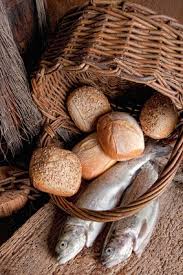
I was thinking about leftovers yesterday morning as I read the day’s scripture during my morning meditation.  The Gospel, John 6:1-15, told the story about the multiplication of the loaves and fishes for feeding the five thousand.  After instructing the crowd to recline in the grass, “Jesus took the loaves, gave thanks, and distributed them to those who were reclining, and also as much of the fish that they wanted.   When they had had their fill He said to His disciples, ‘Gather the fragments leftover so that nothing will be wasted.’  So they collected them, and filled twelve wicker baskets with fragments from the five barley loaves that had been more than they could eat.”  Jesus’ miracle transformed five loaves and two fish into enough food to nourish and curb the appetites of five thousand people with enough leftovers to repeat again and again. 

Taking the bread and giving thanks is a prefiguring of the miracle performed at every mass when, at the epiclesis, the priest calls upon the Holy Spirit and consecrates the bread and wine into the body and blood of Christ.  In receiving the Blessed Sacrament, we are at a feast and being fed with all the graces we need to live Holy lives.

But, we are also nourished and sated by the Word of God in Scripture.  When we pray and meditate daily on the life of Jesus in the Gospels, we are lovingly fed with as much as we can eat in one sitting.  We are given exactly what we need for that day to be virtuous souls.  Our job is to listen to and savor His Word, swallow it by relating it to our lives in the present moment, and then digest it by resolving to apply what we hear to living in a more virtuous way.  Then, we simply have to return to the table and repeat each and every day to partake in the perpetual and eternal leftovers.  No worries about not getting enough, about eating too much, or the food spoiling. There will always be another full and satisfying meal the next day.  And, just as day-old chili gets more flavorful, and pineapple upside-down cake gets more moist, each “meal” just gets better!

Jesus will always give us enough to nourish our souls if we invite Him, through prayer, into our hearts to feed us.  What nourishment do you need today?  Sit at the table, partake of the meal, savor each bite, and rejoice that there are enough leftovers for all the days to come.

“Heavenly Father, thank You for slaking my hunger by feeding me with Your Word, and for quenching my thirst with the Living Water, Your Son, Jesus.  I know through faith that You will never let me go hungry as long as I keep returning to the table through prayer and the Sacraments.  Amen.”

(Leftovers was first published on the blog Reflections of a Lay Catholic)

©2013-2023 Reflections of a Lay Catholic. Reposting and sharing of material in its full and original content is permitted, provided that full and clear credit is given to the author(s) and Reflections of a Lay Catholic.
Have Faith and Possess Life

27 Friday Jan 2023

Posted by Jerry Robinson in Bible Reflections, Faith, Trust

≈ 2 Comments

Tags

Faith, Heb 10:34, Heb 10:39, Mark 4:30, Mark 4:32, Matthew 11:25, Prayer, Psalm 37: 39, Psalm 37:40, Romans 8:23

(A reflection on today’s scripture passages:  Heb 10:32-39; Ps 37:3-6, 23-24, 39-40;  Mt 11:25; and Mk 4:26-34.)

In today’s first reading from Hebrews, we are reminded to not become discouraged and lose hope when we are afflicted by various sufferings.  Rather, we should joyfully accept them knowing that God’s love for us, in the present and eternally, is a better and lasting possession1 if we keep confident and endure to do the will of God.

Scripture is God speaking to each of us.  Meditating on His words today reminded me of how badly I stink at suffering, of how it is so much easier to complain about physical ailments, complicated relationships, and, in general, simply not getting my way, rather than finding joy in spite of those situations.  Then, in the Holy Spirit’s fashion, He didn’t let me dwell on that very long.  He spoke to me with some examples to follow by placing on my mind and heart the sufferings of three close friends:  Harry, Larry and Andy.

Harry has lung cancer.  He endured a series of chemo and radiation treatments and the doctors thought they had it corralled.  But, it came back and he’s now going through a second round.  Harry’s faith is enduring.  He continues to attend daily mass on mornings when he’s able and his compromised immune system is less vulnerable to catching something from the rest of us.  He is always cheerful and, as much as we long to give each other a hug, there is a ton of love in each fist bump.

Larry has skin cancer.  He’s been told he has a couple years of life left…here on this earth.  But, Larry has a trust in God like nobody I’ve ever seen.  He knows from the bottom of his heart that he is in good hands no matter the physical prognosis, and finds strength in the hope of everlasting life with the One Who loves him more than anyone else in the universe.  I know this from the smile on his face and the joy in his eyes I see every time we meet.

Andy was recently diagnosed with pancreatic cancer.  With treatment he might make it through the summer.  I had breakfast with him and his wife a couple weeks ago.  He was as upbeat and jovial as he’s always been.  You’d never know he had a struggle in the world.  Andy is a hard worker, and his state in life is to provide for his family.  I know he will continue to do his best in that role until it is physically impossible for him to do so.

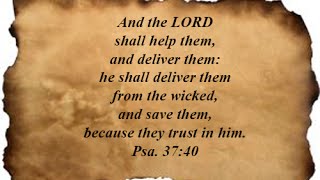
Harry, Larry, and Andy.  Three men who are not among those who draw back and perish, but among those who have faith and will possess life.2  Three men who, through their love of God and faith in Jesus, are examples to the rest of us.  They are humble and childlike3 before God  They know that all things work for good for those who love and trust in God.4  They are like mustard seeds, which have put forth large branches, so that the birds of the sky (the rest of us) can dwell in its shade.5 They bring the Kingdom of God6 to the rest of us so that we can find comfort and strength.  They model the idea that their salvation is from the Lord; He is their refuge in time of distress.  And the Lord helps them and delivers them; he delivers them from the wicked and saves them, because they take refuge in Him.7

Harry, Larry, and Andy.  I pray for them, and every person who is struggling with a terrible disease, each and every day.  Will you join me? 

“Good and gracious God, thank You for placing good and holy men like Harry, Larry, and Andy in my life.  Reassure them, please, that their struggle is not in vain, that through their faith in Your mercy and grace, there will be goodness result from their trials.  Help me, Jesus, develop the trust in you that they have.  For them and for all the faithful, let the Church pray.  Amen.”

(Have Faith and Possess Life was first published on the blog Reflections of a Lay Catholic)

  1. Hebrews 10:34, NAB
  2. Hebrews 10:39, NAB
  3. Matthew 11:25, NAB
  4. Romans 8:23, NAB
  5. Mark 4:32, NAB
  6. Mark 4:30, NAB
  7. Psalm 37:39b, 40, NAB

©2013-2023 Reflections of a Lay Catholic. Reposting and sharing of material in its full and original content is permitted, provided that full and clear credit is given to the author(s) and Reflections of a Lay Catholic.
The Sabbath Was Made For Man

18 Wednesday Jan 2023

Posted by Jerry Robinson in Bible Reflections, Commandments

≈ Leave a comment

Tags

Mark 2:23-28, Mark 3:1-6, Renewal, Rest, Sabbath

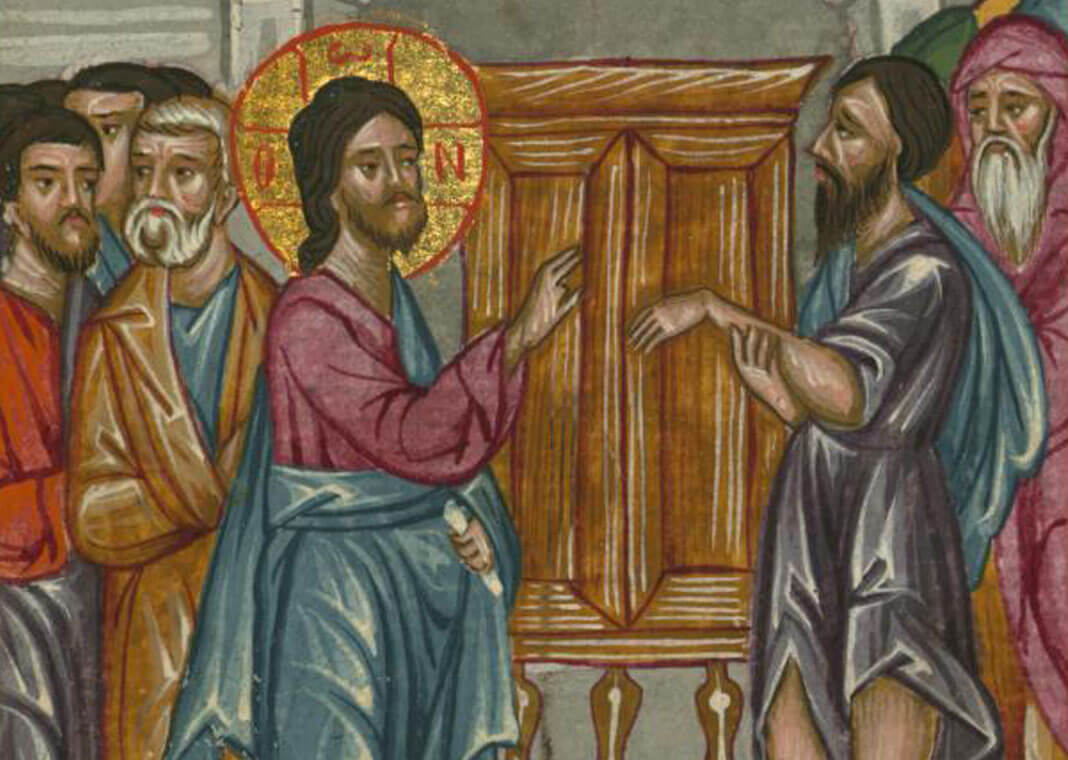
In yesterday’s Gospel passage, Mark 2:23-28, the Pharisees blow a gasket over Jesus and his disciples shucking and eating grain on the Sabbath. Jesus infuriated them even more when He alluded to himself as the Son of Man being lord over the Sabbath and that, “the Sabbath was made for man, not man for the Sabbath.”

Jesus heals the man with the withered hand.

Then, in today’s Gospel, Mark 3:1-6, the Pharisees totally lose it when he defies their authority by restoring a man’s withered hand to normal on the Sabbath, and in the temple nonetheless!  The shame of it all!  Jesus thumbed His nose at their law by showing that if He could do good for someone, why wait until tomorrow when he could do it today.  To the Pharisees, this was the last straw and they went about planning to put Him to death. 

In meditating on these passages, I thought about how the Pharisees, for generations, had added new laws (far in excess of the Ten Commandments) that acted to the detriment of the people and severely restricted their freedom of life.  Jesus, in His response, clearly made known that no man-made law could supersede or void the respect for the dignity God has for His creation – man.  Man’s need for sustenance and physical health supersedes the law of not working on the Sabbath.  Jesus made these allowances, but He never opened the door for totally disregarding the Sabbath.

The religious precepts of that time seem crazy to us now.  To us who love our freedom and ability to do whatever we want, whenever we want, those laws seem to be at the extreme end of the rigidity spectrum.  But, then I thought about the norms of society today, at what is and isn’t acceptable, and I see where we have slid to the opposite end of that scale.

First, there don’t appear to be any rules about conduct on the Sabbath.  Much of society today does not look to God as One to be worshiped, and, even for those who do, many see no reason to respect the Third Commandment of remembering to “keep Holy the Sabbath Day.” There are simply more important things to do whether they are necessary or not. 

Even within our Church we take exceptions.  Most Catholic schools, for example, pull out the stops to allow sports competition to be conducted on Sundays.  Many faithful see this as an “excused absence note” to not attend mass.  The wrong message is being sent.

But, surely, there ought to be a middle ground.  What is it that God wants from us in honoring the Sabbath?

Let’s begin with what He did on the Sabbath.  He rested after a hard week of work.  He took a break.  And he delighted in His creation, all that he had accomplished.  He set the example for us to follow.  But, what does this mean to us?

The Sabbath is meant to be a day of rest for us, a day to lighten our load.  Jesus said to us, “Come to me all you who labor and are burdened, and I will give you rest.”  (Matthew 11:28).  The things that burden us are more than our work, they include our anxieties, the weight of our sins and inordinate attachments that act to keep us distant from Him.  It’s a day on which we can look back over the week and evaluate our work; consider whether or not we gave it our best shot; and identify our vices and decide how we can replace them with virtues that will lead us to holiness.

The Sabbath gives us a chance to appreciate all that is good in our lives: the good that we do, the good that is in our families, and in our neighbors. It’s a chance for us to rest knowing that God loves us for who we are, not for what we do.  Even when we know we have fallen short, we can rest in knowing that He still loves us.

Sabbath rest does not mean we should laze around and do nothing.  We should use it to respect the dignity of other people.  It gives us the opportunity to think about, care about, and rest in the love of our family, friends and neighbors.  Jesus didn’t think twice about curing someone on the Sabbath.  We shouldn’t think twice about doing what it takes to improve relationships with others, bring them happiness, and love them the way they deserve and need to be loved.  They, too, need to know they are loved not for what they do but for who they are.

Spiritually, it’s the day above all other days in which we live out the first Commandment – to worship the Lord our God – by going to mass.  There, we can rest and find solace in recognizing all that God has done for us, primarily in the saving Grace of His death and resurrection.  Because of this, we ought to remember that life is good, and the next life will be very good!  

And, finally, we need to rest and delight in the goodness and beauty of God’s creation:  nature; the giftedness, uniqueness, and beauty of others; and edifying art, music and literature created by those whom He gifted.

We humans need all these things.  We need to be renewed every seven days.  In His infinite wisdom, God knew that we would need a day to regain our strength so that we could do our best in the next seven days. 

He made the Sabbath for us and not the other way around.

“Almighty God, thank You for creating me.  Thank You for creating everyone for me to love and through whom You channel Your love to me.  Thank You for the ability to work, to provide for my family, and to help others in need.  And thank You for Your omniscience knowing that I would need a day to rest and rejuvenate so that I can keep on working in Your Kingdom.  Amen.”

(The Sabbath Was Made For Man was first published on the blog Reflections of a Lay Catholic)

©2013-2023 Reflections of a Lay Catholic. Reposting and sharing of material in its full and original content is permitted, provided that full and clear credit is given to the author(s) and Reflections of a Lay Catholic.
Air, Trees, and the Breath of Life

14 Wednesday Dec 2022

Posted by Jerry Robinson in Bible Reflections

≈ 7 Comments

Tags

Air, Breath of Life, Genesis 2:7, Hail Mary, Rosary, The Sound of Our Breathing, Trees, YAHWEY

This contribution is from my good friend, Bob Magness. Bob is a devoted Catholic, husband and proud father of two daughters. He is a chemist. And, he is a “deep-thinker-about-stuff”. This is the fourth posting from Bob [Random Musings on a Spring Morning (4/22); Proverbs 27:17 – Iron Sharpens Iron (10/22); Reconciliation and a Rock (10/22)]

Air, Trees, and the Breath of Life – By Bob Magness

“Then the Lord God formed the man out of the dust of the ground and blew into his nostrils the breath of life, and the man became a living being.” – Gn 2:7

I’ve been thinking a lot about air lately.  I realize that sounds less than exciting and isn’t exactly the attention grabber most authors strive for.  I get things – words, concepts, phrases – stuck in my mind.  And without any conscience effort, this ‘thing’ gets spun around like a puzzle piece.  It’s as if something is telling me that this ‘thing’ is important and that I need to make some sense of it.  I’m almost embarrassed to say how long this particular ‘thing’, air, has been turning, but it’s been months.  That’s right, months of idle thoughts about air…  oxygen, carbon dioxide, breathing, and life.

The Krebs Cycle is the process by which animals produce energy – at least aerobically.  It’s the understood process of cellular respiration where oxygen is combined with carbohydrates to produce energy.  The by-products of this cycle are carbon dioxide and water.  (Interestingly these are the same by-products we see when burning carbon-based fuels for energy:  wood, gas, oil, etc.)  In a separate but equally important process carbon dioxide and water are combined and, through the miracle of the chemical processes of photosynthesis, the plant produces carbohydrates – sugars – as its own source of energy.  There you have it:  animals use oxygen and create carbon dioxide, and plants use carbon dioxide and return oxygen.  The biological yin and yang of cellular energy.  I had recalled most of that from high school biology.  And with some level of spirituality, we see the beauty in God’s system.  However, something was missing, there was more to this puzzle piece and my thoughts returned to air.

I have written a couple things about gardening; I have a similar passion for trees.  I love trees, what they stand for, what they stand against, and their simple potential for being.  That’s probably a bit dramatic.  I’ll say this, though, I have favorite trees.  Not in the sense of a particular variety, but more in their presence or domination of the surrounding landscape.  I like to point these trees out to anyone that might be the least bit interested.  I like finding beauty in the otherwise unnoticed and mundane aspects of life.  There’s a gigantic bald cypress tree in a nearby neighborhood.  To be clear, it has no earthly right to be in that neighborhood.  It is magnificent.  It towers above the other trees.  There’s another tree that is only visible in fall and winter.  I drive by it daily.  It stands proud above the undergrowth honeysuckle.  Its branches come off the main trunk at right angles, massive branches.  My daughter said once that it reminded her of the whomping willow from the Harry Potter books.  I told her that it was not a willow tree and tried to dismiss her.  I wasn’t going to be outdone and trivialized by a twelve-year-old, but she was right.  Worse than that, she knew that I knew she was right.  I’m digressing…

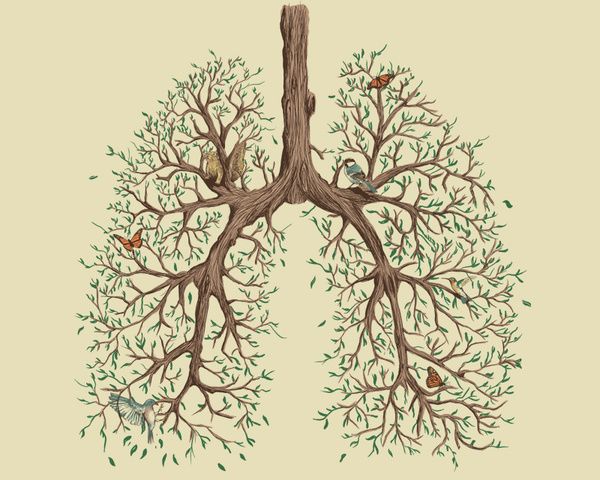
We happened to be on vacation in Oak Island, NC during an early spring break – this was a couple years ago.  The island is full of, you guessed it, oak trees – lots of willow oaks and some smaller live oaks.  One evening we were walking to one of the shops and I happened to see a large willow oak that was lit by the streetlights and was set against the dark night sky.  Without the summer leaves, and silhouetted against the black sky, the tree looked like a set of lungs, upside down of course.  The main trunk of the tree was the trachea.  The tree bifurcated to the two lobes of the lungs, and each of the subsequent branches appeared like bronchi, right on down to bronchioles, and continued its fractal pattern down to the alveoli-like leaf buds. It was a remarkable sight.  A beautiful tree acting as a lung – returning to us oxygen and feeding the earth with tree made sugars.  

I recently came across the book Breath by James Nestor.  An interesting read about the physiological effects that can be achieved by better controlling your breathing and benefits of simply breathing through your nose.  It’s worth the time to read.  Nestor touches on the benefits of emphasizing the exhale phase, extending the exhale.  One of the benefits with extending exhalation is the reduction of pressure on the heart.  As the air pressure in your lungs decrease, the heart has a bit more room to operate and the result is a drop in blood pressure, even if only momentary.  He continues with sections on meditation and prayer saying they are essentially exercises in controlling your breathing.  I thought about this while praying a Rosary:

Hail Mary, full of grace, the Lord is with thee

(Inhale)

Blessed art thou among women and blessed is the fruit of thy womb, Jesus

(Inhale)

Holy Mary, Mother of God, pray for us sinners now and at the hour of our death

(Inhale)

That’s a good amount of exhaling while speaking with only three short inhalations.  And when repeated, let’s say 53 times, the effect can be felt, not only spiritually but also physiologically.  

Again, I had chalked all of this up to fanciful spirituality and the wonderment of God’s handiwork.  But, then, I came across some literature by Rabbi Lawrence Kusher in a discussion about Moses at the burning bush.  Moses asks, “When people ask who You are, what shall I tell them?”  This is where we get, “Yahweh”, but Kusher points out that in Hebrew the vowels were not there.  And that the answer given by God are the four Hebrew letters YOD, HAY, VAV, and HAY- mispronounced as Yahweh, when in truth the four letters cannot be said. The word given to Moses, Kusher claims, “is the sound of breathing”.   He continues, “The holiest Name in the world, the Name of the Creator, is the sound of your own breathing.”  

I stopped.  My air puzzle piece was snapped into place.  

The breath of life.  Divinity breathed into man. All mankind.  Yet another reason to love your neighbor as yourself.

(Air, Trees, and the Breath of Life was first published on the blog Reflections of a Lay Catholic)

©2013-2022 Reflections of a Lay Catholic. Reposting and sharing of material in its full and original content is permitted, provided that full and clear credit is given to the author(s) and Reflections of a Lay Catholic.

How Will You Let this Easter Change Your Life?

05 Monday Apr 2021

Posted by Jerry Robinson in Bible Reflections, Easter

≈ 4 Comments

Tags

Acts 2:22-33, Confirmation, Easter, Fortitude, Pentecost, St. Vincent Ferrer

Happy Easter to you!  I hope it was a day filled with joy.

Yesterday, we proclaimed, “Christ is risen!”  For the faithful it is the day that brings eternal hope to our lives.  It’s the day that reassures us there is a purpose to this life we live and all the struggles that accompany it so that one day we may be resurrected like Jesus and live with Him for eternity.  

But, how do you feel today?  Do you feel different than yesterday.? Or are you the same person you were a week, a month or a year ago?  For many, you’ve returned to work or, in some way, returned to your daily habits.  And, I’ll venture a guess, not all of those habits are completely virtuous.  I know, I’m there with you.

This morning I set my alarm and arose an hour earlier than I have been the last couple weeks.  A contractor was scheduled to show up early and begin remodeling the first floor of my house, and I wanted to make sure I had time for my morning prayer and meditation before they arrived.   As I read the first reading from the Acts of the Apostles (Acts 2: 14, 22-33) about Peter’s speech at Pentecost to the Jews of Jerusalem, my attention was brought to the contrast between the Peter of today and the Peter of last week, who, out of fear, denied Jesus three times.  

After the descent of the Holy Spirit at Pentecost, Peter changed.  He found courage to proclaim the name of Jesus and His death, and profess His resurrection to all of Jerusalem, even to those who were responsible for His crucifixion.  I’m sure Peter was still the same in many ways – gruff and impetuous – but his timidity had been replaced with fortitude.  He spoke boldly and with authority.  He was no longer afraid to be associated with Jesus, rather, he rejoiced in the opportunity.

So I wondered how my life might change.  Do I have what it takes to “proclaim Your death, O Lord, and profess Your resurrection” as I say every time I go to Mass?  And, then I realized I do have what it takes.  I was given the grace to be courageous in my faith when I received the Sacrament of Confirmation.  If you’re a confirmed Catholic, then you were given that grace, too.

Well, it’s one thing to say I’m going to be more courageous, but it’s a whole ‘nuther thing to do it.  Unsure exactly how I would do this today, I resolved to pray for the Lord to present me with an opportunity and, when He did, that I would rise to the occasion.  

In the meantime, I decided to read about the saints of the day.  Today is the feast day of St. Vincent Ferrer, a Dominican friar from the 14th Century.  St. Vincent was a  tremendous preacher who converted thousands throughout Europe.  His efforts so built up the Church that he became the patron saint of those in the building trades.

As I finished reading about this great saint, there came a knock on my door.  It was the contractor’s crew arriving to start work.  We had a walk-around to show everyone the scope of the project and, then, as they were fetching their tools from their truck, it hit me:  God had just presented me with the opportunity for which I had prayed.  It was no mere coincidence that a crew of building tradesmen were beginning to work in my house on the feast day of their patron saint.  And, so, as they all gathered back inside I asked them if they would mind if I prayed for their safety and to a successful project.  I explained the connection with St. Vincent Ferrer, and they bowed their heads with me.  I prayed, “Heavenly Father, thank You for the opportunity to praise You and for the virtues of patience and perseverance that have brought us to begin this project.  I pray for the intercession of St. Vincent Ferrer, that he watch over these workers and keep them safe from harm, and that this project goes smoothly and successfully.  I pray in the name of Jesus Christ our risen Lord.  Amen.”  And, then, in my mind I also prayed, “And, please, let their be no cost overruns!”

I love how God works for us when we love and trust in Him.  Don’t let this Easter go to waste.  Through prayer, place your love and trust in Him, and accept, realize and act on the grace of fortitude given to you in your Confirmation to proclaim the name of His Son, Jesus, to the rest of the world.

“Lord Jesus, thank You for this blessing today.  I pray that, in our fallen society, this Easter season will bring a resurgence of hope to all Your faithful.  Through the intercession of St. Vincent Ferrer, may a  fortress of strength be built in our hearts such that we may all proudly and courageously proclaim Your death and resurrection.  Amen.”

(How Will You Let this Easter Change Your Life? was first published on the blog Reflections of a Lay Catholic)

©2013-2021 Reflections of a Lay Catholic. Reposting and sharing of material in its full and original content is permitted, provided that full and clear credit is given to the author(s) and Reflections of a Lay Catholic.

Where are you at Calvary?

28 Sunday Mar 2021

Posted by Jerry Robinson in Bible Reflections

≈ 4 Comments

Tags

Calvary, Christ's Crucifixion, Eucharist, John 19:28, Mark 15:39

The following reflection was written by a friend and fellow Catholic Spiritual Mentor, Lisa Schartz, from Abilene, Kansas. In her daily prayer and meditation on the Scripture, Lisa asked herself from what vantage point would she have watched Christ’s crucifixion had she been there. The result was this beautiful and touching reflection which she shared with me and I feel obligated to share with you. I know Lisa would truly appreciate any thoughts or comments you might have. And, I know she shares my hope that each of you have a truly blessed Holy Week!

Where are you at Calvary?

by Lisa Schartz

Le Coup de Lance, Peter Paul Rubens, 1620

Imagine the scene at Calvary. Three men are crucified and suffering on their crosses. Blood drips slowly down from the holes in their hands and feet. In the center hangs a man covered in stripes of swollen and torn flesh from a recent scourging. At the foot of his cross stands a young man and several women weeping for the one hanging above them. Roman Centurions are there in force. A few are playing a game of dice off to the side. Others prowl about, keeping a watchful eye on the onlookers. 

In the crowd are some who call out, mocking the man on the center cross. Others seem to be trying to hide the sorrow they feel as they weep behind their cloaks. Some are there merely to see the spectacle. It is not every day that you witness a crucifixion, let alone three at once. Among the crowd are men who appear to be priests or rabbis. Some of these men seem rather smug about the sight before them, but not all. A few of their number appear anxious as if they are waiting for something terrible to occur.

Picture yourself amid this scene. Listen to the taunts and jeers, the shouts of the soldiers, the cries of sorrow and lament. Where are you in this scene? Are you on the fringes of the crowd or are you watching from a distance? Are you among the group kneeling at the foot of the cross? Are you a soldier actively participating in the event? Where exactly do you fit into this scene?

I want to say that I would be kneeling with St. John and our Blessed Mother at the foot of the cross. Then, I consider that St. John was the only Apostle who had stayed with Jesus to this point. If the twelve who lived with and learned from Jesus for three years had abandoned him, would I not likely have done the same? Perhaps I would have stood and watched from a safe distance. Would I have been at the back of the group wanting to be there but reluctant to witness the scene before me? Or maybe, would I have been somewhere near the front of the crowd, watching and perhaps weeping but secure in the anonymity of the public? 

What if I had been brave enough to kneel at the foot of the cross? Perhaps as I kneel there, I am close enough that a drop of Christ’s blood lands on my arm. I watch as the warm liquid seeps into my sleeve. I hear Jesus utter, “I thirst” (Jn 19:28). I ponder how the fabric of my clothes seems to drink in the blood that landed upon it, quickly absorbing it and appearing ready for more. Do I thirst for unity with Jesus in the same way He thirsts for a relationship with me? Does this drop of Precious Blood change me in any way? What if I inched just a little bit closer so that more of the Precious Blood fell on me? If I receive a larger share, will it penetrate my heart? Will I turn from my sinful ways and unite myself fully with the Divine Life of the One Who hangs above me?

If I am brave enough to stay there at the foot of the cross and watch my Lord expire before me, does it change my heart? Am I a different person, having witnessed His death and my salvation? I cringe as I hear the bones crack in the legs of the other two crucified men. My stomach turns at the thought of the pain just inflicted upon them. Then I watch as the Centurion comes before Jesus. He does not break Jesus’ legs since Christ is already dead. Instead, the Centurion grabs a spear and pierces the side of my Lord.

Truly this man was the Son of God!

-Mark 15:39

As he does, blood and water spray forth from his body, drenching the Centurion who falls to his knees. I am also covered in the spray of blood and water. Like the Centurion, I have been bathed in the blood of the lamb. I hear the Centurion utter, “Truly this man was the Son of God!” (Mk 15:39). I know in my heart this is true, and I lower my head to the ground and weep. These are not tears of sorrow, for I know what Jesus has done for me and that he will rise again. No, I weep for the realization of my sins, my failure to love God as he has loved me.

I invite you to spend time with this reflection. Imagine yourself as a witness to this event from different aspects at the scene, and as various people who would have been present at Calvary when Jesus was crucified. Then, I invite you to take it one step further because, as our Catechism teaches us, you have been present at this event many, many times in your life:

When the Church celebrates the Eucharist, she commemorates Christ’s Passover, and it [Jesus’ crucifixion] is made present: the sacrifice Christ offered once for all on the cross remains ever-present. “As often as the sacrifice of the Cross by which ‘Christ our Pasch has been sacrificed’ is celebrated on the altar, the work of our redemption is carried out.’”

(CCC 1364)

Our Catholic faith has it right. You are present at Calvary each time you attend the Sacrifice of the Mass. So, now, go back to that original question that I posed. Where are you in this scene? In my personal experience of Catholic Mass and the emptiness of the front pews, the reluctance of young men to answer the call to become priests, the hesitancy of men to act as altar servers, I doubt few of us can claim to be kneeling at the foot of the cross. Are you that person hanging out at the back of the crowd, sitting in the last pew, ready to bolt at the earliest convenience? Are you somewhere in the middle, perhaps wondering why you have bothered to come or when the event will be over? Maybe you could not be bothered to attend at all because of something in your life more important to you than your Lord.

Are you ready to hear God’s words and embrace His message for you? Are you prepared when the sacrifice is made fully present, and God’s grace is again poured forth? Where is your mind when Christ becomes present on the altar? Is your heart opened to receive God’s love for you? Are you changed when you are not only touched by the body and blood of Christ but allowed to consume your Lord? Or, are you perhaps distracted at the moment when Christ fully unites himself to you, more worried about what you will have for lunch or what time the game starts? 

From the moment that Adam and Eve turned away from God to this moment when I turn from God, not much has changed in Salvation History. God still seeks us and longs for a relationship with us, with you, and with me. And I always find some forbidden fruit which, to my sinful nature, has a greater appeal than God. Where are you in your relationship with your Lord and Savior? Where do you stand at Calvary?

(Where are you at Calvary? was first published on the blog Reflections of a Lay Catholic)

©2013-2021 Reflections of a Lay Catholic. Reposting and sharing of material in its full and original content is permitted, provided that full and clear credit is given to the author(s) and Reflections of a Lay Catholic.

If You’re Going to Believe in Everything You Read, then Start with Your Bible

17 Wednesday Feb 2021

Posted by Jerry Robinson in Bible Reflections

≈ 2 Comments

Tags

Bible, Leaven of Herod, Leaven of the Pharisees, Lenten resolutions, Mainstream Media, Mark 8:14-21, Turn off your television

Last week I drove by the United Methodist Church in our town of Lebanon, Ohio and saw on their marquee this thought provoking quip, “If you’re going to believe in everything you read, then start with your Bible.”  I thought at the time how it has become almost impossible to believe anything one reads or hears.  The mainstream media distorts the truth to fit their agenda, and social media is filled with half-truths and opinions making it difficult to know what is reality.  And, I agreed that the safest place one can go to read the truth and preserve one’s intellect is the Bible.

I thought about this again when I read today’s Gospel passage, Mark 8:14-21, where Jesus tells his disciples, “Watch out, guard against the leaven of the Pharisees and the leaven of Herod.” I know I’ve read this passage many times before but I was always like the disciples, not understanding Jesus’ intent.  Today, I think I grasped His meaning.

Watch out, guard against the leaven of the Pharisees and the leaven of Herod.

Mark 8:15

Leaven, or yeast, is added to flour and water to make bread rise.  Without it, you get flatbread.  But, flatbread is still bread, unadulterated bread.  The leaven is a change agent that adds air to the dough without adding any nutritional value, yet makes the bread look more attractive, and imparts a pleasing and desirable flavor.  

The Pharisees, who were the religious component of authority in Jesus’ time, added their “leaven” of man-made laws which camouflaged God’s commandments, making them secondary.  Herod, the Roman political component of authority, demanded that the Roman laws, his “leaven”, also supersede God’s laws so that he and his government would remain in power.  Although the Jews were oppressed by the Romans, they also depended on them for their security.

We have a similar set up in our culture today.    The modern day pharisees preach love of self over love of God (individualism), love of things before love of God (materialism), love of disordered pleasure over morality (hedonism), and that we can make up our own truth and disregard the truths of human nature given to us by God (relativism).  Our society seems to have accustomed itself to depending on our government, our own Herod, for all its needs, placing our political leaders on a pedestal higher than God, which is right where they want to be.  Together, the two are like the right and left hands of a marionette in a puppet show being orchestrated by Satan himself, the puppet master.

And, our mainstream media is narrating the entire production, telling us what to believe, who to believe, and how we should and should not act.  It’s not just the news sources but also television shows billed as family entertainment, movies whose producers are coerced to present non-Christian content in hopes of receiving industry recognition, music that promotes every sort of immoral decadency, literature that entices us to believe that fantasy is preferential over reality, and declares pornography to be an art form.

And we wonder why our world is a mess.  We have dug our hole deep and it’s caving in on us.  The only way to dig ourselves out is to turn back to God and live by His commandments instead of the perverted norms of our society.  We must adore God more than we do our political leaders and more than we do those who promote immorality.

How might you do this?  For starters, turn off your television.  Ask yourself if the information you glean from a news broadcast makes a positive difference in your life or does it simply cause anxiety, fear, and mistrust.  Decide if watching that sitcom you’re addicted to is making you a better person.  Do you really want to support Netflix or HBO or any of the other media sources by watching a not-so-bad movie yet knowing that their real appeal is in their “racier” offerings?  Consider whether watching a televised sporting event is going to make a difference in your life, or could you be spending that couple hours building relationships with your spouse or children.  The media knows we are weak.  They know we will gravitate to what feels good over what is good.  You can be stronger than they are.

Impossible you ask?  It’s not.  This month marks the thirty-fourth year my wife and I have not watched television.  We have a television but it is only used to watch a handful of movies in a year.  Spending time together in conversation, playing games, praying together, taking walks together and other mutual activities are much more rewarding.  Our children grew up without television.  Instead of parking them in front of the television as children we played with them, read books to them, helped them with homework, provided opportunities for creativity.  In other words, we were present in their lives.  It made a difference.  I’m not pridefully patting myself on the back, just hoping to be an inspiration to you by giving an example that it can be done.  Think about it.

The same goes for every other type of entertainment including books and music.  Ask yourself if that which you are reading or listening to feeds your intellect with the truth of reality.  Ask whether it is good or not.  By good I mean that it not only brings you satisfaction but makes you a better person, whether it fulfills the purpose for which you were designed by God.  We are only truly happy when both conditions are met.  You can find that happiness in the Bible.

As I write this it is Fat Tuesday, or Mardi Gras, the eve of Ash Wednesday and the beginning of Lent.  If you’re looking for something to “give up” for Lent, or wondering how you might grow closer to Christ in this season, consider fasting from television and replace it with reading Scripture, building relationships with God through prayer and with your family, friends and neighbors.  I guarantee you will reap more rewards than by giving up chocolate.  

Since television is not an issue for me, my lenten resolution is to fast from FaceBook completely.  I venture there mostly to see pictures my daughters might have posted of my grandchildren.  But, while looking for those, I easily become distracted by all the other addicting content that steals my time, and which may or may not be believable.  I would much prefer reading the One Book that is believable because I know it is truth, letting it make me a better person, and then going out and practicing what I’ve learned.

I pray that each and every one of you grows closer to our Lord this Lenten season.

“Heavenly Father, You made us for more than we have become.  Help me and all Your faithful during this Lenten season love You more and grow closer to You through prayer, as well as building loving relationships with our family, friends and neighbors.  Amen.”

(If You’re Going to Believe Everything You Read, then Start with Your Bible was first published on the blog Reflections of a Lay Catholic)

← Older posts
Newer posts →

Enter your email address to follow this blog and receive notifications of new posts by email.

Join 264 other subscribers
Follow Reflections of a Lay Catholic on WordPress.com

Recent Posts

  • Are You Ready to Proclaim the Gospel?
  • A Prayer for Continued Progress
  • Be Like the Thessalonians
  • Be Magnanimous Like Mary
  • Are You an Average Catholic?

Categories

Top Posts & Pages

  • The Cry Room Blues
  • Proverbs 27:17 - Iron Sharpens Iron as One Person Sharpens Another
  • Are You Hall of Fame Bound?
  • Thoughts on the Total Solar Eclipse
  • A Special Prayer Request
  • The Choosing
  • So Many Churches, Too Little Time
  • The Anti-Beatitudes
  • Advent: Preparing Our Hearts as a Gift for Christ's Coming
  • A Point of Reference

Archives

  • September 2025
  • August 2025
  • July 2025
  • May 2025
  • April 2025
  • February 2025
  • January 2025
  • December 2024
  • November 2024
  • September 2024
  • July 2024
  • May 2024
  • April 2024
  • March 2024
  • February 2024
  • January 2024
  • December 2023
  • November 2023
  • October 2023
  • September 2023
  • August 2023
  • June 2023
  • May 2023
  • April 2023
  • March 2023
  • February 2023
  • January 2023
  • December 2022
  • November 2022
  • October 2022
  • September 2022
  • June 2022
  • May 2022
  • April 2022
  • March 2022
  • February 2022
  • January 2022
  • November 2021
  • July 2021
  • June 2021
  • May 2021
  • April 2021
  • March 2021
  • February 2021
  • January 2021
  • November 2020
  • October 2020
  • September 2020
  • August 2020
  • July 2020
  • May 2020
  • April 2020
  • March 2020
  • January 2020
  • December 2019
  • November 2019
  • September 2019
  • July 2019
  • June 2019
  • May 2019
  • April 2019
  • March 2019
  • January 2019
  • December 2018
  • November 2018
  • October 2018
  • September 2018
  • August 2018
  • July 2018
  • June 2018
  • May 2018
  • April 2018
  • March 2018
  • February 2018
  • January 2018
  • December 2017
  • September 2017
  • August 2017
  • July 2017
  • June 2017
  • May 2017
  • April 2017
  • March 2017
  • February 2017
  • December 2016
  • November 2016
  • October 2016
  • September 2016
  • August 2016
  • July 2016
  • April 2016
  • March 2016
  • January 2016
  • December 2015
  • November 2015
  • September 2015
  • August 2015
  • July 2015
  • June 2015
  • May 2015
  • April 2015
  • March 2015
  • February 2015
  • January 2015
  • December 2014
  • November 2014
  • October 2014
  • September 2014
  • August 2014
  • July 2014
  • June 2014
  • May 2014
  • April 2014
  • March 2014
  • February 2014
  • January 2014
  • December 2013
  • November 2013
  • October 2013
  • September 2013
  • August 2013
  • July 2013
  • June 2013
  • May 2013
  • April 2013
  • March 2013
  • February 2013

Meta

  • Create account
  • Log in
  • Entries feed
  • Comments feed
  • WordPress.com

©2013 – 2024 Reflections of a Lay Catholic. Reposting and sharing of material in its full and original content is permitted, provided that full and clear credit is given to the author(s) and Reflections of a Lay Catholic.

Create a free website or blog at WordPress.com.

  • Subscribe Subscribed
    • Reflections of a Lay Catholic
    • Join 264 other subscribers
    • Already have a WordPress.com account? Log in now.
    • Reflections of a Lay Catholic
    • Subscribe Subscribed
    • Sign up
    • Log in
    • Report this content
    • View site in Reader
    • Manage subscriptions
    • Collapse this bar
 

Loading Comments...