
• About
  • Books I’m Reading
  • Links

Reflections of a Lay Catholic

Reflections of a Lay Catholic

Author Archives: Jerry Robinson

The Greatest Commandments & St. Wulfram of Sens

20 Friday Mar 2020

Posted by Jerry Robinson in abortion, Commandments

≈ 8 Comments

Tags

abortion, Culture of death, Euthanasia, Mark 12:28-34, St. Wolfram of Sens, The Greatest Commandment

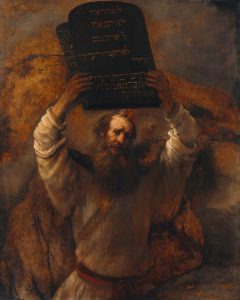
Moses with the Ten Commandments –
Rembrandt, 1659

When I admitted in yesterday’s post, Tradition and Commandments, that I needed to commit to memory the Ten Commandments, I didn’t know that the Gospel reading today would also be about the Commandments. Actually, in today’s Gospel, Mark 12: 28-34, Jesus consolidates the ten into two. He explains to the scribe that the First Commandment is to “‘Love the Lord your God with all your heart, with all your soul, with all your mind, and with all your strength.’” Jesus follows this up by saying, “The Second is this: ‘You shall love your neighbor as yourself.’ There are no other commandments greater than these”.

I may not have had all ten Commandments memorized but I did know that the first three of the ten were directed at loving God, and the last seven were intended for loving other people in our society, our “neighbors”. I’m pretty sure they are arranged that way on purpose. Unfortunately, we humans often get confused and get it backwards. We let our pride make us think we are God, that we are in control. We love ourselves but forget the “neighbor” part.

I say, “we”, in a general sense. We are all sinful by nature, of course, but some humans, often those who choose to totally ignore the Commandments in the first place, can take this to extremes. The pride that tells them to play “God” also tells them they can control their surroundings and circumstances, including other people, to suit their personal preference or agenda. The most extreme case of this in our society today is our Culture of Death – that is, the widely held belief that we can arbitrarily kill the most vulnerable in society: our unborn, through abortion, and the elderly, through euthanasia. No matter how sinful I might be, it just blows my mind that anyone can stoop so low as to intentionally kill their own children or parents for convenience sake.

During my morning prayer time, I like to read about the Saints of the Day. Today is the feast day of St. Wulfram of Sens. I know, who is St. Wulfram of Sens, you ask? Well, St. Wulfram of Sens was a 7th century Archbishop of Sens, France, who gave up his bishopric to return to a simple priesthood so that he could evangelize the Frisians. Frisia was a small pagan kingdom that is now part of The Netherlands and northern Germany.

The Frisians had a custom of sacrificing their children to their heathen gods by hanging them, or tying them to posts driven into the sea floor where they were left to drown when the tide rolled in. Another custom was to draw lots and see who from the community, possibly a family member, would be sacrificed by hanging or by being chopped to pieces. All in the hope of bringing about some improvement in their lives.

Close your eyes for a moment and picture a scene from both of those practices. If you can, that is. Even to the most insensible, non-psychotic, among us, it almost defies imagination! The first thing that comes to mind is pure horror that begs the question, “How could they do such a thing?”

Well, fast forward thirteen hundred years and our society is still doing it. Except that we’re chopping up our babies both inside and outside the womb, and smothering the elderly by removing their ventilation tubes. To us Christians, like St. Wulfram, it’s still an unimaginable heathen practice born from pride and selfishness by people who desire to be their own god and be damned to anyone who might keep them from it!

Oh, the rest of the story: St. Wulfram, finally did convert the Frisians by praying for a man named Ovon who was being hanged. After two hours of hanging, the spectators left him for dead. But, once they left, Ovon’s rope broke, he fell to the ground, and lived. St. Wulfram’s faith convinced the Frisian king and his subjects that our God was the real God.

Let’s all remember and keep the Great Commandments in the right order: first, to love God with all our heart, soul, mind and strength; and second, to love our neighbor as ourselves. That God is God and we are not. And, please, let’s all be St. Wulframs and pray for an end to abortion and euthanasia.

“Heavenly Father, I know You love me. I love You because You loved me first. I thank You. You love me even though I am broken and often sin by not following Your Commandments. Lord, have mercy on us all and forgive us when we place ourselves first and relegate You and Your Son, Jesus to second place. Lord, give us the faith of St. Wulfram to pray for conversion from a culture of death to a culture of life and love for our neighbor. Amen.”

(The Greatest Commandments & St. Wulfram of Sens, was first published on the blog Reflections of a Lay Catholic)

©2013-2020 Reflections of a Lay Catholic. Reposting and sharing of material in its full and original content is permitted, provided that full and clear credit is given to the author(s) and Reflections of a Lay Catholic.

Tradition and Commandments

19 Thursday Mar 2020

Posted by Jerry Robinson in Faith

≈ 5 Comments

Tags

Apostolic Tradition, Deposit of Faith, Dt 4:9, Meditation, Mt 5:17-19, Prayer, Sacred Scripture, Sacred Tradition, Ten Commandments, Tradition

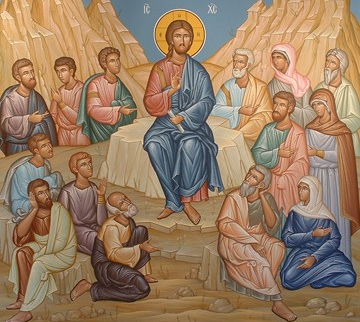
Icon of The Sermon on the Mount

Like many of you, I’m at home in self-imposed semi-quarantine due to the Coronavirus pandemic sweeping the world. I pray this finds you in good health physically, and not losing your sanity sitting at home.

For the two weeks prior to this week, while I was traveling and spending time with family, I unfortunately let my prayer life lag. Thus, in my semi-isolation this week, I’ve found consolation in returning to my morning routine of prayer, meditation and study.

My inspirations for yesterday came from the daily scripture readings. The first was from the first reading, Dt 4:1, 5-9, which tells us of the beauty and importance of the Commandments. Verse 9 particularly caught my attention: “Be on your guard and be very careful not to forget the things your own eyes have seen, nor let them slip from your heart as long as you live, but make them known to your children and to your children’s children.”

Isn’t this exactly what the Apostles did when they passed along from Jesus’ teaching and example and what they learned from the Holy Spirit?[1] Obvious to all Christians is how they did this through the Sacred Scripture of the Gospels and the letters of the New Testament. We all agree that these works were written by men but inspired by God even though there are some minor inconsistencies between them.

But, what about the first generation of Christians who did not yet have a written New Testament?[2] How was the faith handed down for them? It was handed down by word of mouth and stories from the Apostles and disciples that conveyed what was seen with their own eyes and held in their hearts to their children and others to whom they evangelized. For us Catholics, this is what we call Sacred Apostolic Tradition, and it is the second component of what we refer to as the Deposit of Faith.

Sacred Tradition and Sacred Scripture are bound closely together and communicate one with the other. For both of them, flowing out from the same divine well-spring, come together in some fashion to form one thing and move towards the same goal. Each of them makes present and fruitful in the Church the mystery of Christ, who promised to remain with his own always, to the close of the age.[3]

Fortunately for us, the Catholic Church, unlike our Protestant cousins’ insistence on Sola Scriptura, does not derive her certainty about all revealed truths from the holy Scriptures alone. Both Scripture and Tradition must be accepted and honored with equal sentiments of devotion and reverence.[4]

The idea of Apostolic Tradition, even before I ever actually heard it called Apostolic Tradition, made total sense to me. Forty-three years before I became Catholic I was sitting in a history class in the 7th grade at an all boys school in southern England learning about the Protestant and English Reformations. We were lectured about Martin Luther’s 95 Theses, written in 1517, which, for good reason, denounced the Catholic practice of the day of selling indulgences. But, Luther also decreed that salvation could only be achieved by faith alone without regard to good deeds; and, in declaring that the Bible was the only source of divine revelation, effectively threw the baby out with the bathwater when he denied Sacred Tradition. We were especially expected to accept the teaching that King Henry VIII, in 1534, had the authority to defy Tradition and break away from the Catholic Church because he didn’t agree with the Church’s teaching on divorce. And, we learned about John Calvin who, in 1536, also denounced Tradition in favor of Scripture alone; and denied good works as a component of salvation, preaching that man’s destiny was predetermined at birth by God.

In the mind of a 12 year old who had very minimal Christian education, and virtually none about Catholicism, I thought, “How can Protestants simply erase fifteen hundred years of history and start over again?” I could understand their issue with the selling of indulgences, but wiping out tradition to suit their own convenience certainly didn’t seem right. In a way, I knew then that if there was a true Christian faith, it was Catholicism.

As I read that verse from Deuteronomy these memories came back to me and I realized this is one of the reasons why I love being Catholic! Having a faith that is based on both Sacred Scripture and Apostolic Tradition is like being able to trace one’s family tree back two thousand years and not just a few generations. It’s like hearing stories told and retold of things our ancestors personally did and believed and not simply a synopsis of what it was like living in their time.

After reliving this memory, I pulled my attention back to the passage and focused on it’s real intent of urging us to live and obey the laws of God and to hand those down to future generations. As I read on to the Gospel for the day, Mt 5:17-19, Teaching about the Law, I received my second inspiration of the morning. In these passages, Jesus teaches his followers about the importance of living, obeying, and teaching the commandments. In my reflection on the Gospel, I asked Jesus, “What, Lord, are You wanting me to take away from this today? What is Your will for me today and how will it help me grow closer to You?”

In my subsequent meditation, it didn’t take long for me to hear the Holy Spirit begin this conversation:

HS: Are you living My Commandments?

Me: Yes, I’m trying to.

HS: Okay, can you tell me what they are?

Me: Sure! They are: Don’t take the Lord’s name in vain; keep the Sabbath holy; love our parents; um, don’t steal; er, don’t lie; ….okay, You got me, I don’t remember the rest.

HS: Son, don’t you think it would be good for you to memorize these so you can live them?

Me: Yes, Lord. I will do that.

HS: Thank you. I love you.

Me: Thank You. I love You, too!

My resolution for the day was a no-brainer: begin committing the Ten Commandments to heart by writing them down and inserting them at the front of my journal where I can read them daily and be reminded of the basics God is asking of me.

“Heavenly Father, thank You for Your love, generosity and patience with me as I work to grow closer to You. Thank You for Your mercy as I swerve a little trying to keep it between the ditches on Your road to salvation: loving You with all my heart, mind, and soul on the left, and loving my neighbor as I love myself on the right. And, thank you, Lord, for our One, Holy, Catholic, and Apostolic Church as the true depository of our faith in You. Amen.”

______________________________________

[1] Catechism of the Catholic Church, Para. 83 (CCC 83)

[2] ibid.

[3] CCC 80

[4] CCC 82

(Tradition and Commandments, was first published on the blog Reflections of a Lay Catholic)

©2013-2020 Reflections of a Lay Catholic. Reposting and sharing of material in its full and original content is permitted, provided that full and clear credit is given to the author(s) and Reflections of a Lay Catholic.
God Returns Our Generosity

29 Wednesday Jan 2020

Posted by Jerry Robinson in Generosity

≈ 3 Comments

Tags

Encouragement, Generosity, God-moments, Joy, Mark 3:35

After writing today’s post, Please Pray for Our Priests, I thought I would write something a little less somber and with less gravity. I posted Looking for God Moments on Monday about an experience of grace I received the previous day. Well, the Lord didn’t wait long to bring me to another one of those moments. Let me tell you what happened yesterday.

On Monday night in a meeting with 13 other men, we talked about qualities we need to exhibit to imitate Christ. Two of those were generosity and forgiveness. With respect to forgiveness I mentioned that I easily forgive others and have never held grudges. On the other hand, I feel I struggle with being generous to others in the form of encouragement and affirmation. I’m not saying it doesn’t exist, just that I wish I were better at it.

Yesterday morning after reading the Gospel from Mark 3:35 where Jesus says, “Whoever does the will of God is my brother and sister and mother”, and knowing that the will of God is to love him and others, I recollected the discussion from the previous evening. I realized I could love others more effectively by improving my generosity and making others feel valued. My resolution for the day was to look for and take advantage of any opportunities that might arise.

Finishing my prayers, I noticed I had a notification on my FaceBook page saying that it was the birthday of my Tuesday afternoon Holy hour prayer partner. Since I would see her later in the day I saw this as an opportunity for which I had just prayed and resolved to take action. I found a nice blank note card and wrote an encouraging birthday greeting inside. Then later, just before I headed out the door to go to church for my hour of Adoration, I was looking for a book to take and read. I noticed in my book case that I had two copies of Henri J.M. Nouwen’s book, Life of the Beloved. Deciding that I didn’t need two copies, I thought one might make a nice birthday gift for my friend.

As I pulled into the church parking lot my prayer partner was doing the same. With book and card in hand I approached her and gave her my gift. The joy she showed in receiving the gifts bounced straight back to me.

She exclaimed, “How did you know?”

I replied, “Well I saw on FaceBook that it was your birthday.”

She said, “No, I mean how did you know I’ve been wanting to read this book and I planned to go to the bookstore after work tomorrow to get it so I can take it with me on a silent retreat this weekend!”

I replied, “Ha, I didn’t know. I just realized before I left the house that I had two copies on my bookshelf and thought that you might enjoy having one to read.”

Then, as she gave me a quick hug, I looked upwards and thought, “Lord, this is your doing. Thank You for the grace to be more encouraging today and thank You for Your generosity and affirmation for doing the right thing.”

I can’t make this stuff up, folks. God is good and He must chuckle to Himself when He shows His love to us in surprising ways such as this.

“Good and gracious God, thank You once again for Your great love and generosity. You never fail to deliver in surprising ways. You encourage us to keep our eyes, ears and hearts open looking for the God-moments that You bring. Amen.”

(God Returns Our Generosity, was first published on the blog Reflections of a Lay Catholic)

©2013-2020 Reflections of a Lay Catholic. Reposting and sharing of material in its full and original content is permitted, provided that full and clear credit is given to the author(s) and Reflections of a Lay Catholic.

Please Pray for Our Priests

29 Wednesday Jan 2020

Posted by Jerry Robinson in Prayer

≈ 11 Comments

Tags

Anxiety, Depression, Despair, Prayer, Priests, Spiritual Warfare, Suicide

A couple days ago a friend messaged me and asked me to pray for a priest, Fr. “V”, in his diocese who is having doubts about his worthiness to be a priest. Then, today, I read with sadness an article from the Catholic News Agency that a Kansas City, Missouri priest took his own life yesterday (KC Priest Harkins remembered as ‘A good man and a good priest’). The story alludes to the possibility that Fr. Harkins suffered from depression and anxiety which may have led him to suicide.

I don’t suffer from depression or anxiety nor have I ever had thoughts of committing suicide. Unfortunately, however, I have had two friends who succumbed to the pressures of life and took their own lives. I understand that, for someone like me who does not suffer these conditions, it is nearly impossible to know what it is like to be in their shoes. I give thanks to God that I don’t know.

But, there are two things I share with priests about which I do know: a love for our Lord, and the spiritual warfare that we wage against the devil because of our pursuit of holiness. They go hand-in-hand. As the former gets stronger, so the devil works harder against it. Priests, by the virtue of their vocation, are the devil’s prime target. If he can create chaos among the shepherds, the sheep will get lost. Often, the battle waged by the devil can be debilitating and when we feel we have lost that battle, it can lead to depression and anxiety.

A parish priest’s role can be unbelievably difficult and thankless. He is expected to be not only a shepherd of his parishioners but also the parish CEO, finance manager, HR director, activities coordinator, facilities superintendent, IT manager, and wear many more hats. While he’s trying to take care of business the best way he knows, his boss, the bishop or archbishop, often pulls him away to support the overall diocese. Having been a manager in the corporate world, I know how difficult it is to wear all those hats. It’s impossible to please everyone and when you can’t, they default to thinking they can do your job better than you can. Employees don’t always air their discontent, but that’s not always the case with a thousand or more parishioners who have no inhibition about complaining that something is not to their liking. All too often priests get bombarded with suggestions from well meaning parishioners on how to run the parish more effectively; requests to spend money on special interests; threats to withhold their time, treasure and talent if they don’t get their way; innuendos that they aren’t as good as the previous priest; and scathing letters of complaint to the diocese. It can be discouraging and cause a well meaning priest to doubt his ability and choice of vocation.

In many parts of the country we have too few priests to go around. They may have more than one parish. A pastor may have a Parochial Region and have the responsibility for overseeing an Associate Pastor or Parochial Vicar. Add all of the responsibilities of running a small business, and there is little time left to attend to the flock. The priest feels his inability to be there to care for the spiritual needs of the parish and begins to doubt his worthiness. The devil laughs. He doesn’t really care that the sheep are not being fed as long as the shepherd despairs over their hunger.

The responsibilities of overseeing a parish are enormous and the time commitment can be grueling. With masses to be conducted every day of the year, it’s difficult for a priest to take a vacation or get a day off. Even when they do schedule a day off, they often get called in to hospitals for anointing the sick, for conducting funerals, for impromptu confessions, among other things. And, because of the shortage of priests, the luxury of a week’s vacation may only be realized if a substitute priest can be found to offer daily masses to the faithful.

In my work life I knew the feeling of loneliness of being at the top of your organization. You know your employees but you can’t afford, nor have the time, to be close friends with them. Often, employees choose to be detached from their boss because they know they’ve not given their best shot. It’s no different for priests. Parishioners don’t talk to their priests because they think they’re too busy, or because the priest knows what their sins are from the confessional. It can be a lonely profession.

And finally, another thing priests and I have in common is that we are men and we are born with the God-given gift of sexual desire. As husbands, we take a vow of fidelity and chastity to our wives, to use that gift in a loving, self-giving way for the purpose of procreation. Yet, through our concupiscence, which the devil fully exploits, it can often be difficult to harness our natural urges. The devil is a master of taking something good and turning it into an evil under the disguise of goodness.

A priest’s bride is his Church and to Her he takes a vow of chastity. But, just because he’s a priest doesn’t mean he loses his humanness. No, just like us regular men, the innate desire remains in him and has to be controlled. Just like us, priests may have to take cold showers from time to time. And, just like us, we sometimes fail. We feel ashamed and we seek forgiveness through reconciliation. But, it’s not shame, rather the doubting of our faithfulness and love, that the devil desires.

So, why would anyone want to be a priest, you ask, when the road is so rough? Well, he has a secret weapon called “love “- something the devil detests. A priest discerns his vocation because he has an undeniable love for Jesus and a desire to commit his life to Him, along with a strong desire, born from love, to lead others to Christ. In the throes of despair, however, from constantly fighting the mind games that assault him, the power of that love can diminish and may ultimately be depleted. Fortunately, it has a rechargeable battery fueled from our love, yours and mine, through our prayers that provide the supernatural energy needed for the recipient to persevere. Every one of us needs prayers to sustain us but nobody needs our prayers more than our priests, bishops, deacons, religious, and, most of all, our pope.

Won’t you join me in praying every day for our spiritual leaders, those who are at the forefront of spiritual warfare with the Enemy? Let’s be loving, encouraging and grateful for our priests and let them know how much we appreciate them. Let’s offer up our sufferings – those things we do not like, did not choose, cannot change and do not understand – and unite them to the Cross of Christ for the benefit of our friends, and our enemies, but, especially, for our priests and religious.

Please share this post. Priests all across the country and around the world need our prayers, especially in many third world countries where they are being martyred for their faith. Thank you.

“Heavenly Father, may Your love and mercy be with Fr. Harkin, and with all priests like Fr. “V” who, through the wickedness and snares of the devil, are losing hope and abandoning themselves to despair. Pour Your grace upon us, O Lord, by reminding us daily to pray fervently for the Pope, our bishops, priests, deacons and religious, and all those who, through their love for You, are working to grow in holiness. Amen.”

(Please Pray for Our Priests, was first published on the blog Reflections of a Lay Catholic)

©2013-2020 Reflections of a Lay Catholic. Reposting and sharing of material in its full and original content is permitted, provided that full and clear credit is given to the author(s) and Reflections of a Lay Catholic.

Looking for God-Moments

27 Monday Jan 2020

Posted by Jerry Robinson in Grace

≈ 7 Comments

Tags

God-moments, Grace

One simple thing I’ve learned since I’ve been Catholic is that when I’m not living in the present moment and not opening my heart to the special graces God offers me, I seldom see them. On the other hand, when I anticipate and look for them, I frequently experience what I once called coincidences but have since learned to call “God moments”. Today was one of those days when I felt His presence because I was ready for it. I want to share it with you.

To begin, my resolution after prayer this morning was to try to be a “light” for someone I would encounter today and help draw them closer to Christ. I didn’t know how I would do that but I prayed I would seize the moment if I had the opportunity. The problem was I didn’t plan on leaving the house except for attending a Marriage Encounter meeting tonight.

I discovered mid-afternoon that I needed a head of cauliflower for a recipe I was preparing for dinner. I drove to my favorite grocery store only to find they were sold out of cauliflower. Standing in the checkout line with a few other items I needed, I thought it was an inconvenience to have to go to the other grocery store just to buy a head of cauliflower. I consciously thought, “But, if that’s what God needs me to do, then that’s what I’ll do.” And, I thanked him for it.

The produce section of the second store is just inside the front door so I grabbed one of only four heads of cauliflower they had (and wondered what was up with a run on cauliflower in late January!) and headed for the checkout. But, then I thought of one other item I wanted so I dropped back a couple aisles to get that. On the way, I ran into a friend from our parish and we chatted for a moment. On the way back to the checkout I ran into another friend from church and we chatted for another moment. And, then, as we were finishing our conversation another friend from church, along with his daughter, walked down that same aisle and greeted me. Actually, he and I were more like acquaintances than friends because we’d only met and talked to each other a few times over a weekend last September.

Oddly enough, about a week ago, this gentleman had been on my mind for two or three days straight and I wasn’t sure why. During our encounter last September we had exchanged phone numbers so I texted him this message: “My friend, Jerry Robinson here. We met last September on your Welcome weekend. I hope this finds you well. For some reason that God may only know, you’ve been on my mind the last few days. So I thought I’d reach out to you and see how you’re doing and ask if there’s anything for which I can pray for you. If there is please let me know and I’ll include your intentions in my prayers. God bless you.” I hadn’t thought about him since, and he didn’t reply to my text.

So today, we greeted each other warmly and, a little sheepishly, he acknowledged receiving my text and apologized for not responding. I introduced myself to his daughter and I learned that she will be graduating from high school this spring and is discerning which college to attend. Her dad mentioned they were doing the financial aid thing and looking into scholarship opportunities and I commiserated with him about that process and my familiarity with it having put four of my own daughters through college.

I sensed he was perhaps a little stressed about his oldest child (and a daughter, at that!) heading off to college. I mentioned how it’s not easy when your first born flies from the nest and he readily agreed with me. I asked the daughter about which colleges she was considering and we talked about that for a moment. Then, needing to wrap the conversation up, I mentioned to her that I hoped she will keep her faith once she gets to where she’s going because the pressure to do otherwise can be so great. And, I told her I would pray for her discernment and success wherever she decides to go. With that, I glanced at her dad and saw in his eyes both relief and gratitude. I knew that feeling. I’d been there before.

I don’t know when he and I will talk or see each other again but I believe that, by the grace of this God-moment today, we will be more than acquaintances the next time we meet. I believe that God wanted me to pray for this man and his daughter and thus put him on my heart. And, even though he may not have known how to ask for prayers for the one thing weighing heavily on his heart, I believe we were brought together in that grocery store aisle because the Lord knew my friend needed some reassurance to trust in Him.

“Good and gracious Lord, thank You for Your omnipresence, love and generosity! You answer our prayers when we remain in You, especially when our prayers are directed with charity toward others. Lord, You meet us where we are and use us to bring others closer to You. Thank You for the opportunities that You provide for us to serve You. Amen.”

(Looking for God-Moments, was first published on the blog Reflections of a Lay Catholic)

©2013-2020 Reflections of a Lay Catholic. Reposting and sharing of material in its full and original content is permitted, provided that full and clear credit is given to the author(s) and Reflections of a Lay Catholic.

What Shall I Do, Lord?

25 Saturday Jan 2020

Posted by Jerry Robinson in Daily 100

≈ Leave a comment

Tags

Acts 22:10, Conversion of St. Paul, Meditation, Prayer, Resolution, St. Paul

(A reflection on Acts 22:10)

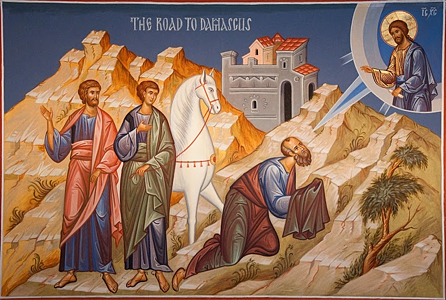
On this Feast of the Conversion of St. Paul we hear St. Paul ask, “What shall I do, Lord?”, after he is blinded on his way to Damascus to arrest Christians. His question is proof of his instant conversion to follow Christ.

It’s a good question for each of us to ask every day, as well, if we desire to follow Christ and grow in holiness. There’s no better way to begin one’s day than through meditation asking the Lord to reveal His will for us. It’s our job, then, to listen and make a resolution to go do it.

“Heavenly Father, through St. Paul and the other Apostles, the faith was spread throughout the world. As I celebrate his conversion today, I pray that I may follow his witness in at least my little part of the world. Amen.”

(What Shall I Do, Lord?, was first published on the blog Reflections of a Lay Catholic)

©2013-2020 Reflections of a Lay Catholic. Reposting and sharing of material in its full and original content is permitted, provided that full and clear credit is given to the author(s) and Reflections of a Lay Catholic.
Praise and Prayer for the Pilgrims on the 2020 March for Life

23 Thursday Jan 2020

Posted by Jerry Robinson in abortion

≈ 1 Comment

Tags

1 Samuel 18:6-9, 1 Samuel 19:1-7, abortion, Culture of death, Jonathan, March for Life, Praise, Prayer, Sanctity of Life

(A reflection on 1 Samuel 18:6-9; 19:1-7)

In today’s first scripture passage we read about King Saul who, because of his jealousy and wounded pride, planned to kill David because David received more accolades for victory in battle than he did. Saul’s son, Jonathan, out of love for his friend, David, and, I believe, having a heart for the sanctity of innocent life, stood up and spoke to his father, intervening and discouraging him from taking David’s life. Through sensible and peaceful conversation, he prevented an evil and senseless murder.

As I read this in preparation for mass this morning, I thought about all the “Jonathans” who are traveling to Washington D.C. today to peacefully participate in tomorrow’s March for Life. And I prayed that, through the grace of God, their peaceful march on behalf of the most innocent and vulnerable will change the hearts of those who seek to senselessly destroy a human life for their own self-satisfaction.

Heavenly Father, I pray for the safety of all my friends and the hundreds of thousands of others who will be marching for the preservation and sanctity of life tomorrow in our nation’s capitol. May they feel in their hearts the prayers of all the faithful who cannot be there with them. By lifting our prayers up to You, Lord, may their strength and conviction be the agent needed to sensibly and peacefully change hearts to do Your will. And, may those who are touched and converted by Your disciples feel Your immense and merciful love. Amen. + Blessed Holy Mary of the Immaculate Conception, Patron Saint of the United States, pray for us. Amen.

(Praise and Prayer for the Pilgrims on the 2020 March for Life was first published on the blog Reflections of a Lay Catholic)

©2013-2020 Reflections of a Lay Catholic. Reposting and sharing of material in its full and original content is permitted, provided that full and clear credit is given to the author(s) and Reflections of a Lay Catholic.

St. Joseph: A Man of Mercy

18 Wednesday Dec 2019

Posted by Jerry Robinson in Advent

≈ 2 Comments

Tags

Advent reflection, Forgiveness, Jason Gray, Jesus, Mercy, Miracle, St. Joseph

The Dream of St. Joseph, by Anton Raphael Mengs, 1774

Today’s Gospel is from Matthew 1:18-25, the story leading up to the birth of Jesus. Every year I am reminded about St. Joseph and what may have been going through his heart and mind when he learned that his betrothed was carrying a child that wasn’t his. My reminder is Jason Gray’s song, Forgiveness is a Miracle (A Song for Joseph) from his 2012 album Christmas Stories: Repeat the Sounding Joy, which I dig out of my CD case every year at the beginning of Advent.

Note: Much of this post is excerpted from the original, A Man of Mercy, from 5 December 2013. I am posting it here under a different title because since then we have garnered many new followers who may not have seen that post. Whether this is your first time to read this or your second, my hope is that it encourages you to find a way to grow in love and mercy, and in preparing your heart to be offered as a gift to our Lord on His birthday.

For me, I continue to be struck with each listening by the profound example that Gray paints for us of the mercy extended by Joseph to Mary. He gives us some insight into the divine wisdom of God. Both the Gospel and the song help me to remember God’s will for me every day is always about love.

As I delved into the song, I discovered that Gray had written an article for The Rabbit Room describing the story behind the song and he explores this difficult situation in which Joseph found himself.  I have re-posted his article below and included a link to The Rabbit Room’s website.  I hope you find it as thought provoking as I did.

The Story Behind “Forgiveness Is a Miracle”

by Jason Gray on October 16, 2012

As I approached writing songs for each of the characters in the Christmas story, I felt particularly protective of Joseph, who I think sometimes doesn’t get the attention he’s due. At the very least I know that I’ve been guilty of not really “seeing” him for the remarkable man that he was, and I wanted to amend that. I enlisted my friend Andy Gullahorn, one of the most masterful storytellers I know, to explore a particular moment in Joseph’s story with me.

Taking my cue from Frederick Buechner’s book, “Peculiar Treasures,” in which he breathes new life into biblical characters who have grown so familiar to us that we no longer experience them as real human beings, I hoped to recapture some of the humanity of the people in the Christmas narrative. It was also important to me to try and write songs that were relevant beyond the four weeks between Thanksgiving and Christmas day. I wanted to tell timeless human stories, and with Joseph we have the makings of just that with a love triangle, a question of revenge or forgiveness, and the age old drama of fathers and sons.

As I read his part in the narrative, I found that more than just a foster parent without much to do (as he was often relegated to in my mind), Joseph is revealed as a man after God’s own heart. Faced not only with the news that his fiancée is pregnant, but also with her incredulous story of how it was God’s doing, Joseph’s character is tested and laid out for all of us to see. What will he do? Will he hurt the one who has hurt him? Will he forgive? This is his moment, and all of history waits and watches in wonder.

There are few things more painful than the betrayal and rejection by the one you love most, so we know it must have deeply wounded him—shattering the dreams he may have had of a future with the girl he loved. Pain is like a lightning bolt striking with a violent energy that can’t be held in the human heart for long. It looks for a way out. The way it usually passes through us is in the all too common progression of hurt turning into anger and then into vengeance. Unless the miracle of forgiveness takes place in a person’s heart to absorb it, the pain we experience will pass through us and be visited upon others.

There is debate as to whether it was within Joseph’s power to have her stoned—while Jewish custom might have allowed it, Roman rule did not. However, if not to her body, we know he still could have done violence to her reputation and her heart. But I believe that Joseph did the hard work of bringing his pain to God rather than letting it pass through him, and that God graced him with the miracle of forgiveness. The narrative tells us he was a “godly man” and that instead of doing her harm, “he decided to dismiss her quietly” so that she wouldn’t be publicly shamed. He took the full force of the blow and–acting as the husband he might have been–became a covering over her supposed sin.

It’s hard for us to experience the tension in Joseph’s story since, as the reader, we know from the start that she isn’t guilty of what he naturally supposes and that God is up to something beautiful that the world has never seen before. But to see Joseph for who he is, I have to remember that he couldn’t know these things in real time. It was only after he had given himself to the work of forgiveness that the angel appeared to him in a dream to tell him that what Mary had said was true after all, and that he should marry her.

It occurred to me that perhaps this is where Joseph’s heart was proven—if not to God who already knew his heart, then perhaps to himself. (I haven’t met a man yet who isn’t daunted by the responsibility of being a father, let alone a father to the Son of God. Maybe this was a test to reveal to Joseph what kind of man he could be.) In this moment he is found to be a man of mercy, which I imagine to be just the kind of man that God was looking for to be the earthly father of his son Jesus. In a way, we see that Joseph carries in his heart the same world changing power of forgiveness that Mary carried in her womb.

It’s also meaningful to me to think of how Joseph forgiving Mary is part of the story that leads to the birth of the savior in whom Joseph would find forgiveness for his own sins. Perhaps it’s the narrative form of Jesus’ teaching that as we forgive we find ourselves forgiven.

As we wrote the song, it was good to be reminded that forgiveness is a kind of miracle. I could be wrong, but I’m not sure that we can muster up forgiveness on our own. It seems to me to be a supernatural force of renewal that we participate in as we point our hearts toward it, pray for it, and make room for it in our lives, but that ultimately we receive it as a gift from God, in his due time.

Forgiveness Is A Miracle (A Song For Joseph)
By Jason Gray / Andy Gullahorn
From Christmas Stories: Repeat the Sounding Joy

Love can make a soul come alive
Love can draw a dream out of the darkness
And blow every door open wide
But love can leave you broken hearted

Did she dare to look you in the eye
Did her betrayal leave you raging?
Did you let her see you cry
When she said the child was not your baby?

Pain can turn to anger then to vengeance
It happens time and again
Even in the best of men
It takes a miracle to save us

When love is like an open wound
There’s no way to stop the bleeding
Did you lose sleep over what to do?
Between what’s just and what brings healing

Pain can be a road to find compassion
When we don’t understand, and bring a better end
It takes a miracle to show us

Forgiveness is a miracle
A miracle
And a miracle can change your world
Forgiveness is a miracle

An angel in a dream spoke into your darkest night
So you trusted in the Lord and you took her as your wife
But the forgiveness that you gave would be given back to you
Because you carried in your heart what she was holding in her womb

Love was in a crowded barn
There you were beside her kneeling
You held it in your arms
As the miracle started breathing

Forgiveness is the miracle
The miracle
And a miracle will change your world
Forgiveness is the miracle
The miracle
A miracle will save the world
Forgiveness is the miracle

Blessed Joseph
Your heart is proven
And through you the Kingdom has come
For God delights in a man of mercy
And has found an earthly father for his son

(St. Joseph: A Man of Mercy was first published on the blog Reflections of a Lay Catholic)

©2019 Reflections of a Lay Catholic. Reposting and sharing of material in its full and original content is permitted, provided that full and clear credit is given to the author(s) and Reflections of a Lay Catholic.

Virtue: A Casualty of a Secular Culture

11 Wednesday Dec 2019

Posted by Jerry Robinson in Virtue

≈ 2 Comments

Tags

Book of Virtues, Cardinal Virtues, Charity, Faith, Fortitude, Hope, Justice, Love, Prudence, Romans 15:4-5, Temperance, Theoligical Virtues, Virtue

The Four Cardinal Virtues – The Strasbourg Cathedral, 13th Century

Several years ago, say around 1994, my daughter, Lisa, who was seven or eight years old at the time, did something she shouldn’t have done (today, I don’t even remember what it was) and I caught her at it. When confronted, she lied to me to try to keep from getting in trouble. So, to teach her a lesson about honesty, I had her read a story from William J. Bennett’s book, The Book of Virtues, and then write me a letter telling me what she learned and why it was important not to lie.

The story I had her read was, Matilda Who Told Lies, and Was Burned to Death by British writer, historian, and Catholic, Hilaire Belloc, which is sort of a “Boy Who Cried Wolf” kind of tale. The title sounds harsh but the story is actually more tame. Young Matilda had, it seemed, a tendency to lie and once telephoned the fire department claiming her house was on fire. The firemen responded and began to douse the house until Matilda’s aunt convinced them the house was not on fire. Then, one night just a few weeks later, while Matilda’s aunt was away….

“….a fire did break out –
You should have heard Matilda shout!
You should have heard her scream and bawl,
And throw the window up and call
To people passing in the street –
(The rapidly increasing heat
Encouraging her to obtain
Their confidence) – but all in vain!
For every time she shouted ‘Fire!’
They only answered ‘Little Liar!’
And, therefore, when her aunt returned
Matilda, and the house, were burned.”

Lisa’s letter to me read:

“To Daddy,
Well Daddy they could call you that [Little Liar] some day. And it tells me to always tell the truth and never tell a lie. Lisa”.

A few years later, her younger sister, Grace, was caught lying and was given the same punishment. Her letter read:

“To Mom and Dad,
It’s important to be honest so you don’t get in trouble and so people will trust you. If you aren’t honest people won’t trust you on anything so you won’t get to do much. Grace”.

These memories came to my mind last Sunday when I listened to the second reading of the Mass:

“For whatever was written previously was written for our instruction, that by endurance and by the encouragement of the scriptures we might have hope. May the God of endurance and encouragement grant you to think in harmony with one another, in keeping with Christ Jesus,” (Rom 15:4-5)

Bill Bennett, compiled The Book of Virtues from stories, old and new, with the intention for them to collectively be an instruction manual for right living, to teach us how to be people of virtue, how to live a moral life that brings, as St. Paul says, “harmony with one another”.

But, Paul’s words tell us that there is another book, even better than Mr. Bennett’s, which has been around for over two thousand years, with stories that have been the basis for virtuous and harmonious living to entire civilizations: the Bible, God’s instruction book on how to get to heaven, and, conversely, in many cases, how not to get there.

To learn about the Cardinal Virtues one only has to read Proverbs, the stories of Solomon, or the book of Sirach to understand how to apply the virtue of Prudence; or to read the stories of David to learn about Justice, Temperance and Self-Control (see 1 Sam 24:1-23). In the Old Testament books of Judith and Esther, one can find classic examples of Fortitude.

In Exodus, Moses sets the example for Perseverance and Leadership as he leads the Israelites out of Egypt towards the Promised Land. And, Job’s experience can teach us much about Patience.

The Theological Virtues are exemplified in Genesis through the Faith of Abraham as he nearly sacrificed his son, Isaac; and the Love (Charity) and Compassion of Joseph as he forgave his brothers who sold him into slavery. And, Hope can be found on nearly every page of the Psalms.

Other examples of virtues like Responsibility, Wisdom, Hard Work, Friendship, Loyalty, and Honesty are strewn throughout the Old Testament, as are other magnificent examples of how to live in right relation to one another.

When Paul wrote, “whatever was written previously”, in his letter to the Romans, he was referring to all the books of the Old Testament. The New Testament had not yet been written, but the virtuous life of Jesus Christ was indeed being told, retold and shared throughout the known world by the Disciples who witnessed it up close and personally. And, as they, like Paul, came to realize, all that had been “written previously” simply prefigured and pointed to the life of Christ.

Jesus was the perfect man – because He was also God. Thus, He is the One Who we should look to and imitate when we want to live a virtuous life. There has never been, nor ever will be, anyone better from whom to learn about living in right and harmonious relationships.

In the predominantly secular culture of the world today, a world that has turned its back on Christian morality and is rife with hedonism, individualism, relativism, and materialism, is it any wonder there is so much hatred, turmoil and erosion of relationships among people? The ultimate casualty has been the loss of virtue.

I wish I could snap my fingers and people (myself, included) would suddenly know that earned labels such as “Little Liar”; that relationships broken due to lack of trust from those we love; and other selfish acts and vices, are behaviors that destroy us as individuals and as society. But, I know I can’t. It’s not that easy. It requires the difficult task of personally living and exhibiting the virtues in a way that others see the good. It means reading Scripture and desiring to imitate Christ. And, it requires prayer, a lot of prayer. Because, we can’t do it ourselves. Our concupiscence won’t let us. We can only live a completely virtuous life by the grace of God. Without Him, as can be seen in much of the world today, it is impossible.

With which vices do you struggle every day? What changes can you make to replace those vices with virtues and grow in holiness so that you can be an example for others?

“Heavenly Father, I pray for the grace to grow in virtue, to become a better disciple, husband, father, son, brother and friend. As I am faced with trials and temptations throughout my day, help me, Lord, to keep Christ, the One Who I desire to imitate, at the center of my life, Through Your grace, I pray I may be an example for others to follow. Amen.”

(Virtue: A Casualty of a Secular Culture was first published on the blog Reflections of a Lay Catholic)

©2013-2019 Reflections of a Lay Catholic. Reposting and sharing of material in its full and original content is permitted, provided that full and clear credit is given to the author(s) and Reflections of a Lay Catholic.

God Uses Us to be Christ to Others

06 Friday Dec 2019

Posted by Jerry Robinson in Charity, Generosity

≈ 6 Comments

Tags

Charity, Corporal Works of Mercy, Generosity, Goodness, Is 29:17-24, Kindness, Mercy, Mt 9:27-31, Ps 27:13, Spiritual Works of Mercy

A couple Mondays ago I drove home to Ohio from Kansas City. I left my daughter’s house a little before 6:00 a.m. hoping to make it out of town before morning rush hour traffic got too bad. I made it to Columbia, Missouri before stopping for gas and grabbing a bite to eat for breakfast. As I pulled through the fast-food drive-thru, I waffled on whether or not I ought to use my digital coupon, with which I could get a second breakfast sandwich for only one dollar more, or limit myself to just one sandwich. I knew I didn’t need two sandwiches but the deal was just too good to pass up. So, I bought both.

As I waited on traffic to pull out of the parking lot, I unwrapped the first sandwich and chowed down. I pulled out onto the street and drove about 100 feet to the left turn lane that would take me back to the interstate. I had to stop at this traffic light, and as I took my second big bite of that hot, juicy sausage, egg and cheese muffin, I saw a man standing on the island holding a sign that read, “Homeless and hungry. Please help.”

I looked over at the open bag in my passenger seat. I looked back at the man and our eyes met. I looked upwards to God, as if I could see through the roof of my truck, and gave Him a big smile. I rolled down my window and handed the sack and sandwich to the man. With a, “Thank you, Sir! God bless you!”, he sat down and immediately began wolfing down his breakfast as though he hadn’t eaten in a week. As I turned left onto the main road, I uttered, “Thank You, Lord!”, knowing that God had just turned my lack of discipline and temptation for indulgence into an opportunity to be generous and merciful.

I had forgotten about this little event until today when I sat down for my morning prayer. As I usually do, I looked to see who the saint of the day was and today happened to be the Memorial of St. Nicholas (yes, the original Santa Claus). St. Nick was known for his generosity to the poor and is considered the patron saint of poor people.

Then, as I read the scripture for the day, I saw how this all came together. In the first reading I read how the Lord will make the deaf hear, the blind see, the lowly find joy, and the poor “rejoice in the Holy One of Israel.” (Is 29:17-24).

Next, in the Psalm for the day I read, “I believe that I will see the Lord’s goodness in the land of the living.” (Ps 27:13).

And, finally, in the Gospel, I read about Jesus bringing sight to the two blind men after they proclaimed their faith in Him. (Mt 9:27-31).

All of these brought me back to that moment two Mondays ago and moved me to give thanks, again, to our Lord for all the goodness He brings to our lives, especially for His sacrifice on the Cross – that merciful act of love that redeemed us of our sins.

I thought about how, as Christians, we are all called to imitate Christ, and how bringing a little goodness to the world is a good place to start. We meet people all the time during the normal course of our day but we probably don’t have a clue as to how they may be struggling in their lives. Any one of the people with whom our paths cross during any given day could have said a prayer that day asking God for help, relief or healing.

And, I thought how God, in His infinite goodness, may just be putting me in that person’s life, even for a fleeting moment, to help in answering their prayer in some small way through an act of generosity, whether it be a corporal or spiritual work of mercy.

How can you imitate Christ today through your generosity?

“Lord Jesus, today, and always, I desire to sow the seeds of Your Word by being thankful for the opportunity to be Your instrument through whom Your mercy touches those in need. Amen.”

(God Uses Us to be Christ to Others was first published on the blog Reflections of a Lay Catholic)

©2013-2019 Reflections of a Lay Catholic. Reposting and sharing of material in its full and original content is permitted, provided that full and clear credit is given to the author(s) and Reflections of a Lay Catholic.

← Older posts
Newer posts →

Enter your email address to follow this blog and receive notifications of new posts by email.

Join 264 other subscribers
Follow Reflections of a Lay Catholic on WordPress.com

Recent Posts

  • Mystogogy – It’s Not Just for Neophytes
  • How Will You Live Eastertide?
  • My “Re-Birthday”
  • Jesus and the Woman at the Well
  • Welcoming the Stranger

Categories

Top Posts & Pages

  • The Good Shepherd
  • Please Pray for Our Priests
  • God Answers Prayers of Thanksgiving
  • You Are Mine
  • The Anti-Beatitudes
  • She Said Yes!
  • Happy New Year!
  • Are You Hall of Fame Bound?
  • A Spiritual Dichotomy
  • A Taste of Spiritual Warfare

Archives

  • April 2026
  • March 2026
  • February 2026
  • January 2026
  • September 2025
  • August 2025
  • July 2025
  • May 2025
  • April 2025
  • February 2025
  • January 2025
  • December 2024
  • November 2024
  • September 2024
  • July 2024
  • May 2024
  • April 2024
  • March 2024
  • February 2024
  • January 2024
  • December 2023
  • November 2023
  • October 2023
  • September 2023
  • August 2023
  • June 2023
  • May 2023
  • April 2023
  • March 2023
  • February 2023
  • January 2023
  • December 2022
  • November 2022
  • October 2022
  • September 2022
  • June 2022
  • May 2022
  • April 2022
  • March 2022
  • February 2022
  • January 2022
  • November 2021
  • July 2021
  • June 2021
  • May 2021
  • April 2021
  • March 2021
  • February 2021
  • January 2021
  • November 2020
  • October 2020
  • September 2020
  • August 2020
  • July 2020
  • May 2020
  • April 2020
  • March 2020
  • January 2020
  • December 2019
  • November 2019
  • September 2019
  • July 2019
  • June 2019
  • May 2019
  • April 2019
  • March 2019
  • January 2019
  • December 2018
  • November 2018
  • October 2018
  • September 2018
  • August 2018
  • July 2018
  • June 2018
  • May 2018
  • April 2018
  • March 2018
  • February 2018
  • January 2018
  • December 2017
  • September 2017
  • August 2017
  • July 2017
  • June 2017
  • May 2017
  • April 2017
  • March 2017
  • February 2017
  • December 2016
  • November 2016
  • October 2016
  • September 2016
  • August 2016
  • July 2016
  • April 2016
  • March 2016
  • January 2016
  • December 2015
  • November 2015
  • September 2015
  • August 2015
  • July 2015
  • June 2015
  • May 2015
  • April 2015
  • March 2015
  • February 2015
  • January 2015
  • December 2014
  • November 2014
  • October 2014
  • September 2014
  • August 2014
  • July 2014
  • June 2014
  • May 2014
  • April 2014
  • March 2014
  • February 2014
  • January 2014
  • December 2013
  • November 2013
  • October 2013
  • September 2013
  • August 2013
  • July 2013
  • June 2013
  • May 2013
  • April 2013
  • March 2013
  • February 2013

Meta

  • Create account
  • Log in
  • Entries feed
  • Comments feed
  • WordPress.com

©2013 – 2026 Reflections of a Lay Catholic. Reposting and sharing of material in its full and original content is permitted, provided that full and clear credit is given to the author(s) and Reflections of a Lay Catholic.

Blog at WordPress.com.

  • Subscribe Subscribed
    • Reflections of a Lay Catholic
    • Join 264 other subscribers
    • Already have a WordPress.com account? Log in now.
    • Reflections of a Lay Catholic
    • Subscribe Subscribed
    • Sign up
    • Log in
    • Report this content
    • View site in Reader
    • Manage subscriptions
    • Collapse this bar
 

Loading Comments...