Tags
Acts 17:28, Contemplation, Evangelization, Jesus, Jn 4:10, Living Water, Meditation, Prayer, St. Photina, Vocal Prayer, Woman at the Well
I’ve been settling into my new office in our parish center and trying to make it functional for my use. My computer and phone are conveniently located, files are arranged in the file cabinet, and books are in the bookcase. I have a crucifix and a cast figure of the Blessed Mother holding the child Jesus hanging on the walls, and I hope to get some pictures hung soon. Finally, I’ve adorned it with a couple house plants to make things look more inviting.

My wife has exclusive ownership of a ‘green thumb’ in our family and I had to ask her advice for how often to water the plants. She told me in a not so endearing tone of voice, “If the soil feels dry, water it!” From experience, I know that if you pour water on the soil from the top, it often comes out the hole in the bottom of the pot and makes a mess on whatever surface it’s sitting. So, my master gardener better-half gave me a shallow plastic tray in which to set the potted plants and then told me to fill the tray with water. She said the soil in the pot would soak up the water through the hole in the bottom of the pot.
The other morning, when I checked, the soil was somewhere between dry and parched. It needed a drink. I heeded her advice, filled the tray with water, and set the pot in it.
I then went about my business of sketching out a plan of how to create an evangelizing culture in our parish, to wit: how to develop a more welcoming and hospitable community where people will intentionally build relationships with each other; how to grow an attitude of charity towards “neighbors”; and how to encourage people to not be afraid to share their faith with others.
After an hour or so, I noticed that the half inch of water I’d poured into the tray had disappeared. Just as I was told, the soil had soaked it up. I envisioned the water molecules defying gravity as they flowed upwards, saturating the soil. I thought about how thirsty that plant must have been.
Then it struck me – plants aren’t the only thing that thirst for water, we humans do, too. Except, our thirst is for the Living Water (Jn 4:10). We may not understand it, but our souls yearn for it. Our deepest desire, and the only true way of living a spiritually healthy life, is to seek God, the one in Whom we live and move and have our being (Acts 17:28). It is God Incarnate, Jesus, that sustains our life.
I had omitted from my notes the most crucial element about a culture of evangelization – a deep relationship with our Lord. Without it, evangelizing amounts to a worthless attempt. If the ultimate reason for evangelizing anyone is to bring them into a relationship with Christ, we are hypocrites if we try to evangelize without having our own personal relationship with Jesus. How can we lead someone to a place which we haven’t been ourselves?
What is a deep and loving relationship with Christ? Well, what makes up a deep and loving relationship with anyone? Basically, it’s friendship. The essence of friendship is spending time with each other, getting to know each other, having enlightening conversations, and loving and wanting the other’s good. Friendship with Jesus is really no different. We do that through prayer.
Us Catholics are good at Vocal prayer, that is, prayers of petition, thanksgiving, intercession and praise (CCC2700-04). And, we’re good at rote prayers that have been memorized and recited since childhood. But, there are two other expressions of prayer that are mostly overlooked – Meditation, or Mental prayer (CCC 2705-08), and Contemplation (CCC 2709-19). Vocal prayer is talking to God. Meditation, on the other hand, is using our God-given intellect and imagination in seeking to understand what God is asking of us. Meditation is often accomplished by reading Sacred Scripture, especially the Gospels, reading about the lives of the saints, and other spiritual writing.
Contemplation takes meditation one step further. St. Teresa of Avila said, “Contemplation is nothing else than a close sharing between friends; it means taking time frequently to be alone with Him Who we know loves us.” During this time of Contemplative prayer, we draw very close to Jesus; we tell Him what’s on our minds and we listen to Him telling us how we can grow closer to Him by becoming more virtuous disciples, spouses, parents, children, and friends.
If you are a married person, you know how important it is to listen to your spouse. A relationship in which one person does all the talking but never listens is doomed for failure. In Meditation and Contemplation, we quiet our minds and relish just being with Him, ready to respond to whatever He says.
Meditation and Contemplation is immersing ourselves into the font of Living Water. It is soaking up His Word and seeing how we can follow Him more nearly and love Him more dearly. It is this Living Water we desire to drink. But, have you ever tried talking and drinking at the same time? It doesn’t work very well.
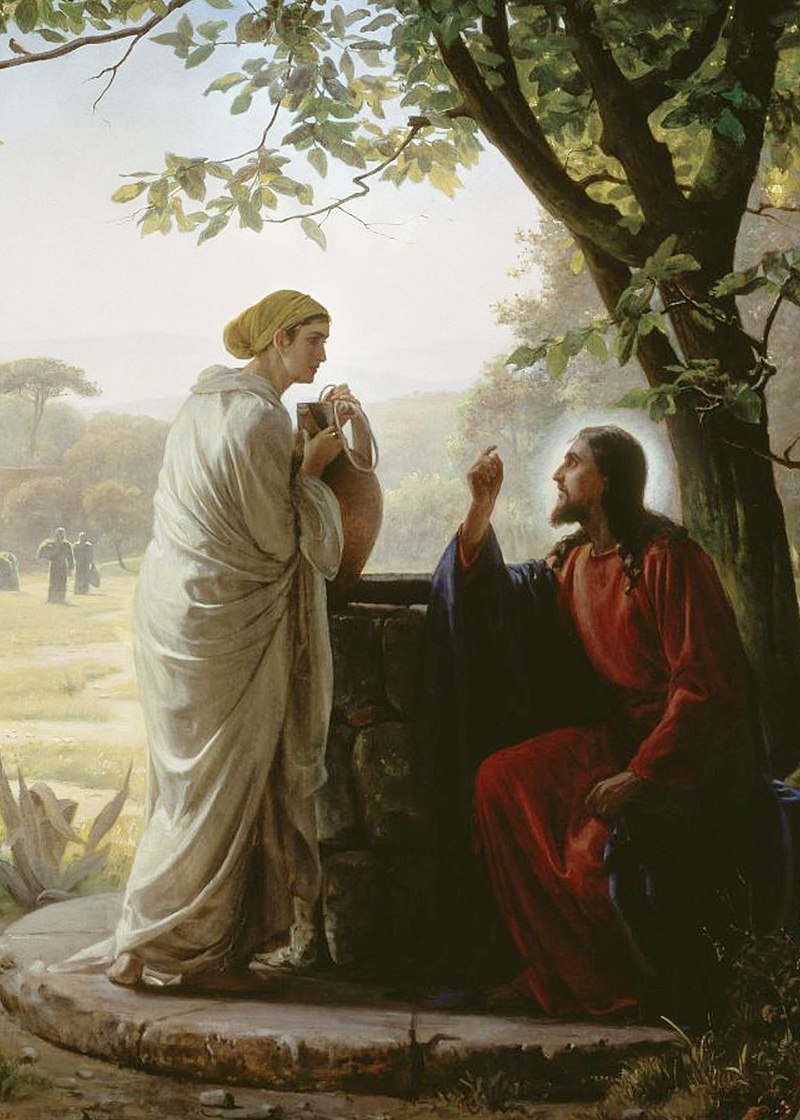
St. Photina, the biblical woman at the well, listened to Jesus tell her about her life. She drank of the Living Water. Then she hurried back to her Samaritan village, spread the Good News, and evangelized the entire town.
Evangelization involves many things. True evangelization begins with having a deep friendship with Jesus and a desire to introduce others to Him, your closest friend.
Spend at least thirty minutes a day quietly immersed and soaking in the presence of our Lord. Tell Him what’s on your mind and then listen for a response. When you hear His inspiration, resolve to act on it that day. Then repeat. Unlike the plants in my office, we need watering every day.
“Loving Lord, help us to draw closer to You by spending time with You, the One we love. Send us Your Spirit to open our hearts and minds to Your Word, and inspire us to act with virtue in carrying out Your will. Help us remove the shades from our lamps, the hang-ups we have in spreading the Good News. Amen.”
(Prayer and Potted Plants was first published on the blog Reflections of a Lay Catholic)
©2013-2023 Reflections of a Lay Catholic. Reposting and sharing of material in its full and original content is permitted, provided that full and clear credit is given to the author(s) and Reflections of a Lay Catholic.
 Reflections of a Lay Catholic